Mason Votes

College Republicans and Democrats Debate Issues Tonight

From Connec2Mason.com
By Jordan J. Frasier

With just five days before voters head to the polls in this year’s midterm election, the Mason chapter of College Republicans and College Democrats will debate political issues tonight.

The event will feature an exchange between three Republican students and three Democrat students as they discuss local and national political issues.

Mason professor Dr. Toni-Michelle Travis will act as moderator.

Read more

For College Kids, Voting Is So Two Years Ago

Caption: George Mason University students celebrate in 2008 after election results were confirmed for President Barack Obama

From The Atlantic Wire
By Elspeth Reeve

The Obamamania that swept college campuses two years ago, spurring millions of young people to vote, volunteer, and lobby their parents to change their minds, now looks like a bubble that has burst. Democrats argue that the enthusiasm gap between its voters and fired up Republicans is overblown, but the numbers among young voters are undeniable. In 2008, Rock the Vote registered 2.5 million young voters. This year, it’s signed up just 280,000. Local registration drives apparently haven’t fared much better, Politico reports. The county that’s home to 90 percent of the University of Virginia’s dorms has registered 2,714 new voters this year, a huge slide from 6,171 two years ago. Likewise, in 2008, new voters numbered 20,000 in the county that includes Colorado State University’s campus. A mere 1,200 registered this year. Why have college kids swung back to apathy?

Read More

Patriots’ Campaign Slogans

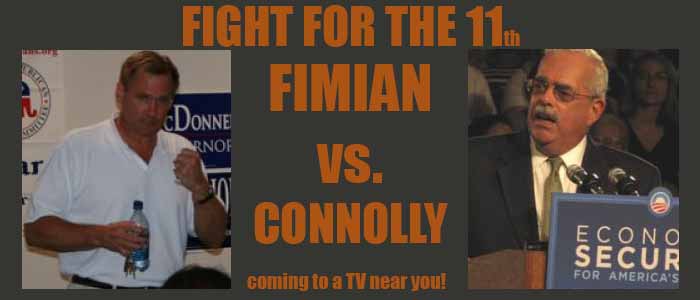
Connolly, Fimian Fight Dirty

By Christian Smith

Incumbent democratic Rep. Gerry Connolly and Republican Keith Fimian, both contenders for Virginia’s 11th district House of Representatives seat, have been duking it out over the airwaves in recent weeks. As the Nov. 2 election quickly approaches, the two have been the stars of an all-out negative ad blitz.

At the beginning of the month, Connolly’s campaign released an ad loosely based in fact that implied Fimian would give himself a $250 thousand bonus if elected.

Of course Tim Edison, Fimian’s campaign manager, wasted no time in disputing Connolly’s claims.

Not to be outdone, the next day Fimian released an ad to TV viewers that had previously been available only on YouTube since April. This ad accused Connolly of “bankrupting America.”

In response, Connolly’s camp produced this video:

But if the winner of this negative ad battle is determined by shear number of produced ads, it’s Fimian who is victorious. In the past two week, including the one listed above, he has produced four negative spots to Connolly’s two.


ELECTION RESULTS

Percent of Precincts Reporting: 99%
GOVERNOR RACE
Creigh Deeds (D) – 41.23%
Bob McDonnell (R) – 58.64% (winner)

LT. GOVERNOR RACE
Bill Bolling (R) – 56.41% (winner)
Jody Wagner (D) – 43.51%

ATTORNEY GENERAL RACE
Ken Cuccinelli (R) – 57.52% (winner)
Steve Shannon (D) – 42.39%

13th DISTRICT HOUSE OF DELEGATES RACE (Prince William Campus) – 100% of Precincts Reporting
John Bell (D) – 38.6%
Bob Marshall (R) – 61.3% (winner)

37th DISTRICT HOUSE OF DELEGATES RACE (Fairfax Campus) – 100% of Precincts Reporting
David Bulova (D) – 67.56% (winner)
Christopher DeCarlo (I) – 24.74%

40th DISTRICT HOUSE OF DELEGATES RACE – 100% of Precincts Reporting
Susan Conrad (D)* – 36.81%
Timothy Hugo (R) – 63.06% (winner)

47th DISTRICT HOUSE OF DELEGATES RACE (Arlington Campus) – 100% of Precincts Reporting
Eric Brescia (R) – 31.87%
Patrick Hope (D) – 63.89% (winner)
Josh Ruebner (I) – 4.11%

*George Mason University graduate student

Students Ride the Mason Vote Van to Polls

What Does It Take to Be Lieutenant Governor?

By Mason Votes Staff Writer Ethan Vaughan

When Virginians go to the polls on Nov. 3, they will not be voting for their three statewide officials as one party ticket. This means that the next administration could be a mixture of political parties.

It has happened before. When Democrat Tim Kaine won a surprise victory over Republican opponent Jerry Kilgore in the 2005 gubernatorial election, it was Bill Bolling, a Republican, who snagged the lieutenant governor’s seat.

With the race for governor turning out to be unexpectedly tight (Democrats were elected in 2001 and 2005 by comfortable margins), the battle to win the state’s second-highest office has been pushed to the side. The lieutenant governor, however, is the state’s second-in-command, and can ascend to the governorship in the death, resignation or disqualification of the governor.

The Constitution of Virginia states that the lieutenant governor must be a United States citizen who “shall have attained the age of thirty years and have been a resident of the Commonwealth and a registered voter in the Commonwealth for five years next preceding his election.”

The greatest constitutional difference between the governor and lieutenant governor is that while the governor may serve only one consecutive term, the lieutenant governor can seek reelection as many times as he likes.

Once in office, the lieutenant governor’s primary responsibility is to preside over the Virginia Senate, casting a vote only if the chamber is evenly divided on a piece of legislation.

Practically speaking, the lieutenant governor makes appearances on behalf of the governor, and, when the two are of the same party, advocates on behalf of the governor’s agenda. In cases where the administration is politically split, however, the lieutenant governor is largely free to push an agenda independent of the governor’s office, an ability whose importance has increased in recent years; since 1980, three lieutenant governors have gone on to take the helm of the state, making the office a springboard to greater political power.

Bolling, who is running again for the position, has a moderate lead against his Republican opponent Jody Wagner; an Oct. 7 Washington Post poll had him leading Wagner 49 to 40 percent.

Political terrain is never steady, though, and both candidates are hitting the trail in the last stretch of the campaign.

“As the state Treasurer and Secretary of Finance, I helped Mark Warner and Tim Kaine balance the budget, create hundreds of thousands of jobs, and make record investments in education and job training,” Wagner said in a statement to Mason Votes. “I’m proud that our efforts earned Virginia the designation as the country’s ‘Best Managed State,’ and that we were named the ‘Best State for Business’ eight times during the Kaine administration alone. I plan to invest in high-growth industries like renewable energy production and biotechnology, utilizing George Mason [University], and other schools as incubators of research and development.”

Wagner said that education, job creation, and transportation would be her biggest policy priority concerns, promising to allow “every student” in Virginia the opportunity to attend college and come up with a permanent solution to the transportation problems in the region, proposing such remedies as public/private partnerships and incentives to get cars off the roads.

The Bolling campaign was skeptical of Wagner’s promises.

In a statement released to Mason Votes, a Bolling spokesperson said that Wagner’s “policies of higher taxes, more regulations and more government spending will kill jobs and drive our economy deeper into recession.”

Bolling pledged to serve “as Virginia’s chief jobs creation officer and oversee Virginia’s economic development and job creation programs,” a goal his camp said he would accomplish through deregulation and lower taxes

“Lieutenant Governor Bolling is uniquely qualified to perform this function because of his background in private business, his experience in state and local government, and his reputation of being one of Virginia’s most pro-business leaders,” the campaign said. “In addition, his policies, of reducing taxes and regulations and investing in proven economic development and job creation programs will help get our economy moving again and create jobs.”

Mason Votes Van Will Again Shuttle Students to Polls

By Mason Votes Staff Writer Ethan Vaughan

For the second year in a row, the Mason Votes Vans will ferry students from George Mason University’s Fairfax campus to their designated polling place, Woodson High School in Fairfax.

The Mason Votes Vans will run from 8 a.m. to 7 p.m. on Tuesday, Nov. 3, and will pick students up from the front of Sandy Creek Parking Deck, where the shuttles and Gunston Go Bus usually run.

Staffed by drivers from Student Government, the two seven-passenger mini-vans will alternate trips, with one heading to the polls while the other is departing, with the goal of ensuring that no student has to wait more than a few minutes for a ride.

Students at the stop will be provided with snacks, drinks and campaign literature from all candidates.

The program provided 400 students with transportation to the polls in 2008, though SG officials acknowledge that fewer people are likely to participate this time around.

“2008 was a historic election so it was easier to promote,” said Student Senate Speaker Mhehvish Khan. “This year, we’ll be working even harder to do that.”

Pete Danjczek, chief of staff to SG President Devraj Dasgupta, said he thought there would be “far fewer riders in 2009, but qualified that SG would try to make up for the deficit with “the passion of last year.”

Danjczek said that members of the fraternity Pi Kappa Alpha would be dispersed throughout the Johnson Center and near Southside letting people know about the shuttle service and distributing campaign literature.

“We want students to understand why they’re voting,” Danjczek emphasized. “We’re handing out an unbiased page of platforms from the candidates’ websites, using their wording. We’re not doing much interpretation.”

Mason Student Runs for House of Delegates

By Mason Votes Writer Ethan Vaughan

Susan Conrad Susan Conrad, a master’s candidate at George Mason University studying for a degree in Instructional Technology, is running for the House of Delegates 40th District seat. She is campaigning on a transportation platform that would require raising gas taxes and automobile registration fees.

“It’s not going to be popular,” said Conrad, who recommended raising the gas tax by about five cents and the registration fee by five dollars. “But the longer we wait, the more it’ll cost. Fairfax roads only got one million dollars for road maintenance this year. People don’t want to pay to fix pot-holes, so they’ll wind up paying for a new car alignment. They don’t want to pay a gas tax, but they burn three dollars in gas a day sitting on Route 66.”

Conrad said that Northern Virginia needs expanded roads, and, ultimately, a much larger Metro system that goes “at least to Gainesville.”

“Those projects will take years to finish,” said Conrad. “In the meantime, there’s some other things we can do.”

Conrad proposed tax incentives for businesses to stagger their work hours, ensuring that “a portion of their workforce will not be on the road at certain times. That way, we can spread out use of the roads.”

Conrad said that a large part of the problem comes from Republican lawmakers in the House of Delegates who have taken from the wealthy communities in Northern Virginia without giving enough back.

“For every education dollar we sent to Richmond, we only get 25 cents back,” she said. “And the local economy has to make up the difference. Just over in Prince William County, they get 56 cents back. There all of these formulas they have down there, and none of the money is coming back to Fairfax.”

Conrad went on to say that a lack of funds affected the entire community, from university students coping with rising tuition to commuters facing long commutes, to businesses who find operating in the area difficult due to “overwhelming traffic.”

“We’re at a pivotal point,” stressed Conrad. “If we don’t allocate money to education, roads, and economic development, we’re going to be in trouble.”

Conrad made clear that she wasn’t advocating withholding funds from the rest of the Commonwealth.

“I definitely feel we have to help,” she stated. “I’m not saying we should get one dollar back for every dollar we give, because when we help other parts of the state we all benefit. However, there’s a disproportionate amount not coming back. Eighty percent of the state’s money is coming from here. If we don’t develop infrastructure here, the whole state is jeopardy.”

Students Respond to Obama’s Nobel Peace Prize