Mason Votes

Time Is Running Out To Register To Vote

The last day to register to vote in the state of Virginia is October 14, 2014

The fastest and easiest way to register as well as update your voting information is:

GMU.TURBOVOTE.ORG

Take the time to register because this ELECTION IS IMPORTANT !
turbo_vote_logo_1.png.237x132_q85_crop_fb_wdet_leadin_thumb

Official Election Results

On November 5, 2013, not all of the official election results for the Virginia’s 2013 election were in. Lt. Governor was the first to be announced with Ralph Northam for the win. The next office that was announced was Governor and Terry McAuliffe was elected into office. However, the results for Attorney General did not not come in that night and as of November 10, 2013 there is still no official results for Attorney General.

Republican state Senator Mark Obenshain of Harrisonburg finished 541 votes behind Democratic state Senator Mark Herring of Leesburg out of 2.17 million cast in the Tuesday polls, according to unofficial state election board figures.

As of Saturday November 9, 2013 the results for Attorney General are still not in and a recount is in progress. For more information : http://www.wjla.com/articles/2013/11/virginia-attorney-general-recounts-continue-96662.html

Mason Votes Election Night Party with LIVE WGMU/MCN Broadcast

Enjoy some free pizza and hang out while the election results come in! Talk politics with your friends and chat with representatives from different political organizations on campus.

There will also be an on-site live MCN/WGMU broadcast. Attendees will have the opportunity to voice their opinion on live television/radio!

TIME: 7:30-9:30PM
LOCATION: George’s, 3rd Floor, Johnson Center, GMU

Watch live: Mason Cable Network Channel 231 On-Campus, or http://masoncablenetwork.com/live/

Listen live: www.WGMUradio.com

Government is Open

Virginia 2013 General Election Candidates

download (1)

Who is running for a position in Virginia?

Below you will find the candidates that are running in the Virginia 2013 General Election along with their website of their campaigns.

Governor

Ken Cuccinelli – Republican  http://www.cuccinelli.com/
Terry McAuliffe- Democratic http://terrymcauliffe.com/
Robert Sarvis- Libertarian http://www.robertsarvis.com/
 
Lt. Governor
Earl W. “E.W.” Jackson, Sr.- Republican http://www.jacksonforlg.com/
Ralph S. Northam- Democratic http://www.northamforlg.com/
Gail Parker- Independent Greens http://www.gailparker.us/
 
Attorney General 
Mark D. Obenshain- Republican http://www.markobenshain.com/
Mark R. Herring- Democratic http://www.herringforag.com/




What You Can and Can’t Do During the Government Shutdown

Feature Photo: Fox 2 Now/ CNN

Tuesday, Oct 1, 2013  |  Updated 2:55 PM EDT

http://www.nbcwashington.com/news/local/What-You-Can-and-Cant-Do-During-a-Government-Shutdown-225824691.html?_osource=SocialFlowFB_DCBrand 

No national parks. No Smithsonian. (And no Panda Cam.) No new applications for social security, no tax audits, no way to check that the employee you want to hire is a citizen.

The government officially shut down at midnight Oct. 1. Hundreds of thousands of federal workers were furloughed, and some of the D.C.-based services tourists and locals alike rely on will be closed.

Here’s a list of what you likely can and can’t do during a government shutdown. We’ll be adding to the list; if you know of something we’ve left off, email us and we’ll research it.

During a shutdown, you can:

Get help from 911: 
All emergency services will continue as usual, including law enforcement and emergency and disaster assistance.

Get caught by a red light camera in D.C.: Red light cameras will still be running, and tickets will still be sent out, which brings us to the next item on the list…

Get mail: Employees of the United States Postal Service are exempt from furloughs.

Get your Social Security benefits: Payments will still be issued, although some could be delayed due to a reduction in workforce.

Receive disability benefits: See above.

Receive SNAP benefits: The Supplemental Nutrition Assistance Program will continue to operate.

Receive WIC benefits in Maryland and possibly other areas: Special Supplemental Nutrition Program for Women, Infants and Children (WIC) is dependent on federal funds for administrative tasks, but some states have enough of their funding to pay benefits, including Maryland and D.C. A call to Virginia’s WIC office was not immediately returned. (View contact info for all states’ agencies here.)

Get a passport, probably: The Bureau of Consular Affairs is funded by fees rather than appropriated funds, so it will continue to operate, a spokesperson tells NBC Washington. Home State Department passport offices, however, are located in federal buildings that may have shut down, so you should check to see if your preferred passport office is open before visiting.

Sign up for healthcare exchanges: Despite the GOP’s attempts to defund or delay the Affordable Care Act, the plan is already funded, and online healthcare exchanges opened Tuesday for uninsured Americans. (Read more.)

Get your trash picked up, even if you live in D.C.: Even if Mayor Vincent Gray’s attempt to declare all city workers essential is rejected, the district has about two weeks’ worth of money on hand already authorized by Congress, which might be enough to wait out a fairly brief shutdown.

Be protected by the U.S. military and law enforcement agencies: Personnel considered essential to public health and safety are exempt from furloughs.

Be paid and receive benefits if you’re in the U.S. military: Congress has approved the Pay Our Military Act, a measure to continue to pay troops on time, and President Barack Obama signed it into law late Monday.

Receive healthcare benefits if you’re a furloughed federal worker: Furloughed federal workers can continue to use their health benefits during the shutdown, even if their premium payments are normally deducted from their paychecks. They will have to make up the premium payments after the shutdown ends. See more here (PDF) and scroll to section H.

Visit a Veterans Affairs (VA) hospital: VA hospitals will remain open. Veterans will also be able to get mental health counseling and get prescriptions filled at VA health clinics.

Get veterans’ disability payments and pension benefits: Claims workers will continue to process these, but the Board of Veterans Appeals is closed during the shutdown, so veterans looking to appeal a denial will have to wait until the shutdown ends.

Ride Amtrak: While Amtrak receives federal subsidies, it’s organized as a corporation and collects enough revenue in ticket fees to outlast a brief shutdown.

Take Metrorail and Metrobus: Metro assured riders Monday that the system will stay open in the event of a shutdown, although it could shorten some trains (for example, from eight cars to six) if ridership is down because fewer people are going to work.

Travel by air: Federal air traffic controllers and most TSA agents will continue showing up to work, although you may find some longer lines at security checkpoints.

Apply for a new patent: The U.S Patent Office is funded for the next four weeks, which should be enough to outlast any government shutdown.

Safely eat meat: Meat inspectors with the U.S. Department of Agriculture (USDA) will continue to report to work because they’re essential for public safety.

Learn about the unemployment rate:
 The September jobs report will be released Friday.

Get an unemployment check: Checks will still be sent out, although some payments may be delayed due to a reduction in workforce.

Pay taxes: Workers will continue to have taxes deducted from their paychecks, and all tax payments will continue to be processed. Note that millions of taxpayers have requested 6-month extensions on their 2012 tax filings, and that the deadline for that is Oct. 15. That deadline is not expected to change.

Go to the DMV: You can still visit the Department of Motor Vehicles in your location because they are run by the state (or in D.C.’s case, the city).

Get weather warnings and watches: All National Weather Service offices are open and will continue to provide forecasts and severe weather alerts.

Visit non-government-run museums: The National Building Museum, the Crime Museum, the Phillips Collection and other fee-based museums remain open for business.

Go to state and county parks: Since they’re funded by state and local budgets, they will remain open.

File a copyright online: The U.S. Copyright Office is closed, but the Electronic Copyright Office is still open for users to register their work.

Have an Immigration Application or Petition Processed: The offices of U.S. Citizen and Immigration Services are open during the shutdown. There may be some delays, however, and the Department of Labor will stop processing permanent labor certifications. See the full breakdown here.

Go to school: Sorry kids, schools are open.

During a shutdown, you can’t:

Apply for new Medicare or Social Security benefits: While current recipients continue to receive payments, a reduction in staff means no new applications can be processed.

Visit the Capitol: While the Capitol remains open for congressional matters, it is closed to visitors.

Get a new small business loan: Existing loans are honored, but new applications will not be accepted.

Go to the Smithsonian museums, the National Gallery of Art or the National Zoo: About 90 percent of the Smithsonian’s 6,400 workers are furloughed; all museums and the zoo are closed. The animals will still get fed, but visitors can’t be around to see that.

Camp in a national park: All national parks — from Yosemite to Shenandoah National Park — are closed. (Long-term campers already in parks were given two days to leave.)

Visit a Civil War Battlefield: Like national parks, historic battlefields are closed.

Watch the Zoo’s Panda Cam: We know — in a government shutdown, there are more important things for many people to worry about. But D.C.’s first panda cub in years was a cause for celebration around the region, and huge numbers of fans have flocked to the Panda Cam since the cub’s birth in August.

Visit the monuments: D.C.’s monuments are under control of the National Park Service, which means tourists can’t visit sites such as the Lincoln, World War II or Franklin Delano Roosevelt memorials.

Check the legal work status of an employee: The E-Verify system allows employers across the country to check on immigration status, but it’s a federal website, which means it is shut down.

Have a Permanent Labor Certification Processed: While the offices of U.S. Citizen and Immigration Services are open, the Department of Labor has said it will stop processing permanent labor certifications during the shutdown. A call to the Department of Labor was, understandably, unanswered. See the full breakdown here.

Continue to be audited: The IRS has suspended audit activities. (They will begin again as soon as the government shutdown is over.) Live telephone customer service assistance is not available, but most automated toll-free telephone applications remain operational. IRS walk-in taxpayer assistance centers are closed.

Go rowing, if you’re part of a crew team that uses a boathouse on federal land: Many local high school teams use boathouses on the Anacostia and Potomac rivers, but access is cut off during the shutdown.


Internship and Paid Canvassing Opportunities

Patrice Winter for Delegate is offering an internship with her campaign for Delegate.

www.electpatricewinter.com

-Gain experience working in grass roots campaigning,

-Boost your resume for college and job hunts.

-Fulfill hour requirements for government service projects.

For more information please contact:
Anne Taylor (571) 354-6196
[email protected]
10560 Main Street
Suite 308
Fairfax, VA 22030
 

Paid Canvassing Positions – to be filled immediately

 Kathleen Murphy’s delegate race in Northern Virginia is looking for enthusiastic individuals to help spread our message by going door-to-door and speaking with voters.

 Canvassers must:
-hold democratic values
-be willing and able to talk with voters
-comfortable knocking on doors

Hours will vary and we are flexible.  Canvassing will begin at 3PM on weekdays, 10AM on Saturdays and 12PM on Sundays.  Must be able to come in 4 days a week, for 3-4 hours a day.  Must have own transportation.

 Compensation:
-$10/hour
-reimbursement for gas from office to canvassing location.
 Please send resume to Mary Kate Waldron if interested.
(703) 662-1334
[email protected]

Virginia’s Lieutenant Governor candidates debate at Mason

Friday, September 27, 2013 – 2:11pm | Fourth Estate Print Editor Niki Papadogiannakis
43eiljn

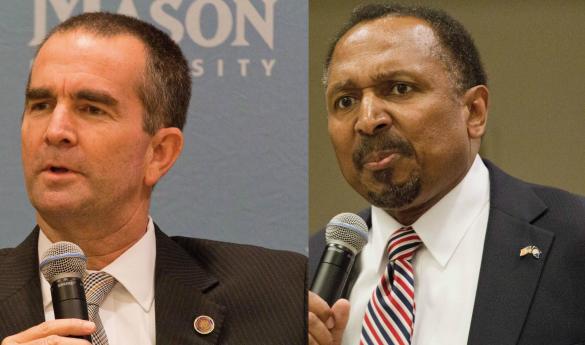
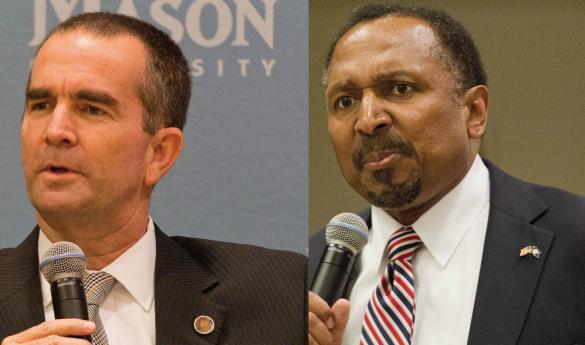
Tuesday night at the Arlington campus, the candidates for Virginia’s Lieutenant governor talked higher education, sequestration and mental health among others in their first appearance together and their only debate of the election.

Republican E.W. Jackson and Democrat Ralph Northam took the stage together in Founders Hall to answer debate questions moderated by WUSA reporter Peggy Fox.

On the issue of higher education, Fox asked Northam if he would support privatizing institutions due to the reduction of state funding for public institutions.

Northam opposed the idea, citing his kids’ experiences in higher education and the legacy of public institutions such as the University of Virginia.

“Last thing I would want to see happen is for the University of Virginia to go private and to decrease access for those children of ours who have grown up and want to go to school there,” Northam said.

Jackson said that what needs to be examined is the federal government’s role in providing subsidies that turn into inflation, meaning that the government will overspend their budget and therefore create more debt.

“We should be looking at providing quality education and higher education for everyone who wants it, but I think we have to look at some smart ways of doing it,” Jackson said.

Northam proposed solving the problem of the decreasing enrollment of Virginia students in Virginia colleges by adopting a system that rewards in-state students by waiving tuition fees for good grades.

“We need to make education a priority so that we can compete [with] surrounding states and the world,” Northam said.

Jackson suggested focusing on community college as alternatives to four-year education and providing more distance education.

“We should be looking at providing quality education and higher education for everyone who wants it, but I think we have to look at some smart ways of doing it,” Northam said.

Both candidates acknowledged the effect that the sequestration spending cuts would have in Virginia and  that partisanship in congress does not lead to results and that they need to figure out how to work together to make changes.

Jackson emphasized that government has limited power and that it should stay limited, while Northam suggested tourism becoming a bigger industry and investing in education as solutions.

The candidates disagreed on how to deal with mental health issues, a topic that resonates with the area after the Navy Yard shooting. Jackson supports investing in helping the mentally ill, especially veterans, and suggested the way to protect them and protect others is to institutionalize them.

Northam disagreed, saying there are other options to institutionalization such as opening access to mental health resources and turned to gun law reformation, referencing the 2007 Virginia Tech University shooting

Jackson left directly after the debate to attend another event. Northam spoke to reporters after the debate and discussed his plan to use the Medicaid expansion to give higher education more state funding.

http://www.gmufourthestate.com/content/virginias-lieutenant-governor-candidates-debate-mason
Lieutenant Governor Candidates to Debate at Mason

http://newsdesk.gmu.edu/2013/08/lieutenant-governor-candidates-to-debate-at-mason/ 

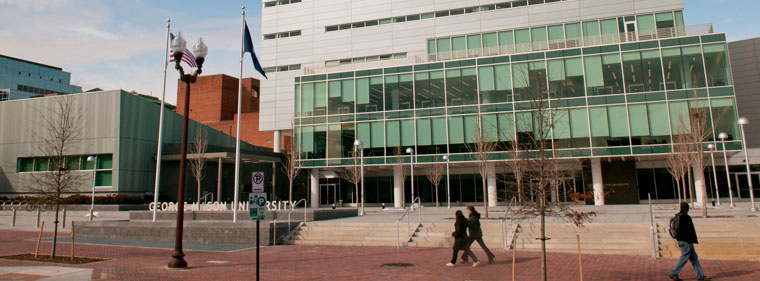
The candidates for Virginia’s lieutenant governor, E.W. Jackson (R) and Ralph Northam (D), square off in a live debate Tuesday, Sept. 24, at George Mason University’s Arlington Campus in Founders Hall Auditorium.

Jackson and Northam will focus on “The Fiscal Future of Virginia.” This is the first debate between the candidates and will be the only one held in Northern Virginia.

The 90-minute debate begins at 7 p.m. and is hosted by George Mason’s School of Public Policy and the State and Local Government Leadership Center in the Department of Public and International Affairs, with assistance by student volunteer organization Mason Votes. WUSA-TV Virginia reporter Peggy Fox will moderate.

“The office of lieutenant governor has been transformed in the modern era into a real political force,” says Mark Rozell, acting dean of the School of Public Policy. “One of these candidates ends up a heartbeat away [from the governorship], and the office is a possible stepping-stone to running for governor later. People need to pay attention.”

“Combined with the federal decade-long sequester and deep projected cuts in federal defense spending, this debate should address fundamental questions about Northern Virginia’s future economy,” says Mason professor Frank Shafroth, director of the State and Local Government Leadership Center at Mason. “The question is: Will the state play a constructive role or not?”

Doors open at 6:00 p.m. Seating is limited and advance registration is required. Reservations can be made at Eventbrite via this link.

Write to Buzz McClain at [email protected]


Terry McAuliffe visits George Mason University

(photos taken by Sean Hickey)

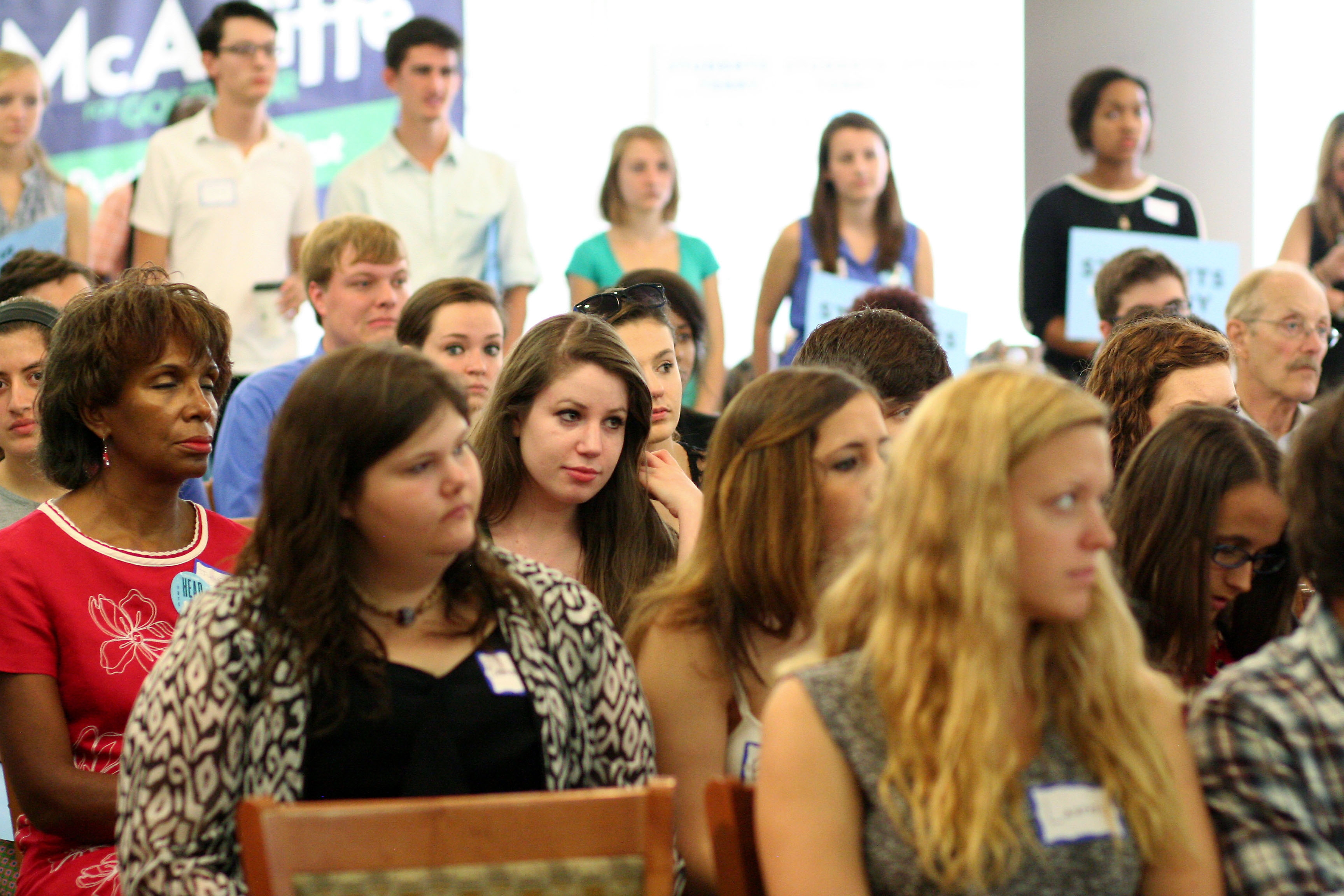
Terry McAuliffe, the Democratic candidate for the governor of Virginia, visited George Mason’s Fairfax campus on Thursday, September 12th. From 9:30- 10:30am, the Democratic candidate answered questions about his campaign and socialized with students. McAuliffe was hosted by the GMU Democrats student organization for a coffee social in George’s restaurant on the third floor of the Johnson Center.

At the meeting, McAuliffe emphasized key points of his campaign platform, which included reforms to Virginia’s metro and transportation infrastructure, healthcare and medicaid expansion and the importance of women being allowed to make their own health care decisions.

McAuliffe, who has lived in Virginia for twenty years, believes that Virginia’s educational system needs reform. He supports an increase in financial aid for higher education, a reform on the SOLs and eliminating overhead costs for higher educational institutions.

At the meeting, the Virginia governor hopeful advised students to pursue what they enjoy doing after graduation and he wants Virginia’s university students to graduate with jobs and minimal student debt.
mcauliff 1