Mason Votes

Moran Holds Volatile Health Care Town Hall

By Mason Votes Correspondent Denise Baken

In the hours before the Health Care Reform debate, long lines snaked around the front and back of South Lakes High School. Support and opposition forces huddled to strategize tactics in preparation of the Jim Moran- Howard Dean Town Hall on Health Care Reform.

The positions ran the gambit. Rhonda of Alexandria was in favor of reform. “Saving billions in prevention care rather than when paying when people get sick makes sense to me. And its more than just the care, when someone is sick, there are other costs to consider, like child care or missed work. This costs us too. I would rather pay for someone’s mammogram now than wait until they need cancer treatment later. I’m just asking logic”. Mac Cannon disagreed, “ We don’t need bigger government. This is too expensive. What we need is tort review. Our society is too litigious. Whether good idea or not, the economic situation precludes it for now.”

Moses McCall favored reform but wanted information. “I don’t understand all the options but a public option sounds good. The main reason we have problem is that Wall Street is influencing the rising cost of health care. We have the wrong incentives. A public options creates competition for better health care rather than more money for Wall Street.

Small business owners also disagreed on the issue. George and Cynthia Alexa felt that small business needed to know who would pay for the program if it passes. “Who will pay?” Cynthia asked. “Its my taxes. I have read some of the bill. But there are so many versions its hard to know what is really being offered. I don’t see how you can spend your way out of a recession.”

But Molly and Roy Ballard, new small business owners said, “ We just started our business and we can’t afford to offer health care as a benefit right now. We have a lawn care business and full-time employees who work very hard but have no health care. They have families. We are willing to pay a little extra for their right to care.”

Moran said he scheduled the Town Hall to provide his constituents with answers questions to their questions on the Health Care bill. Dean, former governor of Vermont, is also a practicing physician. A former presidential candidate, Dean ran on a platform that emphasized Health Care reform.

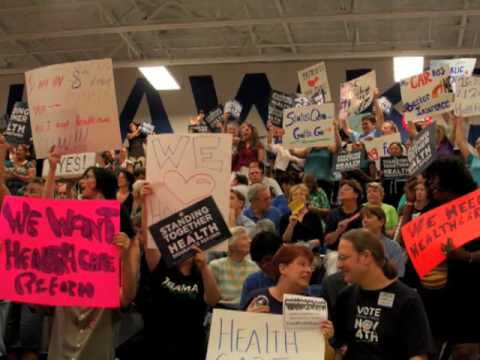
Initially only open to District 8 residents, news of the Town Hall apparently moved quickly. Some participants lined up as early as three in the afternoon. By the 7 PM start time, more than 2500 attendees filled Wendell G. Byrd Gymnasium. Chants of “Health care now” were met with responses of “Just say no.” The audience was diverse representing people of a variety of races, backgrounds, dress and age.

Moran and Dean entered to a cacophony of boos and cheers. Cheers of “What do we want? Health care!” “When do we want it? Now!” were countered by “Leave us alone”, “We can’t afford it“ and “Keep your hands off my health care.”

The two hour session opened with a prayer and the pledge of allegiance and closed with both Dean and Moran expressing appreciation for the lively debate

Moran addressed 11 “myths” associated with the bill offering text from the bill to counter.

When Dean was introduced, Randall Terry, a known opponent of health care reform, shouted down the former governor of Vermont. Terry was escorted out of the gymnasium but held an impromptu press conference outside to ensure his opinion on the public option and health care reform in general was heard. Howard Dean spoke briefly and then took questions from the audience. A lively exchange resulted. By the evening’s end, questions from constituents who opposed, those who supported and the undecided were asked.

Discover Simple, Private Sharing at Drop.io

What is the House of Delegates?

There are two branches of the Virginia General Assembly, the Senate and the House of Delegates. The House of Delegates is a one hundred member legislative body. The entire House is up for reelection every two years and is in session during the months of January, February and April. When the Governor deems it necessary, a special session may also be called.

George Mason University’s four campuses are represented by three delegates. David Bulova (D) is currently the delegate representing district 37 where the Fairfax campus is located. The Loudoun and Prince William campuses are in the 13th district and are currently represented by Bob Marshall (R). District 47, contains the Arlington campus and is represented by Albert Eisenberg. Bulova and Marshall are up for reelection while Eisenberg is not seeking another term.

House of Delegate members receive a salary of $17,640.

Photo by flickr user jamacdonald.

Presidential Debate Live Online Tonight

The 2009 student body president election is growing near, and four Mason students have risen to the challenge and are actively campaigning. The official debate will take place tonight at 6:30 p.m. in the Johnson Center. Can’t make it? We’ll be broadcasting the debates live on C2M in coordination with MasonVotes, as well as hosting a live chat. We hope you will stop by and join us in discussing the election.

Meet the candidates:

To read the rules and predetermined questions being used for the debate, click here.

Debate Protocol and Outline

Fun fact: If each team spends three minutes answering all of the available questions, the debate would last 5.4 hours.

If you could ask the candidates any question, what would it be? Leave your thoughts in the comments.

Opinion Blogging With UPI

Hello Folks,

Please note that I will be writing opinion blog posts for UPI’s The Voice of Young Voters Presidential Transition Forum.

The posts that I am writing over there will be cross-posted here for your pleasure. Please remember that these posts are my personal opinions and in no way reflect the position of Mason Votes.

Have a happy holiday.
-Aram Zucker-Scharff

Final Debate Watch Party a Success

More than 200 people crowded into the Johnson Center Atrium to watch the third and final presidential debate between  Candidates John McCain and Barack Obama. Leading into their final meeting, hopes were high that gloves would come off and answers would be pointed. Although there were moments where it seemed that such hopes would come to fruition, according to a Mason Votes poll, viewers came away disappointed.

Mason Votes’ polls also showed there was no clear overall debate winner. The complete live blog is available on the Mason Votes’ website.

Debate Watch Party Tonight

Tonight at 8:30 p.m. Mason Votes will open the Second Presidential Debate Watch Party with a panel of guest speakers at the Johnson Center, who will speak about the youth vote and the digital sphere’s influence on the electoral process. Join Mason Votes on this page for a live blog of the event and the debate.

A History of Virginia in Votes

By Student Media Technology Manager Aram Zucker-Scharff

Virginia, as one of the original 13 colonies, has had a long history when it comes to presidential elections.

At its peak, 1792, Virginia controlled 15.9 percent of the nation’s total electoral votes. With a count of 25 electoral votes, Virginia had more than any other single state.

From the formation of the modern Democratic Party in 1828 until 1856, Virginia’s declining number of electoral votes went blue. Then in 1860, Virginia voted for John Bell of the Constitutional Union party. That would be the last time the state would vote for a US president until 1872. During that time, the commonwealth was embroiled in the Civil War.

After the war, the race was between Ulysses S. Grant, general, and Horace Greeley, editor of the New York Tribune. In 1872, Virginia, now with 11 electoral votes, down from a Pre-Civil War count of 15, fell to Grant, a Republican, who solidly beat out Greeley’s self-formed Liberal Republican Party.

For the next 13 elections, Virginia was once again a Democratic mainstay. However, in 1928, the Republican candidate from California, Herbert Hoover, won Virginia along with 58.2 percent of the popular vote. The state would fall from 12 to 11 electoral votes. It would be another 24 years before Virginia voted Republican again.

In 1952, Virginia, now back at 12 electoral votes, hitched itself to a winner, America’s star general Dwight “Ike” Eisenhower, a Republican. For the next 56 years, except for a flirtation that helped Democrat Lyndon “LBJ” Johnson win the 1964 election, Virginia fell solidly in the corner of the Republican Party.

Since 1992, Virginia has had 13 electoral votes, and in 7 out of the last 10 elections Virginia has been on the winning side.

In the 2004 presidential election, 54 percent of Virginia voted Republican, for George W. Bush. However, this election, it seems that nothing is certain. Three out of the four major polls list Barack Obama ahead in Virginia, but none by more then 5 percentage points, with the greatest estimate of Obama’s lead being 50 percent, in a Sept. 29th poll. NBC’s latest poll, from Sept. 25th, gives a 3 point lead to John McCain and none of the polls are definitive, with a significant enough percentage of swing voters to move the state to McCain’s column in all but the two Rasmussen polls.

This year may mark the end of a trend of almost a half-century of a red Virginia, but at this point, nothing is certain. As the race continues, one thing is sure, Virginia’s status as a battleground state in this election makes it a valuable prize for either side, be sure to expect plenty of courting.

Voting Information

Voters should check-out the following sites for practical information on voting. Don’t know if you are registered to vote or where your nearest polling location is, want to register, or need practical voting information like what to bring with you to the polls? Go to:

WWW.VOTEFORCHANGE.COM

Mason Votes editors have contacted the campaigns of McCain, Cynthia McKinney, Bob Barr and Ralph Nader in search of similar sites. Only Nader’s campaign provided a similar site:

WWW.VOTERSUNITE.COM

Preview: Six Days in June

The Office of Student Media and the Film and Video Studies program present a free screening on September 27, 7:30 p.m., in Harris Theater of Six Days in June, a film about the 1967 Six Day War between Israel and Egypt. This is part of a series of election-season films at George Mason University.

The movie’s website notes:

Written and directed by noted filmmaker Ilan Ziv (The Junction, Human Weapon), Six Days in June chronicles the events of forty years ago with a fresh historical perspective. Beginning with the buildup for the war, and the political and military maneuvering of Israeli Prime Minister Levi Eshkol and Egyptian President Jamal Adel Nasser, the film takes us through the six days of fighting, the war with Jordan, the occupation of the West Bank and the unification of Jerusalem.

Featuring stunning archival footage and first-hand accounts of the war from both the Israeli and Arab soldiers who fought it, Six Days in June explores how these events became the flashpoint in history that reshaped the regional political landscape, destroyed old systems and brought new forces to the surface. Rarely in modern times has so short and localized a conflict had such profound global consequences.

Is Obama Really Ready to Answer that 3 am Phone Call…

Obama demonstrates his readiness to answer that all important 3 am phone call...

Maybe next time Obama tries to demonstrate his capacity to handle middle of the night crisis, he should hold the phone the right way.  And here I was thinking that McCain was the senile one in this election…