Mason Votes

A Second Presidential Visit to GMU Yields No Change

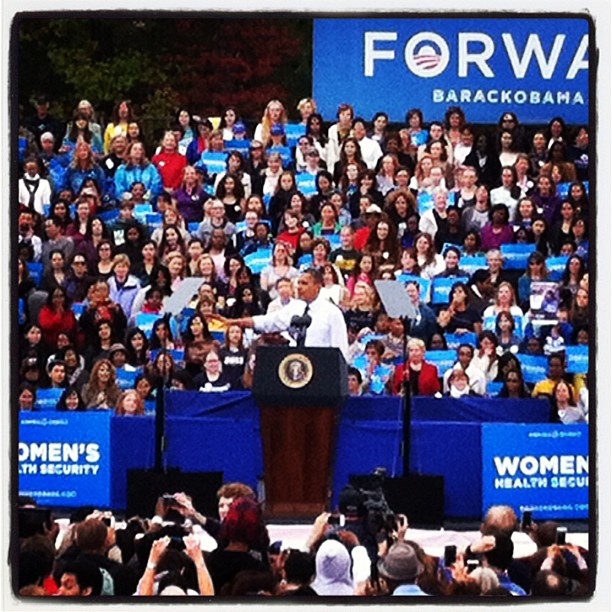
President Barack Obama held a campaign event at George Mason University Friday, marking his second visit to GMU this month.  Mason Votes was there to cover all angles of his visit. His remarks pleased the partisan crowd, but I doubt they will do much to persuade independents or undecided voters with less than three weeks left in the race.

Obama began by calling Mitt Romney’s five-point plan to create 12 million jobs, “a sketchy deal” and quoted the New York Times’ opinion that it was a “snow job on the American people.”  Obama said that Romney’s plan really only has one point, “that those at the very top play by a different set of rules.”

Now with rhetoric like that, you might think Romney’s plan only cuts taxes for the rich.  You may think Romney really wants to stick it to the middle class.  In reality, the only person shoveling anything is Barack Obama, and it isn’t snow.  Romney has campaigned on a 20% tax cut across the board and then capping the number of deductions and exemptions the rich can take.  This would assure that the rich still paid the same share of the tax burden, while lowering the rate for the vast majority of Americans.  So Obama has set up and has been consistently attacking a Romney straw man argument.  He ridicules the tax plan he wants Romney to have, not the one he actually has.

The President did have one new attack line for this rally.  He coined the term, “Romnesia”.  Obama claimed that Romney had been avoiding his prior positions and thus called it a “condition he’s going through”.  That ended up being the big headline out of the rally, Obama’s clever new attack line.

Beyond that term’s small dose of immaturity, what’s more striking is what the speech generally left until the very end, his actual second term agenda.  He ran down a litany of points at the end of his remarks.  The term I caught on to was “invest”.  Obama said he’s going to “invest” in education, clean energy, roads, etc.  What he won’t tell you is that when he says he will “invest”, it means you will have to pay.  And there are not enough rich people in America for him to tax in order to balance that equation.  He attacks Romney for not having specifics, but he never has told the American people how he’ll pay for all these new “investments”.  The answer isn’t hard to discern.  What he’ll do in a second term is exactly what he did in his first, which is put it on our children’s credit card in the form of debt.  If Barack Obama is reelected, the national debt will hit $20 trillion, guaranteed.

In the end, the Obama campaign needs boosted turnout among his voters in Northern Virginia to offset the Romney vote down south.  That’s why he is mobilizing the largest college in NoVa in person, twice.  But he can come a dozen times and it still won’t change the fact that there are 23 million unemployed Americans being ignored by his campaign rhetoric.  Higher gas and food prices being ignored.  The lowest household income and take-home pay in a decade is being ignored.  Those are issues central to this campaign, and it’s why Obama is in trouble and in real danger of being the first President in 20 years to not win a second term.

 *The views and opinions expressed are solely those of the author. 

** Photo by Curtis Kalin.
President Obama Returns to Mason and Talks Women’s Issues

For the second time in less than a month President Barack Obama held a grassroots rally at George Mason University in Fairfax, Virginia. The President talked jobs and the economy, but spent a majority of his stump speech talking about women’s issues. He also debuted a new line of attack against Mitt Romney for his change in position on many issues especially women’s health issues.

[youtube]http://youtu.be/Fi73Nz9Ozk4[/youtube]


President Obama’s full remarks:

[youtube]http://youtu.be/48BmtinOSl4[/youtube]


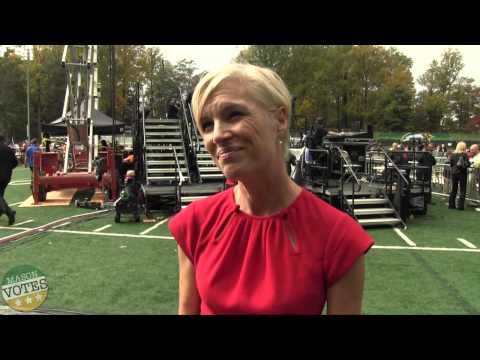
Mason Votes 1-on-1 with Cecile Richards

Mason Votes caught up with Cecile Richards, President of Planned Parenthood, after President Obama’s grassroots rally at George Mason University in Fairfax, Va.

[youtube]http://youtu.be/na60mZPBY6U[/youtube]

VA Senate Candidates Debate Last Time

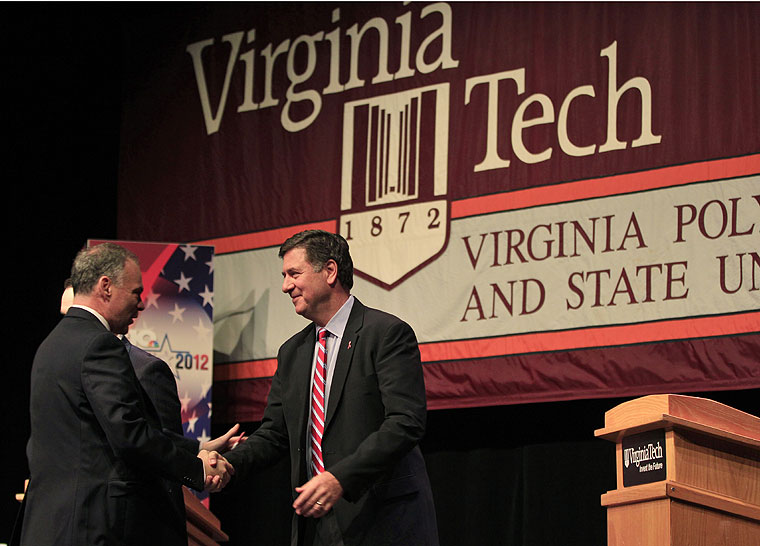
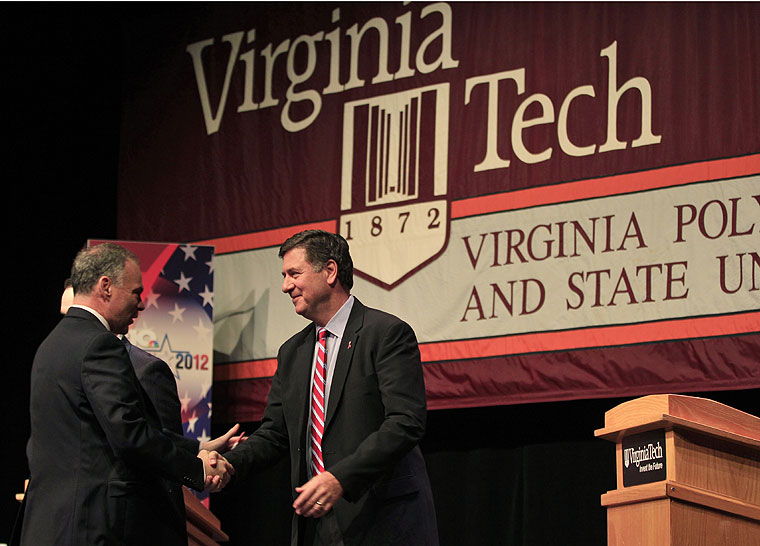
Virginia Senate candidates George Allen (R) and Tim Kaine (D) faced each other for their fifth and final debate this 2012 election season October 18, 2012 at the Haymarket Theater in the Virginia Tech Squires Student Center.

View the entire debate here: http://www.c-spanvideo.org/program/308845-1

Former Gov. Timothy M. Kaine, left, and former Sen. George Allen, right, shake hands prior to a debate at Virginia Tech in Blacksburg on Thursday, Oct. 18, 2012. (Steve Helber | The Associated Press)

Stein Gets Arrested

Photo by: Mary Altaffer/AP Photo

[youtube]https://www.youtube.com/watch?v=pnam1yi5bVs[/youtube]

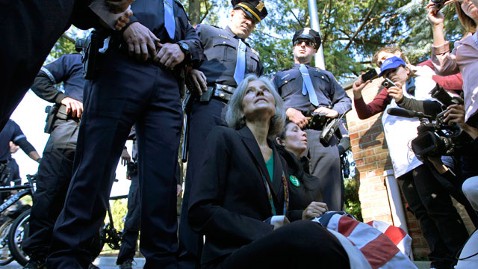
A video of the Green Party’s Presidential Candidate, Jill Stein and her running mate, Cheri Honkala being arrested as they attempted to enter the grounds of the Presidential Debate on Tuesday, has gone viral.

Stein, along with the other third party candidates were not permitted to participate in the event, organized by the Council of Presidential Debates.  The CPD’s rules dictate that only nominees with an average of at least 15% of support in 5 chosen, national polls are allowed to enter the debate.

In protest to being barred from participating, Stein and Honkala held a press conference near Hofstra University, where the presidential nominee stated, “we are here to bring the courage of those excluded from our politics to this mock debate, this mockery of democracy.”  After which they began proceeding to the debate hall, but were met by local police, who would not them in.  Though they refused to leave the premise and were consequentially arrested for blocking traffic.  They were not released for 8 hours.

This is not Stein’s first attempt to be included in the debates.  She has petitioned the CPD to allow all of the candidates who have “demonstrated minimal level of support,” to join. She received over 14,000 signatures.

Stein, along with third party candidates, Virgil Goode, Rocky Anderson and Gary Johnson, will be debating each other on Tuesday night at 8 PM.  It is going to be moderated by former CNN host Larry King and streamed on Ora.tv and YouTube.

Podcast – Jeremy Mayer on Foreign Policy & the Election

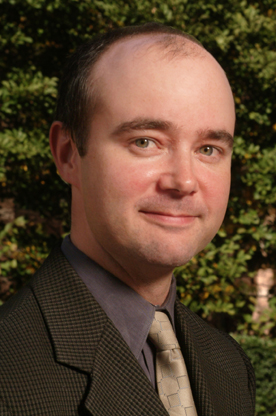
Professor Rodger Smith, GMU Communications Department and WGMU Faculty Advisor interviews Dr. Jeremy Mayer, GMU School of Public Policy.

Jeremy Mayer is an Associate Professor and the  Director of the Master of Public Policy Program in the School of Public Policy at George Mason University. Most recently he is the co-author of Closed Minds? Politics and Ideology in American Universities (Brookings, 2008), co-editor of Media Power, Media Politics, 2nd ed. (Rowman and Littlefield, 2008), co-author of Deconstructing Reagan: A Critical Analysis of Conservative Mythology (2006), and the author of American Media Politics in Transition    (McGraw Hill 2006). He has written articles on diverse topics such as presidential image management, Christian right politics, federalism and gay rights, and comparative political socialization, in journals such as Presidential Studies Quarterly, Social Science Quarterly, and The Historian.

Part 1 of the interview analyzes foreign policy of the Obama administration and Mitt Romney’s focus on foreign policy.

Part 2 continues the discussion of Part 1 and provides detail on why college students should care about foreign policy.

Jeremy Mayer, GMU School of Public Policy

Harvard Institute of Politics releases Fall 2012 National Poll on young voters

[youtube]http://youtu.be/bs70ivV-HOU[/youtube]

Cambridge, MA – A new national poll of America’s 18- to 29- year olds by Harvard’s Institute of Politics (IOP), located at the John F. Kennedy School of Government, finds President Barack Obama continuing to widen the gap between himself and former Massachusetts Governor Mitt Romney leading by a nineteen-percentage point margin (55%-36%) among young adult “likely” voters.  Just weeks before the presidential election, the poll also shows voting enthusiasm slipping as only forty-eight percent (48%) of America’s young adults say they will “definitely” vote this fall.

In addition, the IOP’s newest survey results – its 22nd major release since 2000 – show a solid majority of 18- to 29- year olds (62%) more comfortable with the view that President Obama inherited problems unable to be fixed in one presidential term rather than the viewpoint that he has failed (33%) – see below for more information.  A detailed report on the poll’s findings is available on the Institute’s homepage at www.iop.harvard.edu.

The KnowledgePanel® survey of 2,123 18- to 29- year old U.S. citizens with a margin of error of +/– 2.1 percentage points (95% confidence level) conducted with the Government and Academic Research team of GfK for the IOP between September 19 and October 3, 2012.  Here are some of the findings –

  • President Obama more trusted than Gov. Romney to handle major issues; majority believe problems President inherited are complex and require more time to solve. When America’s 18- to 29- year olds were asked which presidential candidate they trust more to handle a number of top issues, late-September IOP polling shows President Obama favored over Governor Romney on health care (+23 percentage points), foreign policy (+23), to be the Commander-in-Chief of the military (+22), immigration reform (+20) – and the economy (+19). Obama was also trusted more to handle “issues of concern to someone your age” (+31) and “issues of concern to women” (+33).

In addition, six-in-ten Millennials (62%) said the statement: “the problems that President Obama inherited are so complex it takes more than four years to do the job” came closer to their own view, while only a third (33%) said the same about the statement: “despite his best efforts, President Obama has failed.”

  • Romney voters more likely to turnout than Obama voters; less than half of America’s young adults expected to “definitely vote” in November.  18- to 29- year olds favoring Governor Romney are more likely (65%) than those favoring President Obama (55%) to say they will “definitely” vote this fall.  Overall, forty-eight percent (48%) say that they will “definitely” vote in the November elections, with another ten percent (10%) saying “probably” and sixteen percent (16%) saying “50-50.”  African Americans (59%) and Whites (54%) are both significantly more likely to say they will vote this fall than Hispanics (31%), as are college students (55%).
  • Obama leads Romney by nineteen points with young adult “likely” voters, continues to be preferred candidate among 18- to 29- year olds generally and is ahead on college campuses. At the time the IOP’s new fall poll was conducted, 18- to 29- year old “likely” voters gave President Obama a nineteen-percentage point (19%) lead over Governor Romney (55%: Obama; 36%: Romney), a slight improvement from March IOP polling (51%: Obama; 34%: Romney).  Among young adults enrolled in a four-year college “likely” to vote, Obama leads 48%-38% with fourteen percent (14%) undecided.  The IOP’s latest poll also shows Obama has continued to grow his lead among young adults generally to twenty-two points (48%: Obama; 26%: Romney; don’t know: 22%), five percentage points greater than seen in March IOP polling (43%-26%) and eleven points greater than December IOP polling (37%-26%).  Obama leads Romney among 18- to 24- year olds by twelve points (41%-29%) and 25- to 29- year olds by 23 points (46%-23%).
  • President Obama enjoys strong leads in “Blue” and “Swing” states – and also ahead in“Red” states.  President Obama is favored over Governor Romney among likely 18- to 29- year old voters in Swing states by 16 percentage points (54%-38%) and in Blue states by 34 points (61%-27%) – he leads by 6 points in Red states (49%-43%).
  • Governor Romney’s VP pick unhelpful. When young adults were asked how Governor Romney’s selection of Congressman Paul Ryan as his running mate affected their likelihood to vote for him, by more than a 4:1 margin more respondents say the Ryan pick made them “much less likely” to support Mitt Romney (40%: much less likely; 9%: much more likely).  Among likely Republican voters, thirty-four percent (34%) say that the Ryan pick makes them “much more likely” to vote for Romney, with six percent

(6%) saying “much less likely;” among likely Independent voters, nine percent (9%) said the Ryan pick makes them “much more likely” to support Mitt Romney, with thirty-seven percent (37%) saying that it makes them “much less likely;” and among likely voters who are Democrats, three percent (3%) report that the pick made them “much more likely” to vote for Romney, with 65 percent saying “much less likely.”

  • Four-in-ten young adults prefer a Democrat-controlled Congress.  A plurality (40%) of America’s 18- to 29- year olds prefer that Democrats control Congress after the November elections, with one-quarter (25%) saying they support a Republican-controlled Congress and 30% saying Congress should be split.

Obama’s Improved Perfomance

Fully understanding the implications of his disastrous performance during the first presidential debate, President Obama came back in full swing at last night’s Town Hall.  He was able to not only rebut Governor Romney’s falsehoods with the passion and aggression he was so heavily criticized for not having two weeks ago, but did so in a setting that calls for much more tact; which Romney did not seem to realize.

The night was filled with moments in which the Governor seemed completely flustered and combative, acting disrespectfully to not only the President of the United States, who at times he looked like he was going to punch, but the moderator, Candy Crowley.  While both candidates ignored the debate rules on occasion, Romney was not only the first to do so, but was more frequent and more hostile.

Not only was Romney’s performance rocky at best, but the content of his responses to the questions asked were continuously void of specifics.  While, he was persistent in reiterating that he “know[s] how to make an economy work” or “what it takes to create jobs again” or “what it takes to balance a budget,” he refused to share with the American people his supposed knowledge.  When asked about how he would go about solving the problem of pay inequality for women in the workforce, the Governor took a page out of the Ryan playbook with an anecdote regarding how he hired women once; and then stated that we need a stronger economy.  While it is great that he hired women, his answer lacked any mention of discrimination, which has existed long before the Great Recession and is the obvious root cause of pay inequity.

One thing did become clear last night, the contempt that the candidates have for one another is more than just a professional rivalry; but it was President Obama that was better able to hide his disdain.  The debates are the best place for Governor Romney to exemplify to the American people that he has the gravitas to be “presidential” and last night’s incessant whining did not do it.

*The views and opinions expressed are solely those of the author.

Flash Lecture Today

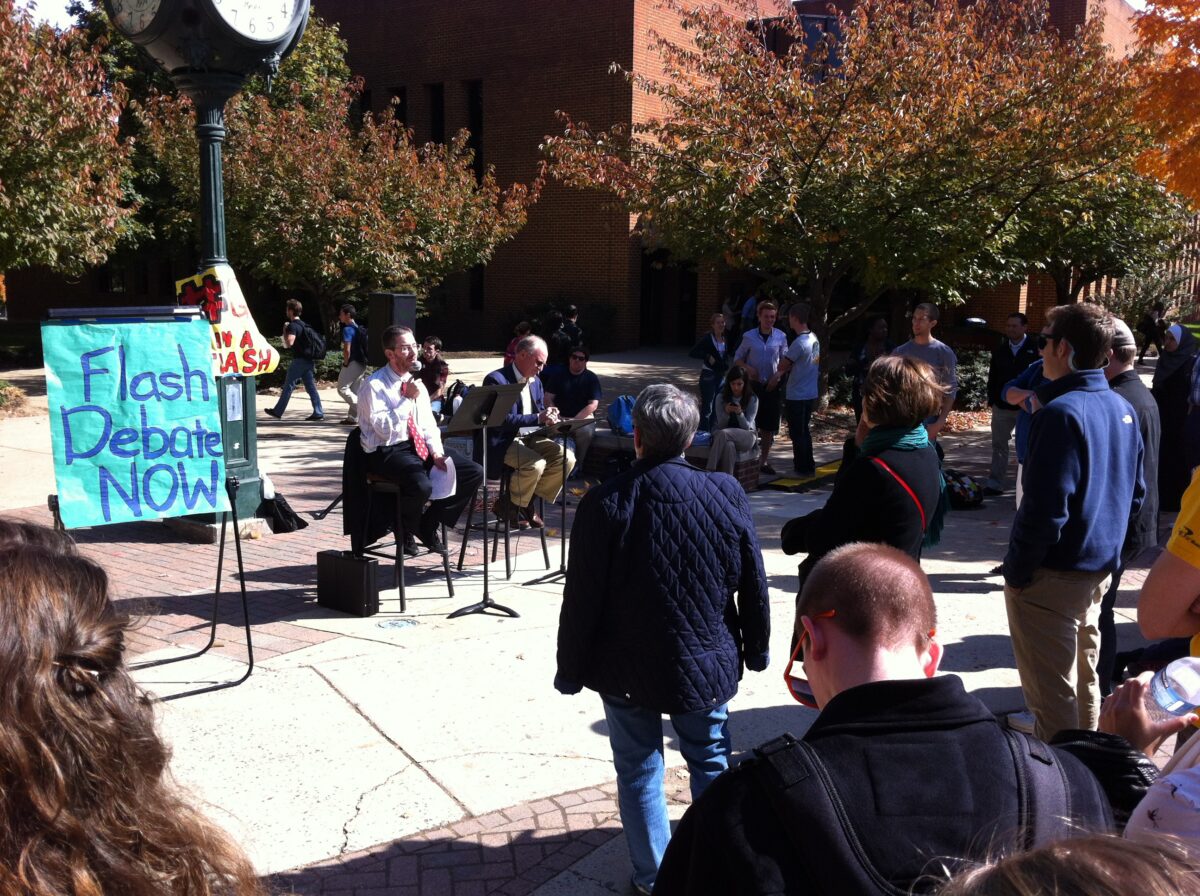
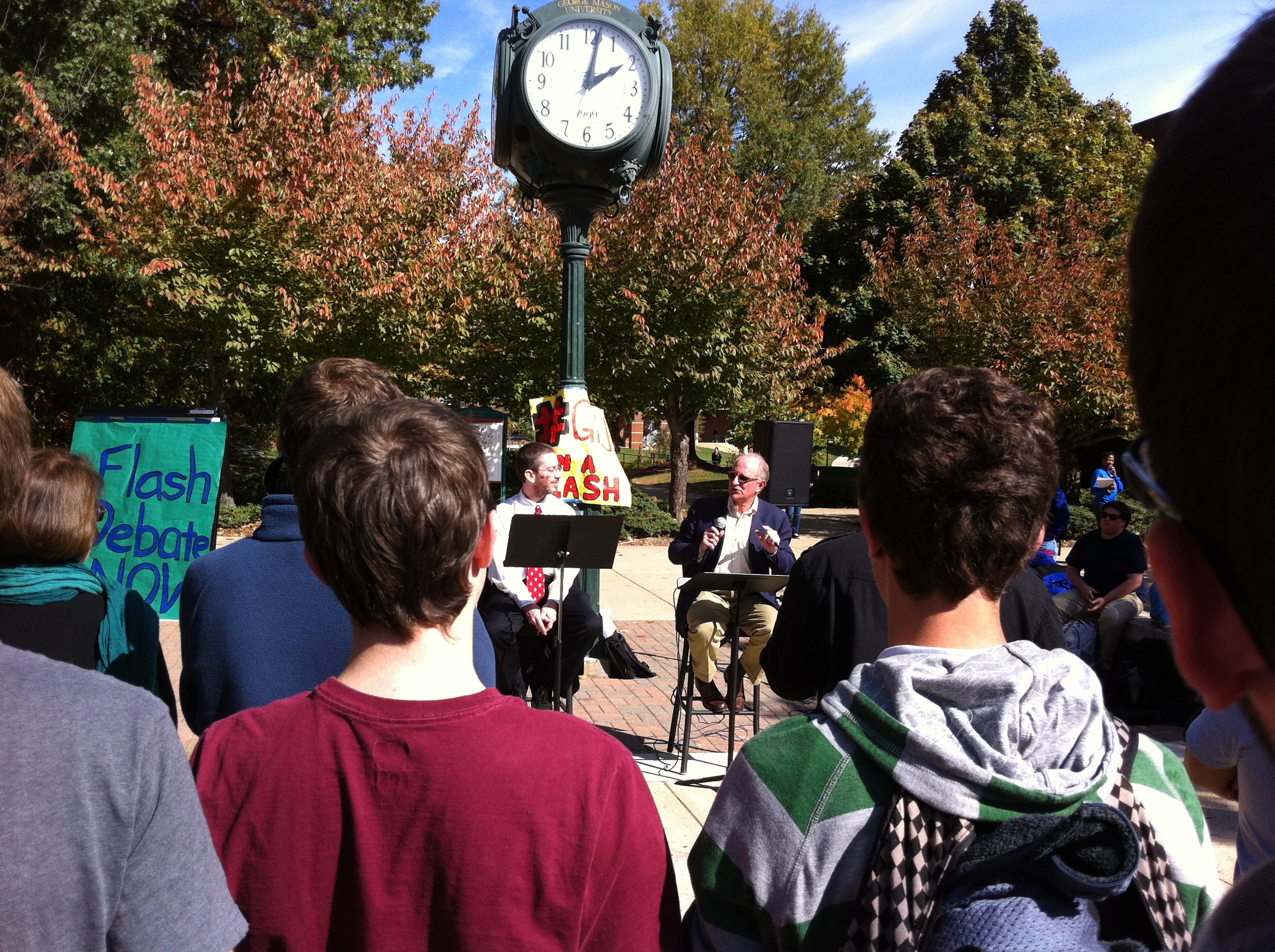
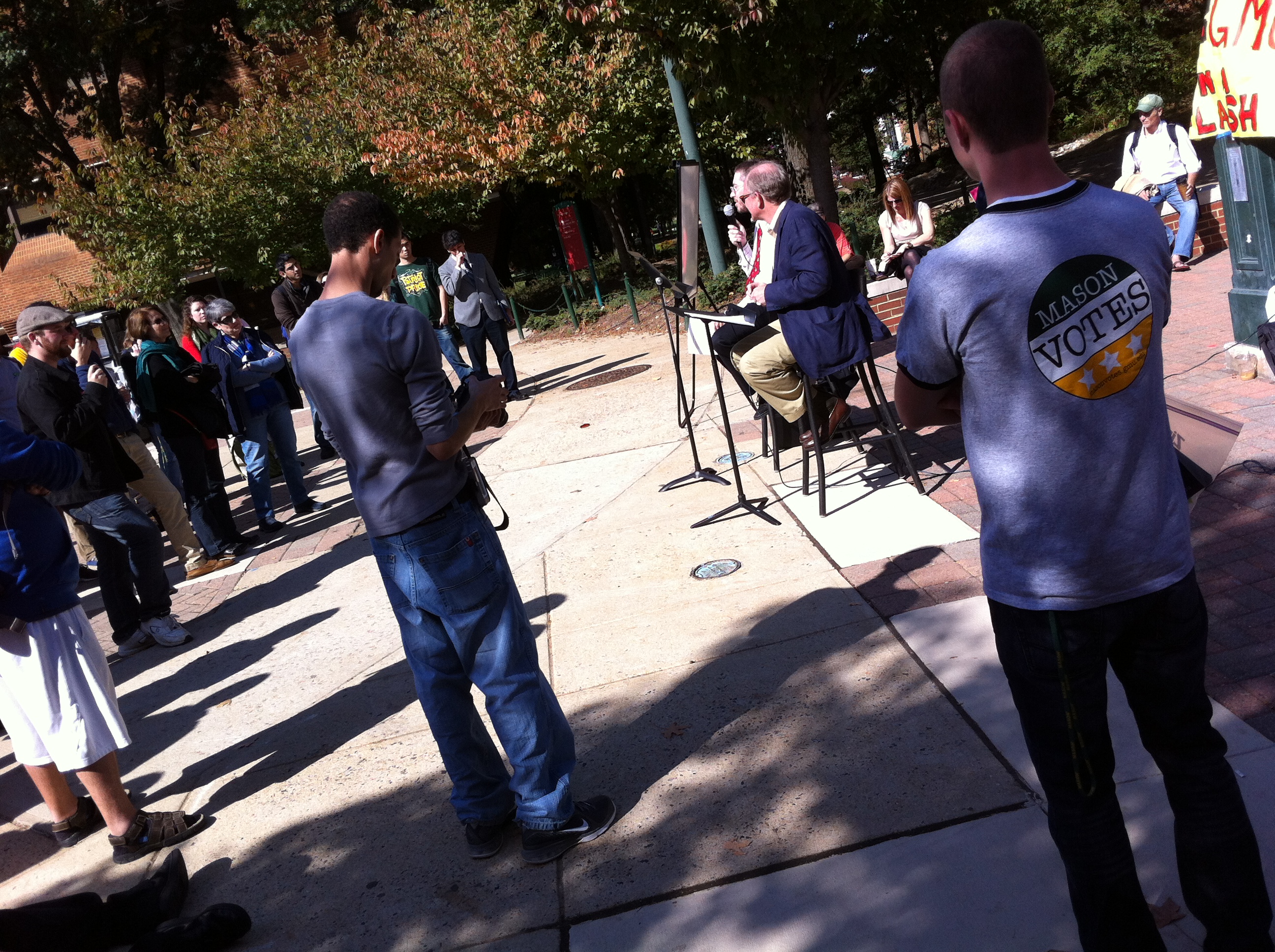
GMU Student Government sponsored a flash lecture today, Oct. 17, 2012, on the economy and the election.  The flash lecture was debate style on the Johnson Center North Plaza that began at 1:30pm between Professors Caplan and Pearlstein.

Student Government Flash Lecture 10-17-2012


Second Presidential Debate Gets Rough

Well the verdict is in: The President did show up tonight.  But as opposed to the empty chair President Obama featured in the first debate, this time it was the truth that was often times missing from his performance.

In terms of style, Mitt Romney did not change all that much from debate one.  He still vigorously went after Obama’s record and repeated one of his main lines that, “we don’t have to settle for this.”  The big change was the demeanor of the President.  He definitely had the fire and had what seemed like a rhetorical bloodlust for Romney all night.  Every answer featured an attack on Romney’s personal finances or his record.  He wasn’t as outwardly rude as Vice President Biden was, but he still poked his way into Romney’s answers.

The questions were from uncommitted voters from New York State and mainly dealt with the economy and domestic issues.  Obama attacked Romney for saying that Detroit should “go bankrupt.”  However, it was the President that actually let the auto companies go bankrupt and then rebuild.  The President assailed Romney as having a one-point plan for the economy, which was based around helping the wealthy.  Again, that might be what Obama wants to think Romney’s plan is, but Romney actually centers the plan on the middle class and broad economic growth.

One of the first angry exchanges of the night was about gas prices.  Romney attacked Obama for not allowing drilling and new pipelines, while Obama asserted that it was the recession that began under President Bush that was to blame for the price of gas fluctuating.   When talking coal and natural gas, Romney attacked Obama by telling him, “I don’t think anyone believes that you will fight for oil, coal, and natural gas.”

On taxes, Obama again went after Romney for being too nice to the top wage earners.  As much as Romney keeps saying the rich won’t pay less, Obama keeps hammering the point.  Especially in this section, it seemed President Obama’s only response to the Romney plan was to call it untrue.  Beyond that he never said why cutting taxes would, in his mind, be a bad thing for the economy.  His plan would raise taxes on the wealthy even though it’s mathematically impossible to pay for all of the President’s new spending while only taxing the rich.  The question needs to be asked, who else will the President have to tax?  I wouldn’t mind hearing some specifics on that.

After that there were a series of questions that really were right up Obama’s alley.  Questions on equal pay, contraception, and how Romney compared with President Bush all fit into the Obama campaign’s own attack lines against Romney. That he’s anti-woman or that he’s the same old Republican.  The President also had a four-minute edge in total time for the night.

The last big exchange was on the terrorist attack in Libya that killed four Americans including Ambassador Chris Stevens.  Romney attacked Obama for mishandling the aftermath and giving out false information to the press in the week following the attack.  The administration’s claim that the attack was a protest, and not a terrorist act was the point Romney hammered home.  Obama was indignant on this and accused Romney of playing politics with dead Americans. It seemed that moment was when Obama was at his most animated and almost visibly angry.

Overall, my partisan opinion would be that Romney continued a well-oiled prosecution of the Obama record.  However, based on Obama’s resurgence and actually showing he possessed a pulse, I think I’d honestly call the debate a draw.  Both men did what they needed to do to energize their respective bases.  Going into the final debate next Monday, both men seemed more eager and more fervent in their ambition to win this race.

*The views and opinions expressed are solely those of the author.