Mason Votes

One-on-One with Tom Davis

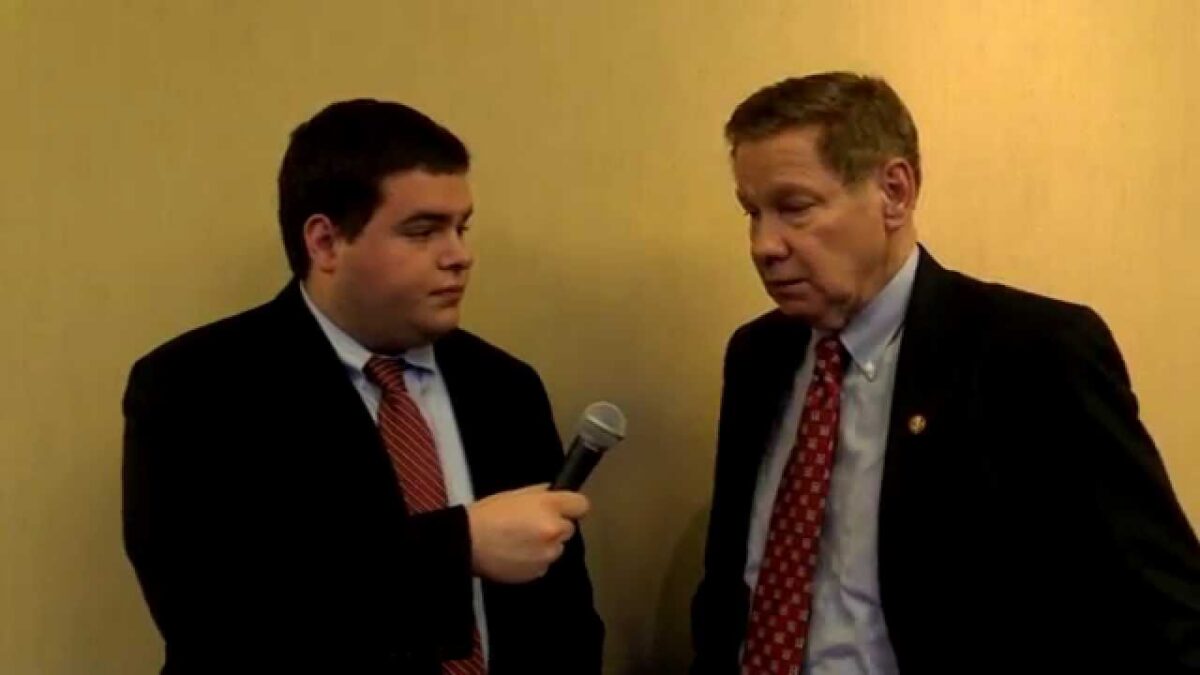
WGMU’s General Manager, Storm Paglia goes one-on-one for a post-election interview with Rector of George Mason University, Tom Davis.

[youtube]https://www.youtube.com/watch?v=VOo6Vy3yPkE[/youtube]
Liberal Columnist Opinion: Election 2014 Predictions

Hau Chu is the Edititor-in-Chief of Fourth Estate and Liberal Columnist of MasonVotes.


Midterm Election 2014 Predictions

It is looking to be a pretty grim midterm election in the projections for Democrats in 2014. Republicans have followed the midterm election playbook and are seeing the benefits.

In recent history, the midterm elections have been a presidential referendum more than anything. In 2006, President George W. Bush saw his party lose Congressional control where there was a net gain of six seat pickups for Democrats in the Senate – giving Democrats a 51-49 split of votes – and a net pickup of 31 seats in the House of Representatives.

Reasons for this momentum swing included the image of Bush as a leader in his handling of the War in Iraq and Hurricane Katrina, the housing bubble burst was looming and members of the Republican Party and political operatives with close affiliations to the Bush White House who were embroiled in political corruption scandals.

In 2010, Republicans countered the strong showing from Democrats in 2006 – and 2008 with the election of President Barack Obama. While Republicans were unable to replicate the Senate takeover of 2006 – they had lost eight seats over the course of 2006-2010 – they equaled the net gain of Senate seats with six pickups to narrow the Democratic majority back to 51-49.

Where Republicans stood out in 2010 was with their net gain of 63 House seats, which was the largest since 1948, and gave Republicans control of the House once again. The issues that President Obama was held accountable for were the Affordable Care Act, the stimulus bill and Wall Street bailouts. Obama also dealt with the rise of the Tea Party, which caused troubles for both parties.

On to breaking down the key Senate races up for grabs on Tuesday:

Alaska

In any given toss-up election, Alaska is the most volatile and unpredictable state to forecast because of how few reliable polls are available. It’s how in 2010, election analysts were blind-sided when incumbent Republican Lisa Murkowski lost a primary to Tea Party candidate Joe Miller. Murkowski went on to win the general election as a write-in candidate. One of the only reliable predictors of Alaska is that it’s generally a safe Republican state — a Democratic presidential candidate has not carried the state since 1964.

Mark Begich, a Democrat and former mayor of Anchorage, Alaska, won his seat in 2008, making him the first Democratic senator for the state since 1981. Begich won for two major reasons in 2008, first was the swell of youth support for then-Sen. Obama’s first election — 123,594 votes were cast for Obama, the most for a Democratic candidate since Alaska’s admittance into the United States.

The second reason was that Begich’s opponent, 40-plus year sitting Republican senator Ted Stevens, was in the midst of multiple scandals. The first was his proposal for the now infamous, Bridge to Nowhere, and second was that eight days before the general election, Stevens was found guilty by a federal court on seven felony counts of failing to report gifts. Even with all of that working for Begich, he only managed to win the general election by a little less than 4,000 votes.

Needless to say, Begich is not the most beloved Alaska politician and polling shows that he faces an uphill battle to Republican candidate and former Attorney General of Alaska under then-Gov. Sarah Palin, Dan Sullivan. Sullivan leads in the polls on average by around two to three percentage points.

Because of Alaska’s history of voting for Republican candidates and Begich’s poor polling in national elections, and despite the uncertainty of projection polls, I am going to predict that Republicans will reclaim the second Senate seat in Alaska.

Prediction: Dan Sullivan (R) defeats Sen. Mark Begich (D-AK).

Arkansas

In recent history, Arkansas has been a reliable Republican state in national elections. This is despite a strong representation of Democrats in the Arkansas state legislature, and that there are more registered Arkansas Democrat voters than registered Republicans. Although this incongruency is present, Arkansas Democrats tend to be much more socially conservative than mainstream Democrats. This is because Arkansas has a large rural, white Evangelical Christian population that has voted to make Arkansas one of the few states with a constitutional ban on same-sex marriage — winning a 75% majority vote — and even has a constitutional ban on abortion in the case that Roe v. Wade is overturned.

Arkansas’ presidential electoral history reads much like Alaska’s with two distinct anomalies in 1992 and 1996, when native son of Arkansas and then-Gov. Bill Clinton carried his home state in both elections. Otherwise, the last Democrat to carry Arkansas was Jimmy Carter in 1976. In fact, Arkansas was only one of five states to see the Republican presidential candidate earn more votes in 2008 than in 2004.

Incumbent Democratic senator, Mark Pryor, won his seat in 2002 defeating a one-term senator and then ran unopposed to any major party candidate in 2008. Arkansas is probably the best representation of the presidential referendum in this election cycle. President Obama has an approval rating of anywhere from 31-33% in Arkansas because of the large base of rural white voters that feel alienated by the Obama administration.

Pryor’s opponent, United States Rep. Tom Cotton, is seen as one of the top faces of this Republican class of candidates. Cotton, 37, comes from an Arkansas town of less than 4,000 and is the ideal Republican candidate mix of young, Harvard-educated, Army veteran and with strong enough far-right ideology to appease the Tea Party sect.

Cotton has consistently led respected projection polls for months now by five to six percentage points and it is hard to see a way that Pryor can make up that much ground this quickly.

Prediction: Rep. Tom Cotton (R-AR-04) defeats Sen. Mark Pryor (D-AR)

Colorado

Always a wild card state to predict, Colorado this year proves to be no different. Where Alaska has a lack of so few reliable polls, Nate Silver of FiveThirtyEight believes that Colorado is oversaturated with polls of varying degrees of reliability. Until 2008, Democrats had not carried Colorado in a presidential election since 1964 — besides 1992 when Clinton won a plurality of votes. This is incongruent to the political makeup of the state legislature where 22 of the last 30 years have seen a Democrat in the governor’s chair.

A reason for this divide in recent years is the growing youth and liberal population in major Colorado cities like Denver and around the Boulder area — where the University of Colorado’s main campus is located. Because there is still a large rural population across Colorado, this has led to a split of United States members of Congress where Republicans have four representatives and Democrats send three to Washington, D.C.

Incumbent Sen. Mark Udall (D) faces a tough challenge from Rep. Cory Gardner (R-CO-04). Udall has been criticized by his opponents for not running on his credentials and rather attack his opponent’s conservatism. Udall is also seen as an ineffective legislator in comparison to his fellow Democratic senator, Michael Bennet, who holds a number of key committee assignments.

Gardner is seen, like Rep. Cotton in Arkansas, as one of the new faces of the Republican party. Gardner is posturing himself as a pragmatist who supports renewable energy and claims to favor selling contraceptive medicine over-the-counter, although critics believe this is just typical election-year posturing and point to his record in the House and Colorado state legislature strongly opposing same-sex marriage, a woman’s right to choose and immigration.

Polls between Udall and Gardner have gone back and forth over the past couple of months, but in recent weeks, Gardner has pulled ahead in multiple polls. Due to Udall’s ineffective campaigning and Gardner’s strong campaigning and poll numbers, I see this as another Republican pickup.

Prediction: Rep. Cory Gardner (R-CO-04) defeats Sen. Mark Udall (D-CO)

Georgia

The politics of Georgia are similar to those of its fellow southeastern state, Arkansas, and of Colorado. There is a strong contingent of rural, white evangelical Christian voters who are offset partially by groups of urban, minority voters centralized in Atlanta and its surrounding areas as well as Athens — the location of the University of Georgia.

Democratic presidential candidates have only carried the state four times since 1964. Two of those times — similar to Arkansas — were anomalies when native son and then-Gov. Jimmy Carter overwhelmingly carried the state in 1976 and in his failed 1980 reelection campaign. The other two times were in 1992 when Bill Clinton carried the state, and in 1968 when segregationist candidate George Wallace took the state.

This race seems to be one of the most unpredictable races for Tuesday. Because polling numbers show that Republican candidate and businessman David Perdue is becoming more and more unlikely to attain the 50% of votes necessary to avoid a runoff election with Democratic opponent and businesswoman, Michelle Nunn, who is the daughter of 24 year Democratic senator, Sam Nunn, also of Georgia.

Because of the uncertain polling — where the lead has shifted back and forth depending on the poll you look at — I am predicting that we will not know a winner of the election on Tuesday night and a runoff will have to be initiated, but ultimately, it seems that Perdue has the narrow edge.

Prediction: No winner on Tuesday, but David Perdue (R) defeats Michelle Nunn (D) in runoff election.

Iowa

Iowa has earned its role as a bellwether of politics from its place as the first primary in the presidential election cycle. The state in recent years has become a crucial swing state. As it stands, the Iowa General Assembly is split between Democratic and Republican control.

Sen. Tom Harkin (D) is retiring after serving for 30 years. Harkin was a staple of Iowa politics and his retirement makes the seat all the more vulnerable for Democrats. Rep. Bruce Braley (D-IA-01) opposes state senator Joni Ernst in a contest that has seen polls go back-and-forth.

The race has largely been marred by a flurry of negative campaign ads with Braley being most negatively affected by the ads. Ernst was initially seen as a non-threat to a sitting member of Congress, but her background story as a National Guard commander and her personality have endeared her to Iowa voters.

Polls as recent as a couple of weeks ago predicted that the election might result in a runoff, but polls in the recent days are showing that Ernst can reach the 50% threshold. Losing Harkin in the Senate and having a Republican take his seat would be an especially tough blow for Democrats, but it seems as though that is the likely outcome on Tuesday.

Prediction: Joni Ernst (R) defeats Rep. Bruce Braley (D-IA-01)

Kansas

Kansas is viewed considered a typical, conservative midwestern state with strong social conservatism because of its large population of white, rural, evangelical Christian voters. The state has long been considered a Republican stronghold on the national level.

This year’s election has proven to be one of the most eventful races of the season. Incumbent Sen. Pat Roberts (R) was considered early on to be a shoo-in for reelection, but his public perception in the state has taken a major toll because of a controversy surrounding his residency. Roberts spends a large majority of his time in Washington, D.C. and it was reported that he rarely returns to Kansas, and even then, only to try and maintain appearances.

This opened up the election considerably, but his main challenge comes from an independent candidate, Greg Orman. Orman has rallied Kansas voters around his personality and promise to bring bipartisanship to Washington. His bonafides in polls were so strong that the Democratic candidate withdrew his name and endorsed Orman. This led to an attempt by Kansas Republican state officials to try and force the ballots to list the Democrat, because polls had shown that Orman would only beat Roberts in a head-to-head matchup but would lose with a Democrat on the ballot.

This petition was rebuffed by the courts and Orman looks to be in a strong position leading up to Tuesday. The only issue that remains is Orman has remained mum on who he would caucus with if he was elected. Roberts and the GOP campaign funding cabal have attacked Orman on his refusal to identify his intentions, and have actually earned some polling points back in recent weeks. Orman holds a slight edge in polls, and I predict that he will defeat the three-term incumbent.

Prediction: Greg Orman (I) defeats Sen. Pat Roberts (R-KS)

Kentucky

Initially thought to be a more tightly-contested election, the polls in recent months and weeks have shown Senate majority leader Mitch McConnell (R) with more of a commanding lead to Alison Lundergan Grimes (D).

The story of the majority of these battleground states is no different in Kentucky. The state has a large population of rural, white, evangelical Christian voters. McConnell has proven to be an effective Washington politician but faced tough election challenges in 2008 and this year because of his lack of personality and reputation as somewhat of a political villain to voters.

Lundergan Grimes has run a notable campaign as a pragmatic Democratic candidate who has specifically tried to set herself apart from President Obama. Lundergan Grimes is a member of the National Rifle Association and has views on energy policy out of the norm of Democrats because of the importance of coal to Kentucky.

Because of McConnell’s position in the Senate and the power of his incumbency, I predict that McConnell will retain his seat.

Prediction: Sen. Mitch McConnell (R-KY) defeats Alison Lundergan Grimes (D)

Louisiana

I feel like I could just copy and paste what I have said about other states, but Louisiana is another example of a state with a large population of white, rural, evangelical Christian voters. President Obama’s approval ratings in Louisiana are particularly grim when divided along racial lines. A University of New Orleans poll conducted last Friday found that 78% of white voters disapproved of the President’s work. While 82% of black voters approve of the President’s performance.

The major reason that this election is as contested as it is because of the multiple Republican candidates on the ballot challenging incumbent Sen. Mary Landrieu (D) due to Louisiana’s ‘jungle primary’ system where there are no primary/party conventions and all candidates who intend to run are put on the November ballot regardless of party affiliation. Landrieu is expected to ‘win’ the election on Tuesday night but will not reach the 50% threshold to avoid a runoff election.

When the runoff is held, it is believed from polls that Landrieu will lose to Rep. Bill Cassidy (R-LA-06). As mentioned, this election will be based less on Landrieu’s record in Washington but more of a referendum on how unpopular President Obama is in the state among likely voters.

Because of public opinion polls, I predict that Sen. Landrieu will lose her seat in the eventual December runoff to Rep. Cassidy.

Prediction: Rep. Bill Cassidy (R-LA-06) defeats Sen. Mary Landrieu (D) in runoff election

New Hampshire

Certainly one of the more narratively amusing elections, where incumbent Sen. Jeanne Shaheen (D) takes on former United States senator Scott Brown (R-MA). Brown won the 2010 special election in Massachusetts following the death of Democratic mainstay Sen. Ted Kennedy. As a teenager, Brown was raised in New Hampshire and re-established residency following his defeat in the 2012 general Senate election.

New Hampshire’s status as a swing state is similar to Iowa because of its place on the primary calendar. The state has been pretty even on the national level in its votes for Republicans and Democrats.

Brown has not polled particularly well and his charm of campaigning from his pick-up truck has seemed to not endear itself to New Hampshire voters as it did Massachusetts voters in 2010. Shaheen has strong New Hampshire credentials serving as a senator since 2009 and she was New Hampshire’s governor from 1997-2003.

Because of the strength of her incumbency and her opponent’s public perception, Shaheen should take her election on Tuesday.

Prediction: Sen. Jeanne Shaheen (D) defeats Scott Brown (R)

North Carolina

North Carolina is the most analogous state to Virginia in terms of its evolving politics. It was long a Republican stronghold — Republican presidential candidates carried the state from 1968-2004, the only exception being the 1976 election of Jimmy Carter. The state has a large share of white, rural evangelical Christian voters but there are large urban areas that are seeing the most population growth from young professionals.

In 2008, Obama carried the state as one of the key swing pickups on his way to victory. Riding this wave of Democratic support is incumbent senator Kay Hagan (D). Challenging Hagan is North Carolina state house speaker Thom Tillis (R).

North Carolina has been subject to a lot of outside funding funneling money to run campaigns against both candidates. Despite riding the presidential coattails to an extent, Hagan began distancing herself from Obama during the election cycle and posturing herself as a pragmatist.

While originally seen as a toss-up, recent polls have given Hagan a slight enough edge to make me feel comfortable in predicting her to win on Tuesday.

Prediction: Sen. Kay Hagan (D) defeats Thom Tillis (R)

From my predictions, I foresee a net pickup of seven seats for Republicans giving them control of the Senate, 52-47. If Greg Orman wins the Kansas election, I would predict that he initially chooses to caucus with Republicans because he has previously stated he would caucus with whichever party had the majority to give Kansas interests more power in Washington. That would then bump the control of the Senate power to 53-47, so now we wait and see how Tuesday night plays out.

Hau Chu is the Edititor-in-Chief of Fourth Estate and Liberal Columnist of MasonVotes.

#WhyMidtermsMatter Samuel Carpenter

[youtube]https://www.youtube.com/watch?v=1Uw6bAaocTs[/youtube]

GMU Student Government senator, Samuel Carpenter talks about why your vote matters this midterm election.

Unable to go to the polls on Election Day? Vote Absentee!

Will you be unable to vote on Election Day in your precinct? There are many acceptable reasons to vote absentee, including:

  • Working and/or commuting for at least 11 of the 13 hours the polls are open
  • A business trip or vacation out of the country
  • Military service
  • Attending college outside of Fairfax County
  • A health condition or disability
  • Being a primary caregiver for a disabled family member

To review all of the criteria for voting absentee in person or by mail, and to download an application, visit the Fairfax County Office of Elections website www.fairfaxcounty.gov/elections/absentee.htm or call 703-222-0776, TTY: 711.

The deadline to apply to receive an absentee ballot by mail is Oct. 28, 5pm.

The deadline for the Office of Elections to receive your voted ballot is 7pm on Election Day, Nov. 4, 2014.

Conservative Columnist Opinion: ISIS

Storm Paglia is the General Manager of WGMU and MasonVotes Conservative Columnist


ISIS: “Beyond Anything We’ve Seen”

One of the issues at the forefront in the upcoming midterm elections is our current conflict with ISIS (or IS, ISIL, etc). Some would argue that America should stay out of this rapidly expanding conflict, that interference only breeds more radicalism.

If any American actively believes that is a reason to avoid this conflict fully, they are naïve. ISIS poses a threat that is “beyond anything we’ve seen”, says Secretary of Defense Chuck Hagel, “the sophistication, wealth and military might of Islamic State militants represent a major threat to the United States that may surpass that once posed by al-Qaeda”.

Many other military leaders including the former SecDef and Director of CIA Leon Panetta, and Chairman of the Joint Chiefs of Staff Gen. Martin Dempsey have spoken in support of American ground forces.

So I sit here and ask myself; when some of our top military leaders are making the previous statements, which should absolutely cause alarm, why is our President refusing to commit a ground force in this conflict yet he is eager to put 4,000 troops in danger in West Africa to combat Ebola.

ISIS is beyond just a terrorist organization, they are idealists with the goal of establishing a religious caliphate state in the Middle East. They have murdered thousands for religious and political reasons during their campaign of terror across Iraq and Syria, and have beheaded multiple American and British prisoners. Lastly, the decisive fact being their stated goal of attacking the United States and Americans at home and around the globe.

So with all of this you may ask, “why continue with a flawed strategy of exclusively airstrikes when a majority of our military leaders suggest we unequivocally need ground forces?”

One word: politics.

President Obama touted the fact that he ended the War in Iraq in every single campaign stump speech he gave during the 2012 campaign, and many are quick to keep him from forgetting. Now he says it “wasn’t his decision to end the War in Iraq” (his exact words in a WH Lawn Press Conference 8/12/14). Well Mr.

President you can’t have your cake, and eat it too. The last thing President Obama wants to do during a hard-fought midterm election is begin another broad ground conflict; something his base would be dissatisfied with, in a time where the President’s approval numbers are at an all time low and Republicans are succeeding in turning the midterm into a Presidential referendum.

That is a broad oversimplification and I urge all to look into this situation much more, but should a President be putting politics ahead of what’s good for the country, as he repeatedly has? Being an informed multi-issue voter is vital to helping our great nation thrive, and candidates’ positions on this issue, along with many others should be influencing your voting selections this November.

Storm Paglia is the General Manager of WGMU and MasonVotes Conservative Columnist

GMU Study on Primary Coverage Misconstrued

Study published by the Center for Media and Public Affairs wrongly interpreted by the O’Reilly Factor and Media Matters

http://storify.com/nosliwneelloc/gmu-study-on-primary-coverage-misconstrued

Enhanced by Zemanta

Paul wins University precinct, more than doubles 10 votes for Romney

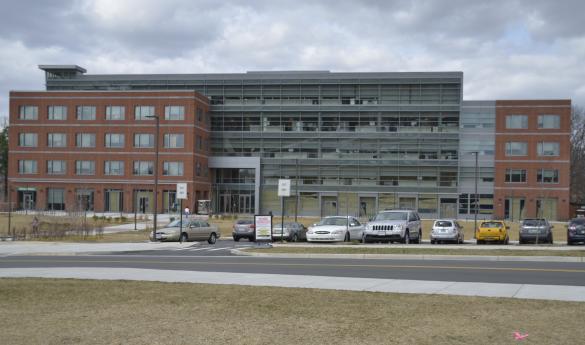
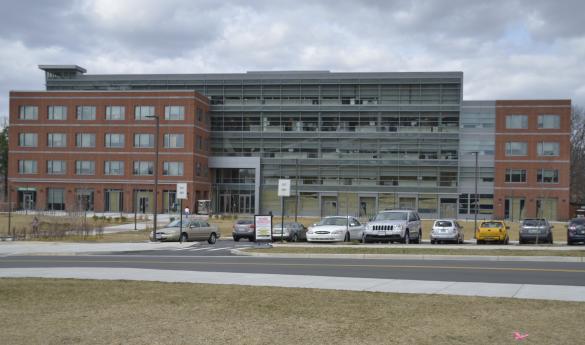
University Hall
Photo of University Hall, where the University precinct is located, taken one day following the election. (Jake McLernon)

Ron Paul won the new University precinct on Super Tuesday with a total of only 22 votes.

Mitt Romney, who was declared the state-wide Virginia winner on Wednesday, received 10 votes in the precinct in which registered on-campus students can cast their ballot. The two GOP rivals were the only candidates on the March 6 ballot.

The total of 32 ballots means roughly 3 percent of registered voters in the precinct participate in the Republican Primary. A total of 1,144 people had registered to vote in the precinct as of March 3, according to the State Board of Elections registrant counts.

“We’re very ecstatic about the results [of Paul winning],” said Sonia Jeffers, events coordinator for Mason’s Youth for Ron Paul group. “We can see how much his popularity and message has spread.”

Prior to Tuesday’s vote, Youth for Ron Paul helped organize advertising and carpooling to get students to Springfield, VA for the Feb. 29 Ron Paul “Leap Day” rally. The group also worked with Mason’s College Republicans to register voters on campus and set up a kiosk in Johnson Center to hand out pocket Constitutions and Ron Paul fact sheets, according to Jeffers.

But Jeffers was surprised by the overall turnout.

“Those numbers are shockingly low,” Jeffers said.

A lack of awareness of the University precinct among on-campus residents, according to some in the Mason community, could have been a factor.

Approximately 6,000 students live on-campus who would be eligible to vote at the precinct’s polling location in University Hall, as long as they are registered at their campus address. The rest of the university’s 33,320 students include a majority commuter population whose precincts would differ based on where they reside. Additionally, a portion of the campus’s residents, could have voted absentee and mailed in their ballot.

Jeffers, who said she hadn’t been politically active until her involvement with Youth for Ron Paul this year, didn’t know about the on-campus precinct until Election Day.

“I had no idea [the University precinct] existed,” said Jeffers. “I was surprised because I didn’t know there was a polling location on campus.”

Tuesday’s primary is the second time ballots have been cast in the University precinct. Established in summer 2011, the precinct was first functional for the Nov. 8 general election, where 76 ballots were cast.

A commuter student herself, Jeffers voted off-campus near her home and said she hoped that other students who didn’t vote on-campus had cast absentee ballots or voted at off-campus precincts. She said she also heard of at least four students who tried to vote at the University precinct but were unable to meet eligibility requirements.

Darren Kessler, a junior at Mason, said he didn’t vote on Tuesday at least In part because he couldn’t identify a candidate that he really liked.

“There’s not really a candidate that stands out that I like,” said Kessler. “[But the vote total] is kind of a crazy thing to hear.”

College of Health and Human Services Professor Naomi Gerber said she notices a big difference between students’ political engagement during this year’s election cycle versus 2008.

“Many [faculty members] have talked at the water cooler about the difference between now and four years ago,” said Gerber. “I walk around and I don’t see fliers or kiosks opening.”

In addition to a lack of student activity, no GOP candidate, in a field which also includes former Senator Rick Santorum and former House Speaker Newt Gingrich, has held a rally on campus since the election cycle began. Obama, the Democrat incumbent in November’s general election, last held a large event at Mason in the spring of 2010 addressing students on his health care initiative.

Although Jeffers said Paul’s rally in nearby Springfield drew great support —around 2,000 attendees according to reports—she hoped Paul would come to the Fairfax campus and speak at the Patriot Center where more students and community members might attend.

“We were trying really hard to get him to campus,” said Jeffers.

Former Massachusetts Governor Mitt Romney, who holds the most delegates in the GOP field, came to Fairfax in late October. His rally, less than a mile from Mason’s main campus, was held to support Virginia state legislators prior to the Nov. 8 general election.

Calling voter turnout at the University precinct “pathetic,” Gerber said she is concerned because she considers the issue of engagement an important one.

A Maryland resident, Gerber said she recently received an email from a Maryland campaign person who was attempting to gather Marylanders to help “stimulate” voter registration in Virginia. She said this might suggest that voting apathy is a statewide issue.

“It seems like Virginia has been identified as a place where a lot of people don’t vote,” said Gerber, who added that she would love to see campus enthusiasm return to where it was in 2008 when both Democratic candidates, Senator Hillary Clinton and then-Senator Barack Obama, came to Mason’s campus prior to the election.

“There was so much energy and enthusiasm,” Gerber said. “It was palpable.”

This article was originally published on 3/9/2012 on Connect2Mason, George Mason University’s student online news source. It is by Adam Sylvain, C2M Managing Editor. The photo is of University Hall and is by Jake McLernon.


Enhanced by Zemanta

Voting on campus at Mason

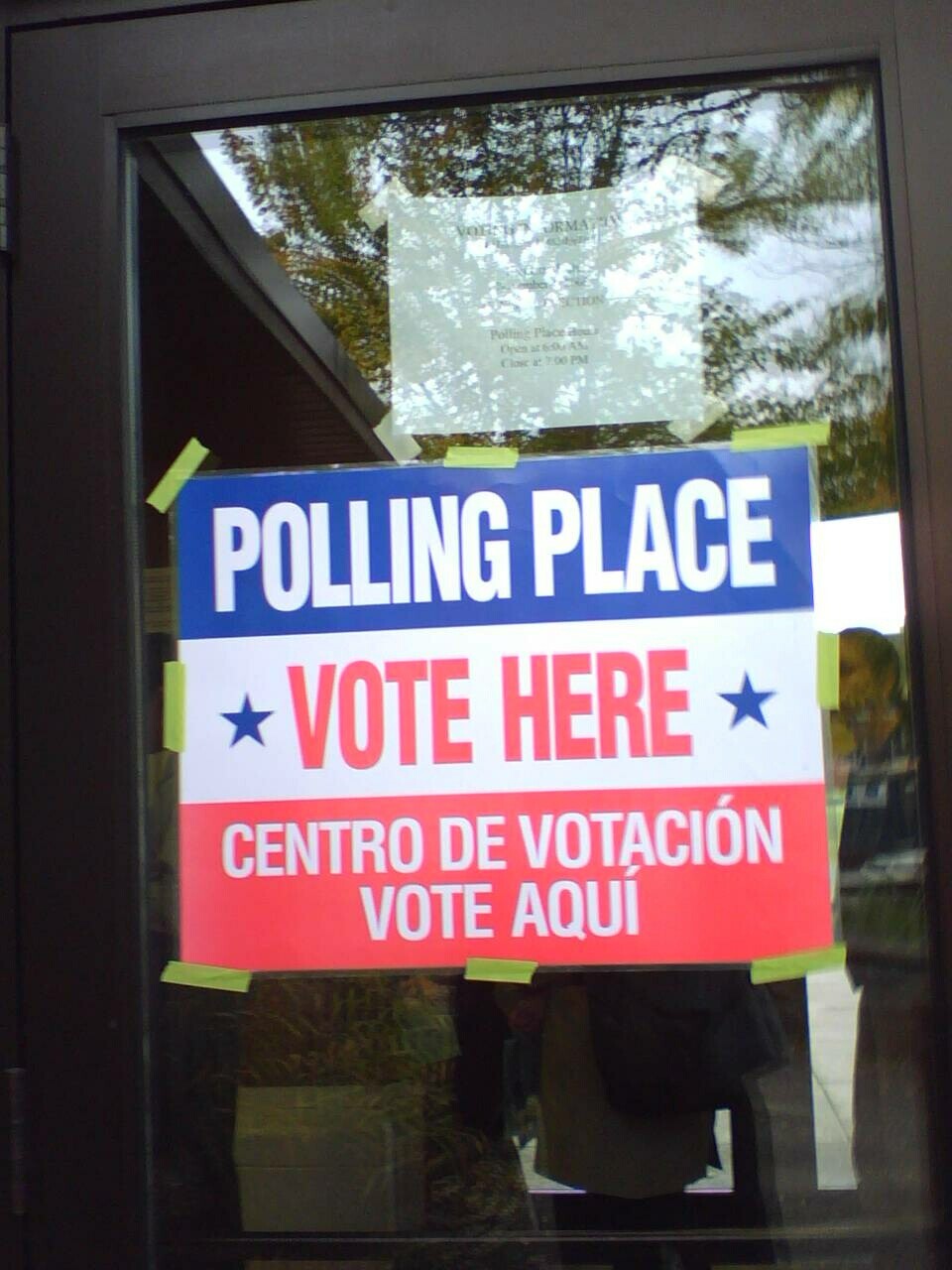
Election season is coming up fast. Voting will be easier than ever for George Mason students, who can now use an on-campus polling place.

Voting at George Mason is easy. If you need to register to vote or you are registered to vote in a different state or location, you can pick up a voter registration form at several locations around the George Mason University campuses. List your dorm/college address as your permanent address in order to vote at Mason’s on-campus polling site.

Photo courtesy of Mrs. Gemstone on flickr

The polling will happen in the new University Hall building. Polls will be open from 6:00 a.m. to 7:00 p.m.

Even if your registration included a photo ID, you should bring a government-issued photo ID to insure that the process goes smoothly. Your driver’s license or passport is preferred. If you do not have either you should bring your Mason ID and any other government-issued ID you might have.

Before going to vote, especially if it has been a while since you registered, you should check to make sure your registration is still valid. You can do so online through Virginia’s Election and Registration Information System.

Mason Student Runs for House of Delegates

By Mason Votes Writer Ethan Vaughan

Susan Conrad Susan Conrad, a master’s candidate at George Mason University studying for a degree in Instructional Technology, is running for the House of Delegates 40th District seat. She is campaigning on a transportation platform that would require raising gas taxes and automobile registration fees.

“It’s not going to be popular,” said Conrad, who recommended raising the gas tax by about five cents and the registration fee by five dollars. “But the longer we wait, the more it’ll cost. Fairfax roads only got one million dollars for road maintenance this year. People don’t want to pay to fix pot-holes, so they’ll wind up paying for a new car alignment. They don’t want to pay a gas tax, but they burn three dollars in gas a day sitting on Route 66.”

Conrad said that Northern Virginia needs expanded roads, and, ultimately, a much larger Metro system that goes “at least to Gainesville.”

“Those projects will take years to finish,” said Conrad. “In the meantime, there’s some other things we can do.”

Conrad proposed tax incentives for businesses to stagger their work hours, ensuring that “a portion of their workforce will not be on the road at certain times. That way, we can spread out use of the roads.”

Conrad said that a large part of the problem comes from Republican lawmakers in the House of Delegates who have taken from the wealthy communities in Northern Virginia without giving enough back.

“For every education dollar we sent to Richmond, we only get 25 cents back,” she said. “And the local economy has to make up the difference. Just over in Prince William County, they get 56 cents back. There all of these formulas they have down there, and none of the money is coming back to Fairfax.”

Conrad went on to say that a lack of funds affected the entire community, from university students coping with rising tuition to commuters facing long commutes, to businesses who find operating in the area difficult due to “overwhelming traffic.”

“We’re at a pivotal point,” stressed Conrad. “If we don’t allocate money to education, roads, and economic development, we’re going to be in trouble.”

Conrad made clear that she wasn’t advocating withholding funds from the rest of the Commonwealth.

“I definitely feel we have to help,” she stated. “I’m not saying we should get one dollar back for every dollar we give, because when we help other parts of the state we all benefit. However, there’s a disproportionate amount not coming back. Eighty percent of the state’s money is coming from here. If we don’t develop infrastructure here, the whole state is jeopardy.”

Students Respond to Obama’s Nobel Peace Prize