Mason Votes

Q&A with Dr. Jennifer Victor: 2022 Midterms

A Faculty Perspective on the Upcoming Elections

By: Alexis McCaffrey, Mason Votes Special Contributor
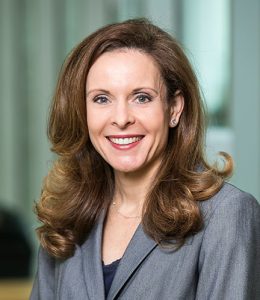
Dr. Jennifer Victor is an Associate Professor of Political Science from Mason’s Schar School of Policy. Photo by: Ron Aira/Creative Services

Dr. Jennifer Victor, an Associate Professor of Political Science from Mason’s Schar School of Policy and Government helped provide some insight into what this year’s election may look like. After 40-minute conversations with the professor, I was able better understand how her love for political science and election thoughts tie together.

Thoughts on Midterms & Voting

Q: What are your thoughts on the 2022 elections?

A: “The general wisdom is that in the lead-up to or in a midterm congressional election the party of the President will lose seats (usually). It’s seen as sort of a referendum on the President and people often are more motivated by being the “out party” or wanting to express criticism than when they are the party in power. Some of those sentiments contribute to the party of the President which typically is losing seats in the midterm election. President Biden’s popularity numbers have been on the low side so we expect this to be a pretty tough electoral year for Democrats. But the thing that is really interesting about the primaries is some of the surprise outcomes that Democrats have done quite a bit better than we might have expected otherwise. I am thinking particularly of the Kansas election which wasn’t technically a primary, but essentially what we so there was a whole bunch of Kansans voters who got extremely motivated to vote as a reaction to the Dobbs Supreme Court decision that overturned Roe v. Wade. It was an abortion measure on the ballot and a whole bunch of voters came out and voted to try to protect abortion rights. Kansas is a pretty conservative state so this actually ended up helping a bunch of Democratic candidates do better than they thought otherwise. We are seeing the backlash of the Dobbs decision play out in a number of elections. I expect this still be a stronger year for Republicans, [but] watching the primaries and special elections that have occurred this spring and summer suggest that there is reason to think that Democrats will do better than would have otherwise. It means more contests are going to be more competitive than they might have been otherwise.”

Q: What do you think about the phrase: “choice is on the ballot this fall”?

A: “What Democrats have learned is that abortion rights and the fragility of abortion rights can be motivators for voters. This is interesting because we don’t usually think of specific policy issues as being the thing or the thing that really motivates a lot of voters. It’s often a post-hoc narrative we tell about who won an election and why. Mostly those explanations are wrong and voters are usually motivated by much more complex coalition building through each party. The polling data suggests that there is pretty sizable amount of data depending on how you ask the question and where you are located but, a majority about 50% to 80% of Americans believe in abortion rights and some kind of access to medical care that includes abortion services. The Supreme Court decision and legal status across the United States has motivated a whole bunch of people to get activated on that issue in way they haven’t been because it hasn’t ever been situation like this since 1973 in variation of legality in abortion rights across states. That set back in abortion rights is potentially strong motivator for a lot of voters.”

Q: Do you encourage students to vote? 

A: “Absolutely. I do a lot of work with student voting. The 18-29 year old voting population is one of the most tenuous and they tend to vote at much lower rates than older folks. There is whole bunch of good reasons for that. College students in particular are interesting and very important population to encourage to vote. Some of the things we know with encourage voting are things like: if you voted in the past you are more likely to vote in the future, somebody asks you to vote your more likely to vote, any way in which the barriers to voting are lower they are more likely to vote, when you feel really embedded and deeply connected to your community you are more likely to vote. All of those are things that are often not true for college students. Like you may have never voted before because you just turned 18 or maybe nobody has campaigned to you and asked you to vote or maybe you just moved and you don’t even know how to vote or register or how to verify that your registered and because you perhaps just moved to college your not deeply embedded in a community you just moved to community where everyone was a stranger just a few months ago. It’s a population that sorta of statistical shouldn’t vote since they don’t have the characteristics that make people more likely to vote, but we also know people’s habits about voting get established when they are young. So if we can encourage voting in the younger population and help people to develop that sense of priority or habit with voting. It’s likely to be habit that will last their entire lifetime.”

Academic Background

Q: How did you get into your line of work?

A:  “When I was in college I was pretty sure I wanted to go to law school because I was very interested in politics and government. I wanted to be a professional and do something that I thought would impact the world in some way and I thought law school was the way to do that. I was kinda on that track and I took LSAT classes and worked for a lawyer one summer. I selected activities that I thought were aiming me toward that career. I didn’t like it that much and the lawyer I worked for wasn’t a great experience and I didn’t find it very rewarding. Around the same time (summer between junior/senior year) I got an offer to work as a research assistant for a political science professor (Matt McCubbins) and I started doing more academic political science-type stuff. It hadn’t really occurred to me to pursue academia rather than law school as a secondary educational path after college. But that particular professor his name was Matt McCubbins, actually passed away earlier this year, big time political scientist in the study of congress. He was very encouraging of my research skills and pushed me towards grad school so in the end, I decided to go apply to Ph.D. programs instead of law schools (senior year). I was accepted to a number of places, I ended up going to Washington University in Saint Louis. I went straight from undergrad into a Ph.D. program. They gave me a great financial package, and usually, when you go do a Ph.D. in social sciences it is all funded. They will pay your tuition and give you a small stipend to do graduate studies. So I did that at WASHU and it took me about 6 years to finish all my education there and I ended up with a Master’s Degree and Ph.D. At the end of all that is to help prepare you to look for a job as professor and they support you going on the job market which can be absolutely brutal. I happened to be in the market for the first time in 2003 which at the time in political science was a pretty decent job market. I had really good support at WASHU and experiences that allowed me to get a bunch of job interviews. My first job was at the University of Pittsburg where I became an assistant professor of political science. I moved over to Mason in 2012.”

Personal Life

Q: What are your passions in life? 

A: “I am pretty passionate about politics. When I was younger I think I was more intrigued by politics as a sport and back in the 1990s and early 2000s politics seemed more like a sport for fun. It didn’t seem that serious and I don’t mean to belittle it. I found it to be stimulating and entertaining and consequential, but not existential. I always saw politics and government as a way that humans can make a difference in the world and change their society or try to make improvements for people who live around them as a way to contribute to the world or solve problems people face. I had always been fascinated with the limits and challenges of using political systems to achieve those types of goals. Which I think is what feeds my interest in the study of politics. As the US got more into the 20teens and Trump-era the whole study of politics changed a lot because my era of focus is on American politics. I think if I studied different parts of the world my perspective on this would have been different. But because my focus has been on American politics watching some of the massive democratic backslidings that the United States has experienced in the last five to six years and even 10 years depending on where you want to start. It has been jarring and upsetting and very disturbing at times it makes this job that I do much more serious and important and consequential for the future of the government of the country than I think it would be when I first got into it. Following all of that and being passionate about understanding democratic governments, how to defend it, the things that happen that weaken it, and being able to explain the various puzzling phenomenon in American politics. I think I feel a pretty strong sense of purpose in helping students understand the frailties and challenges in self-governance in the United States and working to help people come to improved decisions on how to make the world better. I do other things along the line of that like volunteer work for non-profits that are in good governance reform space. I enjoy that kind of work. I also have a family and we enjoy traveling. I grew up in Southern California and my husband’s family is from the Midwest so we travel to visit family, we enjoy international travel and have been to a bunch of places around the world. With COVID it has happened as much lately, but I really enjoy the experience of being in another place and experiencing another culture and learning the language and trying all the food. I am also a runner and practice yoga things like that keep me sane and healthy.”

Q: Favorite book? Or recommendations?

A: “I don’t think I have a favorite book. If you have been to my office you know that it has way too many books in it. I’m always surrounded by books with whatever I am working on or reading about. It’s pretty hard for me to pick one book that’s really impactful. I would say it sort of changes from year to year, different things that I read help me reshape the way that I think about the world, politics, or things that are important. Two books that I will mention have really influenced the way I think about things lately. One is called “Democracy for Realists” which is a political science book and its just sort of a philosophical way of thinking about what Democracy is and what it isn’t and as a system of government the limits that it can have. It has profoundly affected the way that I understand democracies and what I think they can and can’t do. It has affected the way that I write about and teach about it in the last five years or so. Another book that I find my mind returning to a lot in different things that I write about or talk about with students or teach, is a book called “The Sum of Us”. She is a kind of scholar, not a traditional one but she has done a lot of writing that is adjacent to scholarship and has a lot of the same qualities as scholarship. The book is about the collective costs of systemic racism and she focuses on the United States and she focuses on the aspects of black history in the United States. Her point that I think is so compelling and so important is that at all of these various instances in US history when the United States has experienced or regions in the United States have experienced extreme racism or discrimination or patterns where a community has really subjected a whole population it comes at the whole cost of the whole society, not just the cost of the population being subjected. So the idea of it is that the systemic racism that we have sorta embedded in US institutions and US history is not just affecting the populations that are targeted, but it actually profoundly sorta affects the whole population and the idea that people are willing to give up public goods in order to benefit the whole society or prevent some sub-populations from not gaining access to those public goods is an important realization people need to understand about US policymaking.”

Q: Favorite spot on campus?

A: “I would say it sorta depends on my mood, but I think I really like the spot near the benches between Horizon Hall and the Library in the quad area that is there. It’s just sorta a nice intersection of a bunch of different paths from different parts of campus and there’s often stuff going on in the lawn, different groups of students doing different things. The benches that are decorated by different student organizations or people will set up tables along that big walkway to promote whatever it is they are working on. The community that happens in that space is something that I appreciate even if I am just sorta walking through it.”

Advice for Students

Q: What is the best advice (in general) you can give to students pursuing their degrees (undergraduate and graduate)? 

A: “One of them sounds very simple, but I think it’s actually quite hard for a lot of us to do and that is to simply read. We all live very fast-paced lives and constantly have things going on electronically that our demanding our attention. Competing for our attention and it can be really hard to turn that off and to find a quiet place and sit down with a book or an article. A lot of the reading a lot of us tend to do these days is “scroll reading” or short bits (headlines, blurbs, so forth). The struggle to turn that stimulus off and invest in the deeper concentration you get from reading a book or chapter can’t be replaced. It allows us to access parts of our brain and intelligence we can’t access without getting into that deep concentration space. It can be hard to find the time and personal commitment to giving ourselves permission into that sort of solitary place of concentration. It’s important for learning, teaching, or just expanding our brains and the way we think about almost anything in the world. The second thing I would say is don’t play it safe and get outside of your comfort zone. I think a lot of us come into scholarly or academic settings with a fair number of assumptions about how things are gonna work or what we are going to be exposed to or what we are good at or what we think we are going to like. Those assumptions create an incredible amount of barriers around what we are willing to try, expose ourselves to, or even learn about. I think students who hated math or hated it in high school can take statistics courses or logics courses or coding courses that turns out they like and with some effort can be good at it. Just making the commitment to do something that you thought wasn’t for you is good and takes courage. That courageousness feds creativity and leads to some of the best scholarly work people can do.”

_____________________________________________________________

Photo by: Ron Aira/Creative Services
VA Voter Registration Deadline is Monday, Oct. 17th!

Don’t Forget to Register or Verify:
elections.virginia.gov/registration

If you have already registered in Virginia:

Check your registration and confirm that you are registered at your current address, find your polling location, or update your registration online at elections.virginia.gov before Oct. 17, 2022.

If you need to register in Virginia:

Qualifications for voter registration: US Citizen, resident of Virginia, and 18 years old on or before November 8, 2022 (born on or before November 8, 2004).

Voter Registration Deadline: Tuesday, October 17, 2022 is the deadline to register to vote or update an existing registration. Learn more: elections.virginia.gov/registration

Online: You may submit your registration and absentee ballot requests online only, if you have a Virginia DMV record:

  • If you have a Virginia driver’s license, you can register online. Go to: elections.virginia.gov and use the secured citizen’s portal. It takes about 2 minutes to register online, you will need your Virginia driver’s license number. The last day to register or update your registration to be eligible to vote in the Nov. 8 General Election is Oct. 17 postmarked by mail or in person by 5:00 p.m., or online by 11:59 p.m.
  • If you don’t have a Virginia driver’s license, go to elections.virginia.gov to fill in the registration form, print it, sign it, and send it to the Department of Elections by mail. Your registration form must be postmarked by Oct.17, 2022.

Students living on the Mason’s Fairfax campus: You may register to vote from your campus address (see instructions below). You will need to change this voting address when you move.

IMPORTANT NOTE for on-campus student voters in Fairfax:

ONLY students registered at their current Fairfax campus address may vote at the University Precinct located in Merten Hall on Election Day.

All other Mason students and faculty must vote at their registered home precincts, either inside the county, within the Commonwealth or your home state.

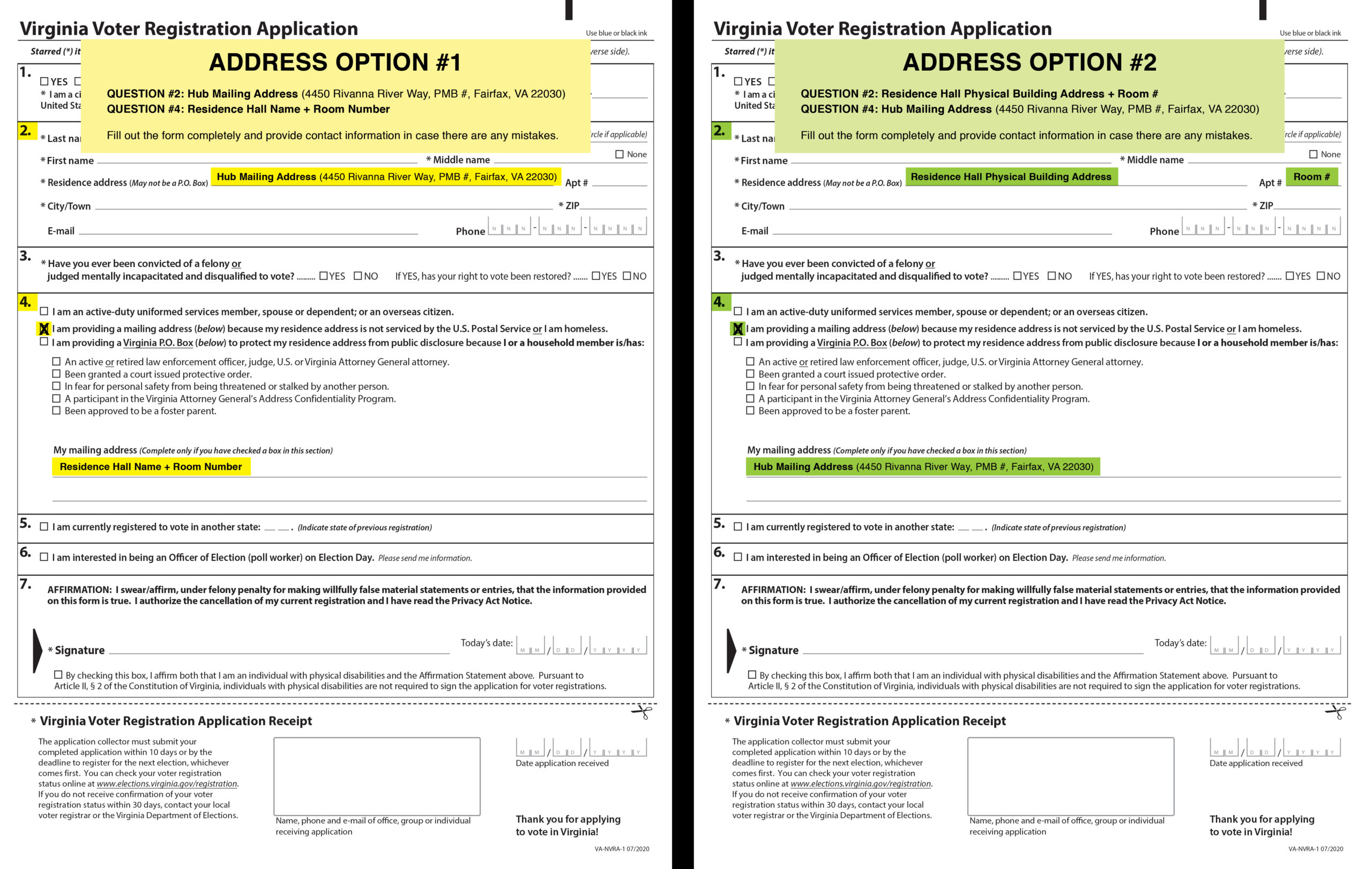
On-campus resident addresses on voter registration applications for Mason students can be provided in two ways (both are correct):

  • ADDRESS OPTION #1: Provide the Hub mailing address (4450 Rivanna River Way, PMB #, Fairfax, VA 22030) as the address for Question #2 on the voter registration application, AND provide your current residence hall name and room number under Question #4 on the voter registration application.
  • ADDRESS OPTION #2: Provide your current residence hall’s physical building address for Question #2 on the voter registration application, AND provide the Hub mailing address (4450 Rivanna River Way, PMB #, Fairfax, VA 22030) as the mailing address under Question #4 on the voter registration application.

Don’t know the physical address of your residence hall? Click here to find it on the list >

Click here to view examples of Address Option #1 & Address Option #2 >


Mason Student Running for Fairfax City Council

Billy Bates Wants Your Vote (and to Get an “A” in Physics)

By: Gabriel Yossick, Mason Votes 2022 Online Editorial Team
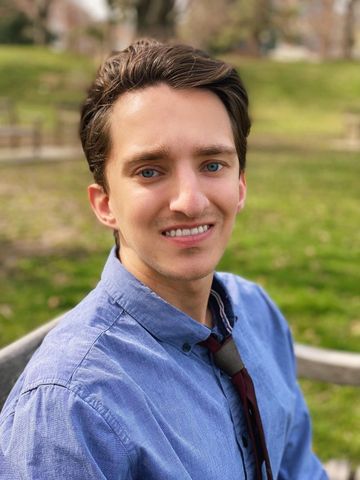
Billy Bates, a Mason senior majoring in physics, is currently running for Fairfax City Council. Photo courtesy of: Kathy Hackshaw

Billy Bates, a Mason senior majoring in physics, is currently running for Fairfax City Council. His platform consists of progressive policies that include denser zoning, greener development, alternatives to driving, and numerous other policies which can be found on his website: www.batesforfairfax.com.

He first got involved in the political process because of Fairfax High School’s mascot. 

“In freshman year of high school, I was trying to get the team named changed, which was Fairfax Rebels, named after the Confederates,” Bates said.

Old street names, too, were problematic remnants of the Civil War. Both issues would ultimately be solved years later, but working on them served as a catalyst for Billy, a gateway to other issues that were locally and nationally relevant.

His first political internship was with the 2020 Elizabeth Warren primary campaign. He then went on an internship blitz including Representative Gerry Connolly’s (D-VA 11) campaign, Delegate Alfonso Lopez’s (D-VA 49) campaign and office, and Terry McAulliffe’s (D-VA) gubernatorial campaign, along with various other internships relating to Democratic campaigns.

Bates has also had just as much local political involvement. He served as Fairfax High School’s student liaison on the Environmental Sustainability Committee from 2020-2021, he is an active member of the Fairfax City Democratic Committee and played an active role in the Fairfax City Citizens for Smarter Growth, a group self-described on their website as supportive of higher density mixed-use zoning, bicycle-friendly development, and financially sound policy. He helped design their current logo and helped run their newsletter.

Surely with the number of internships and work opportunities Billy has he must have a secret? Nope, getting started working with campaigns and political groups is as easy as sending an email.

“It’s a lot easier than what you might think, just reach out to the campaign, ask about volunteer opportunities or internship opportunities, with the large campaigns would have interns like the state and national campaigns, like the Connolly and Lopez campaigns,” said Bates. “I’d say, reaching out to people and talking to people takes a lot of practice, and definitely did not come as natural to me as it does now.”

Physics often serves as an escape from politics, and vice versa for Bates.

“I wouldn’t be as productive in either apart, as I am in each of them together. Doing campaign stuff sort of helps, sort of like a palate cleanser, a chaser,” said Bates.

Time management makes this all doable for Billy. After all, he runs the campaign nearly all by himself. He certainly is not a master yet, he would be the first to swear by that. But he is improving, thanks to his classes.

“I definitely say it just takes practice and putting in effort to try and get better and better at it,” says Billy.

Dana Moskowitz is a Mason alumn, Instrument Technician and Surgical Assistant at a local Oral Surgery Clinic and is a fitness instructor for Taekwondo, HardCore and Cycle Express got to know Billy this past year as his instructor for indoor cycling. Moskowitz noticed Bates rapid improvement in his ability, and quickly got to know him personally.

“He’s been able to try new things and pick up on them quickly,” said Moskowitz. “I look forward to seeing what he does in the future.”

Catherine Read, a longtime resident of the city, George Mason Alumni, and current candidate for the Fairfax mayoral seat got to know Billy through his active participation in the community and saw firsthand his passion for serving the city.

“He has probably knocked more doors in this city than any other candidate,” said Read. “He is committed, disciplined, he knocks on the doors, he has conversations about things he cares about.”

Read, who has funded many candidates, such as local candidates like Delegate Danica Roem (D-VA.13) and Ryan Mcelveen for Fairfax County School Board, served as Bates’ first donor. Read herself has served on the council before, so she is aware what the caliber of candidate needed for the job.

“He is wicked smart. He can tell you whatever you want to know about the city,” said Read.

Bates explains his platform and positions to community members at a campaign kick-off event in Fairfax City. Photo courtesy of: Kathy Hackshaw

It was at Read’s house that Bates’ campaign kick-off took place. Core members of the city Democratic committee, neighbors and other community members got to get to know Bates and his platform for the first time. One of the issues that really stuck with the attendees, was Bates’ knowledge of the Fairfax City Stormwater Utility (SWU) fee.

Commercial properties, with their vast parking lots, create a vast amount of impermeable surface. This means a lot of stormwater is built up, and without the proper infrastructure, can cause serious damage to a community. Previously the cost for maintaining and repairing this infrastructure came out of property taxes, which meant homeowners disproportionally paid for something they did not contribute to. However, recently the city changed the funding so that SWU redistributes the costs back to commercial properties. The lack of messaging from the city, though, has created a game of political football. Bates, as someone involved with the environmental policies within the city, knows full well the importance of the SWU, especially with the inflammatory rhetoric surrounding the issue.

“People walked away impressed that Billy could take away a complex concept and put it into language everybody could understand,” said Read.

“The fact of the matter is the stormwater utility fee is merely a redistribution of existing means of revenue collection,” said Bates.

Billy also serves as an interesting bridge between Fairfax City and George Mason. The two communities are fairly segmented off from each other, with little crossover between each community’s events.

“You would wonder how one of the largest universities in Virginia could be at the end of university drive and yet you don’t see anybody,” said Read.

Read believes Bates can serve as an ambassador to both communities and possibly start a greater bridging of both communities. Read herself, if elected, would be the first Mason alumn to serve as Fairfax City mayor.

_____________________________________________________________

Photos courtesy of: Kathy Hackshaw/Billy Bates

Inflation a Top Concern for Republicans, Independents

Higher Gas Prices Could Impact Midterm Preferences

By: Jacob Pritchard, Mason Votes 2022 Online Editorial Team

Energy inflation has acutely affected the Northern Virginia area, including the main campus of George Mason in Fairfax. Energy inflation means the price of energy is rising more sharply than usual. Currently, transportation costs such as gasoline purchases account for 28 percent of energy consumption. Energy prices rising affect commuting prices, and general spending on vehicle fuel and other forms of energy.

Fairfax County has been consistently above the national average in terms of gas prices. The Virginia State gas price average is 3.33 dollars, while Fairfax’s prices stand at a higher 3.69 dollars, according to AAA. At one point this summer, Fairfax County had the highest gas prices in all of Virginia.

College students are impacted particularly hard by rising energy prices. 20-24 year olds typically earn an average weekly income of 633 dollars, while 25-34 year olds earn an average income of 928 dollars. Due to having less income, younger citizens often spend a greater proportion of their money on fuel than someone older than them would.

Tyler Mandell is a George Mason University sophomore studying communications:

“Rising gas prices definitely impacted those who are less well-off,” Mandell said. “Prices have also made my mother discouraged about me driving even short distances. It has certainly made people more critical of the government, for example with Republicans becoming more critical of the Biden Administration.”

According to an NPR poll published last month, inflation is the biggest single issue driving voters. For 40 percent of Republican voters and 37 percent of Independent voters, inflation is the top issue influencing voting choices for this election cycle. However, this sentiment is shared by just 13 percent of Democrats, who rank abortion rights, healthcare, and the January sixth hearing higher.   

Professor Cesar Martinelli works in the George Mason Economics Department with focus on Economic Theory and Political Economy:

“There has been a lot of spending associated with the COVID crisis, throughout the current and previous administration,” Martinelli said. “This has implications for the level of [energy prices]. There have been some international causes on the relative price of causes, related to supply chain problems caused by the COVID crisis and the war in Ukraine. There are accusations that price gouging is creating inflation, which has created shortages, which happen when the price mechanism is not allowed to work.”  

Multiple sources including the U.N. describe the global economic effects of the war in Ukraine. Becauses attacks by Russia have left Ukraine unable to export substantial food and energy resources the way they usually do, supply has gone down, and prices have gone up.

During midterm elections, the incumbent president’s party is often viewed negatively by voters. Incumbent parties often end up losing seats in Congress, especially true during times of economic turmoil. 

There was an energy crisis during Carter’s Administration, where a fuel embargo from Middle Eastern nations ultimately caused the price of oil to rise from $3 to $12 per barrel. In 1978, Incumbent President Jimmy Carter’s Democratic Party lost 15 seats in the House of Representatives. Two years later, Carter went on to lose to Ronald Reagan by a margin of 9.7%, including a 12.7% margin in Virginia.

“We attribute too much to the administration, but it is a constant that bad economic conditions lead people away from the incumbent,” Martinelli said. “This may affect the prospects of Democratic candidates. [However], this is a super polarized electorate, so the effect may be negligible.”

Interview with Senator Tim Kaine

Virginia Senator Visits Mason Square

By: Brad Byrne, Fourth Estate Editor-in-Chief and Taylor Ramirez, Opinion Editor

This story was originally published on gmufourthestate.com. Fourth Estate is Mason’s official student-run newspaper.

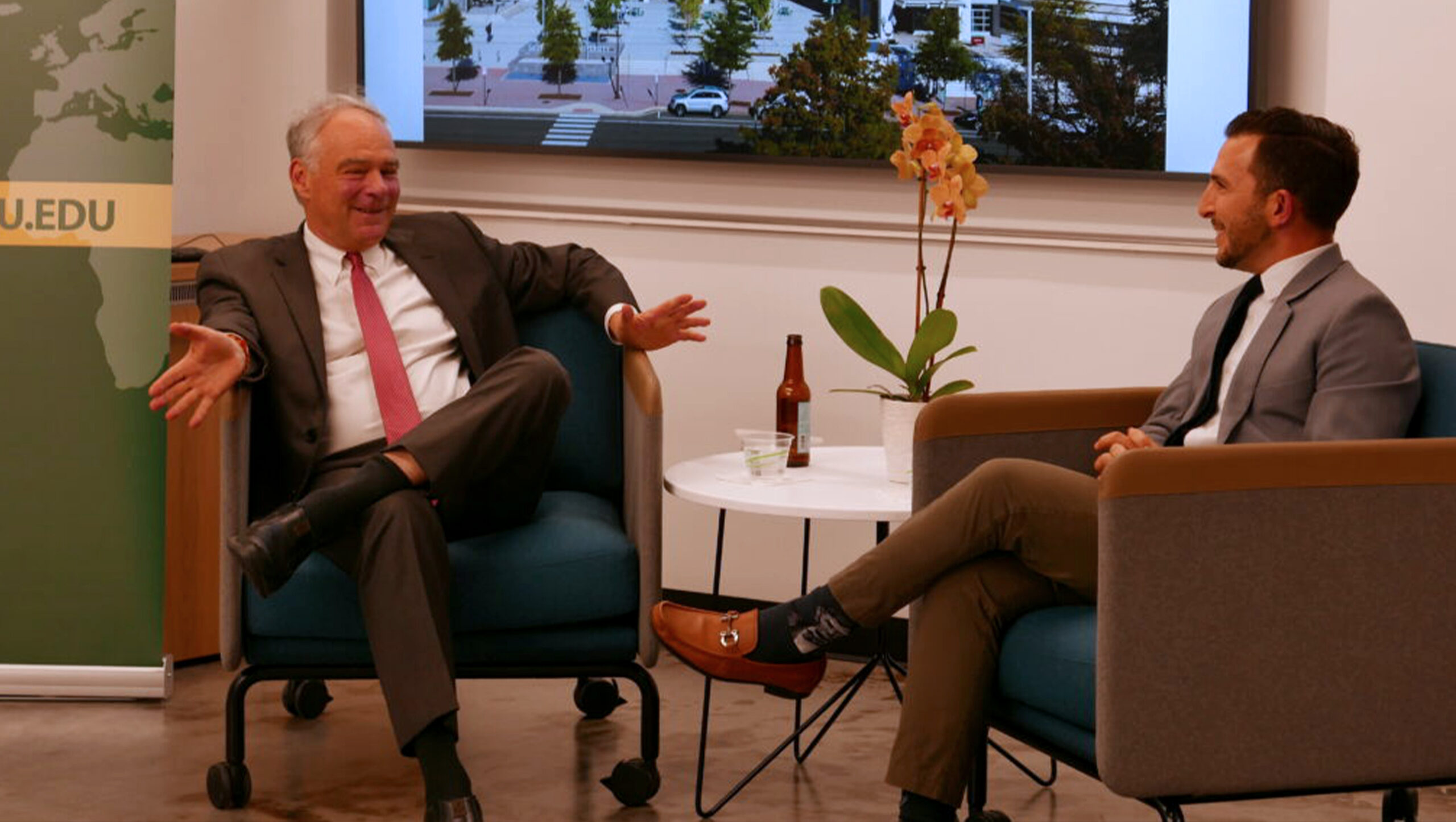
VA Senator Tim Kaine speaks at Mason’s Schar School in Arlington on September 12, 2022. Image by: Taylor Ramirez/Fourth Estate

The Schar School of Policy and Government hosted Sen. Tim Kaine as its special guest for an information session for current prospective Master of Public Policy students. The MPP Bistro is a recurring event hosted at Mason Square by Justin Gest, Associate Professor and Director of the Masters in Public Policy Program at Mason.

Gest and Sen. Kaine had an informal Q&A that covered topics like Schar School graduates working on Sen. Kaine’s staff and how the Biden administration was able to get legislation passed in Congress.

Sen. Kaine stated that the Biden administration has prioritized passing “simple bills”, like The Inflation Reduction Act of 2022, which includes measures like lessening inflation and tackling climate change, over “everything but the kitchen in the sink” bills to be passed and make Congress work. 

When asked to elaborate on how Congress can continue to work with the threat of Republicans gaining control, Sen. Kaine hopes to keep Democrats in control by helping where he can. “I’m really focused on two things in the midterms. One, I can’t focus on every state’s House Representatives, with the Virginians I can. And there are three Democratic congresswomen that are really running good races, I know them very well and I’m doing all I can to help, but I’m not on the ballot this cycle. I am doing things to help Senate colleagues around the country…We’ve seen the progress that we’ve been able to get in the last two years, and we can get a lot more. But if we were to lose the House or the other, it would be very tough.”

With National Voters’ Registration Day coming up on Sept. 20, Sen. Kaine stressed the importance of college students voting in the upcoming midterm, “It’s really important and I think events of the last couple of months have really shown what’s at stake. President Biden did student loan forgiveness, which is a really significant thing. He did that, Democrats supported it, the other side didn’t, they don’t want to do that.” 

“There are issues on the table right now that affect students, President Biden has responded well to my urging that he dramatically increase the public service loan forgiveness program.”

Sen. Kaine noted the passion of young people in the United States, “Young people are the most passionate in our country about climate issues, [like] The Inflation Reduction Act [of 2022] we just did, which is going to accelerate historic clean energy.”

Sen. Kaine has cosponsored Sen. Tina Smith’s Emergency Grant Aid for College Students Act along with Sen. Amy Klobuchar and Sen. Robert Casey. The bill aims to provide aid to college students who encounter a financial emergency that impedes their ability to stay enrolled.

“I think we learned during COVID the way traditional student loans work,” said Sen. Kaine. “You fill out the FAFSA and it’s a big complicated thing, you [fill out] what the family income is and then you get an award for the year. But it doesn’t take into account if circumstances change, in the middle of the year, a parent could lose a job, or a parent could get ill, a parent could pass away. There could be some other catastrophe and that’s not really how we set up student financial aid to work.”

“We realized that emergencies don’t just happen during pandemics, they happen all the time. So I hope we might be able to find, particularly in a budget bill at year-end, the ability to do that.”

Constitution Day 2022

Mason’s Constitution Day 2022 event is Friday, September 16, 2022: RSVP via Mason360

Each year, Americans celebrate the signing of the U.S. Constitution by the founders on September 17, 1787.

Learn more about the Constitution: studentmedia.gmu.edu/constitutionday

___________________

Constitution Day Event Info:

Date: Friday, September 16, 2022

Time/Location: 12-2pm in The Hub 1201 (lower level)

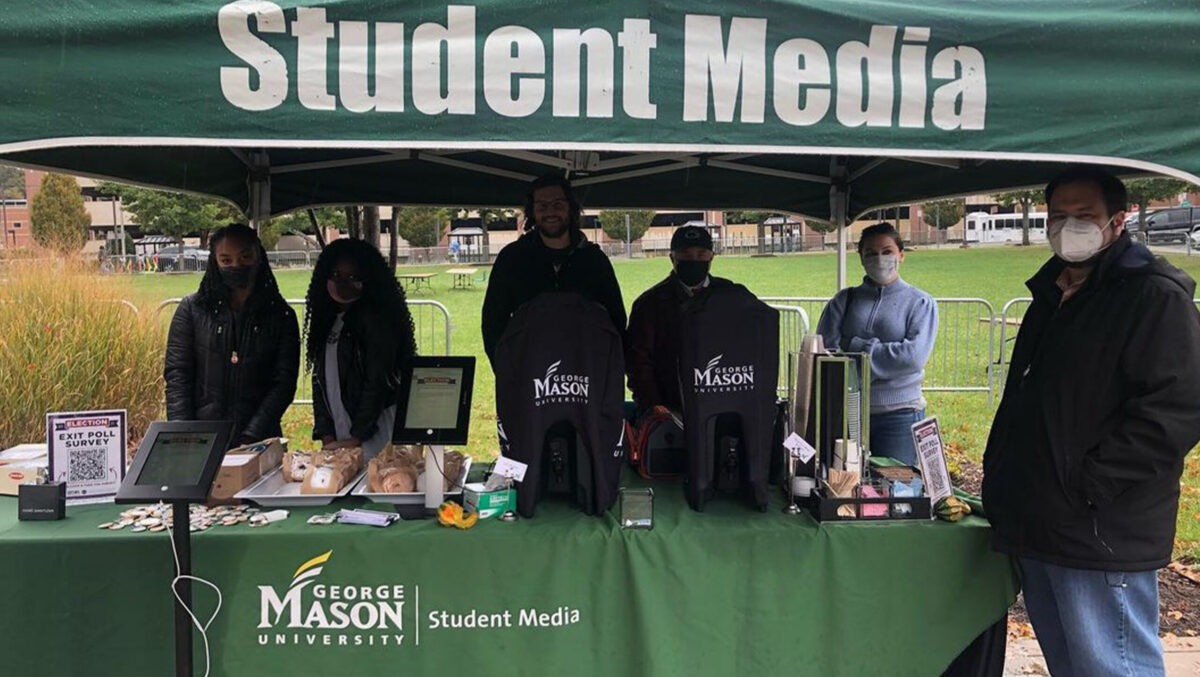
Host: Student Media

RSVP via Mason360: cglink.me/2d7/r1675409

Event Description: Join Student Media as we help the Mason community celebrate the signing of the U.S. Constitution by our founders on September 17, 1787. This annual event features free food, giveaways, games and trivia, and the chance to meet our student leaders and learn more about our student-run media groups!

Check out the Constitution Day resource page to learn more and watch a video of Mason students, faculty, and staff sharing what “We the People…” means to them: https://studentmedia.gmu.edu/constitutionday/

National Voter Registration Day 2022

#NationalVoterRegistrationDay is Tuesday, September 20, 2022!

Are you registered?

Monday, October 17, 2022 is the deadline to register to vote or update an existing registration in Virginia. Learn more: elections.virginia.gov/registration

There’s no time like NOW to make sure you are registered to vote or to update your voter registration with your current address. Visit vote.gov to find out how.

According to U.S. Census data from 2020, as many as 1 in 4 eligible Americans are not registered to vote. Every year millions of Americans find themselves unable to vote because they miss a registration deadline, don’t update their registration, or aren’t sure how to register. National Voter Registration Day wants to make sure everyone has the opportunity to vote.”

Virginia residents can learn more and register via elections.virginia.gov/registration

Non-Virginia residents can find guidelines for their state via usa.gov/election-office

2022 qualifications for voter registration in Virginia:

  • Be a resident of Virginia (a person who has come to Virginia for temporary purposes and intends to return to another state is not considered a resident for voting purposes).
  • Be a U.S. Citizen.
  • Be 18 years old (any person who is 17 years old and will be eighteen years of age at the next general election shall be permitted to register in advance and also vote in any intervening primary or special election).
  • Not be registered and plan to vote in another state.
  • Not currently declared mentally incompetent by a court of law.
  • If convicted of a felony, your right to vote must have been restored.

Learn more about 2022 election deadlines: https://www.elections.virginia.gov/casting-a-ballot/calendars-schedules/upcoming-elections.html

More info about #NVRD from nationalvoterregistrationday.org: National Voter Registration Day is a nonpartisan civic holiday celebrating our democracy. First observed in 2012, it has quickly gained momentum ever since. Nearly 4.7 million voters have registered to vote on the holiday to date. Celebrated every September, National Voter Registration Day seeks to create broad awareness of voter registration opportunities to reach tens of thousands of voters who may not register otherwise. The holiday has been endorsed by the National Association of Secretaries of State (NASS), the National Association of State Election Directors (NASED), the U.S. Election Assistance Commission (EAC), and the National Association of Election Officials (The Election Center).

#MasonVotes #VOTE #NationalVoterRegistrationDay

Now Recruiting: 2022 Mason Votes Online Editorial Team

Scan the code above to apply by September 12th!

Are you a journalist or writer interested in politics, policy, and civic engagement?

Student Media is currently recruiting student journalists to serve on the Mason Votes Online Editorial Team and cover the 2022 midterm elections.

Training will be provided and students will receive a $500 scholarship for their participation if selected.

APPLY NOW: bit.ly/MasonVotesF22

DEADLINE: Monday, September 12th @ 10pm

Questions? Email [email protected]

___________________

2022 Online Editorial Team Scholarship Flyer:


How Did Mason Vote in 2021?

381 Mason Students Voted at Merten Hall on Election Day

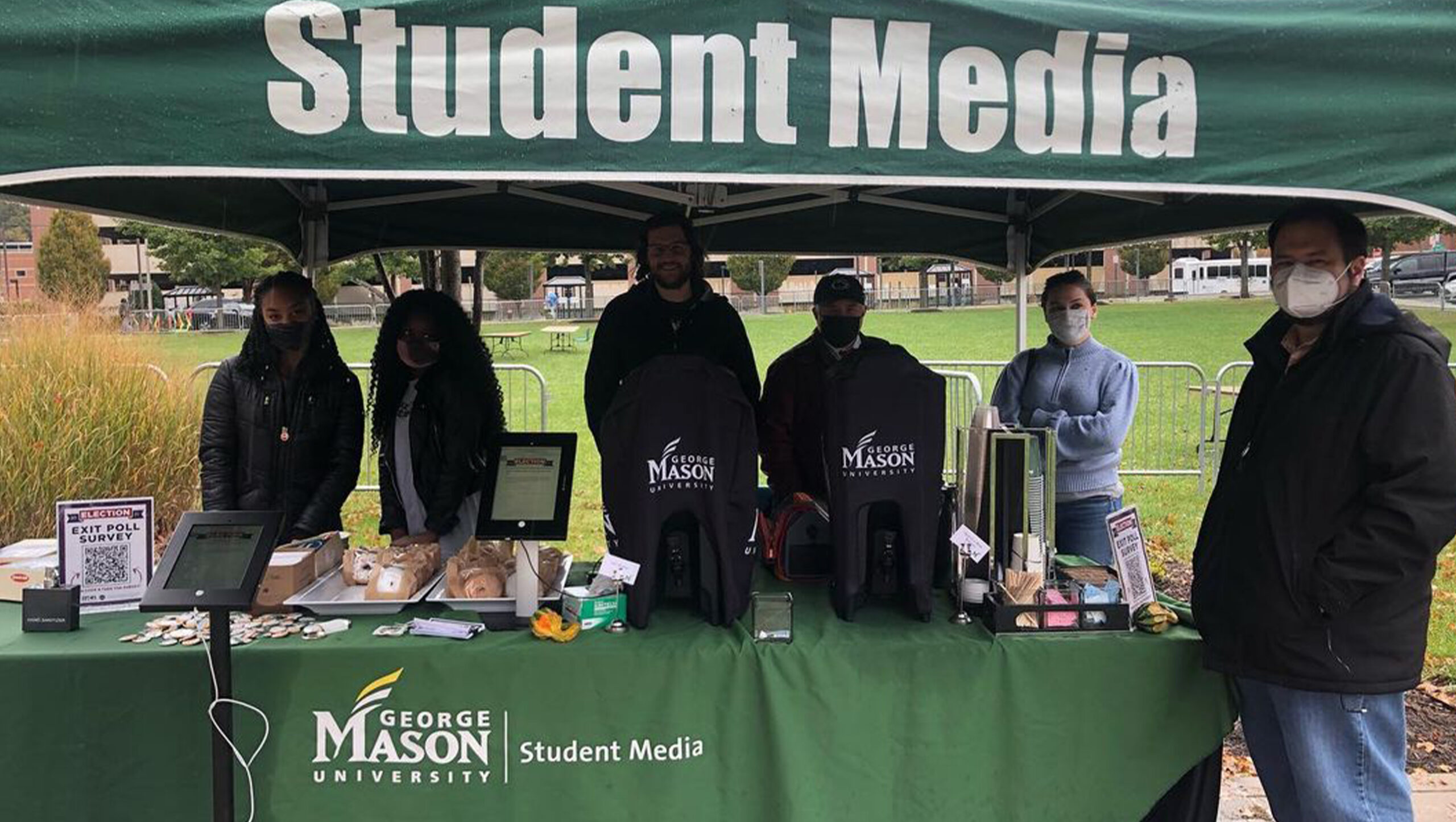
Students conduct voter exit surveys outside Merten Hall on Tuesday, November 2nd. Photo by: David Carroll/MCN

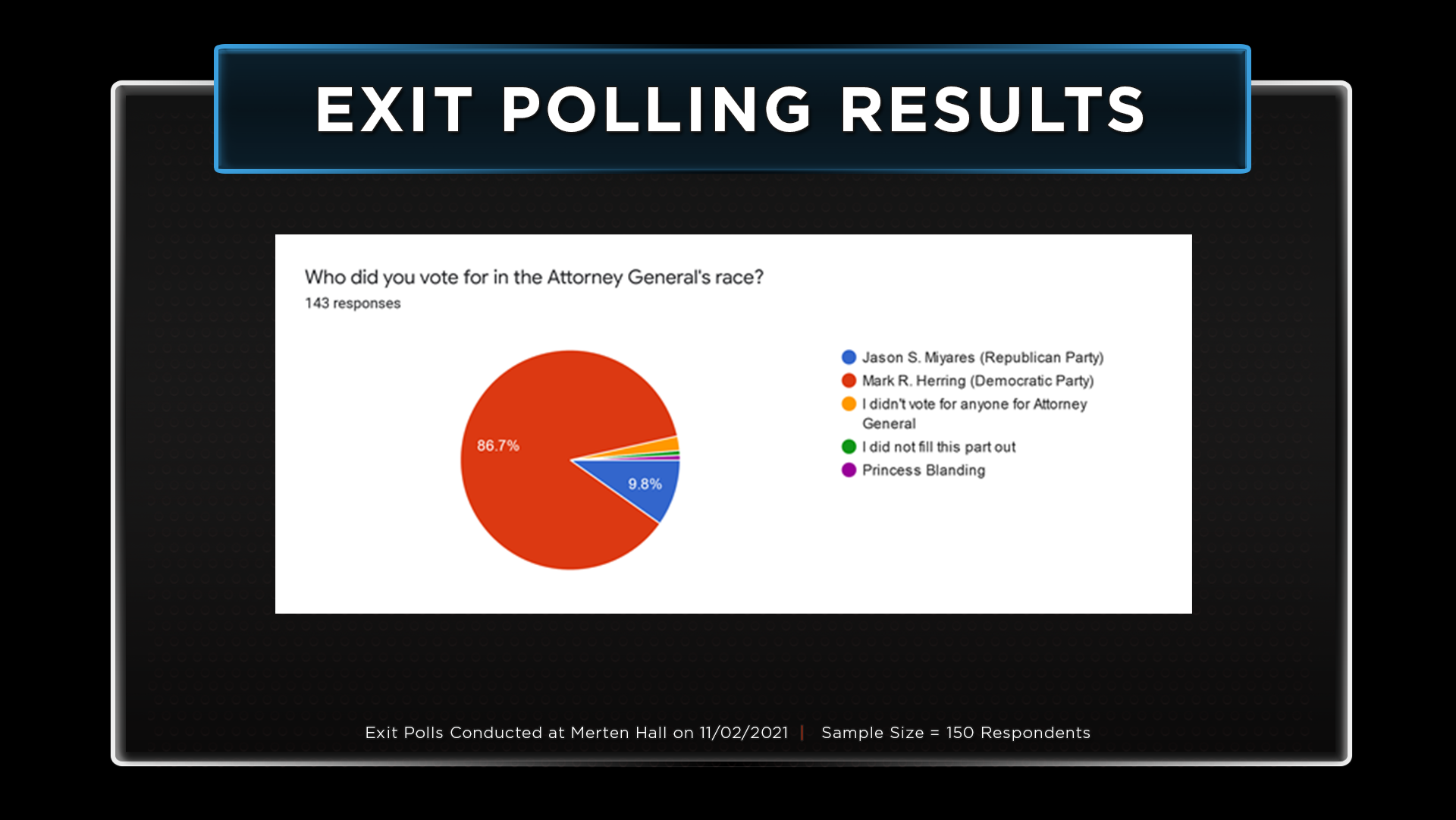
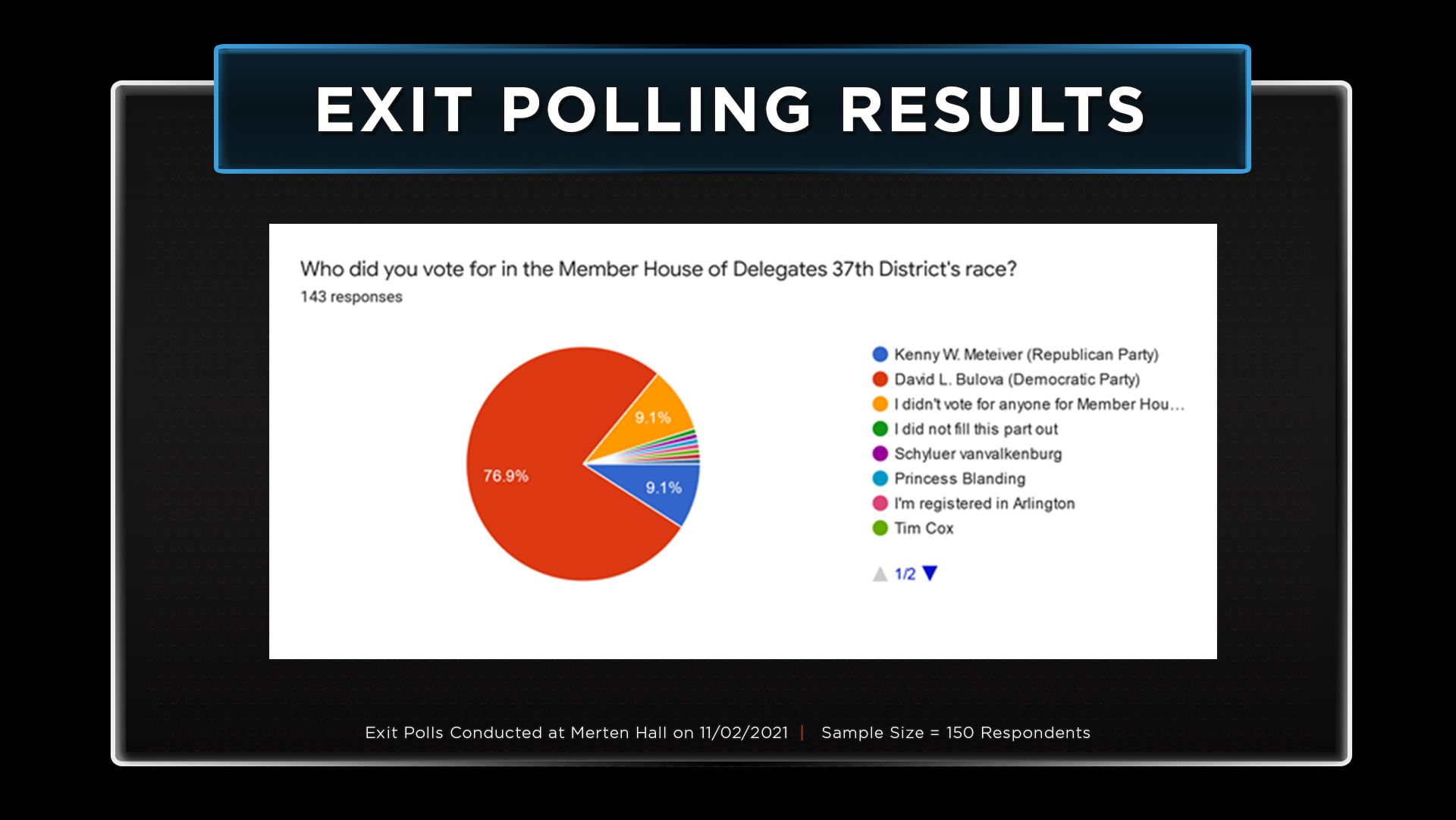
Student Media, Mason Cable Network, and Mason Votes conducted exit polling outside Merten Hall on November 2nd to learn more about what issues and candidates were motivating voters in 2021.

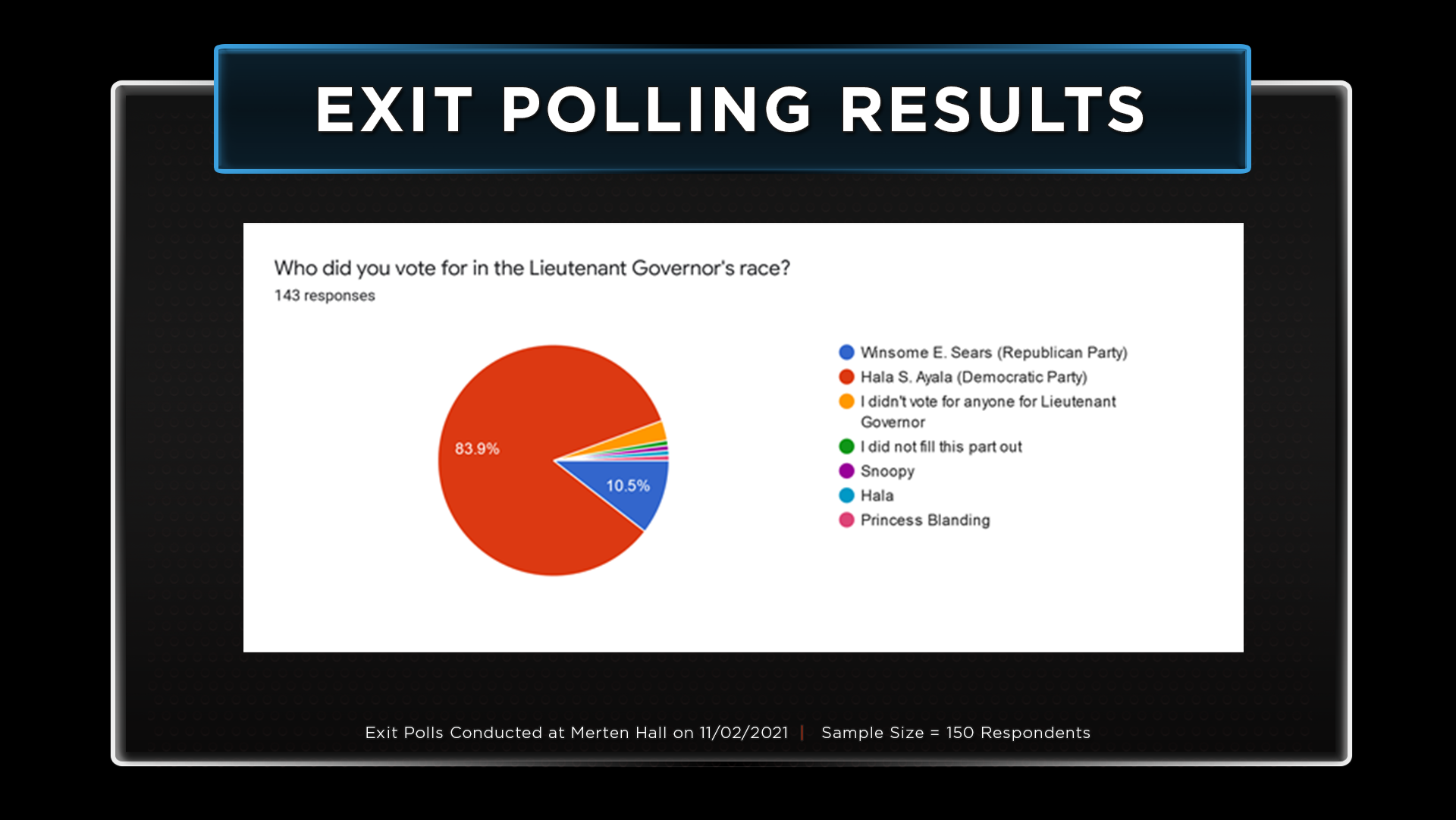
Students were asked to complete a short exit survey after voting at Mason’s on-campus polling place, and the results were analyzed during Mason Cable Network’s LIVE election night broadcast.

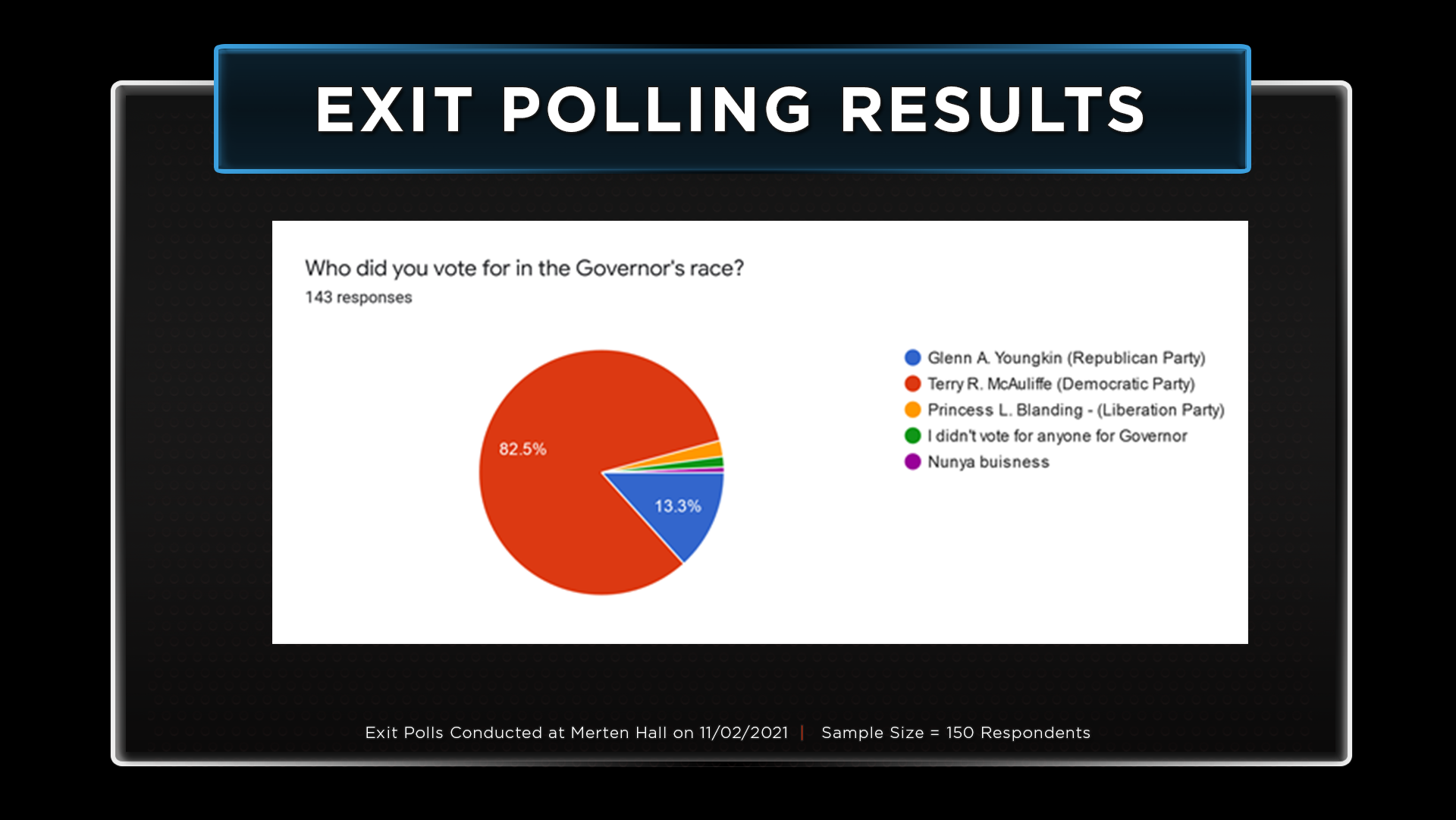
Mason voters overwhelmingly supported Democratic candidate Terry McAuliffe (82.5%-McAuliffe (D), 13.3%-Youngkin (R), 2.1%-Princess Blanding (L), 2.4%-Other/Didn’t Vote), but Republican Glenn Youngkin was elected to serve as the 74th governor of the Commonwealth of Virginia and will be sworn in on January 15, 2022.

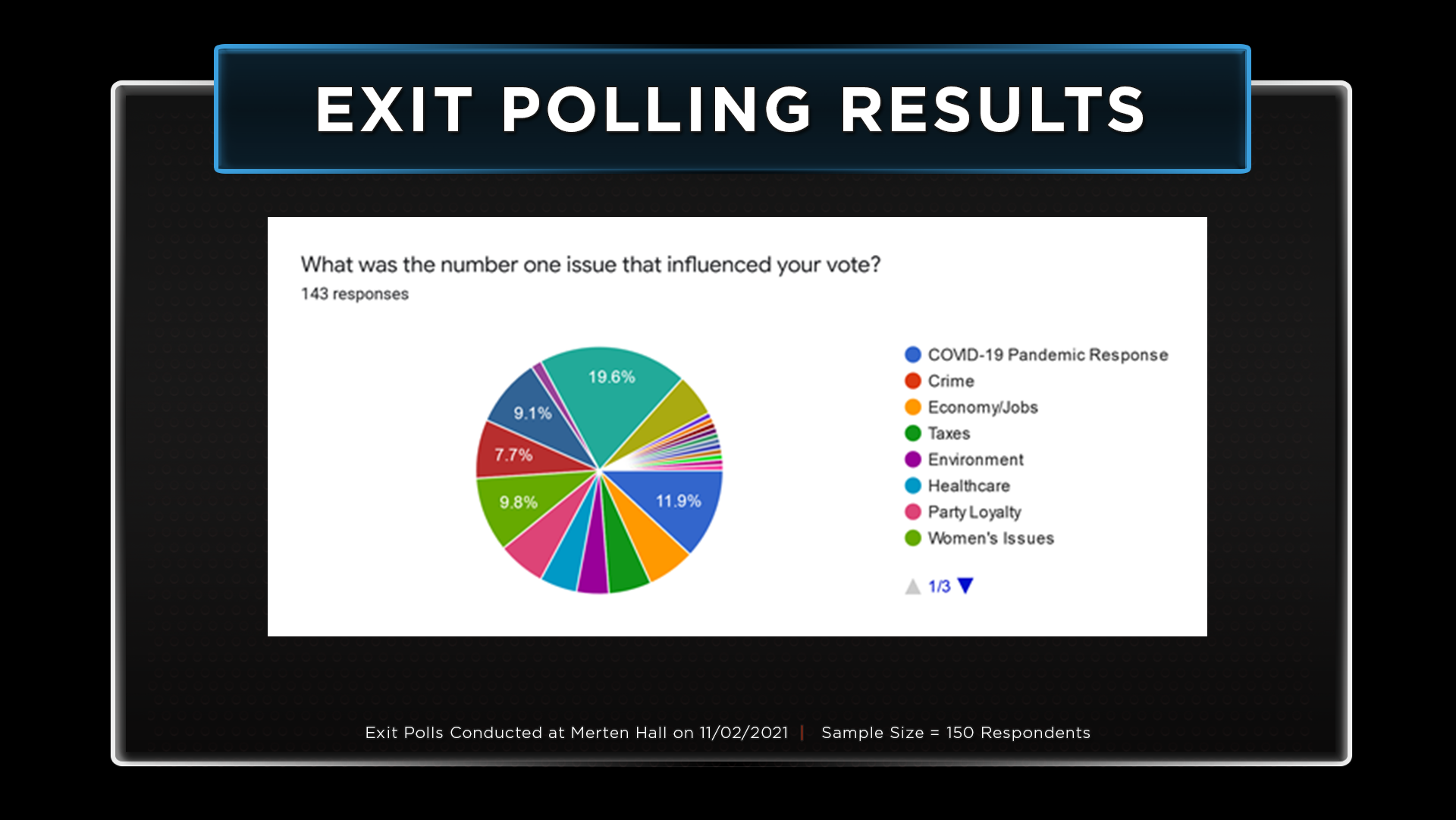
By far the most important issue to Mason students when casting their vote was Social Justice, with nearly 20% of respondents selecting that as their top concern: (19.6%-Social Justice, 11.9%-COVID-19, 9.8%-Women’s Issues, 9.1%-Abortion, 7.7%-LGBTQ+ Issues, 6.3%-Jobs/Economy, 6.3%-Party Loyalty, 5.6%-Taxes, 4.9%-Healthcare, 4.2%-Environment).

Enthusiasm was topic of concern for both parties during this off-year election cycle, but a majority of survey respondents at Mason reported being “very” or “somewhat” enthusiastic about voting in 2021: (42%-Very Enthusiastic, 32.7%-Somewhat Enthusiastic, 18%-Neutral, 6%-Not Very Enthusiastic, 1.3%-Not Enthusiastic At All).

_____________________________________________________________

Curious how Mason voted in 2021?

Check out the results of Mason Cable Network‘s 2021 exit polling below:

(Click on an image to enlarge the size)

_____________________________________________________________

Photo by: David Carroll/MCN

Post-Election Analysis: What Virginia Republicans Got Right

Youngkin Focused On Local Issues That Drove Enthusiasm

By: Jack Houston, Mason Votes 2021 Online Editorial Team

Republicans across the country are now celebrating what could be a sign of a “red wave” in 2022. While the results in Virginia could be a one-off, many are predicting a good election cycle for 2022 Republican candidates. However, this article won’t be focused on 2022. Rather, it will look at what Glenn Youngkin and the Virginia GOP got right this time around.

As I did in my analysis of the Democratic strategy, I’ll start with how the Virginia GOP selected its nominees. Unlike the Democrats, Republicans opted for a convention, instead of a Statewide Primary. This has negative aspects as well as benefits. On the negative side, a convention naturally limits the participants to registered Republicans who wanted to drive to the limited locations available. However, unlike the Democrats, the Virginia GOP chose to nominate its candidates via ranked choice voting (read more about ranked choice voting here). There were multiple reasons for this, one being the fact that ranked choice voting requires a broad base of support. This is opposed to plurality voting that determines winners based on who receives the largest share. As there were multiple candidates vying for the GOP nomination, there was a significant chance that the winner could have received a minority of the total vote. While not stated publicly, it’s likely that GOP Leadership feared that a candidate such as State Sen. Amanda Chase (who participated in the January 6th attack on the U.S. Capitol) could have won the nomination this way. By choosing to use ranked choice voting, they were able to nominate Glenn Youngkin, a political novice but savvy businessman with significant financial support and no negative history. Had a candidate such as Chase been nominated, McAuliffe’s strategy of tying the GOP candidate to Former President Trump would have been much more effective and likely would have won him the Governorship.

However, the GOP’s wins aren’t just a result of their convention. Glenn Youngkin proved to be extremely politically capable. While McAuliffe attempted to nationalize the campaign, Youngkin focused on local issues that were driving enthusiasm within his base as well as swing voters. In a year that favored the GOP to begin with, this was vital as he was able to mobilize these voters to support him. Additionally, unlike many other Republican candidates, Youngkin was able to thread the needle by keeping Trump at arms-length while not disavowing him. This meant that he didn’t offend Trump’s base while simultaneously giving moderates/swing voters “permission” to vote for a Republican.

To sum up, Youngkin was exactly the candidate that the GOP needed to win, especially in a state like Virginia that’s been trending blue. His focus on local, kitchen table issues made McAuliffe’s strategy of attempting to tie him to Trump fail. Had Youngkin fully endorsed the former president, it’s extremely likely that enthusiasm would have turned sharply against him, instead of McAuliffe. Additionally, the Virginia GOP’s decision to use ranked choice voting, instead of traditional plurality voting, helped them pick a candidate with broader support. Lastly, McAuliffe simply wasn’t the right candidate for the Commonwealth in 2021. While the dust is still settling, it’s becoming increasingly clear that voters want candidates with content, not just negative ads. Whether or not Democrats will heed this lesson in time for the 2022 Midterms is yet to be seen.

Click here to read my analysis of what Virginia Democrats got wrong in 2021 >