Mason Votes

Who Gets On the Debate Stage?

After the first and second presidential debates, many students wondered if Hillary Clinton and Donald Trump will be the only ones they will see take the stage. The answer? Yes.

This year, Gary Johnson (Libertarian Party candidate) and Jill Stein (Green Party candidate) both wish to make the cut. However, Donald Trump and Hillary Clinton are the only two participants who are eligible to participate in all nationally-televised debates.

Why? According to the nonpartisan candidate criteria set forth by the Commission on Presidential Debates, neither Johnson nor Stein meet the national polling threshold of 15% required to participate.


According to the Commission:

“Under the 2016 criteria, in addition to being Constitutionally eligible, candidates must appear on a sufficient number of state ballots to have a mathematical chance of winning a majority vote in the Electoral College, and have a level of support of at least 15% of the national electorate as determined by five selected national public opinion polling organizations, using the average of those organizations’ most recently publicly-reported results at the time of the determination.” (www.debates.org)


The current Real Clear Politics polling average shows just how far both Johnson and Stein are lagging behind the 15% debate threshold:rcpolitics-average

For those who like visualizing data, note the wide gulf between the major and third party candidates as well as the 15% line:rcpolitics-graph

Reporting by Hannan “Nannie” Abubaker.

Tonight is the FINAL Presidential Debate of 2016 and airs LIVE at 9:00PM from the University of Nevada-Las Vegas.

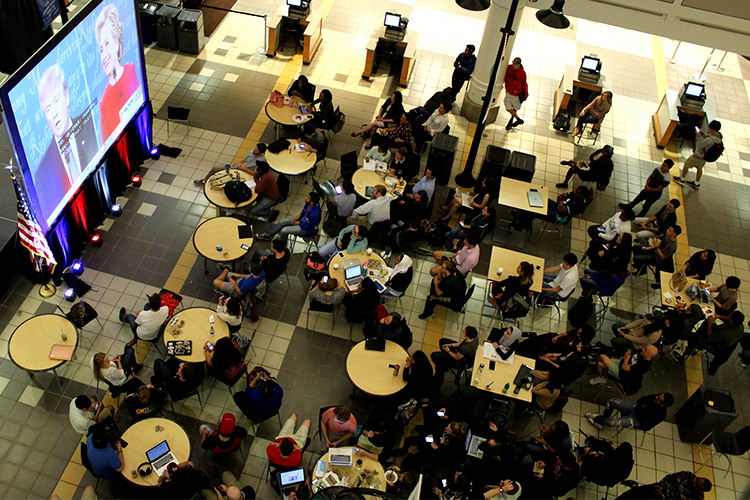
Mason Votes is hosting a watch party on campus in the Johnson Center Atrium at 9:00PM.
final-debate-watch_twitter

Big Debates, Small Talk

By: Victoria David

st-louisOn Sunday October 9th, Donald Trump and Hillary Clinton took part in a second presidential debate that The Washington Post called “dark,” and a “bitter, boundary-breaking” debate.
For the second time in two weeks, voters got the chance to witness one-on-one exchanges between the Republican and Democratic nominees. But unlike the first debate’s “opposing podium” format, the second was structured as a town hall where audience members were able to pose questions directly to the candidates.

Both Trump and Clinton were given the opportunity to express their views and plans on various issues ranging from Supreme Court appointments to defeating ISIS, but most of the post-debate analysis and chatter was consumed by discussion of body language and a now-infamous Access Hollywood video from 2005 that revealed Donald Trump making lewd comments about women.

Reporters David Fahrenthold and Katie Zezima summed up the 90-minute spectacle in an article posted online just after the debate: “The second presidential debate veered into ugly territory Sunday night in St. Louis, as the two nominees swapped insults and interruptions.”

How did the Mason community react?

“Ridiculous”

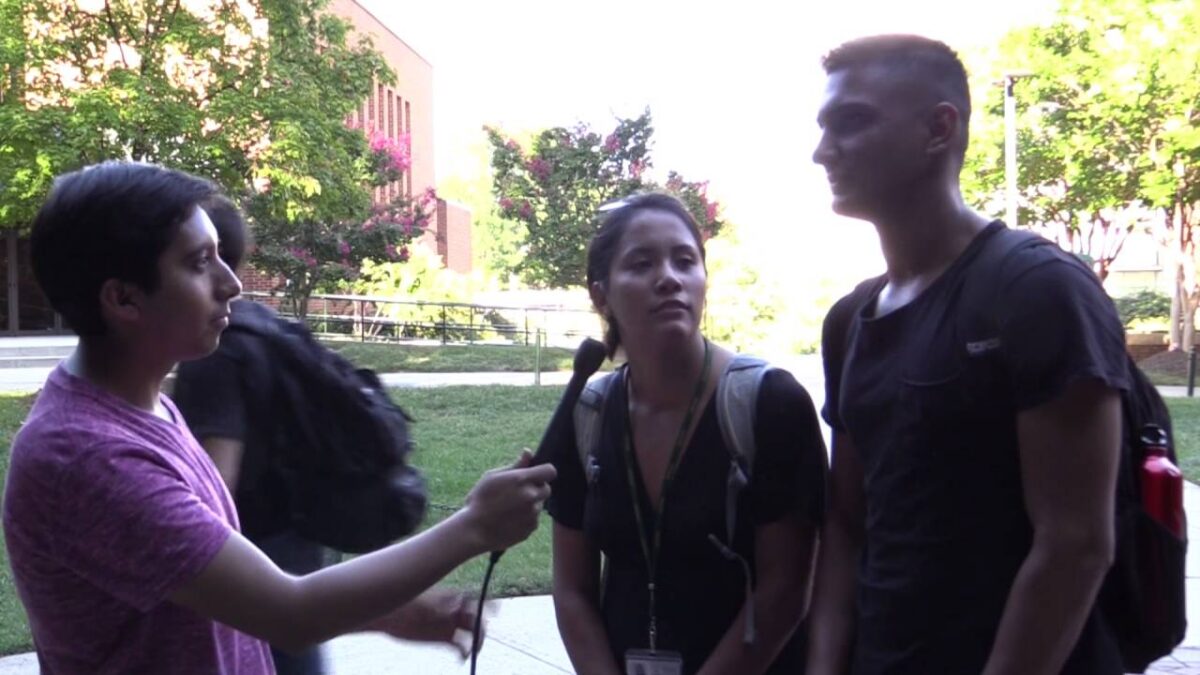
Most of the students we interviewed did watch the debate. It was the first one Cameron was able to watch. He said it “sounded like kindergartners fighting, it was ridiculous” and, with a sour laugh, admitted it made him feel “ashamed of our country.” “Ridiculous” was also the first word that came to Morgan’s mind when asked about Sunday’s night, although she thought it made the debate more “entertaining.” Becca, an English exchange student, had a similar view: “I thought it was a joke. Both candidates are just out to get each other rather than to discuss [the issues].”

“Debates Matter”

Despite those negative reactions, most of our interviewees thought the debates were still important. According to them, debates allow voters to see how candidates can “react to questions” and “interact with one another.” It is a way to make up one’s mind about a candidate while avoiding any bias or influence from the media. Katie thinks that debates are a crucial part of the process insofar as they show “how eloquent the candidate is along with their demeanor under pressure, a situation in which a President often finds himself.” The town hall format also seemed to make a difference. Becca indeed felt it brought an “added bonus” as the audience questions “made the debate more relatable.”

That being said, most students do not seem to have watched the vice presidential debate because, as Katie put it, “they are not the ones running for President.” When asked why they didn’t tune in for the VP showdown, many invoked the “I didn’t have time” excuse. But in general, students were simply more interested in hearing the candidates at the top of ticket speak than their running mates.

“Really Low Expectations”

We asked students if the debate(s) they watched lived up to their expectations, and the responses were pretty unanimous. “Yes,” they answered, before quickly adding, “because I had really low expectations.” Kristen, who only got to watch the first debate, said it corresponded to what she had been hearing so far in the media. “I knew both candidates’ scandals would be spoken about, and they’d both spend their time attacking the other,” said Becca. Like the others, Katie was somewhat disillusioned, “I didn’t really have any expectations for this debate.”

For Kanako, an international student at Mason, it was her first experience with American presidential elections. Coming from Japan, she thought it was “interesting”, to say the least. “In Japan, politicians are not very honest either,” she admitted. Contrary to short Japanese campaigns, she thinks “lengthy elections in the U.S. give voters the chance to take the time necessary to make their choice.”

Most of the students we interviewed said that these debates did not impact their decision. “I already had a clear idea of who I was going to vote for, and this debate only validated my decision,” Cameron told us.

A number of students seem to be tired of the permanent attacks that have flooded the debates of this campaign. But while the lack of enthusiasm and disillusionment is real, the ones we interviewed haven’t lost faith in politics. The majority actually watched at least one of the debates so far. All of them were registered to vote, and they felt they have a duty to learn about candidates’ stances for themselves.

“Unique” was a recurrent word in students’ mouths. Ultimately we are witnessing one of the most singular political battles in the history of the United States.

VP Campus Debate Watch

161004220902-12-vp-debate-1004-split-3-large-169On Tuesday night, former Virginia Governor and U.S. Senator Tim Kaine (D) faced off against former Indiana Governor Mike Pence (R) in the one and only vice presidential debate of Election 2016. Both nominees had the difficult task of defending their respective running mates while making a positive case for their ability to serve as second in line to the commander in chief.
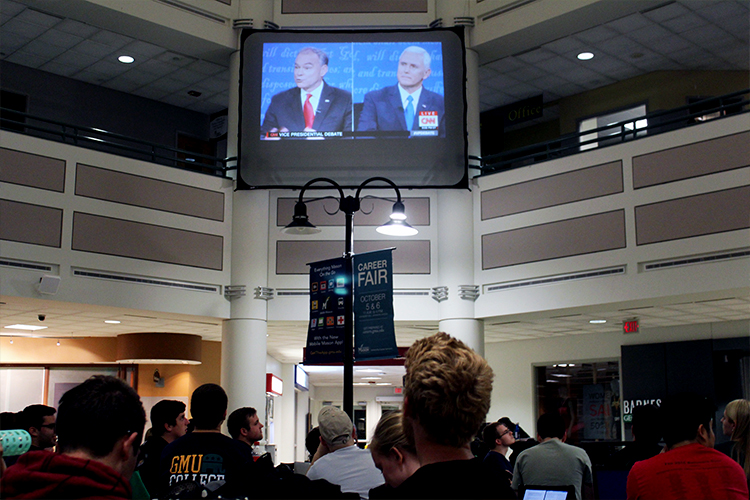
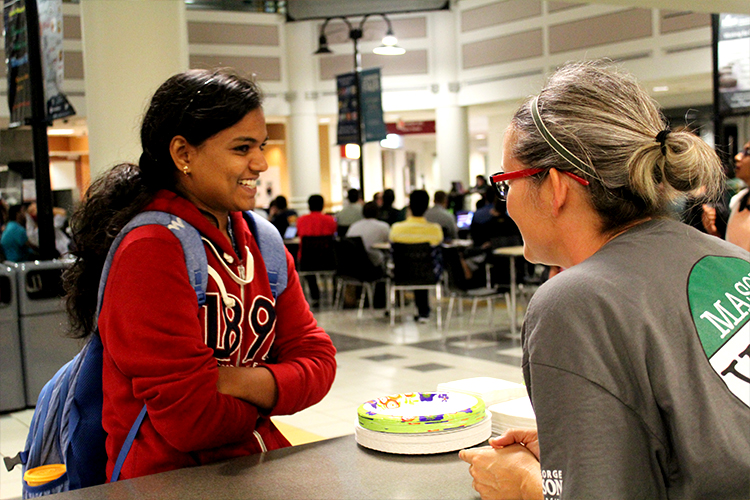
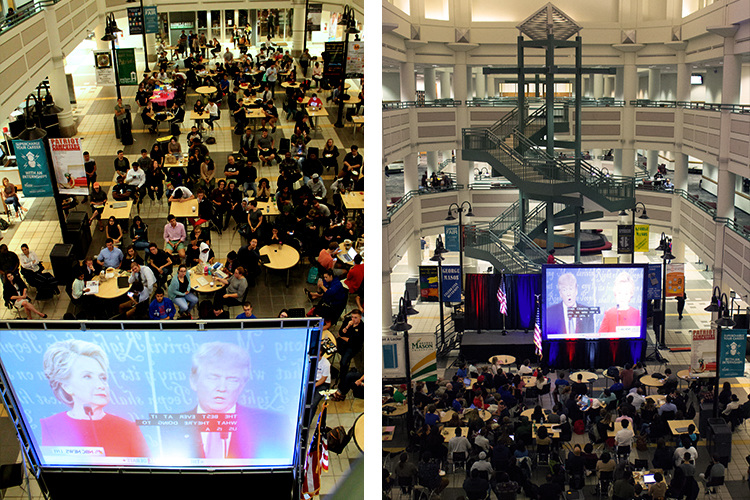
Mason Votes hosted a watch party in the Johnson Center Atrium so students could watch Tuesday’s vice presidential debate together on the big screen. Mirroring the national dearth of  interest paid to this year’s vice presidential candidates, the crowd that gathered in the Johnson Center was much smaller than the 150+ students and staff that showed up to watch the historic first debate between Donald Trump and Hillary Clinton last week.
In fact, Pence vs. Kaine drew in less than half of the 100+ million viewers that tuned in to witness the first Trump vs. Clinton showdown, making it the lowest-rated VP debate since Cheney vs. Lieberman in 2000.

While reviews of the individual candidates’ performances have been mixed, today’s newspaper headlines all highlighted the contentious tone of the event. Newseum’s Ellie Stanton summed up the national post-debate coverage this way: “newspaper headlines declared the debate “feisty,” “passive, aggressive” and “aggressive from the start.” While newspapers differed over whose performance was stronger, editors agreed on one thing: The candidates pulled no punches.”

Mason Votes will host a Debate Watch Party for each of the two remaining presidential debates of Campaign 2016 in the Johnson Center Atrium at 9:00pm:

• 2nd Presidential Debate Watch Party  |  Sunday, October 9th

• 3rd Presidential Debate Watch Party  |  Wednesday, October 19th

Photos by Mimi Albano.

VA Ranked #1 in Voter Demographic Representation

The folks over at WalletHub just released the results of a data study that examined how demographically representative each state’s electorate was when compared to actual population. In other words, are those who actually turned out to vote on election day an accurate representation of the state’s broader demographic makeup?

Virginia was ranked #1 for having the highest “Voter Representation Index” and was determined to have the most representative voting population of any state with regard to demographic distribution. This means that the diverse subset of Virginians who voted in recent elections mirrors the broader demographic makeup of the state more closely than any other.

Voter Representation Index was calculated using U.S. Census data: “we compared each state’s voter distribution to its electorate distribution by race, age and gender to determine the state’s Voter Representation Index.”

The top 10 states by Voter Representation Index are listed below.

For the complete 50 state ranking, check out the full article on wallethub.com.


Overall Rank State Voter Representation Index Racial Representation Age Representation Gender Representation
1 Virginia 92.51 94.50 86.38 96.66
2 Ohio 90.93 90.23 86.58 96.00
3 Missouri 90.78 87.78 86.70 97.86
4 Wisconsin 90.55 86.23 88.97 96.46
5 North Carolina 90.17 86.85 85.83 97.83
6 Michigan 89.90 85.60 85.72 98.38
7 Vermont 89.79 93.11 78.98 97.27
8 Washington 89.66 87.16 84.59 97.23
9 South Carolina 89.65 87.32 89.17 92.47
10 Pennsylvania 89.29 81.26 88.41 98.19


Manny on the Street – Ep1

Manny goes out on campus to find out how Mason students are preparing for the upcoming 2016 presidential election.

He investigates whether Mason students are registered to vote and if they are aware of the registration deadline in Virginia (hint: it’s Monday, October 17th). Manny also asks what issues matter most to Mason students and why they think voting in this election is important (or not).

Video by: Manfred Veizaga

When Henry Met Michelle

By: Victoria David

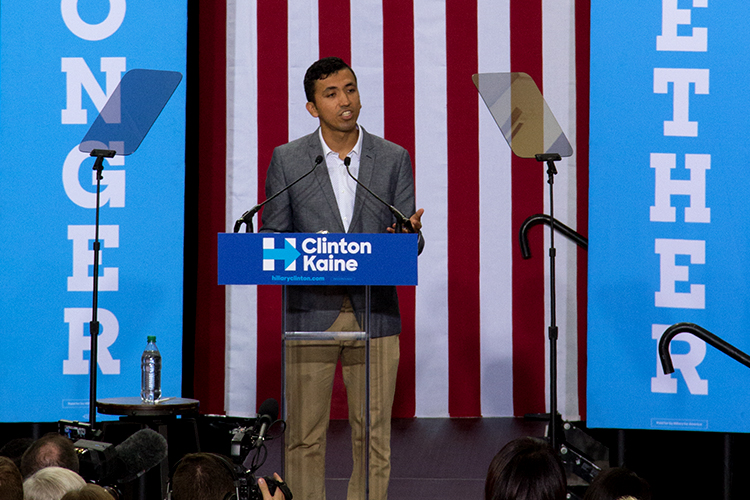
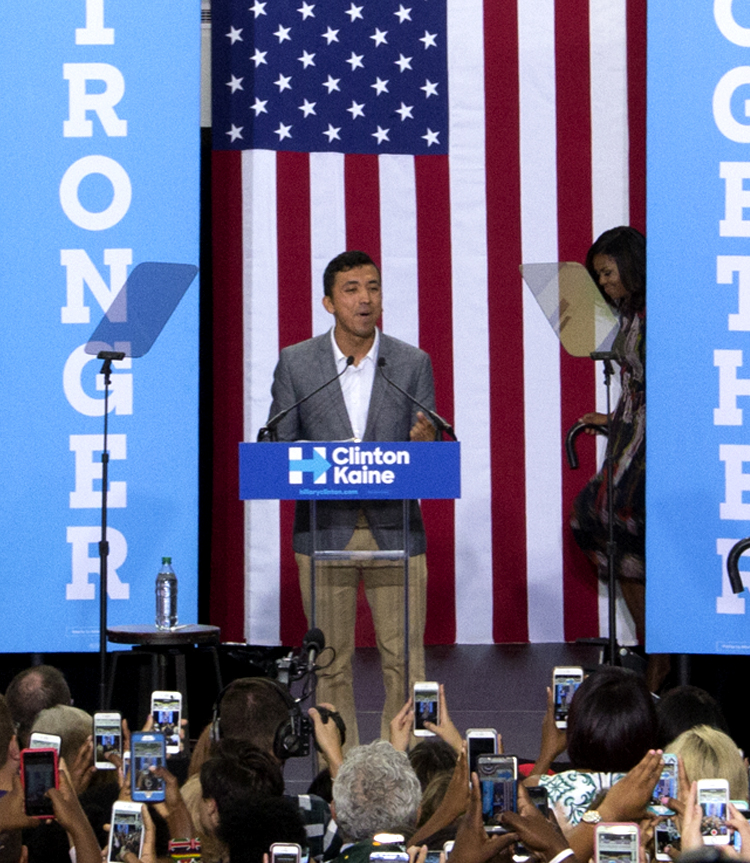
If you were there for Michelle Obama’s visit to Mason on September 17th, you might remember Henry Lopez. If not, bare with me, his story is worth reading. Henry is the lucky student that got to introduce the First Lady of the United States and share his story as undocumented immigrant. So who is Henry Lopez?

“Home”

Henry Lopez was born in Guatemala and was brought to the United States by his parents at the age of four. He grew up with his two siblings in Northern Virginia, where he spent seventeen years of his life. Therefore, it is very natural that America is the place he has always called “home”.

He then went to college at Mason, just like his older sister. Allowing their children to pursue college education was always a priority for his parents. Higher education was, for Henry and his family, “the window to what we see when we think about the American Dream.” Henry insists that he would not have had the opportunity to attend Mason without the Obama administration’s action to protect undocumented immigrants. “The opportunity they gave to DREAMers such as myself is tremendous.” So, you can only imagine how much it meant when he got the call that he would be introducing Michelle Obama.

“In the Right Place at the Right Time”

Henry-IntroductionHow did than happen? How did Henry end up introducing one of the most important people in the United States? He simply seized the opportunity that was given to him.

When Henry was in high school, he was involved in a mentorship program that helped undocumented students navigate through the college process. That organization was contacted by Hillary Clinton’s campaign in an effort to get more DREAMers to talk about their personal stories. They naturally recommended Henry. And there he was, standing on the stage, delivering a speech and introducing the First Lady of the United States.

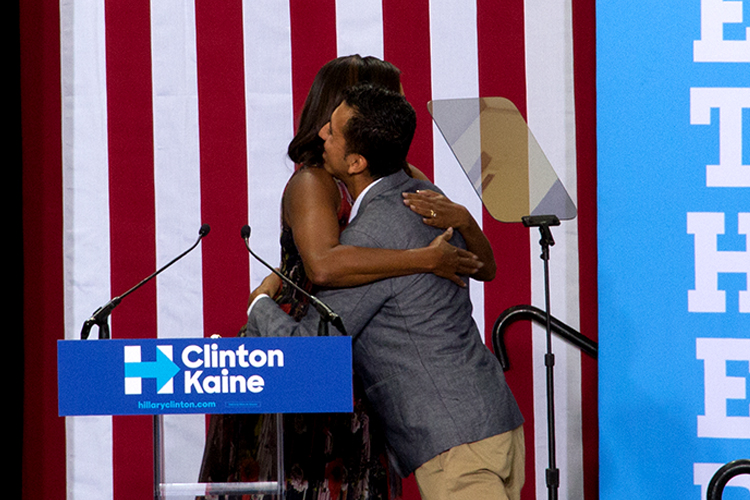
I asked what his experience was like meeting Mrs. Obama and what they said to one another. “It was very brief, he said, but she shook my hand. I got the chance to thank her for everything she has done while she thanked me for being here and sharing my story.”

“Honored and Determined”

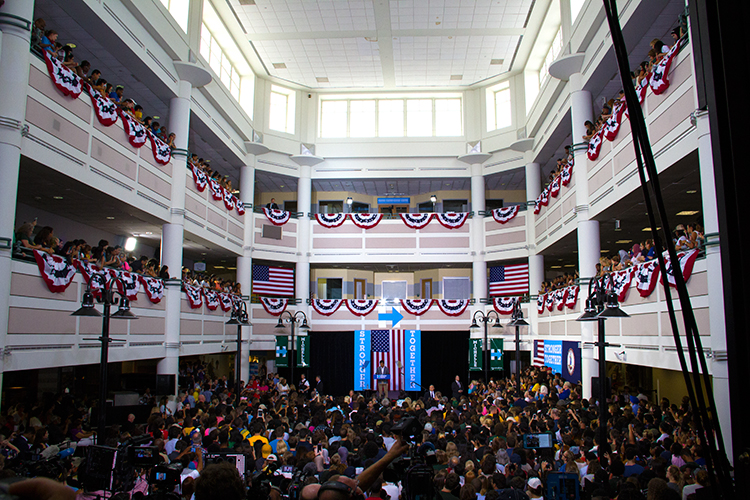
Henry only found out the night before that he was going to speak at an event that attracted over 2,000 students and community members to the Johnson Center Atrium. However, he was prepared after years of public speaking practice in high school and seemed comfortable on stage during the event.

Henry wrote his own speech and “knew what he wanted to say” from the moment he got the campaign’s phone call. “The campaign incorporated some of Hillary Clinton’s educational plans but it was very much my own speech, my story,” he insisted.

To the obvious question — “weren’t you scared?” — we got the not-so-obvious answer: “not at all!” Indeed, Henry explained to us that having to speak in front of the Mason community made things easier for him. “I was extremely honored to introduce her and excited to be there.”

“Vote!”

Although he is not affiliated with any political party, Henry takes politics very seriously. He spends his free time trying to get people register to vote here at Mason. “Politics is very important to me because of all the implications of it for the country.”

He says he is confident that Clinton will win, and despite being somewhat concerned by Trump’s success, he is convinced that Trump’s “message is not aligned with what Americans believe”.

Henry’s main message is for students is to “get out there and vote!” As a student who cannot vote, his message could not be more powerful. “In an election where the stakes are completely different and the directions that we can take are so sharp, it is crucial that people register to vote,” he summed up.

As a computer science major, politics is not part of his career plans but, with a story already so powerful, who knows where life can take him?

Photos by Leslie Steiger.

Campus Debate Watch #1

Debate_8

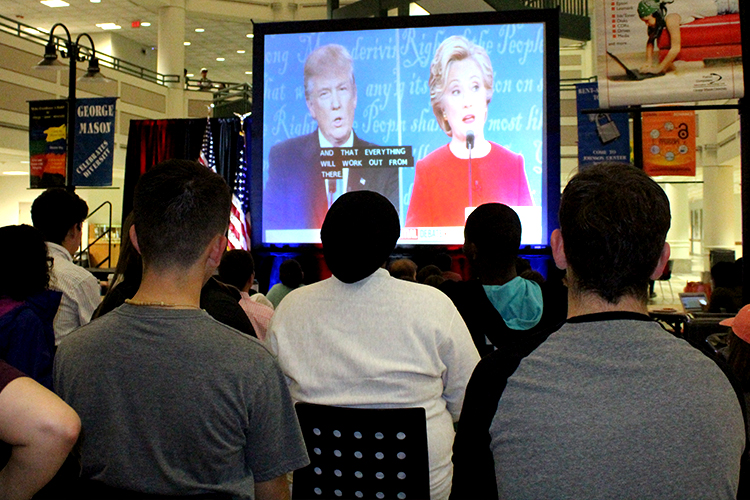
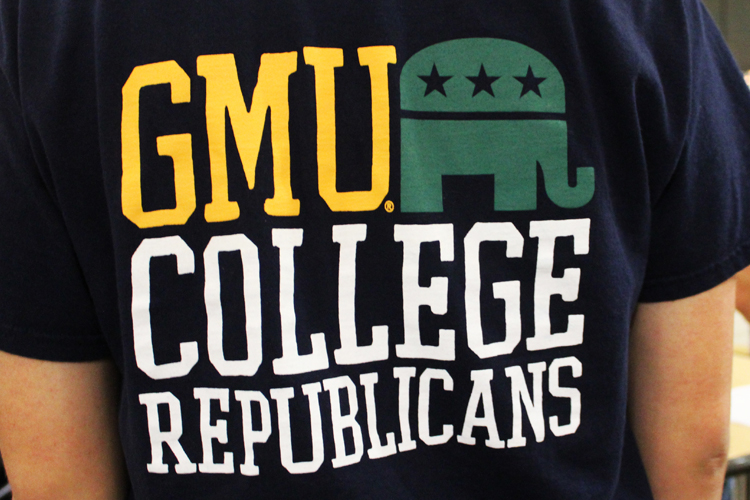
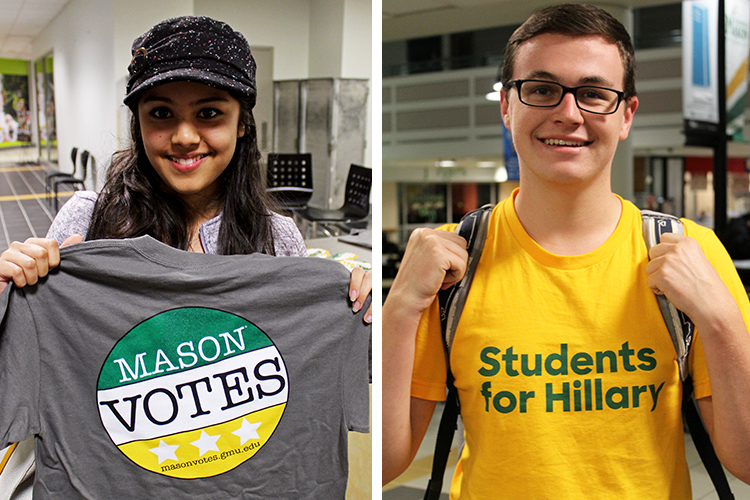
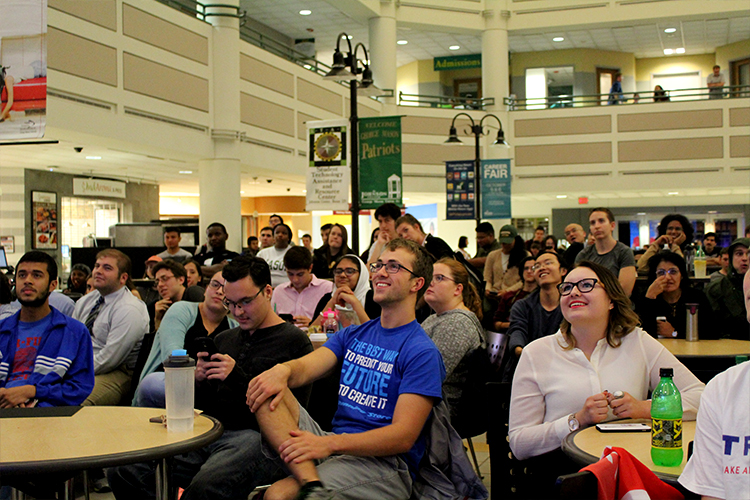
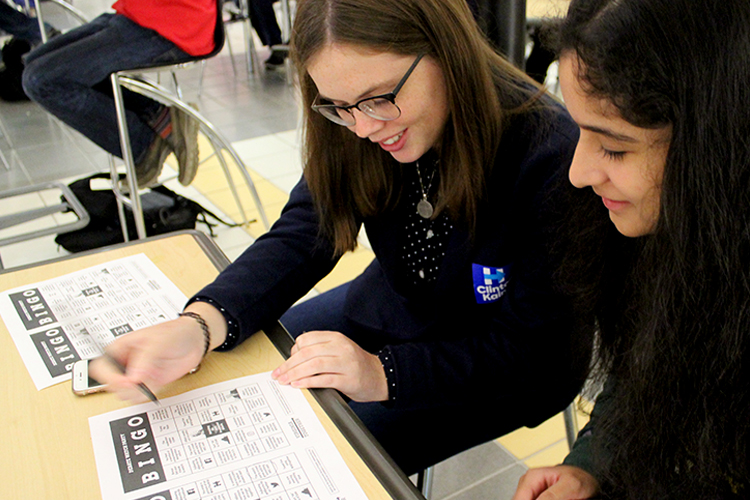
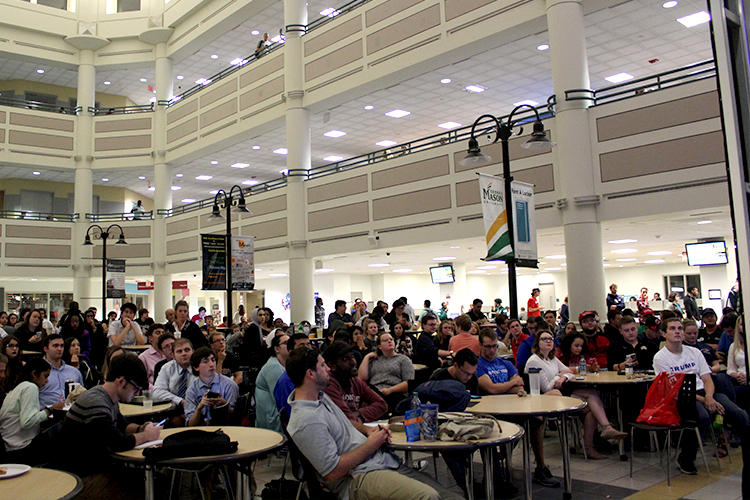
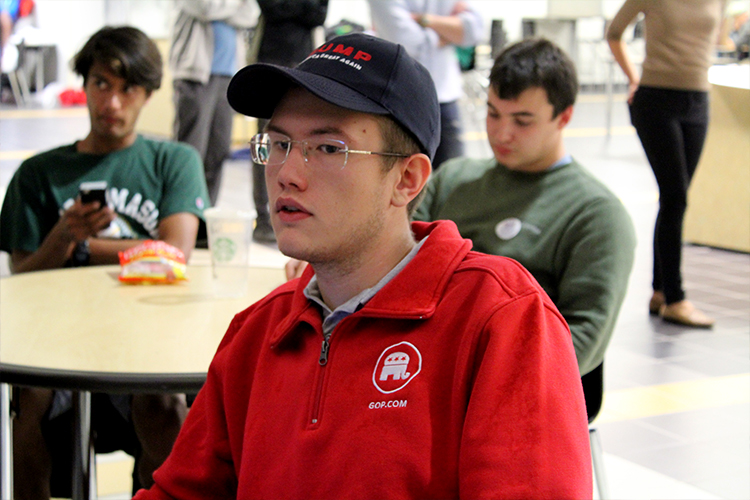
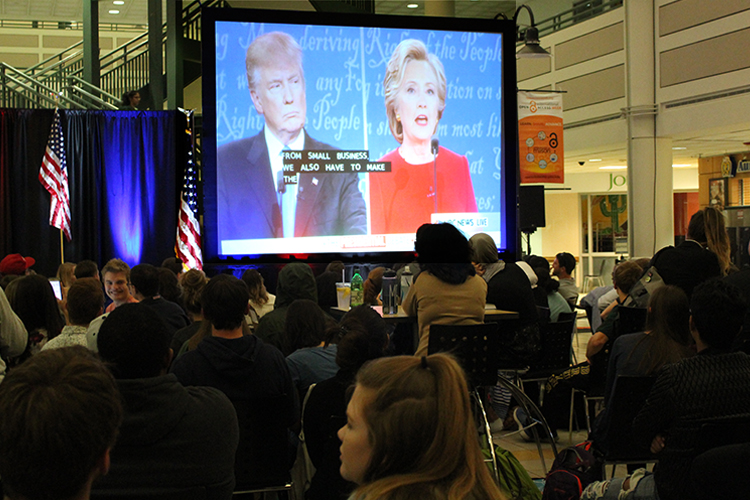
Mason Votes hosted a watch party in the Johnson Center Atrium so students could gather on campus to watch Monday’s historic presidential debate unfold on the big screen. Supporters of both candidates enjoyed the debate side by side, with Clinton and Trump campaign gear on display throughout the crowd.

In addition to the large group of Mason students that turned out to experience the first one-on-one meeting between rivals Clinton and Trump, early indications suggest that last night’s debate audience may have set a new record for televised debates.

The previous record holder was Carter vs. Reagan in 1980 that pulled in some 80 million viewers. Even if the official ratings number for Clinton vs. Trump (Part I) exceeds that benchmark, the actual number of Americans who witnessed the debate is thought to be much higher when non-traditional viewing and public gatherings are added in.

Consider this reporting from CNN Money’s Brian Stelter:

“…the debate averaged a total of 80.9 million viewers across 12 of the channels that carried it live. Nielsen traditionally measures viewers who watch via traditional TV at home. That means people who watched the debate at parties, bars, restaurants, and offices were not counted. Nor does the 80.9 million viewer total include PBS and C-SPAN. Ratings for PBS will be available later Tuesday. Many millions also watched the debate via the Internet… This means the actual total audience is significantly higher than 80 million.”

Want to learn more about the issues that are important to Mason students? Check out this post.

Mason Votes will host Debate Watch Parties for the remaining presidential and vice presidential debates in the Johnson Center Atrium at 9:00pm:

• Vice Presidential Debate Watch Party  |  Tuesday, October 4th

• 2nd Presidential Debate Watch Party  |  Sunday, October 9th

• 3rd Presidential Debate Watch Party  |  Wednesday, October 19th

Photos by Mimi Albano.

Students Sound Off Before First Debate

Debate-1-Illustration-Header

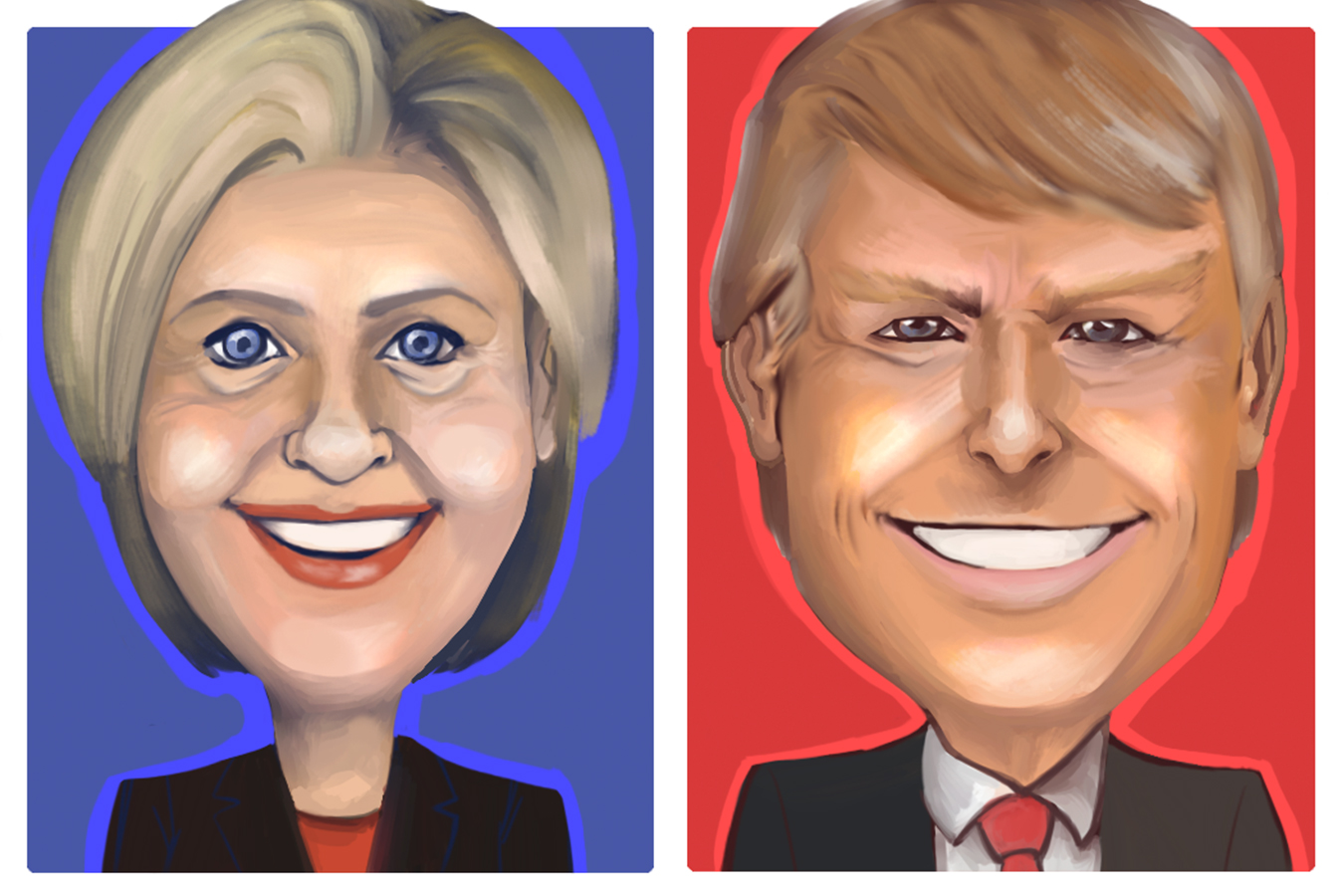
The students of COMM 145 (Newspaper Workshop I) interviewed students on Mason’s Fairfax campus earlier today ahead of the first Presidential Debate that is set for tonight at 9:00pm on NBC.

Students were asked what issues are most important to them and if there is anything that the two major candidates could say or do during tonight’s debate that might change their mind. Here is what Mason students on campus today had to say:

Caitlyn Bernard, Senior, Biology, Undecided Voter

Will you watch tonight’s debate? “Yes.”

Top three issues:

  1. Social/Domestic Affairs (“there’s a lot of divide in the country”)
  2. Economy (big social class gap)
  3. Foreign Policy (“how we interact with others determines how we’ll do as a country”)

Is there anything that could happen in the debate that might make you change your opinion of the candidates? “A lot of things, many issues need to be better addressed.”

Why do you think it is important for young people and college students to vote? “Your vote still counts… We can’t escape it – this will impact us for years.”


Katy Mumper, Sophomore, Business Management, Clinton Voter

Will you watch tonight’s debate? “Honestly, probably not. I’ll watch highlights later.”

Top three issues:

  1. Making sure Trump is not elected (“he is dangerous, crazy”)
  2. Minimum Wage (“$7.25 is not a living wage”)
  3. Women’s Rights (“so women get the health care they need”)

Is there anything that could happen in the debate that might make you change your opinion of the candidates? “Hillary could say something to make me think more of her, or Trump could say something to make me think less of him.”

Why do you think it is important for young people and college students to vote? “We represent a lot of the population. This will affect us for years.”


Arthi Chandrasekran, Senior, International Studies/Global Conservation, Undecided Voter

Will you watch tonight’s debate? “No, I have another commitment.”

Top three issues:

  1. Environment (“take care of the planet”)
  2. Women’s/Human Rights (“we’re all human – we should be able to coexist”)
  3. Federal Spending (“some [expenses] are more important than others”)

Is there anything that could happen in the debate that might make you change your opinion of the candidates? “As long as they don’t say stupid things… I will feel like I’m being represented.”

Why do you think it is important for young people and college students to vote? “You have power when you vote.”


Ayesha Gill, Freshman, English/Economics, Clinton Voter (former Bernie Sanders supporter)

Will you watch tonight’s debate? “Yes.”

Top three issues:

  1. Immigration (“[as a] melting pot, we are made from immigrants”)
  2. Health Care
  3. College Debt & Women’s Rights

Is there anything that could happen in the debate that might make you change your opinion of the candidates? “No.”

Why do you think it is important for young people and college students to vote? “We are the future.”


Michele Lee, Junior, English, Undecided Voter

Will you watch tonight’s debate? “Maybe.”

Top three issues:

  1. Women’s Health
  2. Abortion
  3. College Tuition/Student Debt

Is there anything that could happen in the debate that might make you change your opinion of the candidates? “Education [policy]. Not everyone is given an opportunity but everyone deserves one.”

Why do you think it is important for young people and college students to vote? “We need our opinions voiced. [It is important to] exercise our vote to make a difference.”


Sofia Herring, Sophomore, Government, Trump Voter

Will you watch tonight’s debate? “Yes, because it is going to be one of the most controversial debates in history. It will be very interesting to see how Trump and Clinton compose themselves in a debate against each other.”

Top three issues:

  1. Taxes (“should be fair and equitable”)
  2. Immigration
  3. College Tuition/Student Debt (“as an out-of-state college student, it is hard to pay”)

Is there anything that could happen in the debate that might make you change your opinion of the candidates? “Absolutely not.”

Why do you think it is important for young people and college students to vote? “We really need to have our voices heard. We are the future of America and we won’t always have people making decisions for us.”


Anonymous, Senior, French, Clinton Voter

Will you watch tonight’s debate? “Yes, but I will watch it recorded instead of live.”

Top three issues:

  1. Economy
  2. Civil Rights
  3. Foreign Policy

Is there anything that could happen in the debate that might make you change your opinion of the candidates? “No.”

Why do you think it is important for young people and college students to vote? “Though the Presidential Election only lasts a few years, we don’t get those years back.”


Pat Marino, Junior, Political Science, Johnson Voter

Will you watch tonight’s debate? “Yes, in addition to Monday Night Football.”

Top three issues:

  1. Foreign Policy (“if our aid is cut from countries such as South Korea, our relationships with many countries will be damaged”)
  2. College Tuition/Student Debt
  3. Domestic Affairs (“Black Lives Matter movement and cultural equality”)

Is there anything that could happen in the debate that might make you change your opinion of the candidates? “No. I truly believe Gary Johnson is the best candidate possible.”

Why do you think it is important for young people and college students to vote? “We set the standard of living for future generations with who we put in office.”


Anonymous, Senior, Law, Trump Voter

Will you watch tonight’s debate? “Absolutely.”

Top three issues:

  1. Environment (“sustainability of Earth”)
  2. Unemployment/Economy (“technology and automation keeps advancing”)
  3. ISIS/Terrorism (“needs to be eradicated”)

Is there anything that could happen in the debate that might make you change your opinion of the candidates? “No.”

Why do you think it is important for young people and college students to vote? “It is our civic duty.”


Anonymous, Junior, Global Affairs, Johnson Voter

Will you watch tonight’s debate? “Yes.”

Top three issues:

  1. ISIS/Terrorism (“huge foreign policy issue”)
  2. Supreme Court (“they set legal precedence”)
  3. Welfare (“needs to be reformed – the country is being drained economically”)

Is there anything that could happen in the debate that might make you change your opinion of the candidates? “No. My candidate isn’t in the debate.”

Why do you think it is important for young people and college students to vote? “It is important to get a sense of civic involvement and realize that their voice matters in this democracy.”


Anonymous, Junior, Communication, Clinton Voter

Will you watch tonight’s debate? “Yes.”

Top three issues:

  1. Immigration (“we need a better solution”)
  2. Black Lives Matter (“we need to better address the situation”)
  3. Women’s Rights (“women still don’t make as much money as men”)

Is there anything that could happen in the debate that might make you change your opinion of the candidates? “No. I am set on my vote.”

Why do you think it is important for young people and college students to vote? “Because it’s important for them to exercise their right to vote and make their voice heard.”


Anonymous, Freshman, Health Administration, Clinton Voter

Will you watch tonight’s debate? “Yes.”

Top three issues:

  1. College Tuition/Student Debt
  2. Health Care (“once we get off our parent’s health care plan, we have to see solutions for us”)
  3. Immigration (“because Trump wants to build a wall and that’s not how you solve the issue”)

Is there anything that could happen in the debate that might make you change your opinion of the candidates? “No.”

Why do you think it is important for young people and college students to vote? “Anyone who didn’t vote can’t complain if Trump wins!”


Anonymous, Senior, Finance, Trump Voter

Will you watch tonight’s debate? “No, because I have work. It’s not on my list of priorities.”

Top three issues:

  1. Gay Rights
  2. Abortion
  3. Second Amendment (“I care a lot about my ability to carry freely”)

Is there anything that could happen in the debate that might make you change your opinion of the candidates? “No. Hillary is crooked.”

Why do you think it is important for young people and college students to vote? “To keep crooked people out of office.”

Reporting by: Courtney Boone, Caleb Chrisley, Molly Feser, Alexander Manalac, Anthony Oswald, Keirsten Robinson, and Connor Wilcoxen.

Illustration by Mary Jane DeCarlo.

Faculty Connections to Election 2016

InglisBob Inglis, executive director of Mason’s Energy and Enterprise Initiative was ranked number 46 on the Politico 50 list for his work on what Politico called “the conservative case for fighting climate change.” The site’s top 50 ranking is described as a “guide to the thinkers, doers and visionaries transforming American politics in 2016.” Inglis tied at number 46 with advisor Katharine Hayhoe, associate professor of Atmospheric Science at Texas Tech University.

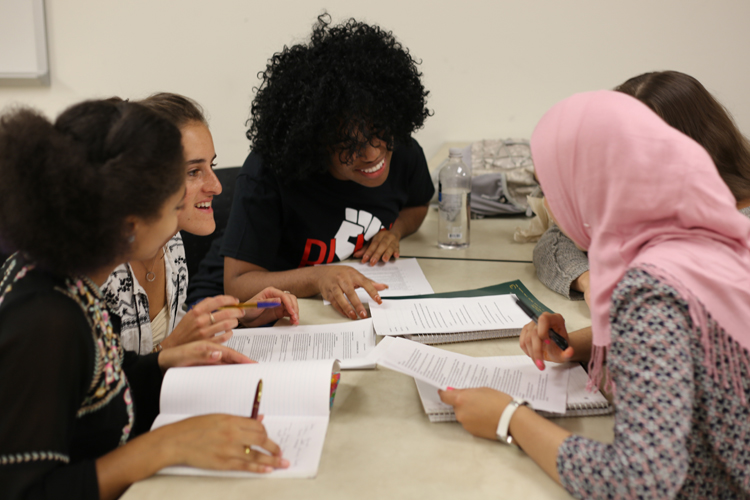
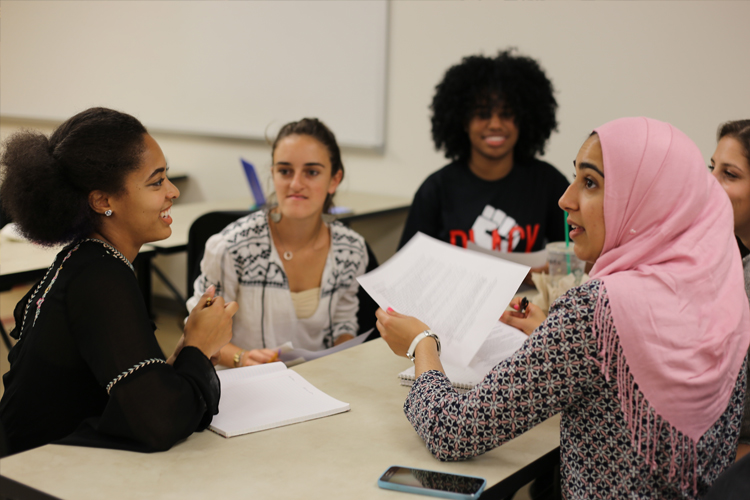
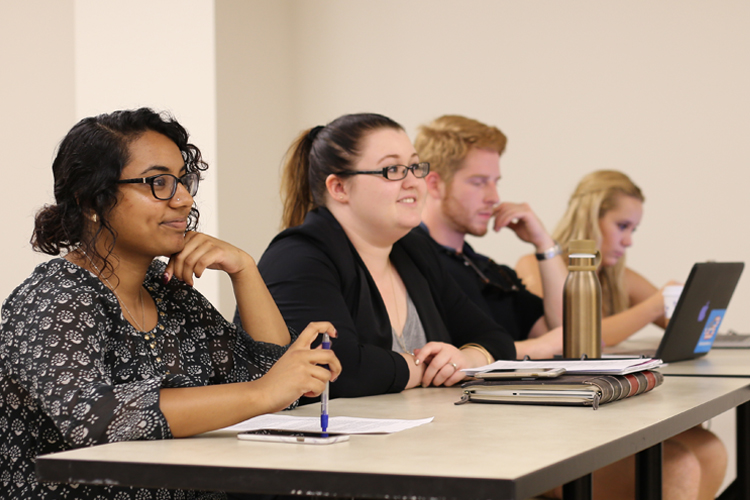
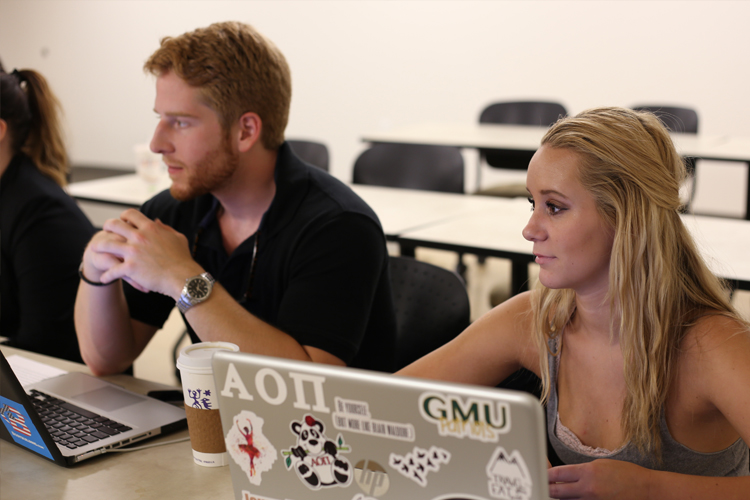
GuttmanRobert Guttman, former director of Mason’s Schar School of Policy and Government, is currently teaching Political Journalism (COMM 374). The focus of the course is helping students express their opinions about the upcoming election while building their portfolios. One recent assignment was for students to debate the issues in class, performing as a specific candidate (Clinton, Johnson, or Trump).

Below: Student discuss the issues of Election 2016 in COMM 374. Photos by Mimi Albano.

MuirJanette Muir, Associate Provost for Undergrad Education, is an expert in the role of political communication in campaigns. She can also talk about political advertising and presidential ads, political debates, gender differences in communication and problems with media coverage. She is very interested in engaging citizens in critical thinking about political campaigns and helping them to become better informed voters. In January 2008, she took a group of younger voters to the New Hampshire primaries to study youth engagement in politics.

MayerJeremy Mayer is an associate professor in the Schar School of Policy and Government. His areas of research include American government and politics, elections, foreign policy, media politics, public opinion, racial politics and statistical methods.


FauntroyMichael Fauntroy, Assistant Professor of Public Policy, is the author of the recently released book “Republicans and the Black Vote.” He teaches courses in urban policy and American government and specializes in race and American politics. Prior to joining the faculty at Mason, he was an analyst in American national government at the Congressional Research Service, where he provided research and consultations for members and committees of Congress. He was also a civil rights analyst at the U.S. Commission on Civil Rights, where he conducted research on major civil rights issues.

KorostelinaKarina Korostelina, a social psychologist who teaches at George Mason’s School for Conflict Analysis and Resolution, has conducted a new nonpartisan study that examines Donald Trump’s rise to be his party’s nominee through a conflict analysis lens. She concludes that the reality TV personality and businessman aggressively evokes nostalgia for an America of a different era, empowers supporters with a myth of national identity, aggravates a penchant for intolerance and challenges the traditional balance of power.

HopsonMark Hopson, Assistant Professor of Communication, holds a PhD in Intercultural Communication from Ohio University, and MA and BA degrees in Organizational Communication from Western Michigan University. His research involves communication informed by race, culture, power, marginalization, gender, identity and difference. In his research, he examines the way mass media informs perceptions about race and culture. In addition, he has training and experience in violence prevention-education, diversity workshops, and academic and life skill building programs. He is currently working on a book titled, “The Talking Drum: Exploring the Role of Critical Memory in Intercultural Communication.” He can also discuss the way race and racial issues are used in media and communication in regards to presidential campaigns.

NicholsLen M. Nichols, Professor and Director of the Center for Health Policy Research and Ethics is a renowned health care economist and former director of the Health Policy Program at New America Foundation (NAF), a nonprofit, nonpartisan policy research institute. Nichols joined Mason’s College of Health and Human Services as a professor and director of the Center for Health Policy Research and Ethics (CHPRE). In his position at NAF, Nichols successfully bridged the worlds of health economics and health services research among health system stakeholders and clinical leaders, elected and appointed policy officials and journalists. He founded and directed Health CEOs for Health Reform, an NAF sub-group that was pivotal in helping policy-makers see that delivery system reform and health insurance reform are necessary and feasible partners. During his time at NAF, Nichols testified frequently before Congress and state legislators and published widely in a variety of health journals, including a commentary on the health care debate, “Be Not Afraid,” which was published Feb. 24 in the New England Journal of Medicine. Before joining NAF, Nichols served as vice president of the Center for Studying Health System Change, principal research associate at the Urban Institute, senior advisor for health policy at the Office of Management and Budget during the Clinton administration and chair of the Economics Department at Wellesley College.

BenedettoRichard Benedetto, Mason Law Professor, is a retired White House correspondent and columnist for USA Today and political columnist for Gannett News Service. He reported on local, state and national government and politics for nearly 40 years and continues to write political commentary for publications such as Politico. Benedetto is a founding member of USA Today , joining in 1982. He wrote the national newspaper’s first Page One cover story. Benedetto covered the White House during the administrations of Ronald Reagan, George H.W. Bush, Bill Clinton, and George W. Bush. He has covered every national political convention since 1972 and every presidential campaign since 1984.

Martin Sherwin is a professor of history in the College of Humanities and Social Sciences. He’s area of expertise include U.S. history, particularly Cold War-era politics, diplomacy and culture.

Jennifer Victor is a political scientist at the Schar School of Policy and Government who specializes in Congress, legislative politics, interest groups and political parties. She is a veteran in front of the camera and can clearly articulate an academic analysis to the conversation.

Mark J. Rozell, dean of the Schar School of Policy and Government, is the author of nine books and editor of 20 books on various topics in U.S. government and politics including the presidency, religion and politics, media and politics, and interest groups in elections.

Bryan Caplan, Associate Professor of Economics, is author of “The Myth of the Rational Voter: Why Democracies Choose Bad Policies” and an adjunct scholar of the Cato Institute. Caplan’s articles have appeared in the American Economic Review, the Economic Journal, the Journal of Law and Economics, Social Science Quarterly and numerous other outlets. Caplan’s area of expertise is voter irrationality.

John Farina, Associate Professor in the Religious Studies Department, is an attorney that has practiced corporate and church-state law and published articles on current topics on law and religion. He is the author of “Beauty for Ashes: Spiritual Reflections on the Attack on America” and “Great Spiritual Masters: Their Answers to Six of Life’s Questions.” He is currently writing “The Intelligible Sphere: Theory of Religion in Civil Society.”

Michael McDonald, Assistant Professor of Government and Politics, is a senior non-resident fellow at the Brookings Institution. His research shows that voter turnout is not declining, the ineligible population is rising. His research on redistricting warns of the uncompetitive nature of elections as a result of redistricting. McDonald has worked as a redistricting consultant for several states and has authored several articles and op-eds on voting and elections.

James Pfiffner, Professor in the School of Public Policy, has lectured at at the State, Justice and Defense Departments, in addition to universities throughout the United States and Europe. He has written or edited 10 books on the presidency and American government and served in the director’s office of the U.S. Office of Personnel Management. Pfiffner is a decorated war veteran and has been listed in “Who’s Who in America” in 2000. His areas of expertise are the U.S. presidency, American national government, and public management.

Peter Pober, Director of the Forensics Team and Associate Professor of Communication, is the director of the nationally ranked forensics team and an expert in public speaking and presidential debates. He can discuss the importance of public speaking and communication in campaigning, and how public speaking can affect one’s image. He can also give tips on effective public speaking for someone in a leadership role.

Justin Gest, a political science professor and expert on immigration at Mason’s Schar School of Policy and Government, is the author of the “The New Minority,” detailing the rise of the American working class and its impact on the presidential election.

Faculty information courtesy of Office of Communications and Marketing.

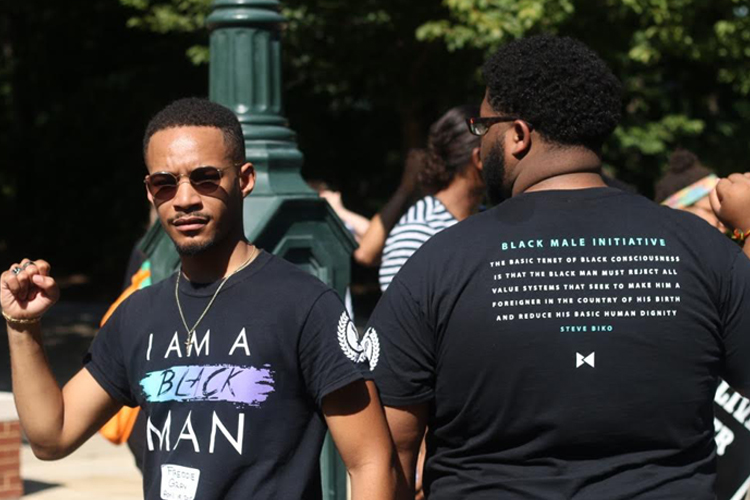
Peaceful Protests on North Plaza

Protest_4

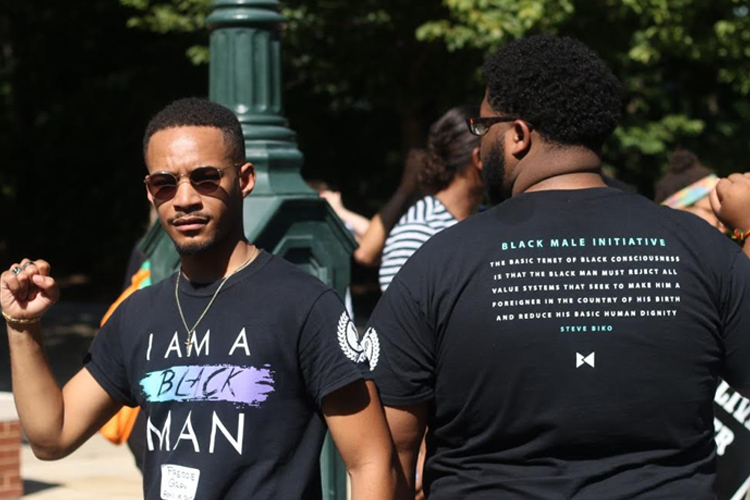
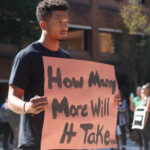
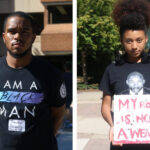
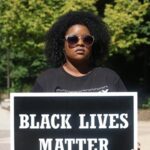
FAIRFAX, VA — In an effort to reclaim space on campus, a several black student organizations at George Mason University organized a peaceful demonstration on North Plaza this afternoon.

Students from all backgrounds joined the demonstration to stand in solidarity with the families directly affected by violence, raise awareness, and gather in unity as one student body.

With all that has happened across the country this week — protests, violence, and yet more black males fatally shot by police — we wondered if these events changed students’ views on the current presidential election. Mason Votes interviewed some of the student protestors asking the following question:

Do you feel that candidates are addressing the issues you have and does that impact whether or not you plan to vote?

Mason student Darius Simmingon responded this way: “As far as voting, yes I do plan to vote especially with what is at stake if I do not vote. I plan to vote democratic because Trump does not represent my values and only represents the corporate America. Racism will always be present regardless of where we are, but we will always be here and it is our job to protest against those who are racist, especially those who are against these peaceful protests. They are the ones that claim that racism doesn’t exist, but they are only able to say that because of the privileges that they hold. That is why I will vote for Hillary Clinton because Donald Trump’s values do not benefit me, nor the black community.”

Xavier Savannah agreed with Simmingon, adding, “Yes I will be voting and I plan to vote for Hillary because I do not agree with Trump’s stance on a lot of things. On the news we hear a lot about what is happening with the police shootings but not a lot of people are coming up with resolutions or are trying to fix the issue at hand and it’s irritating because we hear a lot of criticism.“

Breana Young stated that she believes the best way to create change is to vote: “Of course I will vote, regardless of whether or not I believe there should be other, better, candidates running. Our ancestors have gone through way too much for me not to go vote. Many have died and shed tears for this right, my right. Yes I will proudly go and be voting”.

Students like Simmingon, Savannah, and Young gathered during the event to converse on what actions they need to put forward to be heard and to help create a safe space for the minority community at Mason.

At the end of the peaceful protest, a crowd of students that had gathered around watch on their way to class clapped as the demonstration successfully concluded.

Reporting by Hannan “Nannie” Abubaker.

Photos by Kristopher Head.