Mason Votes

1-on-1 with Mason Votes: Colonel Chris Perkins

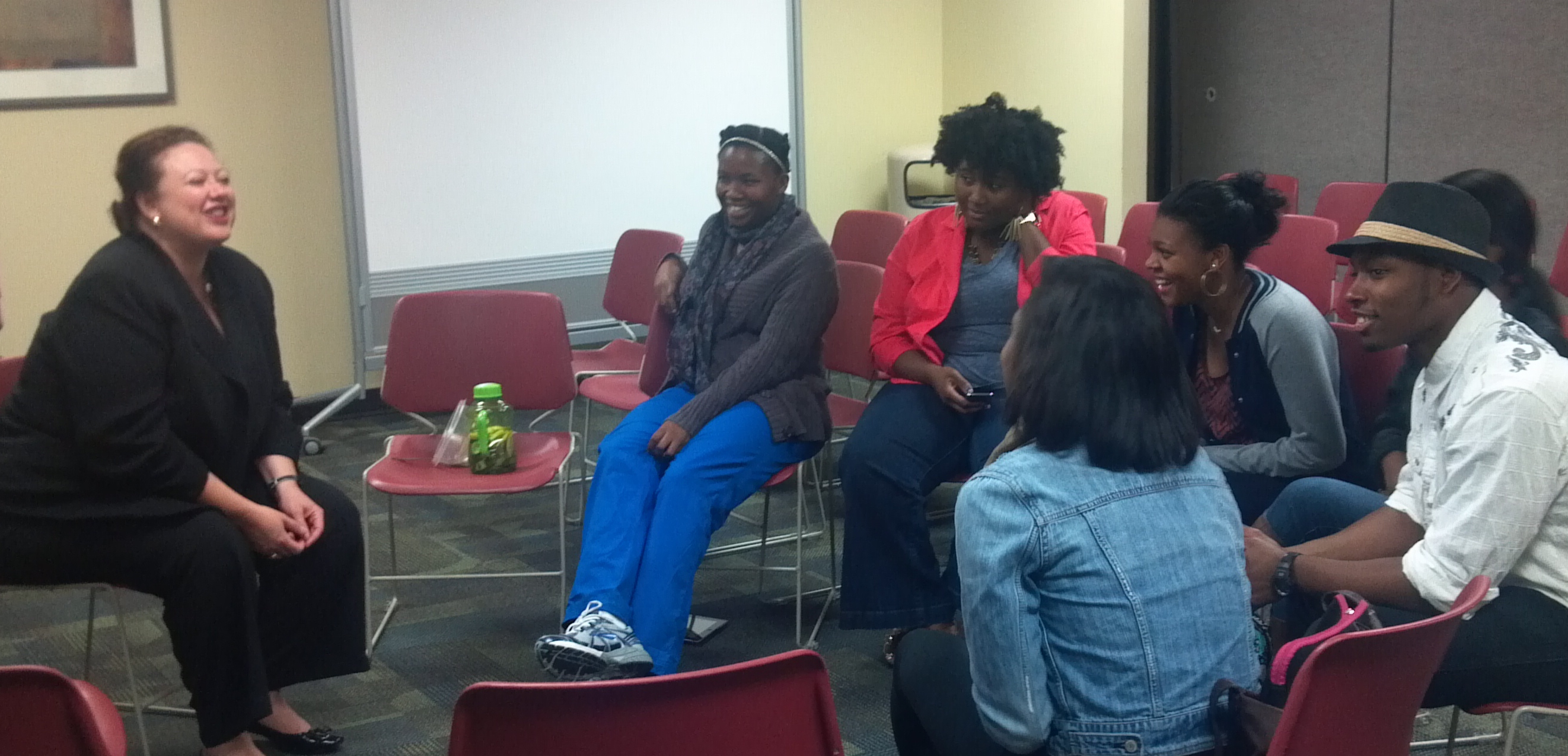
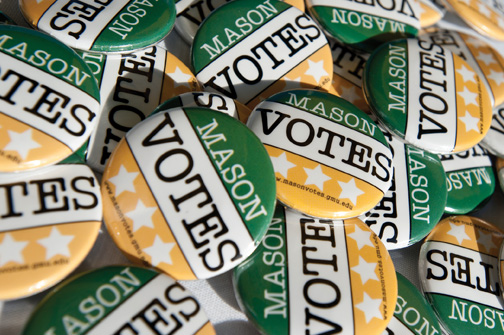
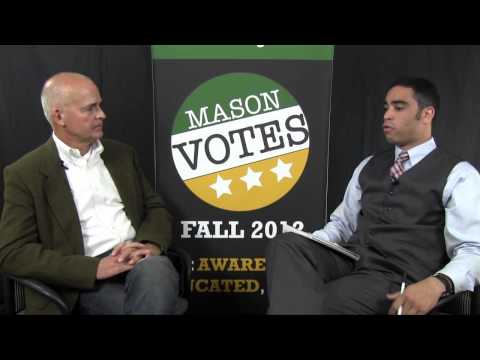
Mason Votes went 1-on-1 with Colonel Chris Perkins the Republican candidate for Virginia’s 11th congressional district. His opponent is Congressman Gerry Connolly.

Colonel Perkins spoke at length about the importance of this year’s election and shared his opinions opinions about how to best address the major challenges facing America.

To learn more about Colonel Perkins you can check out his campaign website here: http://www.perkins2012.com/

Here is our interview:

[youtube]http://www.youtube.com/watch?v=p-PlvtYB3lA&feature=g-all-u[/youtube]

Join Mason Votes and the Office of Student Media on Election Night

On Tuesday, November 6, Mason Votes in conjunction with the Office of Student Media is hosting a live election night show. The program will broadcast live from the Johnson Center Atrium and available via webcast at Connect2Mason.com, MasonCableNetwork.Com, and Mason Cable Network campus TV channel 231.

Be Aware, Get Educated, and Vote!

[youtube]http://www.youtube.com/watch?v=plP2z9bq-_Q[/youtube]

GMU Chapter of NAACP: “What’s Your Stance?” Series Oct.24 and Oct.11

The GMU chapter of NAACP has hosted two more “What’s Your Stance?” Series events in October. Below are coverage of each event: 

Event – October 24, 2012

On October 24, 2012 the GMU NAACP chapter continued their “What’s Your Stance” series introducing education issues and policies. Their guest speaker for the evening was Tina Hone, founder of Silence of the Coalition an organization launched in January 2012 in order to be the voice of underrepresented students in the Fairfax County Public School system. Hone discussed ways to bridge the achievement gap between White and Asian students and Black and Hispanic students in Fairfax County.

“I felt compelled to make sure the playing field was equal for every child in America.” said Hone.

According to Hone, Fairfax County Public Schools consists of mostly minority students compared to white students that were shown according to the Fairfax County website

(http://www.fairfaxcounty.gov/demogrph/pdf/2011_youth_survey_report.pdf), take up 44.5 percent of the population as of the 2011-2012 school year. Secondly, of the students in Fairfax County, 25 percent come from less fortunate families.

Hone continued the discussion mentioning the purpose of the No Child Left Behind Act, which is now referred to as the Elementary and Secondary Act (ESEA), is to bridge the achievement gap in schools.

“Not enough is being done to close this achievement gap. They have been trying to build the achievement gap since I was fourteen years old, and I am old.” said Hone.

Although Hone believes more should be done to bridge the gap, she commended President Obama on the work he has done to help education policies.

“In this campaign, we need to look at the pressure the President has put on education.” said Hone.

One of the issues Hone explained regarding mending the gap was the use of standardized tests within the state.

“African American poor people do less well on standardized tests.” said Hone.

Furthermore, the success rates for White and Asian students are higher than success rates for Black and Hispanic students. According to the Huffington Post (http://www.huffingtonpost.com/2012/08/23/virginia-new-achievement-based-on-race_n_1826624.html) 45 percent of Black students and 52 percent of Hispanic students are required to pass the math standardized tests as opposed to 68 percent of White students and 82 percent of Asian students being required to pass this test. Hone wants to make sure that each student has the same opportunity as their peers regardless of their racial background.

“The most pressing issue to me is for as many brothers and sisters from the poorest neighborhoods to make it out.” said Hone.

Even with a law degree, Hone was an instructor through the Teach for America program and expressed that she understood the challenges of teachers in the classroom. She mentioned the importance of programs like Teach for America.

“Some of our best teachers are asking to go to tougher schools.” said Hone.

A final issue that Hone brought up was about evaluating the teaching profession.

“There are still teachers teaching who don’t have our kids best interest at heart.” said Hone.

In Hone’s last remarks, she informed Mason students that in countries such as Finland, it is harder to be a teacher than getting accepted into Medical School.

Event – October 11, 2012

On October 11, 2012 the George Mason chapter of the National Association of Advancement of Colored People (NAACP) held their second segment of their “What’s Your Stance” series. The topic at hand was Women’s Health and Cortney Hughes-Rinker, a Mason Assistant Professor, Anthropology; Sociology & Anthropology led the discussion.

The first question asked was, “Why are women’s rights important in politics?”

Rinker continued with 4 solutions to the question. The first being, women’s bodies are fields of contest, the second being women should have control over their bodies and not a government with a majority of male politicians; the third being the concept on war on women is not just about women’s health; and lastly, politicians should not make women and their bodies interconnect.

Mason students were able to interact with Rinker and participated in a discussion regarding the presidential candidate initiatives on women’s health.

During this discussion, the topic of abortion was brought up where Veronica Ramos-Coreas, NAACP member, shared her thoughts on Planned Parenthood.

“Planned Parenthood doesn’t just perform abortions. There are contraceptive services and sex education provided also.” said Coreas.

Rinker mentioned that these issues are also social issues and men have different issues from women issues.

Beenish Butt, a senior stated that “men can’t have children and that alone is a major difference in men and women issues.”

Rinker informed Mason students that during this year, $16.8 million dollars were spent on Abortion ads in media alone.

Rinker also discussed topics in healthcare regarding women’s rights stating that “critics have claimed Romney’s plan of including more services for less money but not mentioning what services will be included are vague. Meanwhile, critics claim that Obama’s plan will take out money of elderly and taxes will increase to help preventative programs.”

By the end of the event, Mason students were asked what they thought the government’s role was in overreaching in healthcare.

“I want to know that the government should have regulations to prevent me from harming myself, but when it comes to my decision making, I want to have that freedom.” said Coreas.

Following the event, Ebonie Miller, biology major shared her thoughts on the event.

“It brought to light a lot of the issues that are never discussed. We talk about women’s issues but never talk about how policies affect our decision as women.” said Ebonie.

Electoral College Analysis: Six Days Out

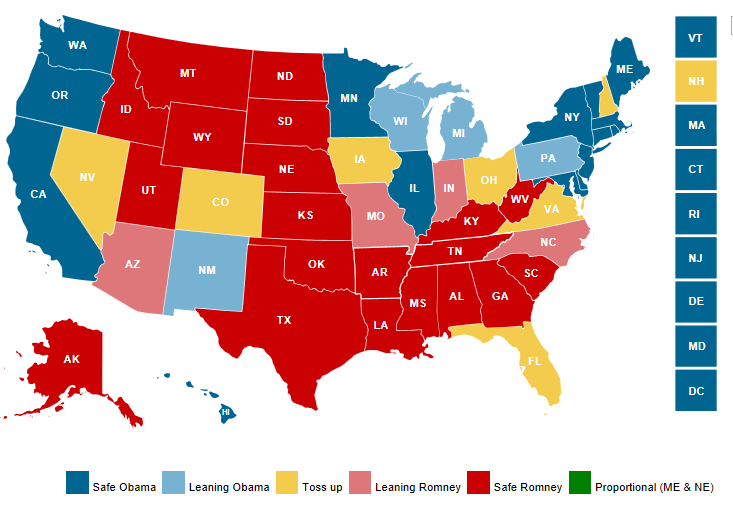
With just 6 days until Americans go to the polls, the electoral map is more congested and confusing than ever.  Polls are all over the place and the race seems to be tightening everywhere.  Let’s go through it.

Using the map from Real Clear Politics, there are 11 “toss up” states.  That distinction is given to states where the polling is +/- 5 points.  The electoral vote with out the 11 toss-ups is 201-191 Obama.  But in order to really attempt to predict anything, I’m going to put some of these states as leaners for Obama and Romney.

States like Pennsylvania, Michigan, Wisconsin, and Nevada seem pretty set as leaning towards Obama.  Romney seems to have a significant, albeit significant lead in North Carolina, Florida, and Virginia.  After allotting those votes, the race remains tight with Obama leading Romney 253-248.

There are 4 states left that are pure toss-ups.  Obama and Romney are within a single point of each other in New Hampshire, Iowa, Colorado, and Ohio.  Just 37 electoral votes are between these states.  However, taking nothing away from New Hampshire, Iowa, and Colorado; the state of Ohio really is the lynchpin of this election for both sides.  It’s 18 electoral votes would put Obama over 270 if he were to win it, and would put Romney just 4 votes short if he were to pull it out.

Many people may pontificate on TV about how they know exactly what will happen in Ohio or anywhere else, but this race is truly one that is too close to call.  The polling is simply too erratic and the margins just too close together.  It’s hard to believe that either candidate will pull away in the final days.  What’s more likely is that the race will be a turnout matchup.  Which side can get more of their side to the polls.  Most independents have made up their minds, and those that haven’t historically split anyway.  The winner of the Presidency on November 6 will be the team that can motivate their respective supporters to brave the weather and vote.  Down the final stretch, that’s where you can expect the focus to be.

Rommey’s Deception

Photo by: lepesunset on flickr.com

Last week, the Romney/ Ryan campaign once again proved that their primary strategy for this election is deception.

At a campaign rally in Ohio, a key battleground state and a major beneficiary of the 2009 auto bailout, Governor Romney informed the crowd of a story he had read earlier that day; stating “that one of the great manufacturers of this state, Jeep, now owned by the Italians, is thinking of moving all production to China.”  This was of course, far from accurate and a complete distortion of the article he was referring to, written in Bloomberg News.

Not only does Jeep have zero intention of moving all production from the U.S. to China, it has added about 7,000 jobs in North American since 2009.  In actuality, the article in which Romney was referring to, explains that Chrysler, who owns Jeep, would be reopening its plants in China due to the increase in demand of Chinese costumers, never implying they were halting American production.

Executive, Gualberto Ranieri at Chrysler was quick to respond with a statement denouncing Romney’s dishonesty, saying “Jeep has no intention of shifting production of its Jeep models out of North America to China…  A careful and unbiased reading of the Bloomberg take would have saved unnecessary fantasies and extravagant comments.”

What did Romney do next?  Apologize for his misrepresentation?  No.  Pretend that he had never made those comments and move on?  No.

Instead, he began airing an ad making the exact same accusation.

If Governor Romney would decide to run a commercial reiterating a fact he had already been publically ostracized for stating, one can only wonder what ethical decisions he would make as President.

*The views and opinions expressed are solely those of the author.

Are You Election Ready?

Check your Virginia voting registration status here: http://www.sbe.virginia.gov/Index.html

Election Day is fast approaching, it is important to come up with your voting plan for the election. Make sure to go to the Virginia Registration Lookup Tool to confirm that your registration information is correct. Check now before Election Day (Nov. 6, 2012).  Make sure that you know where your polling location is and how you are going to get there. Polls are open in Virginia from 6:00 a.m. – 7:00 p.m. on Tuesday, November 6.

If you are voting absentee in another Virginia locality, or outside Virginia, make sure that you know the application deadline. Applications in Virginia must be received by 5:00pm on Tuesday October 30.

As a reminder, student IDs are valid voter ID in Virginia, so make sure to bring your GMU student photo ID to the polls!  If you have any questions or see that your information is incorrect, please contact the Fairfax County Office of Elections at 703-222-0776.

Can’t make it to the polls on Election Day?

In Virginia you can cast an absentee ballot either in person or by mail.  Details are on the Virginia State Board of Elections site, http://www.sbe.virginia.gov/absenteevoting.html.

Here is a link to absentee voting locations in Fairfax Country, http://www.fairfaxcounty.gov/elections/absentee.htm.

Remember to Vote!

U.Va.-GMU Poll Shows Tight Race for Virginia’s 13 Electoral Votes

A University of Virginia/George Mason University poll shows Mitt Romney with a slim 1 percentage point lead over President Barack Obama in Virginia.

The poll showed 46 percent of registered voters are supporting Mitt Romney with 45 percent supporting President Obama. The poll also found that 2 percent are still undecided and another 2 percent are backing another candidate. The poll surveyed 641 registered voters in Virginia and has a margin of error of plus or minus four.

In a statement, Thomas Guterbock provided more detailed information about the registered voters that were polled. Guterbock said, “Slightly less than three-quarters of the voters backing each candidate say their support is very strong, with a large majority of undecided voters unwilling to report leaning toward a particular candidate.”

Third party candidates such as Libertarian Party candidate Gary Johnson, Constitution Party candidate Virgil Goode, and Green Party candidate Jill Stein could have an affect on the final outcome.

Virginia has 13 Electoral College votes. President Obama won the state in the 2008. Mitt Romney hopes to turn the state red again. The state is very important to both men’s path to the all important 270 Electoral College number.

Photo by | Dakota Cunningham C2M

Student Reactions to Final Debate

Connect2Mason‘s Video Editor, Trevor DeSaussure, was on the scene at the the final Debate Watch Party, Monday, October 22, held in the Johnson Center Atrium to ask for student reactions to the final presidential debate between President Barack Obama and Governor Mitt Romney.

[youtube]http://www.youtube.com/watch?v=AUPXiA0L6Jo&feature=share&list=UU1TuP1898FOdPrvng_HGDCA[/youtube]


Higher Education: Candidates Clash on Key Issue

Job creation, health care, and women’s rights seem to be hot topics of discussion this presidential election but rest assured, candidates have not forgotten about a key issue on every college students mind; higher education.

President Obama and Governor Romney both broadly support the expansion of higher education yet hold very different viewpoints on how it should be funded.

One of the biggest differences is that President Obama supports government intervention in the loan-giving process while Governor Romney supports private lending.

In the past 4 years, President Obama has doubled government funding for need-based federal Pell Grants. Mitt Romney’s policy states that he would curb funding for Pell Grants and focus on awarding grants to students who ‘need them the most.’

In 2010, President Obama signed the student reform act into law, which lowers the cost of federal student loans and permits students to repay their loans at low, fixed percentages for up to 20 years. Funding was cut from private lending so the Education Department now grants all federally backed loans. The Obama administration claims that cutting out private lenders will keep student costs low. The GOP platform, which Mitt Romney supports, calls for a repeal of this legislation.

Obama’s primary focus is to make college accessible and affordable for more Americans by continuing the award of Pell Grants and federal lending. Romney plans to refocus government attention on higher education reform by focusing on the success of students already in college. Romney claims that the inflation in tuition rates is due to federal intervention and that once the federal government removes itself from the lending process, tuition prices will stop rising.

Consider these substantially different education platforms when casting your ballot this November.

Opinion: One in the Same

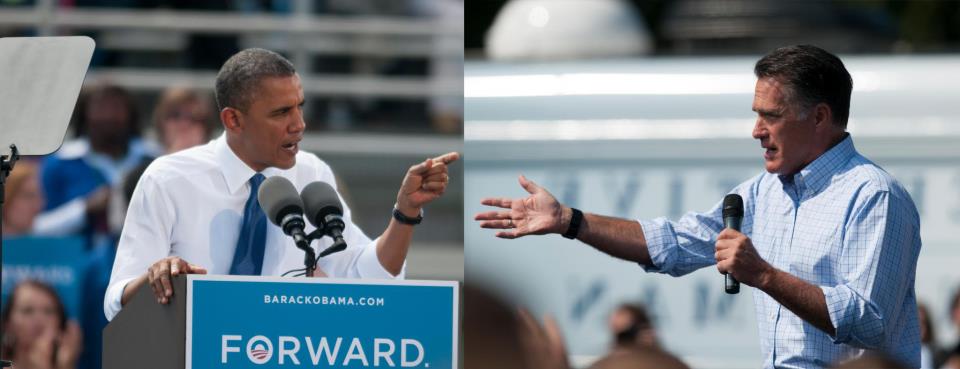
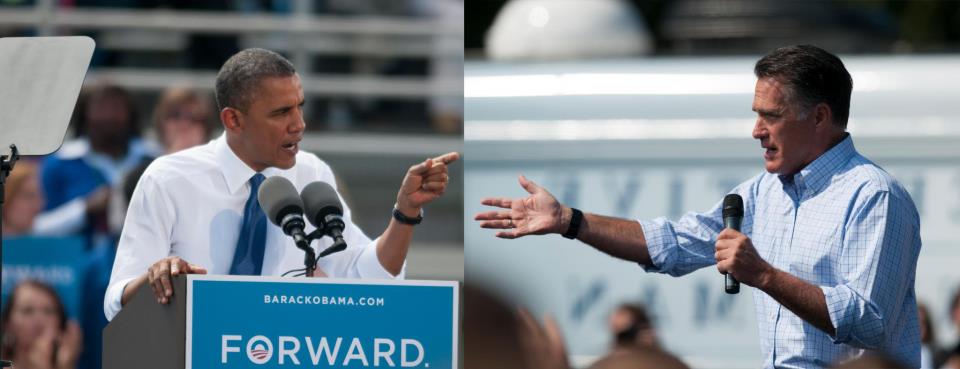
The objective of the final presidential debate was to determine if Governor Romney or President Obama scored higher on the “ability to seem like the Commander in Chief” test.  And while Romney was not as bellicose as he was in the second debate, he undeniably received a lower grade, unable to hide his discomfort discussing foreign policy.

Romney spent the entirety of the debate altering his past positions and agreeing with President Obama; differentiating himself only by stating the he would have done what the President did, but somehow better.  Obama made sure to point this out, expressing joy that the Governor was now supporting his foreign policy on a number of occasions.

Romney explained that because of the President’s leadership, Iran was now four years closer to a nuclear weapon, but that the Obama Administration was right in imposing the sanctions that have put the rouge state in economic turmoil; lacking any explanation as to how his policy over the next four years would be any different.  While discussing the current civil war in Syria he criticized the President for not taking a strong enough stance against al-Assad, but gave no specific alternatives, explaining that he would continue what Obama is already doing.  Romney also declared that he would fulfill the President’s plan to remove troops in Afghanistan by 2014, contradicting his previous position to evaluate the situation before making a final decision to drawdown.

Romney tried to detract from his obvious inexperience and past positions by continuously dancing his way to the left, mentioning his desire for peace, more often than not, and seizing any opportunity he had to reference the economy.

In the globalized world that now exists, discussion of the economy and education was appropriate, as foreign issues have understandably become domestic ones; but it replaced many foreign policy matters that should have been debated.  Neither candidate mentioned the Eurozone crisis, or the effects that it is sure to have on America.  Nor was there any real discussion of Latin America or any East Asian countries other than China.  While the Middle East is of obvious importance to America’s national security, it must not be forgotten that the rest of the world exists.  Over the last four years we have seen the President work with NATO to help defeat an oppressive regime in Libya and work with European leaders regarding their financial crisis.  Last night was Romney’s chance to prove that he is aware there are more than two regions in the world, and he missed the opportunity.

Governor Romney needed to show the American people that he would be a strong alternative to Obama, but instead he presented himself as a more nervous version of the current President.

 *The views and opinions expressed are solely those of the author.