Mason Votes

Inside Job

Cover photo by Nathan Moore

President Barack Obama made a stop in Woodbridge on Friday, September 21, 2012 to fire up his base and to also reiterate the goals and guiding principles of his campaign. These ideas ranged from strengthening American manufacturing to tackling the national deficit. The subject that stole the show was not the economy, but the President’s claim that Romney wants to pull an “inside job” in Washington. This came as a rebuttal of a recent Romney attack focusing on a quote from the President when he appeared on the Spanish language TV channel Univision. On this channel the President declared, “You cannot change Washington from the inside.” Romney quickly jumped on the opportunity to voice another five second opinion and claimed that the President was throwing in “the white flag of surrender,” and admitting he could do nothing to solve America’s problems. Many of the political ads and banter over the past few weeks have been less than noble, but this assertion is especially hollow because Romney said the exact same thing verbatim, in 2008. Since the Romney campaign will not be dictated by fact checkers, this quote will most likely be lost in the wave of attack ads and gaffes that will undoubtedly flood the mainstream media in the upcoming weeks, and this will not be the only thing lost in the noise.

Beyond the glow and glare of the superficial jabs in the political arena, Obama’s use of the phrase “inside job” draws attention to a serious problem facing the country that is often ignored. What is ignored is that the very economic system guiding the country may be the real problem; not Democrats, or Republicans, but capitalism itself. This is surely the view of many of the Occupy protesters who made their voices heard in 2011. It continues to be a pervasive, yet elusive element of the political dialogue. Perhaps some form of “inside job” is needed, where the very system that shapes and dominates the lives of billions is transformed, from the inside out.

With the spotlight constantly shining down on Obama and Romney, it is easy to forget that there are still serious problems within the capitalist system that may not be able to be solved by simply electing a new President or supporting a new party. No one on Wall Street has been criminally convicted for the 2008 financial crisis that devastated millions of people around the world. More recently economist Richard Duncan stated, “Civilization may not survive the death spiral,” of debt America has accumulated. In the face of these facts, both Obama and Romney continue to offer up “solutions” to help the Middle Class, none of which even hint at the core of the problem. These problems consist of corporate greed, big money in politics, a military-industrial complex that feeds on global war, and unsustainable practices that threaten the only planet known to support life in the universe.

Obama’s mentioning of sustainable practices at the Woodbridge rally are hard to reconcile with the capitalist system that is inherently unsustainable. On one hand, sustainability is not profitable to corporations that need the products they sell to expire in a timely fashion so consumers need to buy more and more. On the other hand, as long as lobbyists and financial interests have the undivided attention of politicians and policy makers, sustainability will be nothing but rhetoric, not reality. Obama’s “All of the Above” energy policy that supports the use of both fossil fuels and renewable energy may not be enough to curb what the International Energy Agency has called “irreversible climate change” the Earth will face in five years unless drastic measures are taken immediately. It is clear that what is needed to solve many of America’s, and the world’s problems, is not a new President or a new party, but an entirely new system.

Senator Mark Warner, who introduced Obama at Friday’s rally, started a chant with the words “Guard the Change.” However, the change that America needs to end economic inequality, war, and destructive climate change, has not yet happened and will not happen under a Democrat or a Republican, as long as they are operating within a capitalist, for profit, system. An inside job is needed; one that addresses real issues and offers real solutions. The inside job that Mitt Romney has to offer is nothing more than a continuation of the destructive policies that have proven unquestionably inefficient and undeniably inhumane and oppressive to a majority of the population. The “outside job” of change President Obama spoke of will be equally flawed if that change has its base in a capitalist system that breeds corruption and class struggle.

At the Woodbridge rally the President did a great job, as he always does, of getting his supporters excited and delivering a powerful and rousing speech. Immediately after the teleprompters are turned off and the microphones go silent the real problems are still there, lurking beneath the surface of party politics, largely ignored by the mainstream media, and eating away at the very existence of society and the planet. No one should expect either Presidential candidate to begin to oppose capitalism or offer up new solutions, but ordinary people living under a callous and rigged system can come together and begin to move toward a brighter horizon. The people are not powerless and do not have to depend on an inefficient system to fix problems that threaten the very existence of the human species and the planet Earth. Yes, an inside job is needed, but not one that involves the same political practices that were an accomplice to the 2008 financial crisis and will be complicit in the next. An inside job that addresses the rotting decay at the black heart of the American government and capitalist system is what is needed. The people, united and marching under no banner but their own, can come together to begin to address these issues in a meaningful way. No one speech, no one man, no one party, can save America from self-destruction, only the people, operating under a whole new system can preserve the planet for future generations of lovers and dreamers.
Tim Kaine and George Allen Debate Recap

George Allen Post Debate Press Conference:

[youtube]http://www.youtube.com/watch?v=2TfFmQ9ta9k&feature=g-upl[/youtube]

Tim Kaine Post Debate Press Conference:

[youtube]http://www.youtube.com/watch?v=3jS2506QgkI&feature=g-upl[/youtube]

On Thursday September 2o, 2012 George Allen and Tim Kaine squared off in another debate. The two men are campaigning for the open United States Senate seat from Virginia being vacated by the current Democratic senator Jim Webb. Senator Webb decided not to run for a second term in the senate after serving for six years.

The debate was held at the Capital One Conference Center in McLean, Virginia. Sponsoring the debate was the Fairfax County Chamber of Commerce. David Gregory of NBC, host of Meet the Press moderated the debate. Also joining Mr. Gregory in asking questions were NBC4’s Julie Carey, Aaron Gilchrist, and the Washington Post’s Ben Pershing.

Tim Kaine a Democrat and George Allen a Republican have both been governors of Virginia, and George Allen has held one of the two U.S. Senate seats from Virginia. He lost his re-election bid in 2006. Both men were asked tough questions from David Gregory and the panel. Those questions spanned a wide rang topics; topics such as education, economics, national security/foreign policy, and social issues. Both held there own on the stage and held nothing back when attacking each others records as governor, and in Governor Kaine’s case he also attacked Governor Allen’s record during his service in the U.S. Senate.

The attacks on one another’s records didn’t stop once the debate was over. After the debate both men held press conferences to answer questions from the media who were in attendance. You can watch both press conferences by clicking on the videos above.

Virginia’s senate race is one of the most watched in the country. The winner of this race may have a direct impact on the outcome of whether or not the Democrats hold on to their majority in the senate, or if the Republicans take back control. Recent polling out this week from the Washington Post and Quinnipiac University show Tim Kaine with a 7 to 8 point lead over George Allen. This marks the fifth straight poll showing the Democrat ahead. There are still several weeks until the election, and things can change. Both men will continue to campaign vigorously until Election Day on November 6th, 2012.

Before you Cast Your Ballot

Article By: Ryan Symons

I was recently introduced to an article written by Georgetown University professor Hans Noel. The piece is titled “Ten Things Political Scientists Know that You Don’t”, and generally challenges what some see as conventional wisdom in American Politics. I am in no way attempting to challenge the information laid out in this article, only extending Mr. Noel’s views and research to the readers of Mason Votes. In attempt to educate the uninformed and the “informed” reader during this election season, here are the ten things political scientists know that you don’t:

It’s the Fundamentals, Stupid

If it seems as if networks like CNN, Fox, and MSNBC thrive at over-analyzing political events, especially during an election year, you are probably right. A percentage of Americans rely on the analysis and break down of political events by these networks in order to form an overall opinion on the subject matter or person. Others have a pre-conceived ideological stance, and others could care less. The question is all this analysis necessary? According to Noel, “Presidential elections can be forecast with incredible accuracy well before the campaign really begins.” If you look at the state of the economy, you will have a fare idea how the party in power will do. Noel also points to important facts such as whether the country is at war, and how ideologically moderate the candidate is. The fundamentals can even be applied to midterm elections. With no surprise the voter’s opinion on the President plays a significant role in how the midterm elections turn out. The President’s party usually always loses a significant number of seats during the mid-term elections in a down economy. Political pundits and analysts always like to complicate their predictions, but if you go back to the fundamentals, the answer will be out in the open.


The Will of the People is Incredibly Hard to Put Your Finger on

How do you know when a politician is lying to you? When he or she tells you that they know what “The American People” want. Really, do you actually know what each of the three hundred million plus Americans that live in this country want? Highly unlikely, but yes, we do firmly believe in majority rule. That said, the poll system we use in order to determine how the majority feels is not a fool proof tool. Most people who interpret the polls have no idea how to read the polls, and the pulse of the poll can be severely affected by the wording of the question. In my opinion, there are too many variables and too many opportunities for manipulation to fully trust a poll. Noel has instead offered research findings on public opinion.

1.)    Most people are not very ideological

2.)    Most people do not have strong political opinions

3.)    Most people take cues from political parties and leaders

4.)    Let the polls be the polls – polls are very good when they ask very specific questions.


The Will of the People May Not Even Exist

The best explanation I could give to describe this is to physically show you an excerpt of Noel’s piece outlining collective rational.


Collectively Rational: “The American people,” as a collective, should behave

as though they are rational. This means, for example, that if the group

prefers Obama to McCain and it prefers McCain to Romney, then it ought to

prefer Obama to Romney. Otherwise, we have a cycle that could never be

settled. Individual people may sometimes fail to meet this standard of

“rationality”, of course, but we do not want our system of voting to introduce

more irrationality.”


There is No Such Thing as A Mandate

This section, again, is a section that can be best explained by extracting an excerpt from Noel’s piece. This small excerpt outlines what happens following an election with regards to the “mandate” given to the person who was democratically elected.


“In a narrow sense, winning the election gives you a “mandate.” You are

now legally empowered to exercise your authority. But after every election,

pundits will declare a more complex “mandate.” They will tell you not simply

who won, but what that victory means. The winners won because they promised

X and voters wanted Y and were afraid of Z.”


“These narratives are created after the fact by people who want you to think

one thing or another (Grossback, Peterson, and Stimson, 2006, 2007). Winners

claim a mandate to change everything, and losers explain it all away as an

anomaly. But exit polls saying that some voters cared about some things are thin

reeds on which to spin out the will of the people.”


Duverger: It’s the Law

If you are not familiar with Duverger’s law, it states that the simple-majority simple-ballot system favors the two party system. There have certainly been cases around the world to contradict that notion; however, the American political system seems to be different. If the American people ever wanted a competitive third party, it would need an electoral reform. The Tea Party, Green Party, and Independents might just have to wait until these reforms become a reality to seriously challenge for the White House.


Party On

Forgive me if I am misinterpreting, and I do encourage all readers to read the original piece. It is just a reality, no matter who the American people elect, that they will not come together with other members of Congress to find the best deal for the American people. They will find the best deal for their party, whether that is Democratic or Republican. Each party is elected on the specific platform they presented throughout their campaign and that is what is expected to be carried out. This has led to intense polarization of the parties today and will surely play a role in November.


Most Independents are Closet Partisans

When you hear that the independent vote will be critical in the upcoming election, call the bluff. Noel argues that independents are not all that independent when you look at it closely. Independents tend to vote as an “independent”, but it seems as if their independent vote generally looks rather partisan. If an independent keeps voting for the same party with little to no change are they still considered independent?


Special Interests Are A Political Fiction

All of us are backers of “special interests.” We each tend to favor certain pro-environment, pro-business, pro-union, etc. A special interest is an interest opposed to the “general interest”, but if you subscribe to previous views laid out, there is no such thing. Can we fully grasp the “general interest”? Is there such thing as a “general interest”? If not than there is no way a special interest can exist.


The Grass Does Not Grow By Itself

Grassroots movements, largely, are not actually very root-y at all. Think of it how Noel explained it. People generally don’t just go out and spontaneously rally. Someone hosts a rally and invites people to come. Two examples I can think of were Glenn Beck’s “Rally to Restore Honor” and John Stewart and Stephen Colbert’s “Rally to Restore Sanity and/or Fear.” It is the same thing with grassroots movements; they involve some sort of central planning. So just like the President’s grassroots movement, the Tea Party activists might be saddened to hear that it wasn’t very grassroots-y at all, yet funded from a central organization, probably the Republican party [my own opinion].


We Do Not Know What You Think You Know

A Few things to leave you with:

1. Money buys the votes of the general public. (Maybe savvy donors just

donate to candidates who will win in the hopes of influencing them.)

2. Money buys the votes of elected legislators. (Maybe savvy donors just

donate to candidates who will vote the way they would like, and not to

those who would not.)

3. Parties influence the votes of elected legislators. (Maybe politicians just

sort themselves into the parties they agree with in the first place.)

4. Some candidates are just better campaigners than others.

5. Democracy leads to economic growth. (Maybe economic growth enables

democracy. Or maybe they are spuriously related.)

6. Autocracy leads to economic growth. (Maybe economic performance

enables dictators to hold onto power.)

7. The media is biased. (Maybe they are just trying to tell us what they think

we want to hear.)

8. Voters make choices based on their own self-interest. (Maybe they

rationalize their choices in this way.)

9. Voters choose the candidate that is closer to their own preferences.

10. People are more likely to vote when they think the election will be close.

11. And at least one political scientist, probably many, will insist that some

number of the previous nine items also belong on this list.

To read the original piece I am responding to written by Hans Noel click this link: http://www.ib.ethz.ch/teaching/pwgrundlagen/noel2010_forum.pdf

The views, facts, and opinions introduced in this article are that of the author of the original article, Hans Noel, unless otherwise specified.

The Anniversary of Occupy Wall Street and the Future of Democracy

Article By: Nathan Moore

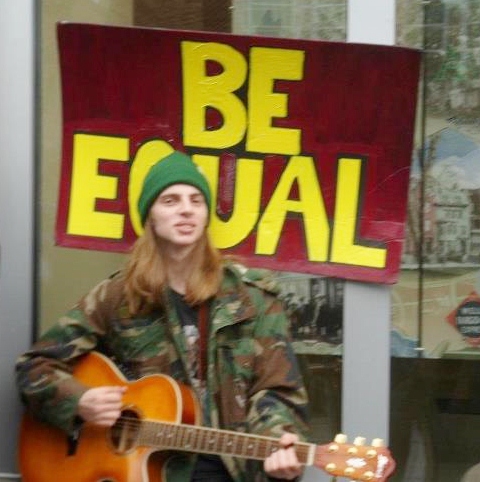
Photo By|  Fibonacci Blue

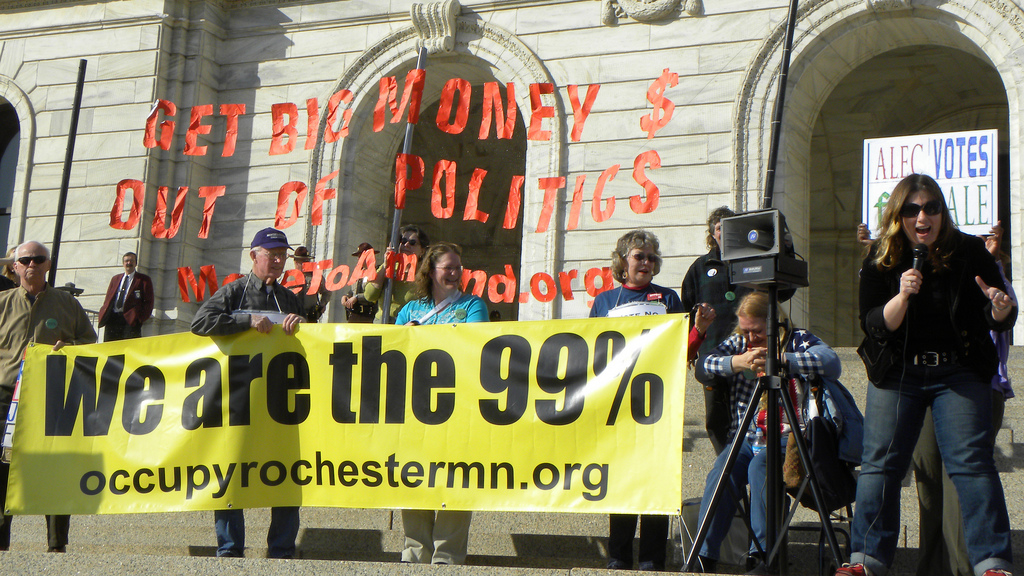
Monday, September 17th marks the one year anniversary of Occupy Wall Street. One year ago a small group of protesters poured into the streets of New York to draw attention to income inequality, government corruption, and corporate greed, leading to Occupation movements sprouting up all over the United States and eventually spreading across the entire planet. Although many have questioned Occupy’s impact and have been quick to point to its waning momentum, the Occupy movement accomplished its goal of redirecting the national conversation to focus on issues that have long been excluded from the mainstream political dialogue, such as the worst economic inequality since the Great Depression and the overwhelming and undemocratic force of money in modern politics. On this anniversary it should be remembered that it was the Occupy protesters who delivered the now ubiquitous 1% and 99%  slogans to America, pointing to a very real problem that has still not been meaningfully addressed by either the Democrats or Republicans.

Even if the numbers at the protests have dwindled and the initial energy of the Movement has died down there are still important lessons to draw from Occupy; the most pertinent being their reluctance to support a political candidate. Unlike the Tea Party who rallied behind and elected many politicians, Occupy has never endorsed a candidate nor do they intend to in the foreseeable future. Their reluctance to stand behind the Democrats or Republicans points to the very real fact that many American voters are disillusioned with both parties and are now seeking alternatives like the Green Party, Constitution Party, Libertarians, and Socialists. Beyond exploring alternative party politics, Occupy sought to engage people in the political process on a real and human level. Occupy reflected the idea that true Democracy does not always blossom from a vote, but often requires people to take to the streets and rediscover their shared humanity and common struggle. They nurtured the idea that when reform is no longer possible and the system is rigged for the financial elite, the 99% must come together in solidarity to peacefully fight for a better future for all.

The Occupy Movement, which lit a fire in thousands across the country in 2011, suffered a brutal and callous response from authority figures and politicians alike, but it has not disappeared. Recently a magnificent documentary tracing the origins and future of the Occupy Movement entitled American Autumn: An Occudoc spread across the internet, and in D.C. many Occupiers have splintered off into work groups, most notably, Occupy Our Homes DC, a group who fights against unlawful and inhumane home foreclosures. The anniversary of the Occupy Movement will see many teach-ins, marches, rallies, and protests, but whether or not the anniversary draws out as many people as in 2011 is irrelevant. Occupy succeeded in its mission of drawing America’s attention to real problems that still need real solutions. The Occupiers do not believe these solutions will be found among the Democrats and Republicans. They believe the change the country needs will not come from one man or one party, but from the people, practicing real Democracy; Democracy that is not bought with billions of dollars or represented by a single politician, but lived and breathed by the people, the 99%.

*The views and opinions expressed are solely those of the author.

VP Candidate Paul Ryan speaks to Values Voters in DC

Republican Vice Presidential candidate Rep. Paul Ryan spoke this morning at the Values Voter Summit in Washington, DC this morning.  The gathering is the premiere assembly of social conservatives in the nation.  Mason Votes was on hand to cover the speech.

Ryan spoke on a number of topics and they weren’t limited to social issues like abortion or gay marriage.  What made headlines was his words on the American embassy attacks this week that left four U.S. workers killed, including the Ambassador to Libya.  He said, “We know who we are dealing with in these attacks.  They are extremists who operate by violence and intimidation.  And the least equivocation or mixed signal only makes them bolder.”  He further declared, “American foreign policy needs moral clarity and firmness of purpose.”

Ryan then shifted to a major line of attack on the President’s record regarding the economy.  “The Obama agenda failed not because it was stopped, but because it was passed.”  He pointed out the amid all the talk of Mitt Romney leaving out certain words or topics from his convention speech, President Obama left out the words ‘unemployment’, ‘record’, and ‘recovery’.  Ryan slammed Obama for a failure to keep his promises saying, “If Barack Obama’s promises weren’t good then [2008], what good are they now?”

The main meat of the Ryan address was debunking what he called the President’s “straw man arguments”.  He said of Obama, “No one is better at rebuking nonexistent opinions.”  On the President’s promise to bring the poverty rate down, Ryan argued that, “After four years…just about every segment of society is worse off.”  Ryan also rebuked the line from the DNC that “government is the only thing we all belong to” by saying that during his seven swearing ins to Congress he never swore an oath to the government, he swore it to, “support and defend the Constitution of the United States under which government is limited and people are sovereign.”  Ryan also maintained his strong pro-life stance as well as attacking Obama for his support of abortion.

Ryan did have to contend with two separate interruptions from liberal protesters.  Each time, Ryan seemed to brush it off and the crowd chanted the protesters down.

Ryan finished by citing that a majority of Americans believe we’re on the wrong path.  His solution is to point out “there’s an exit up ahead and it’s marked: November 6, 2012.”

You can watch the full speech HERE.

First Lady Michelle Obama speaks with College Press

Photo by|U.S. Department of Labor

Hours before she addressed the Democratic National Convention, First Lady Michelle Obama held a press conference with college students from all around the country. With the election coming up, the First Lady was not shy in her assessment of the role the youth vote will play come November. Naturally this conversation was focused around the issues that are on the minds of every college student across the nation: cost of attendance, and student loans.

The First Lady made sure that each and every person on the call understood that both she and President Obama realized the harsh reality that an education today doesn’t come cheap. As all of us here at George Mason University and other colleges and universities across the country have seen; the price to be educated is not getting any cheaper. She stressed that her and the President have only reached the heights they are at today due to the education they received. It was entirely clear that if re-elected, President Obama and Secretary of Education Arne Duncan would continue to make education reform a top priority in bringing America forward. Both the First Lady and President Obama see an education not as a luxury but as an economic necessity. In order to have first class citizens, you first need a first class education.

The numbers don’t lie. America is behind their global peers in terms of education. If America wants to continue to be the hub of innovation and ingenuity it is today, as a nation, we must tackle the problems surrounding education in our country.

Attending college is not an economic reality for everyone in our country. The First Lady pointed to her husband’s doubling of Pell Grant as a sign that he has young people and their futures in mind when making decisions related to education. She wanted us all to know that we are the engine of her husband’s campaign. Young people, specifically college students, are being counted on to mobilize as many people as possible this upcoming election season.

The few pieces of advice Mrs. Obama had for college students was to join Obama support groups, and to register friends and relatives who aren’t yet registered to vote. The role of young people in this election is going to be huge, regardless of your political affiliation. If you are a Republican, Democrat, Libertarian, Independent, etc. it does not matter. What matters is that you involve yourself in the Democratic process. As a generation we must “Be Aware, Get Educated, and Vote!”

With regards to how First Lady Michelle Obama felt about this upcoming election, she had this to say:

“We are going to win this.”

League of Conservation Voters: Membership Engagement Campaign Internship


Title:Intern – Membership                                           Status:Unpaid

Reports To: LCV Volunteer Coordinator                Job description: Virginia is a critical state in the 2012 election cycle with candidates such as President Obama and Tim Kaine on the ballot. The League of Conservation Voters (LCV) seeks interns to assist with a membership engagement campaign in the Northern Virginia region.  Qualified interns will have excellent interpersonal skills, committed interest in environmental issues and elections, and proficiency with Microsoft Suite and the capacity to learn new programs. No previous experience necessary. Class credit available if needed.

General Description: The League of Conservation Voters (LCV) is a national non-profit organization that works to turn environmental values into national priorities. To secure the environmental future of our planet, LCV advocates for sound environmental policies, elects pro-environment candidates who will adopt and implement such policies, and provides state LCVs with the resources and tools to accomplish and sustain their mission.  More information can be found at www.lcv.org .

Duties:

  • Specialized phone calls to LCV membership
  • Participate in campaign activities with federal candidate campaigns
  • Facilitate membership outreach events, including logistical planning and volunteer management
  • Help elect pro-environment candidates to federal office

Expected hours: Minimum weekly commitment of five hours

Applicants should submit their resume and a brief paragraph describing their skills and interests to [email protected]

Applications are accepted on a rolling basis. However, interested applicants are encouraged to apply in a timely manner.

Fall for the Book Presents “2012 Election Panel: Choices for November”

With the presidential election looming, Fall for the Book welcomes four scholars to offer in-depth perspectives on the issues at stake for the politicians, the parties, and the voters:David Maraniss, author of the new biography of the president, Barack Obama: The StoryScott Keeter, director of survey research at the Pew Research Center and co-author of A New Engagement? Political Participation, Civic Life, and the Changing American CitizenLinda Killian, journalist, senior scholar at the Woodrow Wilson International Center for Scholars, and author of The Swing Vote: The Untapped Power of Independents; and Elizabeth Price Foley, professor of constitutional law at Florida International University College of Law and author of The Tea Party: Three PrinciplesSponsored by Gale Cengage.

The event is free and open to the public. The event will be held on the George Mason Fairfax campus on Friday September 28, at 1:30pm in Research Hall, Room. 163.


Get Involved with Mason Votes

Are you interested in politics, journalism, or both? Mason Votes is looking for reporters, writers, researchers, photographers, and videographers to help cover this year’s elections. It’s important as students and young people to be aware, get educated, and vote.

Mason Votes is a place where students can come and learn where each candidate stands on the major issues. We offer a non-partisan evaluation of their positions and let the facts speak for themselves.

[youtube]http://www.youtube.com/watch?v=Gv7dRGASt3k[/youtube]

Visit studentmedia.gmu.edu to find out more on how you can apply to get involved. You can also visit the Office of Student Media on the ground floor of the Hub (formerly known as Sub 2).