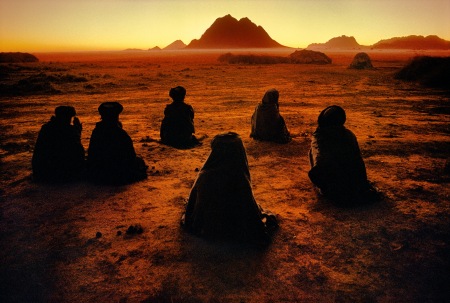
Photo from | http://stevemccurry.wordpress.com
After 9/11, the United States entered Afghanistan to fight back against those who attacked us on our own soil. It’s been about twelve years since we established a ground presence in Afghanistan, yet we are still fighting today. The question I pose is how many people in the United States took the time to educate themselves on those we are fighting? By educating I do not mean listening to what MSNBC, Fox, and CNN have to say about them. I mean did anyone take a real interest in educating themselves through research as to who these people actually are. The answer is, probably and sadly, not many. We are so quick to sputter out reasoning and to publicly accuse the teachings of an unfamiliar religion as being the catalyst to these attacks. So I pitch to you a topic revolving around the lifestyle and cultural make-up of those we are currently at war with. For the ill-informed or wrongly informed, it may surprise.
Islam has always battled for precedence over the tribal communities in Northern Pakistan and Afghanistan. Specifically, the Pashtun tribes of Pakistan and Afghanistan have always been deeply rooted in tribal tradition. It was Muhammad who united the feuding Bedouin tribes and instilled in them the teachings of Islam. Ever since then the Pashtun tribes have seen no distinction between being Pashtun and being a Muslim. The one glaring difference is the tribe’s strict adherence to the ancient honor code of Pukhtunwali. While being a Muslim and being a Pashtun are believed to be one in the same by those who practice, the tribal tradition has continued to take a notable precedence over the teachings of Islam.
The Pashtun tribes are primarily located on either side of the Afghanistan-Pakistan border along the Durand Line and Hindu Kush Mountain Range. It is an area Pashtuns themselves call Pashtunistan because they do not recognize the Durand Line as a legitimate border. Having said that, Pashtun populations are not restricted solely to those areas, as the Pashtun people hold a plurality throughout Afghanistan and inhabit a distinct portion of the Northwest Frontier Province (NWFP), specifically the Federally Administered Tribal Area of Pakistan (FATA) (Barfield). The Afghan Pashtuns are, again, part of the plurality within the population of Afghanistan while the Pashtuns in the FATA are a semi-autonomous group of people with little ties to the state of Pakistan. Pashtuns from more settled areas of the NWFP, however; are centrally governed by the Pakistani state in Peshawar Province (Barfield). These tribes were around centuries before the states of Afghanistan and Pakistan.
The tribal society is broken down into segments. At its lowest level is a sub-section also referred to as a kor, then there is a section or khel, sub-clan or beg, clan, tribe, and eventually the overall Pashtun ethnic group (Amato). As Ahmed said of the Mohmand tribe:
“The Mohmands must be understood within a phyletic context – that of Pukhtuness – and a religious context – that of being Muslim. Every Mohmand carries a blue-print in his mind of five concentric circles that emanate from ego and place him in his universe: the tribal sub-section (Kado Khel in Bela Mohamandan); the clan (Tarakzai); the tribe (Mohmand); the ethnic group (Pukhtun); and the religion (Islam)” (Ahmed, 320).
The Pashtuns are not a tribe but an ethnicity of people. Within the Pashtun ethnicity are a series of tribes, clans, sections, subsections, etc. These tribes are different from one another and often feud. There are two defining characteristics that are shared between the various tribes; the tribal honor code of Pukhtunwali and its roots in Islam. Pukhtunwali was around centuries before the creation of Islamic law.
The tribes of Arabia that predated the prophet Muhammad were characterized by raiding and feuding amongst one another, fighting for livestock, territory, and honor (Salzman). Much like he did with the people of Medina, Muhammad united these tribes under a constitution for all Arabs with an inclusive structure giving tribes a god given identity as Muslims (Salzman). Changing years of societal norms and beliefs did not come easy. The tribes had only known conflict and the mindset of “us against them.” In order for Islam to take root in these tribal societies and garner a distinct umma, it was essential that a balanced opposition was created in the form of the Muslim to the infidel, and the dar al-islam (the land of Islam and peace) to the dar al-harb (the land of the infidels and conflict) (Salzman). A group pitting themselves against another group is the catalyst for the creation of a civilization. In the case of these Arabian tribes, it was the creation of the Muslim civilization. For the Pashtun tribes, it is not as clear. While the Pashtun tribes, and many of the tribes that still exist today, did identify and accept the teachings of Islam, they still strictly adhere to their ancient societal codes. The only difference that is recognized or pointed out is that these Pashtuns strongly believe that their honor code, Pukhtunwali, runs hand in hand with the teachings of Islam.
Pukhtunwali translates literally into “the way of the Pashtuns” and defines the identity of those who follow it (Kakar). Pukhtunwali is an ancient tribal honor code followed by the Pashtun people. In a Pashtun society, to live without honor is to not exist. Pashtuns who no longer follow Pukhtunwali are no longer considered Pashtuns and are secluded from the community and all the benefits it offers (Kakar). Pukhtunwali incorporates many codes, but focus will be put on the codes of nang, melmastia, badal, namus, and jirga.
Nang translates literally to “honor”, but the word honor does not accurately depict the meaning of the word in terms of the Pashto language. Nang is the central authority of Pukhtunwali. Nang is often talked about in two principles: practices in battle and defense of honor (Kakar). As eluded to earlier, to live without honor in a Pashtun society is to not exist. It is considered nang to engage in battle to protect those in your tribe, and it is also nang to act in retaliation to an insult with superior force than that of the insulter (Kakar). With these acts Pashtuns prove their honor through their willingness to fight for the tribe against potential oppressive powers, and also defend the honor of the tribe in the event of insult.
Melmastia is the code of hospitality. Under this code of Pukhtunwali, Pashtuns are required to provide hospitality to anyone who seeks it, including enemies (Jaspal). Pashtuns are required to house, cloth, feed, give gifts, and provide security to their guests (Kakar). While the majority of these aspects are covered under melmastia, providing security falls under a different code called nanawati (Kakar). Nanawati requires Pashtuns to provide security to all of their guests and to fight for them as if they were one of their own. Nanawati is also an outlet where people can ask for revenge-conflict, or badal, to end (Kakar).
Much like melmastia and nanawati, badal is a core element of nang. Badal is the code of revenge to restore honor that often revolves around the variables of women, wealth, and land (Hussain, 21). If insult is brought upon the tribe, under Pukhtunwali it is warranted and encouraged to seek revenge against the insulter in order to restore honor of the tribe. Again, going back to the importance of honor in a Pashtun society, it is often thought that if revenge is not sought after by those that were insulted, then they are exhibiting shameless and dishonorable traits (Hussain, 21). Like the honor of the tribe, the honor of women is also upheld under namus.
Namus involves both men and women but Pashtuns often refer to it as the “defense of the honor of women” (Dupree, 126). Namus is integral in maintaining the gender segregated nature of Pashtun society (Kakar). It is deemed dishonorable if a man enters a women’s compound having no relation to any of the women and is grounds for expulsion from the community (Kakar). Without upholding the honor of women it would be impossible to be involved in jirga which is the governing body of Pashtun tribes.
Jirga is a council set up under Pukhtunwali that has legislative authority to make binding decisions (Dakar). The tribal elders who make-up the Jirga must exhibit great honor and must follow the code of Pukhtunwali strictly. As mentioned above, the FATA of Pakistan is semi-autonomous and has little to no interaction with the state. Jirga is the closest thing you can get to an acting government in this area. Though the Pashtun people of Pakistan, and in some respects Afghanistan, don’t align themselves with a state, they certainly align themselves with a religion; Islam.
I am not trying to say that anyone who belongs to a Pashtun tribe or speaks the Pashto language is at war with the United States. Nor am I saying that any tribe member that just happens to live in Northern Pakistan or Afghanistan is fighting against the United States. All I am doing is trying to inform the reader as to whom it is that make up the majority of people we are engaged in battle with in this region. I do not do this region justice in this adequate but rather simplistic explanation of its people. I challenge you to educate yourself on the matter. Maybe you too will break outside the bubble of a sound-bite media.