Mason Votes

John McCain Suspends Campaign

Republican Presidential Nominee John McCain has just announced that he is suspending his campaign. McCain campaign headquarters stated that he will continue the suspension until “the economic crisis is over.” McCain has asked Democratic Presidential Candidate Barack Obama to suspend his campaign as well and postpone Friday’s debate on foreign policy. Obama’s campaign has yet to comment.

Youth asks: The older the wiser?

by Katherine Libby, United Press International

As the presidential election nears, the George Mason University campus is buzzing with students talking politics, dispelling the myth that the nation’s youth simply don’t care.

One student changing the reputation of young voters is Zach Rosen, a communication major at George Mason University. Rosen, known for his happy-go-lucky attitude, is serious about this year’s presidential election and believes that there are a few key issues that matter most.

Among his top concerns are the war in Iraq, energy and the economy. What this election might really come down to for Rosen and many other young voters is the age and experience of the next president.

“McCain has been involved in politics for a long time, but his age is a big liability,” he said. “And although I agree with some of his policies and respect the sacrifices he made for our country, if something were to happen to him our nation would be at the hands of a pretty inexperienced governor.”

Although at age 72, the Republican presidential candidate would not be the oldest president to hold office, McCain’s “green” conservative running mate Alaska Gov. Sarah Palin may have made Independents and moderate Republicans think twice about the reality of such possibilities. “I mean, four years is a long time,” Rosen said.

Republican vice-presidential nominee Palin is not the only one being scrutinized by students at George Mason, however. Many students on campus question whether or not if after serving only five years in the U.S. Senate, Barack Obama is ready to lead the country.

“Barack may not have as much experience as McCain, but his running mate, Sen. Joe Biden certainly does,” Rosen said. “So that’s the question; do I care more about age or experience of my president, and my vice president?”

And at one of the nation’s most diverse college campuses, Rosen isn’t the only student to be concerned with these two major issues.

“It comes up a lot in conversation at school,” he said. “And I’ve realized that the people who are affected most by this issue are people who are not loyal to a specific party, which is a great portion of young voters.”

As the students at George Mason are forced to choose between more than just age and experience in the upcoming election, it is clear that youth have their own voice.

“I think young people are finally starting to realize that to make changes in our country we have to actually do something about it,” Rosen said. “It’s like the importance of a (the) vote has finally settled in.”

From: The Voice of Young Voters

VA Board of Elections Accused of Attempting to Confuse Students

By Noah Martin

The Virginia State Board of Elections has been accused of possibly trying to confuse student voters. In an effort to make registering to vote easier for students, the Board has posted a self-guided questionnaire on their website.

Representatives from the Brennan Center for Justice at New York University Law School have raised concerns about the questionnaire and have sent a letter to Secretary of Virginia State Board of Elections, Nancy Rodriguez, requesting that the questionnaire be changed or removed from the website.

Jennifer Rosenburg, fellow at the Brennan Center for Justice, and Wendy Weiser, Deputy Director of the Democracy Program at the Brennan center for Justice wrote in the letter, “The questionnaire may actually confuse, mislead, and intimidate student voters.” According to them, the questionnaire asks students personal questions and questions that are irrelevant to determining voter residency.

When asked about whether she thought there were ulterior motives for posting the questionnaire, Rosenburg replied, “Its impossible to get inside another person’s head. Possibly it was trying to discourage student voters, but I don’t know.”

The questionnaire consists of 11 questions, most with multiple steps, and helps the student determine whether to vote in the state of Virginia or their home state if they lived in another state prior to attending college or university.

While a completed questionnaire is not required in order to register to vote, the Virginia State Board of Elections decided to post it as a tool to be used by students if desired. “The questionnaire has been around for some time internally and has been used by registrars to help students determine whether they want to vote in Virginia or in an other state,” said Valarie Jones, Deputy Secretary for the State Board of Elections, “its for the voter to make their own decision.”

Questions pertaining to enrollment status, tax dependent status and type of tuition paid by the student, in or out-of-state, are some of the questions that Rosenburg and Weiser cite in their letter as irrelevant which might intimidate student voters. In their letter, they express the secondary concern that students may be misled into believing that registering to vote will affect their tuition or tax status. “In virtually all cases, registering to vote has no impact on such matters,” Rosenburg and Weiser wrote.

In response to accusations that the questionnaire was hindering students from registering to vote, Deputy Secretary Jones stated, “I can tell you, students are signing up in droves to vote in the state of Virginia.”

Rosenburg’s alternative for students is the Brennan Center For Justice’s Legal Guide for Student Voting, a web tool designed to inform students of their rights as voters and to dispel myths about the registration process and its possible consequences.

To view the Virginia State Board of Election’s student questionnaire and decide for yourself go here

To view Rosenburg and Weiser’s letter in response to the questionnaire go here

Presidential Debate Watch this Friday

By Noah Martin

The outcome of a televised debate is about more than a candidate’s response to the questions, so come to the Johnson Center atrium at George Mason University for a Debate Watch party this Friday to view Senator Barack Obama (D-Illinois) and Senator John McCain (R-Arizona) confront each other over issues of foreign policy and national security and hear detailed analysis from a panel of experts.

The debate itself begins at 9 p.m. but at 8 p.m. a panel comprised of Mason professors and representatives from local Republican and Democratic committees will discuss campaign issues. The panel will include Communications Professors Steve Klein and Stephen Farnsworth and New Century College professor of communication and rhetoric Janette Muir.

Immediately following the debate, panelists will give their impressions of each of the candidate’s performance and discuss them with the audience.

The debate watch is sponsored by Mason Votes, C-SPAN, Cox Communications and New Century College.

Hispanic and Latinos Rock the Vote!

Today, Sept. 23, a Rock the Vote event focusing on Mason’s Hispanic and Latino communities is being held in the SUB1 Patriot Lounge at 7 p.m. As part of Hispanic Heritage Month, students will be discussing how the Hispanic/Latino community can affect the 2008 presidential elections.

You can register to vote at this event.

The event is sponsored by Latinas Promovienda Comunidad/Lambda Pi Chi Sorority, Inc., Mu Chapter, the Hispanic Student Association, and the Peer Empowerment Program, and co-sponsored by the College Democrats and College Republicans.

Author David Bacon Talks about Illegal Immigration

By Noah Martin

David Bacon, photojournalist, author, and immigration rights activist, spoke at George Mason yesterday as a part of the Fall for the Book program.

Bacon came to speak specifically about his new book Illegal People but addressed the larger issues of immigration rights today, the current credit crunch, the War On Terror, the immigration policy of both major party presidential candidates and the housing market collapse.

Bacon explained that there are currently more than 200 million people living outside their country of origin, approximately 5 percent of the world’s population. He emphasized the effect that North American Free Trade Agreement has had on people all over the world, not just the population movement between the U.S. and Mexico.

NAFTA was intended to create free movement of labor and goods across North American borders. When it came into effect, U.S. corporations able to cover overhead costs either moved their manufacturing out of the country or out-sourced to foreign contractors in order to take advantage of lower labor costs. Zero-sum logic and popular sentiment suggest that if people lost jobs in the U.S. then people in other countries gained an equivalent number of jobs. However, Bacon claimed, unemployment increased in both countries. When NAFTA came into effect, American workers lost jobs, primarily in the manufacturing sector, while Mexico also lost over a million jobs.

The Clinton Administration delivered a $20 billion bailout to Mexico. According to Bacon, the money was cycled through subsidiaries of large U.S. financial institutions in Mexico City and back into the U.S. market. Mexico’s oil revenues, which account for the largest percentage of Mexico’s gross national product, went to pay off the debt instead of towards Mexico’s social infrastructure – schools, hospitals, public housing, etc.

In addition to collecting oil revenues, said Bacon, Mexico was forced to cut subsidies on corn production. Because of subsidized agribusiness in the US, it became cheaper for people to buy imported corn from U.S. Farmers. Mexicans who could no longer make a living wage off of corn farming became dislocated workers. “That tells you something about the inequality of trade agreements,” Bacon said.

Bacon claimed that NAFTA has caused the displacement of peoples and the migration of over 6 million people to the U.S. “If you go to Mexico today, the saying goes, that not one family doesn’t have someone working in the United States,” said Bacon.

Undocumented, rather than illegal, is the term that Bacon prefers to describe migrant workers who come to the U.S. This preference, he claimed, is not a simple matter of semantics. 12 million people work in the United States without documentation. The relatively small group of people that would use the term “illegal” do it to demonize immigration into the U.S.

While undocumented simply connotes being unaccounted for, illegal connotes a difference in status and value as a human being. “Is that difference in status a benefit to people in this country?” Bacon asked.

He cited the civil rights movement as an example of the point he was trying to make. English speakers do not use the words “colored” or “negro” anymore. This is not simply because the language changed but because the civil rights movement challenged the social reality of citizens and caused a change in language as a result. Colored and negro could be used only as long as an oppressed voice was excluded from the social reality. But during and after the civil rights movement, terms used by members of the movement to describe themselves became part of the language spoken by citizens of the changed social reality.

“The important thing is to change the reality of the social situation in order to change the terms used to describe a difference in status,” Bacon said.

He continued his address by tracing the history of how certain races and nationalities were excluded from the social reality by not being recognized by the law. The trend he claimed, was that immigrants were recognized as workers but only as workers, not as human beings.

“Today, this same idea is being replicated. People are increasingly being charged with criminal violations for working or crossing the border in the United States,” Bacon said.

Formerly working without the proper documentation in the United States was a civil offense. Violators were required to leave and if they did not do so voluntarily, they were deported. Today, working without proper documentation is a criminal offense. When arrested, violators are taken to court and then ushered off to privatized federal prison where they serve as a free labor force.

The crime of misusing social security numbers associated with migrant workers is different than popularly presented, said Bacon. 12 million people work without immigration documents. People come here to work and need social security numbers. When they cannot obtain them through the proper channels, they make up, buy, or steal numbers. Social security puts money into a suspense fund if the number does not match up with worker using the number. The money from that suspense fund is used for the retirement plans and medical benefits of U.S. citizens. In other words, social security revenue generated by migrant workers actually benefits the retired generations of U.S. citizens, claimed Bacon.

Guest worker programs are a solution to the immigration swell proposed by many legislators claiming to be pro-immigration. Under these plans, employers would be allowed to recruit people and bring them to the United States. Under these programs however, workers cannot bring their families and are forced to leave if their job is terminated.

Walmart, Marriot Corporation, and other industries relying on immigrant labor have supported guest worker plans. The goal of these programs, said Bacon, is to convert the workforce into a controllable workforce in industries dependent on undocumented labor. Guest worker programs create a workforce tied to their employer without recourse to legal rights or political voice.

“Do we want immigration policy that recognizes people and their families or only people as workers,” Bacon asked.

Our focus, Bacon claimed, should be on the social status we want for people working in the United States. It determines the status of people when they are here, it does not dissuade or prevent people from coming here.

When asked how best to deal with a predatory system of immigration policy Bacon responded, “Face the reality, don’t debate immigration policy on the one hand and then pass free trade agreements. I like a diversity of people but immigration should be a voluntary process. First we need to deal with the status of migrant workers. They need to have a status. We have to make it possible for people to come here legally and not cross the desert. We have to figure out an immigration policy that will allow people to come back and forth [across the U.S.- Mexico border] without fear of reprisal. We have to protect the rights of people.”

To find out more about David Bacon, his work, or to obtain a copy of his book Illegal People, go to  http://dbacon.igc.org.

Albright Talks Foreign Policy at Mason

By David Pierce, courtesy of Broadside

Former U.S. Secretary of State Madeleine Albright spoke at a foreign policy town hall meeting, sponsored by presidential nominee Sen. Barack Obama’s campaign, Saturday in Dewberry Hall. She was part of a three-person panel that included terrorism expert Richard Clarke and Rep. Jane Harman (D.-Calif.)

Albright, 71, introduced herself as a life-long scholar of national security policy and expressed her opinion about the current global scene. “I don’t think I have ever seen the world in such a mess and that is a diplomatic term,” Albrigh said.

Albright outlined major foreign policy issues that she felt the next president has to face once elected. She explained that the country needs to fight terrorism without creating more terrorists in the process, placing blame on the Bush administration. “Even former Secretary of Defense Rumsfeld said we were creating more terrorists,” Albright said, adding “not everybody who dislikes us is part of Al Qaeda.”

The former secretary of state claimed our nonproliferation system was broken. She said that the original agreement was that nations with nuclear arms should disarm, while those who do not have nuclear weapons should not acquire them. “Both sides of that bargain have been broken,” said Albright. She felt that the United States has not disarmed and that North Korea has exploded a nuclear weapon, both occurring while President Bush has been in office.

Albright also expressed concern regarding the negative aspects of globalization, especially the expanding gap between the rich and the poor. She felt that the recent financial crisis affecting the global stock market was of major concern to the next president, as well as the importance of talking to our enemies as a diplomatic tool.

“When President Obama suggests we talk to Iran, it is a sign of strength, not of weakness,” explained Albright. She had some advice for President Bush, “You don’t say to a country ‘I won’t talk to you until you do all of the things that we are actually going to talk about,’” said Albright, “which is what is going on now [in the Bush administration].”

Harman assured the audience of the capability of Senators Obama (D-Il.) and Joe Biden (D-Del.), if elected. “Democratic women and men understand security issues,” claimed Harman adding “It’s a slam dunk for Obama-Biden.” She also criticized the Bush administration’s handling of the September 11 terrorist attacks and the war in Iraq. “We’ve had seven years to capture, or kill, Osama bin Laden,” said Harman, “[Instead we] went into Iraq, and took our eye off the ball.”

Clark began his speech by emphasizing the importance of Virginia in the 2008 general election. “This is the battleground state,” exclaimed Clarke, “We could be the pivot of this election.” He expressed his support for Obama by saying that he was right for calling for a troop withdrawal timetable, an action that was opposed by the White House. “The Bush administration just agreed to a withdrawal timetable with the Iraqi government,” said Clarke.

Albright and Clarke both criticized Republican presidential candidate Senator John McCain (R.-Ariz.) “I very much want to see a confident president, rather than a certain president,” said Albright. Richard Clarke questioned McCain’s judgment. “When McCain was singing about bombing Iran,” Clarke said, “Obama was suggesting that we use something called diplomacy first.”

Questions were briefly accepted from the audience as the event neared conclusion. When asked about Republican claims that Obama does not have the experience required to become President, Albright immediately replied “I’ll start by saying they are totally wrong.” She further explained that Obama is a person of incredible judgment and wisdom. “He knows the difference between the Sunnis and the Shias [in Iraq],” said Albright, adding “he has also served very well on the foreign relations committee.”

Immediate feedback from audience members after the speech concluded was varied. Ian Cook, a Vienna resident, said “I was more taken by Richard Clarke.” Cook also expressed criticism of Albright’s support of Obama, saying that the other panelists supported the Democratic presidential nominee more than she did.

Jim Pflieger, a Fairfax resident, was very pleased with Albright’s speech. “I wish I could’ve gotten a CD of [her] speech to use it to convert independents over to Obama… She had a very convincing argument.”

When Oscar Ramirez, the Virginia policy director for the Obama campaign, asked at the beginning of the event if there were any undecided voters in the audience, three hands were raised. By the conclusion of the event, one of those voters claimed to have decided to vote for Senator Obama.

Biden Holds Women’s Rally in Loudoun County

Senator Joe Biden and his wife Jill Biden, Ph.D., held a women’s rally in Sterling, VA this morning, where they touted the need to have equal pay for equal work, a women’s right to choose, better healthcare options, tax credits for education and the right to privacy.

Mason Votes was there to provide live blogging, available on http://www.twitter.com/masonvotes, and the complete audio available soon.

Mason Professors Discuss Political Ideology in America

by Noah Martin

George Mason University’s School of Public Policy will host Bruce L.R. Smith, Jeremy D. Mayer, and Lee Fritschler, authors of Closed Minds? Politics and Ideology in American Universities, on the Arlington campus in the Original building room 244 on Friday from 6:00 – 7:30pm.

Smith, Mayer, and Fritschler will lecture on their new book which suggests that the political landscape of American universities has shifted since the pinnacle of student political involvement during the 1960s. Now, according to the authors, universities have withdrawn from the arena of politics, rather than the commonly held belief that universities are mainstays of liberal political ideology.

Smith is a former professor of political science at Columbia University, a staff member at the Brookings Institution and is currently a visiting professor at the School of Public Policy at Mason.

Mayer is an associate professor at the School of Public Policy at Mason. He is the author of Running on Race: Racial Politics in Presidential Campaigns 1960 – 2000.

Fritschler is professor and director of executive education at the School of Public Policy at Mason. 

For more information on the presentation contact [email protected].

What’s Going on Right Now, Wednesday

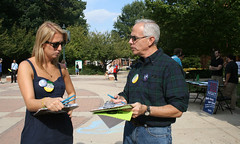
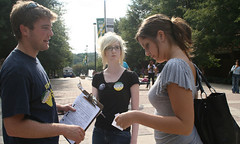
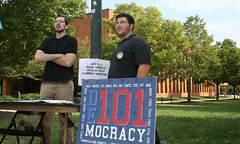
CNN is on campus covering students registering to vote


CNN Interviews Students about Election


Students Register to Vote


ec2228b0016a4a9688b1ae20742f89ff5db841f31f6c4b5682d9a142285f4be3  


VA-21 on Campus


2219129b4a264814aec0eb23a94bfdb1