Connect2Mason interviews students to find which national candidate they prefer.
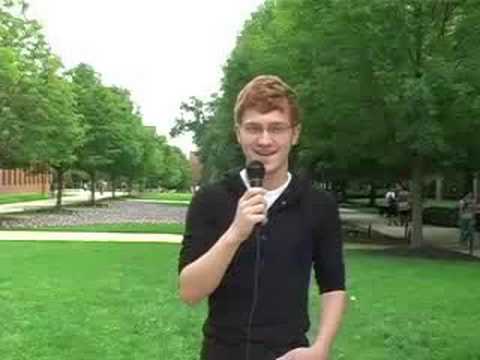
Connect2Mason interviews students to find which national candidate they prefer.
The Feminist Majority Foundation, a non-partisan organization, will be on campus this Wednesday presenting in classes and registering students to vote. Check out their newest video!

At George Mason University, volunteers for Presidential Nominee Barack Obama’s campaign are registering 50-60 students to vote everyday.
“Being a recent college graduate myself, I know a lot of students forget to register or forget to register in the right place. I want to make sure everyone gets a chance to register to vote in what’s going to be a very important election,” said Ben Leiotta who coordinates the registration efforts.
Registering Democrats and Republicans alike, volunteers staff a table outside the Johnson Center Monday through Friday and, when staff numbers permit, approach students to ensure they are registered properly.
According to volunteers, reactions to their presence have been positive. The group coordinates efforts at Northern Virginia Community College as well.

The new Student Media film club and Mason Votes is showing “The Future of Food” and “Trashed” this Wednesday from 7:30 – 9:30 p.m at Harris Theatre.
“The Future of Food” is a documentary filmed on location in the United States, Canada and Mexico which investigates the distribution of unlabeled, patented, genetically engineered foods. It follows farmers who have been negatively impacted by new food technology and provides solutions to the farm crisis. “Trashed” documents the trash disposal industry and the impact of “seemingly innocuous act of ‘taking out the garbage.’”
For more information on these films go to http://www.thefutureoffood.com/ and http://www.trashedmovie.com/
Content Editor Christian Yingling interviews Libertarian presidential candidate Bob Barr after he spoke at George Mason University.
Content Editor Christian Yingling facilitates a roundtable discussion between George Mason University’s College Republicans and College Democrats. Who is the best candidate for students? What’s going on in local elections? Student experts explore the answers.
The excitement was palpable at Van Dyke Park in Fairfax, Virginia this morning at a rally held by Republican Presidential and Vice Presidential Nominees John McCain and Sarah Palin. “I look forward to seeing the environment here because Northern Virginia is primarily always Democrat. It made me excited to know I’m not one of [only] 20 Republicans up in here,” said junior George Mason University student Chris Brooks.
Today, a lot more than 20 Republicans showed up. According to McCain’s campaign there were 23,000 people in attendance but according to security, 25,0000 came. Either of these counts more than doubles the population of the City of Fairfax. “[This is] the largest turnout for Senator McCain so far on the campaign route,” said Rob Lederer, Mayor of Fairfax City.
McCain’s campaign took advantage of the large crowd and distributed names and phone numbers of potential voters. During the rally Orson Swindle, who was a prisoner of war at Hanoi Hilton with McCain, directed the crowd to participate in a mass phone bank by calling their assigned potential voters during the rally and campaigning on behalf of the McCain/Palin ticket.
The rally continued with former Senator Fred Thompson, who accused Democratic Presidential Nominee Barack Obama of thinking that “running for president is a qualification to be president.”
When McCain and Palin arrived on stage with their spouses, the response from the crowd was overwhelming. “I am honored to be considered on this team of mavericks,” said Palin, whose speech heavily accentuated her success and experience as governor of Alaska and mayor of Wasilla, Alaska. She stressed her fiscal leadership by highlighting her state’s budget surplus. “We gave that money back to hard working Alaskans and in these tough times, I’m ready to join John McCain in Washington and we’re going to do the same thing: tax relief for all Americans.”
“I championed earmark reform also,” said Palin, referring to the practice of directing specific amounts of money to specific projects within Federal agencies. “While our opponent [Obama] was requesting a billion dollars in earmarks as a senatorial privilege, what I was doing was vetoing half a billion as an executive responsibility.”
Palin also underscored the need for innovative energy options. “We are going to make this nation energy independent,” she said. “We need American resources brought to you by American ingenuity and produced by American workers.”
As Palin introduced McCain, who had been standing by her side during her speech, the crowd erupted in applause and cheers. “Thank you all of Northern Virginia,” responded McCain. “My friends, the Commonwealth of Virginia is a battleground state, we must win it and we will win it with your support.”
Taking Obama’s theme of change, McCain said, “Let me offer an advance warning to the old, big spending, do nothing – me first, country second, Washington crowd: change is coming, change is coming and it’s coming to our nation’s capital.”
“That’s what this campaign is all about: change and reform.”
Like Palin, McCain addressed the need for a new energy plan and criticized the government takeover yesterday of Fannie Mae and Freddie Mac. “We need to keep people in their homes but we can’t allow this to turn into a bailout of Wall Street speculators and irresponsible executives.”
“All you’ve ever asked of the government is for it to stand by your side and not in your way. That’s just what I intend to do.”
McCain hit Obama hard on his lack of experience with national security and ended his speech by saying “I want to be president of the United States because I know I can inspire a generation of Americans to serve a cause greater than their self interest and themselves…I’ve always put my country first and my friends you can count on that.”
“I thought it went really well. He made a lot of points that I completely agree with,” said Woodard.
“I really enjoyed it. I found it really inspiring…I found myself crying,” said Mason alumna Kristell Forensca. “I think [Palin] is incredible. As soon as she walked out on stage, I started tearing … it’s so inspiring because she is a woman…having her as a candidate is just an amazing accomplishment.”
Not everyone was as inspired as Foresnca however. According to security at the event, approximately 100 protestors were present. Heated exchanges occurred between supporters of the rival candidates before, during and after the rally. There were media reports of a number of protest groups at the event including the American Federation of Labor and Congress of Industrial Organizations, Greenpeace and Code Pink.
If you have videos or pictures from the rally, send them to [email protected]
George Mason University has just released a press release listing all the professors who are available to comment on the Presidential Election. The list is sorted by the professors area of expertise and lists names, contact information, and their areas of experience.
TIP SHEET: GEORGE MASON UNIVERSITY PROFESSORS AVAILABLE TO COMMENT ON PRESIDENTIAL ELECTION ISSUES
September 4, 2008
Media Contact: James Greif, [email protected] 703-993-9118
Following are George Mason University faculty experts with knowledge in areas of the presidency and political campaigning.
CHARACTER, MORALITY AND APPEARANCE OF THE PRESIDENT
James Pfiffner
Professor in the School of Public Policy
Expertise: the U.S. presidency, American national government, public management
In addition to lecturing at the State, Justice and Defense Departments, Pfiffner has lectured at universities throughout the United States and Europe. He has written or edited 10 books on the presidency and American government and served in the director’s office of the U.S. Office of Personnel Management. Pfiffner is a decorated war veteran and has been listed in “Who’s Who in America” in 2000.
Media Contact: James Greif, 703-993-9118, [email protected]
Peter Pober
Director, Forensics Team, and Associate Professor of Communication
Expertise: Public speaking, communication
Pober is the director of the nationally ranked forensics team and an expert in public speaking and presidential debates. He can discuss the importance of public speaking and communication in campaigning, and how public speaking can affect one’s image. He can also give tips on effective public speaking for someone in a leadership role.
Media Contact: Tara Laskowski, 703-993-8815, [email protected]
PRESIDENTIAL ELECTIONS AND CAMPAIGNS
Jon Gould
Associate Professor and Director, Center for Justice, Law & Society
Expertise: presidential campaigns, campaign finance reform, international legal and electoral development
Gould served as counselor to the campaign manager of the Clinton/Gore 1996 presidential campaign, and on the legal staff of the 1988 Dukakis/Bentsen presidential campaign. He can provide details on political marketing and campaign strategy.
Media Contact: James Greif, 703-993-9118, [email protected]
Allison Hayward
Assistant Professor of Law
Expertise: Election law, campaign finance law, constitutional law, ethics
Hayward has written broadly on campaign finance and election regulation, in both the academic and popular press. Previously Hayward practiced election law in California and in the District of Columbia. She is a member of the State Bar of California, the District of Columbia Bar, United States Supreme Court Bar and the Eastern District of California Bar.
Media Contact: James Greif, 703-993-9118, [email protected]
Janette Muir
Associate Professor, New Century College
Expertise: Political campaigns, political advertising, first ladies
Muir can discuss the role of political communication in campaigns. She can also talk about political advertising and presidential ads, political debates, gender differences in communication and problems with media coverage. She is very interested in engaging citizens in critical thinking about political campaigns and helping them to become better informed voters. In January 2008, she will be taking a group of younger voters to the New Hampshire primaries to study youth engagement in politics.
Media Contact: Tara Laskowski, 703-993-8815, [email protected]
Solon Simmons
Assistant Professor, Institute for Conflict Analysis and Resolution
Expertise: Presidential and congressional elections, class and culture politics, third-party candidates, political views of college professors
Simmons has published widely regarding American elections, the role of outsider presidential candidates and the role of class and culture in politics. His academic interests include the discussion of values and political narratives in the television era as well as examination of the fault lines in American politics over the past half-century. He has also conducted a study of political views and political correctness of faculty members in U.S. colleges and universities. His research has been widely covered in national media including The New York Times, The Washington Post, “The Today Show”, NPR and “Meet the Press”.
Media Contact: James Greif, 703-993-9118, [email protected]
PRESIDENTIAL HISTORY
Richard Norton Smith
Scholar-in-Residence of History and Public Policy
Expertise: Presidential history
Smith is a presidential historian and former head of six presidential libraries. He can discuss presidential trivia, trends and movements in presidential history, past elections, and most anything and everything related to the presidency.
Media Contact: Tara Laskowski, 703-993-8815, [email protected]
RACE AND THE PRESIDENCY
Michael Fauntroy
Assistant Professor of Public Policy
Expertise: Race and politics, black voting patterns, Republicans and the black vote, race and public policy, redistricting, Congress
Fauntroy is the author of the recently released book “Republicans and the Black Vote.” He teaches courses in urban policy and American government and specializes in race and American politics. Prior to joining the faculty at Mason, he was an analyst in American national government at the Congressional Research Service, where he provided research and consultations for members and committees of Congress. He was also a civil rights analyst at the U.S. Commission on Civil Rights, where he conducted research on major civil rights issues.
Media Contact: James Greif, 703-993-9118, [email protected]
Jeremy Mayer
Associate Professor in the School of Public Policy
Director, Masters of Public Policy Program Expertise: presidential elections, media, racial politics, foreign policy, public opinion
Mayer published a groundbreaking study, “Racial Politics in Presidential Campaigns 1960-2000,” as well as articles and chapters on presidents and elections. Mayer has extensive media experience, appearing on national and international programs including “World News Tonight,” “The Newshour,” “Headline News” and CNBC. He has also given multiple lectures on behalf of the U.S. government on American politics in countries around the globe including Germany, Japan, Mexico, the Netherlands and Portugal.
Media Contact: James Greif, 703-993-9118, [email protected]
Toni-Michelle Travis
Associate Professor of Government and Politics
Expertise: Race and gender issues in politics, Virginia and urban politics
Travis is the author of the annual “The Almanac of Virginia Politics. As a former Fellow at Oxford University’s Rothermere American Institute, she conducted research on “The Evolving Color Line” which explores how the old black/white racial division has been changed by the arrival of non-European immigrants who are called “people of color.” She also co-authored “The Meaning of Difference,” which examines race, gender, social class, sexual orientation and disability. Travis has
served as a political analyst on Virginia and national politics on BBC World Service, C-SPAN, CNN, Fox Morning News and the Washington, D.C. affiliates of NBC, CBS and ABC.
Media Contact: James Greif, 703-993-9118, [email protected]
RELIGION AND POLITICS
Mark Rozell
Professor of Public Policy
Expertise: Virginia politics, executive privilege, Christian right politics, interest groups and the role of the media in politics
Rozell is the author of nine books and editor of 16 books on various aspects of American government. He has testified before Congress on several occasions on executive privilege issues and has lectured extensively in the U.S. and abroad.
Media Contact: James Greif, 703-993-9118, [email protected]
John Farina
Associate Professor, Religious Studies Department
Expertise: Religion as relates to contemporary society, politics, law, public affairs and history
As an attorney, Farina has practiced corporate and church-state law and published articles on current topics on law and religion. He is the author of “Beauty for Ashes: Spiritual Reflections on the Attack on America” and “Great Spiritual Masters: Their Answers to Six of Life’s Questions.” He is currently writing “The Intelligible Sphere: Theory of Religion in Civil Society.”
Media Contact: Catherine Ferraro 703-993-8813, [email protected]
Hugh Heclo
Robinson Professor of Public Affairs
Expertise: Religion and politics, American democratic institutions, social welfare policy
Heclo is the author of “Is America a Christian Nation” and “Christianity and American Democracy.” He has received national awards for his books including “Comparative Public Policy” and “A Government of Strangers” He specializes in social welfare and can provide specific assessments of past and present presidential terms, specifically those of Ronald Reagan and George W. Bush.
Media Contact: James Greif, 703-993-9118, [email protected]
VOTERS AND VOTING
Bryan Caplan
Associate Professor of Economics
Expertise: voter irrationality, public choice and public finance
Bryan Caplan is author of “The Myth of the Rational Voter: Why Democracies Choose Bad Policies” and an adjunct scholar of the Cato Institute. Caplan’s articles have appeared in the American Economic Review, the Economic Journal, the Journal of Law and Economics, Social Science Quarterly and numerous other outlets.
Media Contact: James Greif, 703-993-9118, [email protected]
Michael McDonald
Assistant Professor, Government and Politics
Expertise: voting behavior, redistricting, Congress, American political development and political methodology
McDonald is a senior non-resident fellow at the Brookings Institution. His research shows that voter turnout is not declining, the ineligible population is rising. His research on redistricting warns of the uncompetitive nature of elections as a result of redistricting. McDonald has worked as a redistricting consultant for several states and has authored several articles and op-eds on voting and elections.
Media Contact: James Greif, 703-993-9118, [email protected]
Susan J. Tolchin
Professor of Public Policy
Expertise: voting trends, American electorate, Congressional ethics, the American presidency and women in Congress
Tolchin is the author of “The Angry American – How Voter Rage is Changing the Nation” and co-author of “Glass Houses: Congressional Ethics and the Politics of Venom.” She has appeared on many television and radio news programs including the “Today Show” and “Newshour with Jim Lehrer.” Her latest co-authored book is “A World Ignited – How Apostles of Ethnic, Religious and Racial Hatred Torch the Globe.”
Media Contact: James Greif, 703-993-9118, [email protected]
About George Mason University
George Mason University, located in the heart of Northern Virginia’s technology corridor near Washington, D.C., is an innovative, entrepreneurial institution with national distinction in a range of academic fields. With strong undergraduate and graduate degree programs in engineering, information technology, biotechnology and health care, Mason prepares its students to succeed in the work force and meet the needs of the region and the world. Mason professors conduct groundbreaking research in areas such as cancer, climate change, information technology and the biosciences, and Mason’s Center for the Arts brings world-renowned artists, musicians and actors to its stage. Its School of Law is recognized by U.S. News & World Report as one of the top 35 law schools in the United States.
###
From: http://eagle.gmu.edu/newsroom/display.php?rid=651&keywords
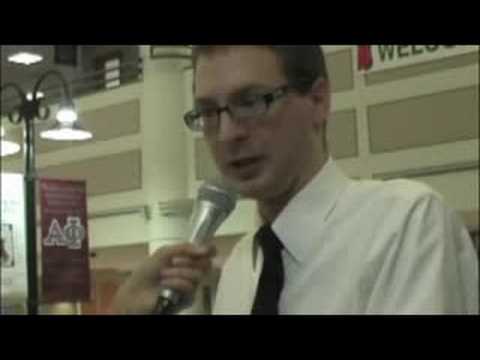
Priscilla Munnelly, Mason Votes correspondent, interviews students directly after John McCain accepted the Republican Presidential Nomination.
Podcast: