Mason Votes

President Obama Returns to Mason and Talks Women’s Issues

For the second time in less than a month President Barack Obama held a grassroots rally at George Mason University in Fairfax, Virginia. The President talked jobs and the economy, but spent a majority of his stump speech talking about women’s issues. He also debuted a new line of attack against Mitt Romney for his change in position on many issues especially women’s health issues.

[youtube]http://youtu.be/Fi73Nz9Ozk4[/youtube]


President Obama’s full remarks:

[youtube]http://youtu.be/48BmtinOSl4[/youtube]
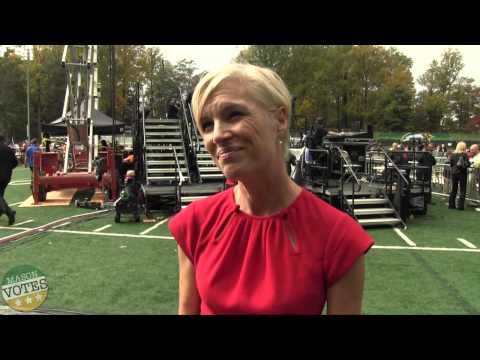
 

Mason Votes 1-on-1 with Cecile Richards

Mason Votes caught up with Cecile Richards, President of Planned Parenthood, after President Obama’s grassroots rally at George Mason University in Fairfax, Va.

[youtube]http://youtu.be/na60mZPBY6U[/youtube]

VA Senate Candidates Debate Last Time

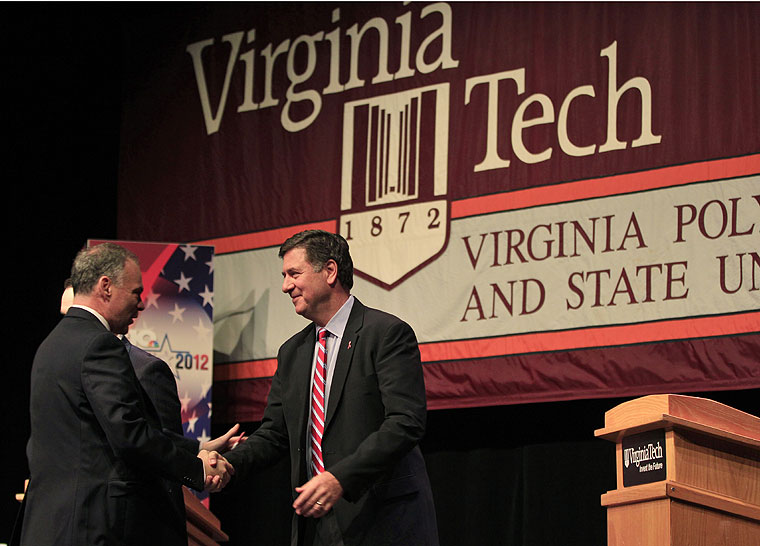
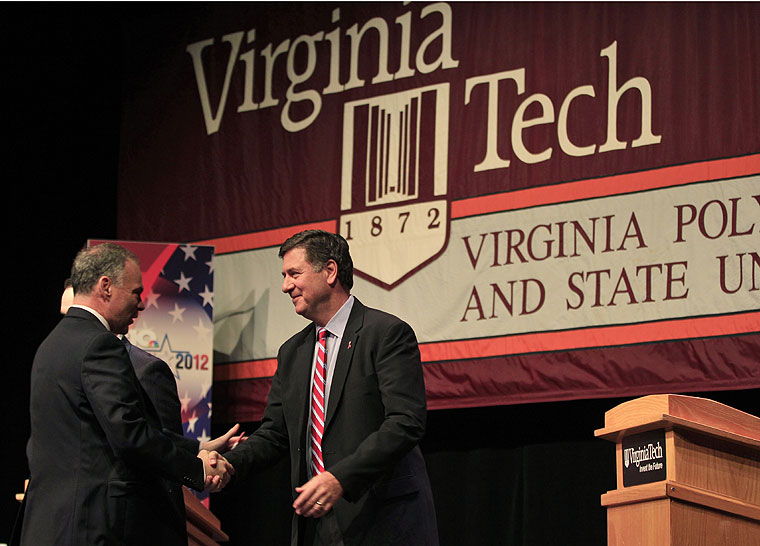
Virginia Senate candidates George Allen (R) and Tim Kaine (D) faced each other for their fifth and final debate this 2012 election season October 18, 2012 at the Haymarket Theater in the Virginia Tech Squires Student Center.

View the entire debate here: http://www.c-spanvideo.org/program/308845-1

Former Gov. Timothy M. Kaine, left, and former Sen. George Allen, right, shake hands prior to a debate at Virginia Tech in Blacksburg on Thursday, Oct. 18, 2012. (Steve Helber | The Associated Press)

Podcast – Jeremy Mayer on Foreign Policy & the Election

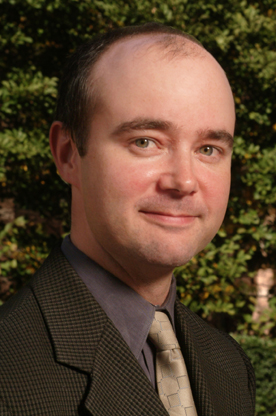
Professor Rodger Smith, GMU Communications Department and WGMU Faculty Advisor interviews Dr. Jeremy Mayer, GMU School of Public Policy.

Jeremy Mayer is an Associate Professor and the  Director of the Master of Public Policy Program in the School of Public Policy at George Mason University. Most recently he is the co-author of Closed Minds? Politics and Ideology in American Universities (Brookings, 2008), co-editor of Media Power, Media Politics, 2nd ed. (Rowman and Littlefield, 2008), co-author of Deconstructing Reagan: A Critical Analysis of Conservative Mythology (2006), and the author of American Media Politics in Transition    (McGraw Hill 2006). He has written articles on diverse topics such as presidential image management, Christian right politics, federalism and gay rights, and comparative political socialization, in journals such as Presidential Studies Quarterly, Social Science Quarterly, and The Historian.

Part 1 of the interview analyzes foreign policy of the Obama administration and Mitt Romney’s focus on foreign policy.

Part 2 continues the discussion of Part 1 and provides detail on why college students should care about foreign policy.

Jeremy Mayer, GMU School of Public Policy

Harvard Institute of Politics releases Fall 2012 National Poll on young voters

[youtube]http://youtu.be/bs70ivV-HOU[/youtube]

Cambridge, MA – A new national poll of America’s 18- to 29- year olds by Harvard’s Institute of Politics (IOP), located at the John F. Kennedy School of Government, finds President Barack Obama continuing to widen the gap between himself and former Massachusetts Governor Mitt Romney leading by a nineteen-percentage point margin (55%-36%) among young adult “likely” voters.  Just weeks before the presidential election, the poll also shows voting enthusiasm slipping as only forty-eight percent (48%) of America’s young adults say they will “definitely” vote this fall.

In addition, the IOP’s newest survey results – its 22nd major release since 2000 – show a solid majority of 18- to 29- year olds (62%) more comfortable with the view that President Obama inherited problems unable to be fixed in one presidential term rather than the viewpoint that he has failed (33%) – see below for more information.  A detailed report on the poll’s findings is available on the Institute’s homepage at www.iop.harvard.edu.

The KnowledgePanel® survey of 2,123 18- to 29- year old U.S. citizens with a margin of error of +/– 2.1 percentage points (95% confidence level) conducted with the Government and Academic Research team of GfK for the IOP between September 19 and October 3, 2012.  Here are some of the findings –

  • President Obama more trusted than Gov. Romney to handle major issues; majority believe problems President inherited are complex and require more time to solve. When America’s 18- to 29- year olds were asked which presidential candidate they trust more to handle a number of top issues, late-September IOP polling shows President Obama favored over Governor Romney on health care (+23 percentage points), foreign policy (+23), to be the Commander-in-Chief of the military (+22), immigration reform (+20) – and the economy (+19). Obama was also trusted more to handle “issues of concern to someone your age” (+31) and “issues of concern to women” (+33).

In addition, six-in-ten Millennials (62%) said the statement: “the problems that President Obama inherited are so complex it takes more than four years to do the job” came closer to their own view, while only a third (33%) said the same about the statement: “despite his best efforts, President Obama has failed.”

  • Romney voters more likely to turnout than Obama voters; less than half of America’s young adults expected to “definitely vote” in November.  18- to 29- year olds favoring Governor Romney are more likely (65%) than those favoring President Obama (55%) to say they will “definitely” vote this fall.  Overall, forty-eight percent (48%) say that they will “definitely” vote in the November elections, with another ten percent (10%) saying “probably” and sixteen percent (16%) saying “50-50.”  African Americans (59%) and Whites (54%) are both significantly more likely to say they will vote this fall than Hispanics (31%), as are college students (55%).
  • Obama leads Romney by nineteen points with young adult “likely” voters, continues to be preferred candidate among 18- to 29- year olds generally and is ahead on college campuses. At the time the IOP’s new fall poll was conducted, 18- to 29- year old “likely” voters gave President Obama a nineteen-percentage point (19%) lead over Governor Romney (55%: Obama; 36%: Romney), a slight improvement from March IOP polling (51%: Obama; 34%: Romney).  Among young adults enrolled in a four-year college “likely” to vote, Obama leads 48%-38% with fourteen percent (14%) undecided.  The IOP’s latest poll also shows Obama has continued to grow his lead among young adults generally to twenty-two points (48%: Obama; 26%: Romney; don’t know: 22%), five percentage points greater than seen in March IOP polling (43%-26%) and eleven points greater than December IOP polling (37%-26%).  Obama leads Romney among 18- to 24- year olds by twelve points (41%-29%) and 25- to 29- year olds by 23 points (46%-23%).
  • President Obama enjoys strong leads in “Blue” and “Swing” states – and also ahead in“Red” states.  President Obama is favored over Governor Romney among likely 18- to 29- year old voters in Swing states by 16 percentage points (54%-38%) and in Blue states by 34 points (61%-27%) – he leads by 6 points in Red states (49%-43%).
  • Governor Romney’s VP pick unhelpful. When young adults were asked how Governor Romney’s selection of Congressman Paul Ryan as his running mate affected their likelihood to vote for him, by more than a 4:1 margin more respondents say the Ryan pick made them “much less likely” to support Mitt Romney (40%: much less likely; 9%: much more likely).  Among likely Republican voters, thirty-four percent (34%) say that the Ryan pick makes them “much more likely” to vote for Romney, with six percent

(6%) saying “much less likely;” among likely Independent voters, nine percent (9%) said the Ryan pick makes them “much more likely” to support Mitt Romney, with thirty-seven percent (37%) saying that it makes them “much less likely;” and among likely voters who are Democrats, three percent (3%) report that the pick made them “much more likely” to vote for Romney, with 65 percent saying “much less likely.”

  • Four-in-ten young adults prefer a Democrat-controlled Congress.  A plurality (40%) of America’s 18- to 29- year olds prefer that Democrats control Congress after the November elections, with one-quarter (25%) saying they support a Republican-controlled Congress and 30% saying Congress should be split.

President Barack Obama to Visit Mason for a Second Time

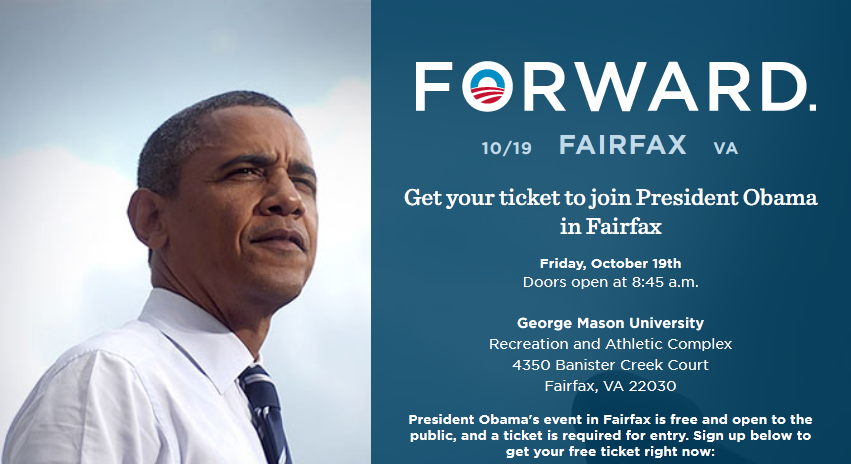
On Friday, October 19, President Barack Obama will visit the Mason Fairfax campus for the second time this election cycle. He will hold a grassroots rally at Robinson Field  adjacent to the Recreational Athletic Complex (RAC).

Students can register for a ticket online at: http://OFA.BO/BarackGMU . Students can text GMU to the number 62262 to receive a link to the e-ticket registration page.Tickets will also be distributed for Mason faculty and students in Johnson Center room 116. The Johnson Center ticket distribution begins Thursday, October 18 at 9 a.m. Students and faculty will need to show their Mason ID in order to obtain a ticket.

Please be aware that tickets obtained online or in paper form from the Johnson Center distribution grant the same access to the event. There is no difference between the tickets.

Doors for Friday’s grassroots event open at 8:45 am.

Mason Votes will update this story as more information becomes available.

Obama to visit GMU Friday, Oct. 19, 2012


Flash Lecture Today

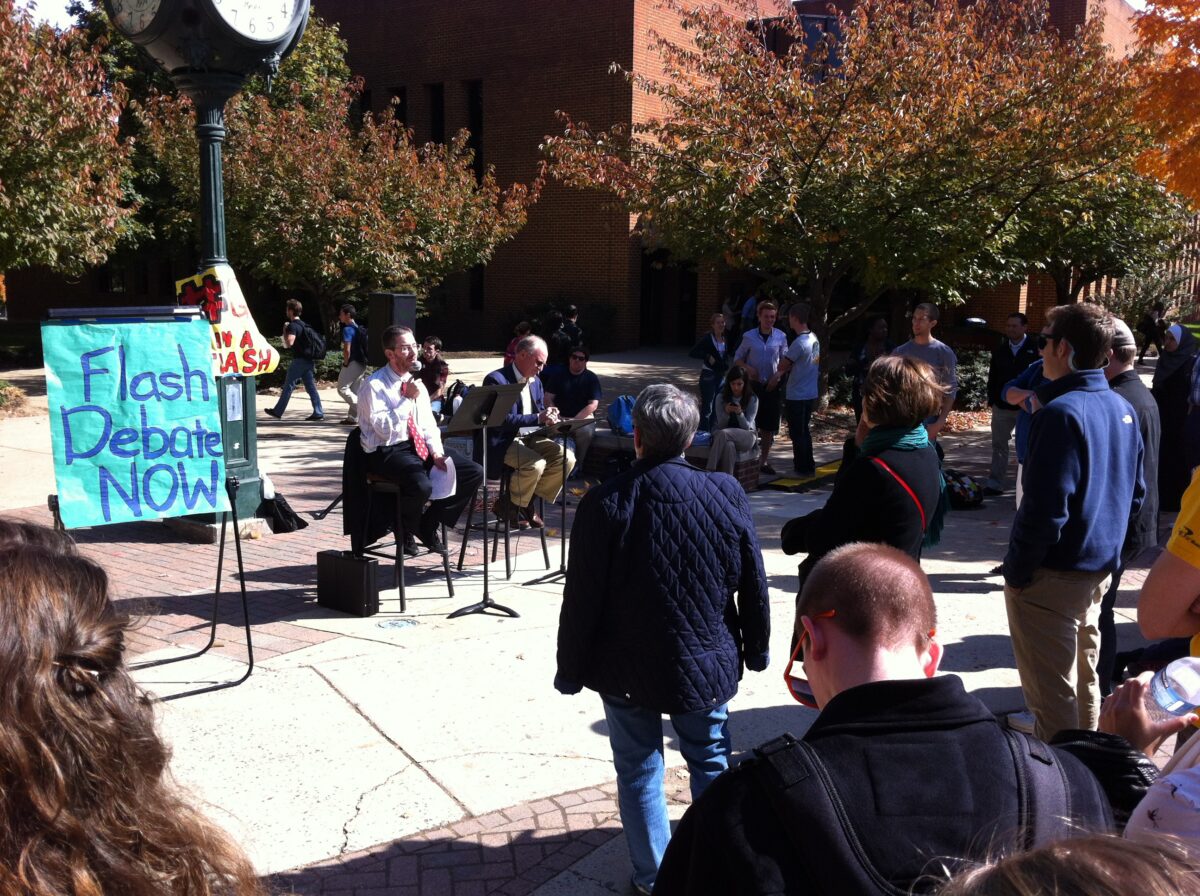
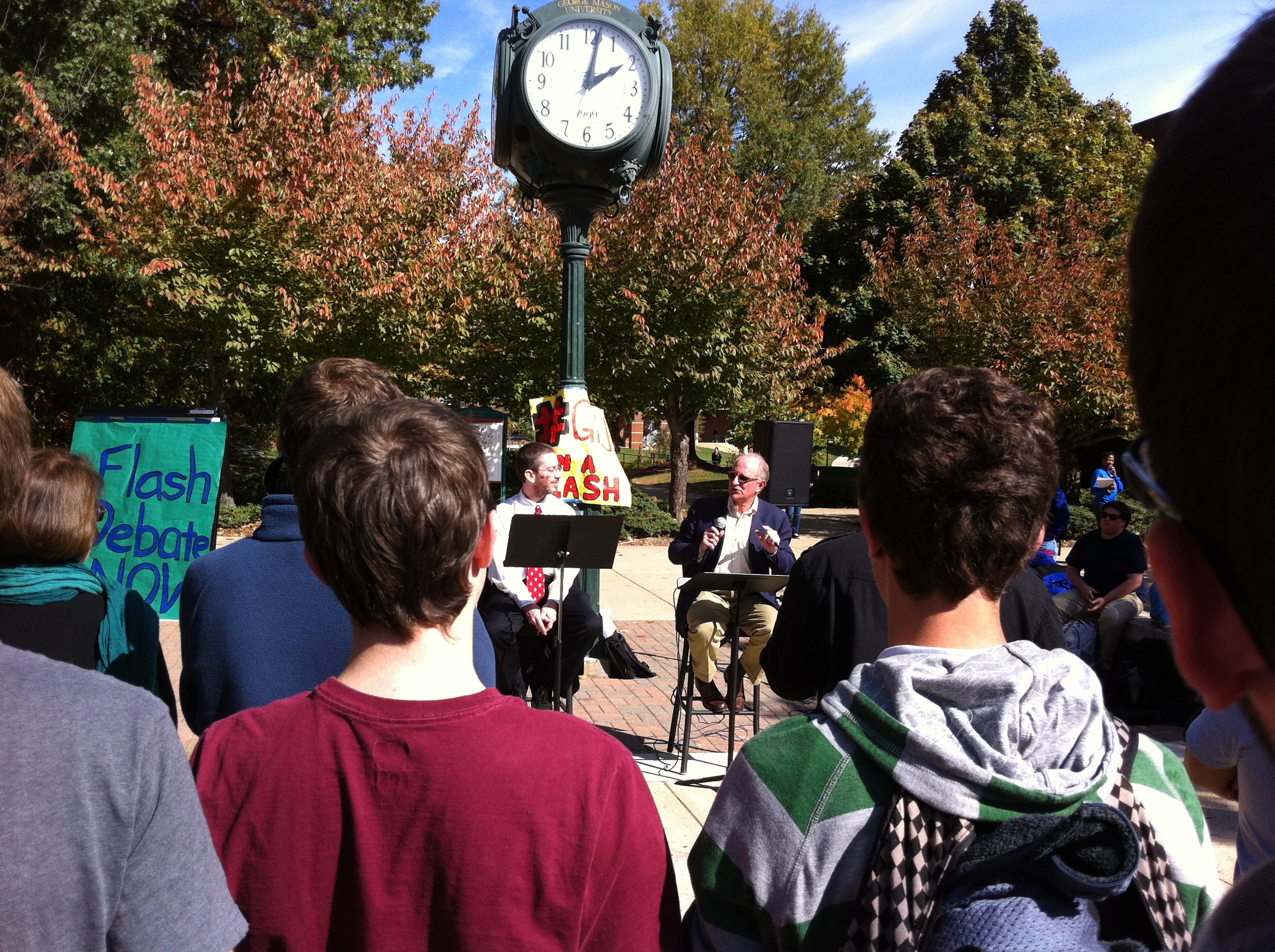
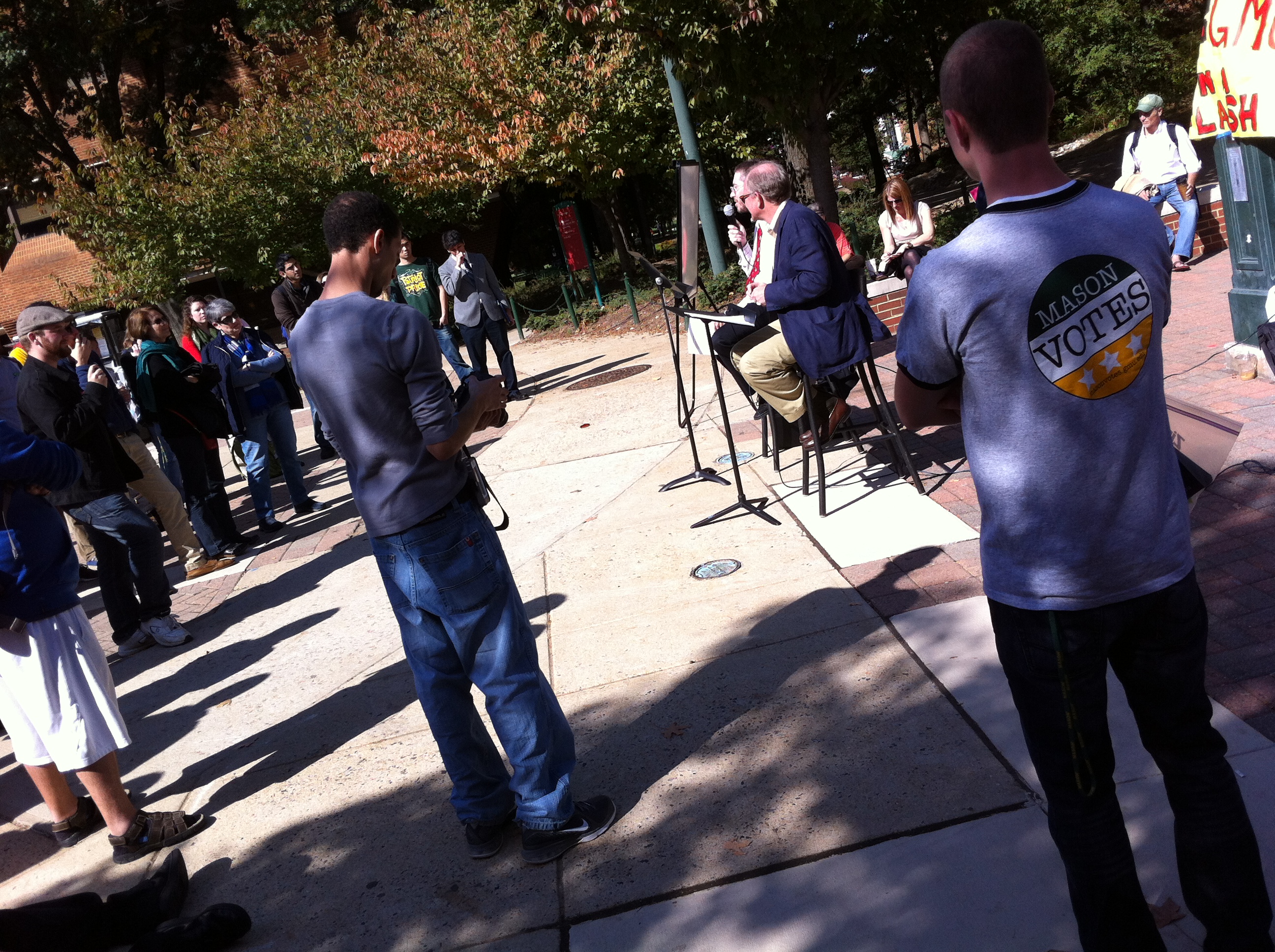
GMU Student Government sponsored a flash lecture today, Oct. 17, 2012, on the economy and the election.  The flash lecture was debate style on the Johnson Center North Plaza that began at 1:30pm between Professors Caplan and Pearlstein.

Student Government Flash Lecture 10-17-2012


Student Responses to the VP Debate Video

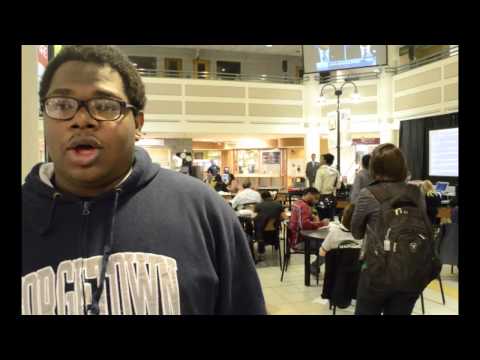
Connect2Mason was on scene at the Mason Votes Vice Presidential Debate Watch Party October 11, 2012.  Here is what students had to say about the debate and Presidential race so far.

[youtube]http://www.youtube.com/watch?v=CPlnvhJJ7Ns&list=UU1TuP1898FOdPrvng_HGDCA[/youtube]

Charlie Neibergall / AP
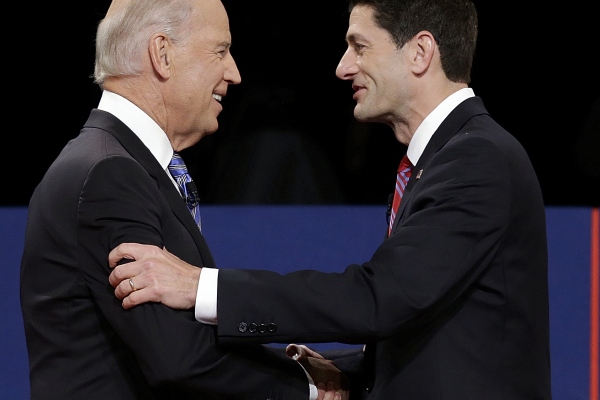
Vice President Joe Biden and Republican vice presidential nominee Rep. Paul Ryan of Wisconsin shake hands before the vice presidential debate at Centre College in Danville, Ky., on Thursday, Oct. 11, 2012.
Read more: http://swampland.time.com/2012/10/12/watching-the-vice-presidential-debate-with-the-sound-off/#ixzz29VdoUEyL


Election Poll Monitor Opportunity

Common Cause logo

My name is Michael Lore and I am the Virginia Grassroots Poll Monitor Volunteer Coordinator for Common Cause.  The 2012 election is upon us and VA is a battleground state with new districts and new identification standards at the polls.  I applaud you for your interest to be an engaged citizen on Election Day 2012.  We are a non-partisan coalition of groups that seeks fair and open elections with as much participation as possible.  (www.866ourvote.org)

The roll of a grassroots poll monitor is fairly simple.  Although you will learn the specifics when you are trained, the basic idea is that you would serve as a frequently asked question guide outside the polls.  Most of the time will be spent helping citizens who are confused about their polling place or whether they can vote on a regular ballot or provisional, you would serve as a first line of defense and a go-between with our command centers around the state and national offices.  Overall, we need boots on the ground to help voters and relay problems to our central offices so we can examine trends and alert the election officials of the problems.  You will not be an election official, you will be the non-partisan citizen oversight of those officials from a distance.

In 2008 I was an election protection volunteer in Virginia and the experience gave me the reward of a patriotic pride of participation in our democratic process.  As a grassroots election protection volunteer you will be a true participant in the process, without a partisan hat.  However, if you so desire, you can put your partisan hat on, once you have taken off the Election Protection shirt, you must also however go to a different polling place than where you were volunteering.

Just a reminder, Election Day is November 6th and your participation in the grassroots poll monitoring program will require a commitment to work several hours on Election Day and to be trained to handle your role outside the polls before Election Day where you will be assigned to a polling place near you, or if you are available to one of the more contentious areas in the state.  Spanish speaking individuals are especially desired.

Please sign up at this link TODAY.
http://salsa3.salsalabs.com/o/50015/p/salsa/web/questionnaire/public/?questionnaire_KEY=1297

The trainings will begin next week (NOVA: Saturday Oct 20th 10am-12pm or Friday Oct 26th 6-8pm) and we are trying to determine if we will require additional trainings, so please sign up as soon as possible.  Do not hesitate to call or email if you have any questions prior to the trainings, but training info will be found on the electronic sign-up sheet at the link above and we will be in touch when you have signed up.  I know you are busy with day-to-day responsibilities, so we will ensure that your time is truly appreciated and not wasted.

Regards,
Michael

Kaine in the Lead

Photo by: Giarc80HC on flickr.com

In the race to represent Virginia in the United States Senate, Public Policy Polling has Governor Kaine steadily leading Senator Allen in a poll taken between October 4th and October 7th.

Democratic Candidate Kaine is holding a 7-point lead, with 51% of the people surveyed saying they would vote for him if the election were held today and 44% saying the would vote in favor if Republican Candidate Allen; with a margin of error of +/- 3.6%.  The survey was taken by 735 likely voters in Virginia, with 38% identifying as democratic, 32% as republican and 30% as independent or other.

Polls taken within the first week of October by Rasmussen Reports and NBC/WSJ/Marist also have Kaine with a 7-point advantage, while and Real Clear Politics has him leading by 4.7%.  This signifies a large shift in the campaign as many past polls had this race at a virtual tie until midway through September.

Democrats, who hold a majority in the Senate with 51 seats, are defending 23 of them this election cycle, while Republicans are only fighting for 10.