Mason Votes

Mason Asks: Tim Kaine

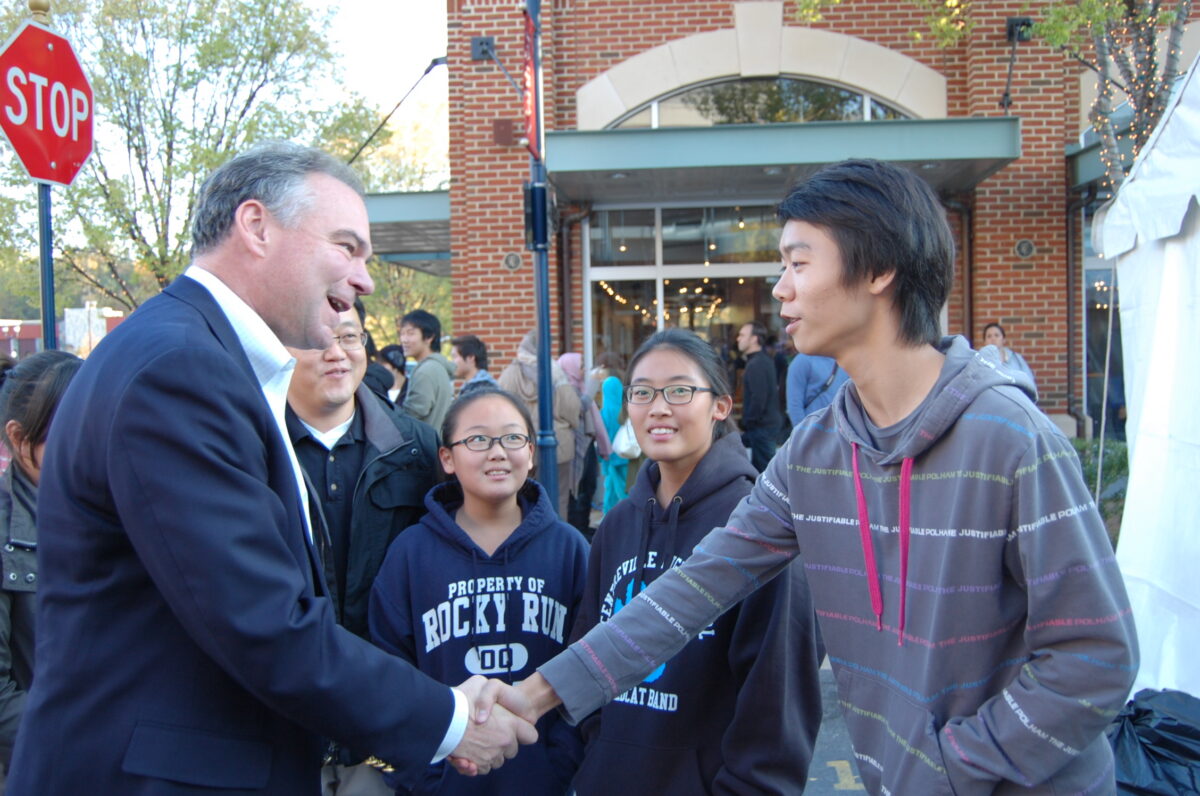
Photo courtesy of: kaineforva.com

In November, Virginians will go to the polls to elect a United States Senator to fill the seat left by retiring Senator Jim Webb.  Tim Kaine is hoping Virginians will elect him.  As Governor, he improved Virginia’s economy and made education and environmental issues a top priority.  In addition to Governor, Tim Kaine has served as Mayor of Richmond, Lieutenant Governor, and Chairman of the Democratic National Committee—Kaine is now hoping to add Senator to that list. Governor Kaine took time from his busy campaign schedule to sit down and answer a few questions for the George Mason community—and for that, we thank him.

1. Your senate race is promising to be one of the most expensive of the 2012 cycle. What steps, if any, is your campaign taking to blunt the impact of out of state money?

There is no question this will be a close election that will require substantial resources to win, but those competing to be Virginia’s next Senator have a responsibility to run races that honor Virginia’s tradition of transparency and accountability in campaign finance. In the very first debate of this campaign, I offered George Allen a chance to run a no-outside money campaign, and he refused. When I gave him a second chance, and asked him to sign a pledge to keep secret money of this race, he turned me down again. Already, outside groups have spent over $1.5 million in our race on false TV ads.

But we have a secret weapon of our own, and that’s our incredible grassroots support. I am fortunate to have a strong base of grassroots support – since the start of this campaign we have received support from more than 20,000 individual donors. We will work hard to continue to build on this momentum, as every phone banker, door knocker and small dollar donor will be critical to win this race.

2. The amount of student debt incurred by today’s graduates continues to grow and has many wondering if college is even worth it. What are your thoughts on this?

Whether students choose to enroll in a university, a community college, technical school or a workforce training program, it’s important that we do more to ensure high school graduates have access to high-quality, affordable options to continue their education and increase their skills. As Lieutenant Governor, I helped shepherd $900 million into expanding the state’s higher education system, and as Governor I led passage of an additional $1.4 billion bond package in 2008 to construct state of the art classrooms and labs. I also allocated millions to need-based tuition assistance for Virginia’s students.  As Senator, I will work to increase access to higher education and preserve programs that increase the affordability of higher education, like the Pell Grant program.

But the bottom line is, students should not have to incur extraordinary debt to develop the skills they need to compete in an increasingly tough global job market. We have seen in Virginia that when we invest in education, improve its quality and lower its cost, our students develop skills that attract businesses and contribute to the talent economy that is critical to secure the United States’ position as an economic leader. I will take this Virginia lesson to Washington and pursue the same strategies at the national level, to make sure we have a national talent strategy that matches and exceeds our global competitors.
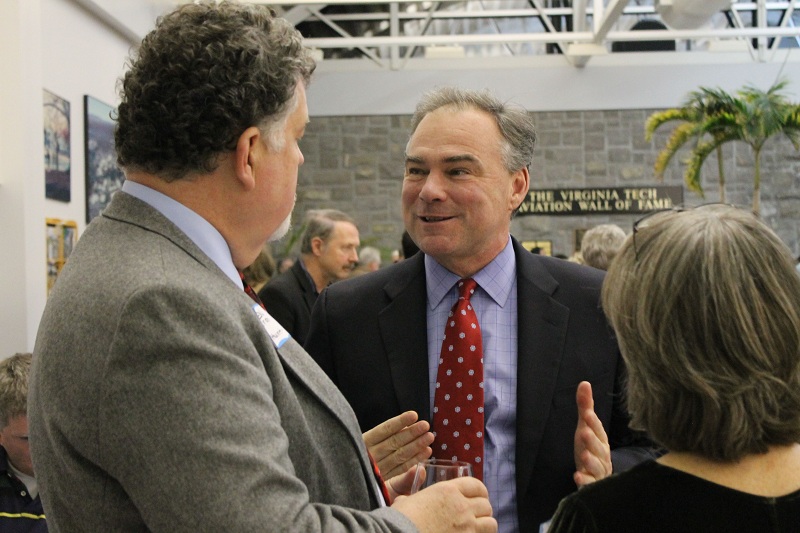
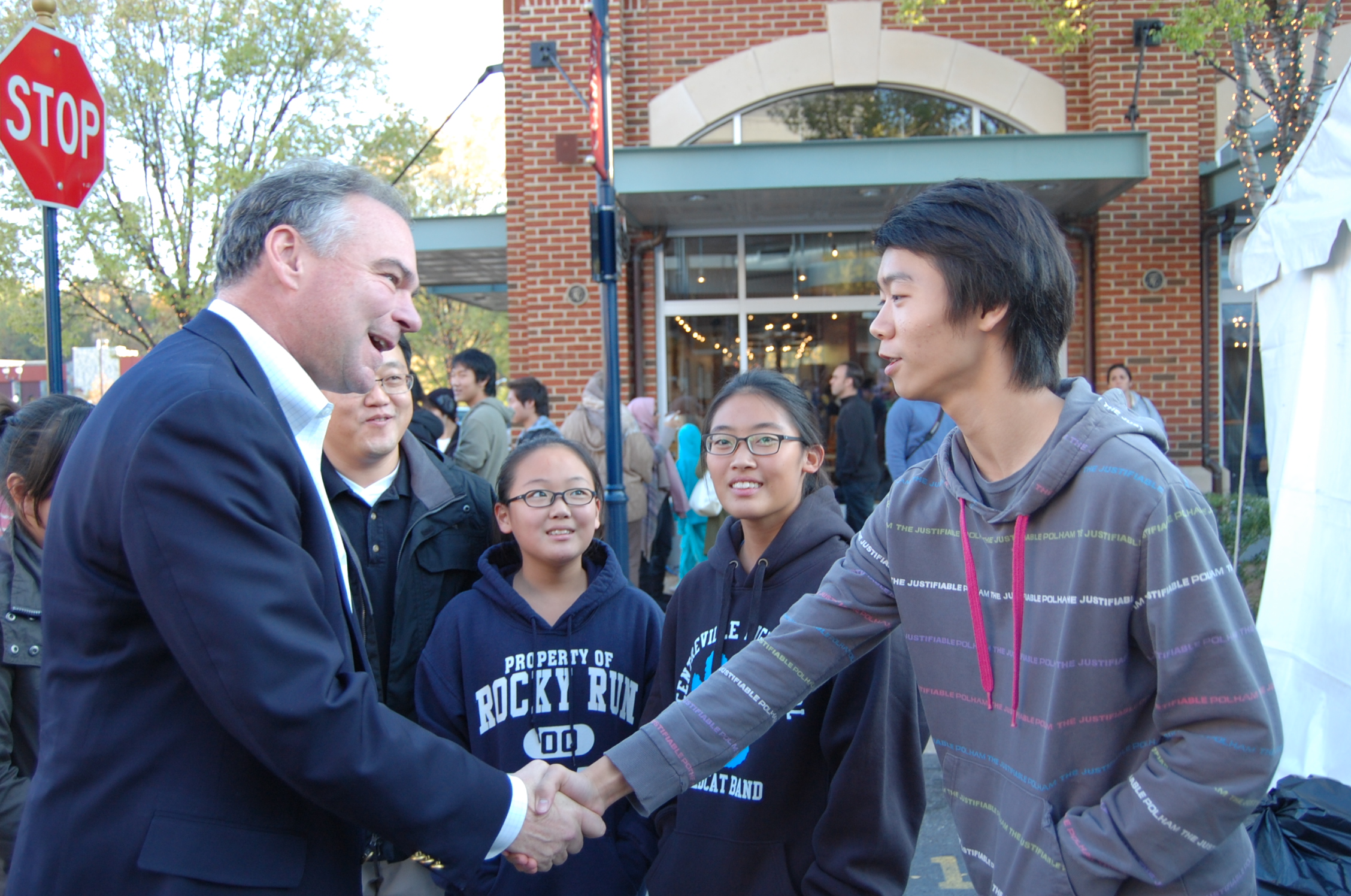
Photo courtesy of: kaineforva.com

3. Recent college grads are having a hard time finding good jobs. What is your plan to get Virginia’s young people working?

I am committed to ensuring that Virginia’s higher education system adequately prepares its graduates to find jobs in an increasingly competitive job market.  All Virginia students deserve access to affordable higher education, but it’s equally important that the degrees they earn give them the skills necessary for the jobs open today. As I travel around the Commonwealth meeting with business leaders in every region of the state, I hear time and again that they have jobs available but can’t find workers with the appropriate credentials.  Improving our workforce training and technical education is absolutely essential to ensuring that today’s workers are prepared to compete for the jobs of today and tomorrow.

4. Everyone seems to agree that something needs to be done about the soaring national debt. Obviously, this is a very complicated issue, but could you give us some insight into the type of debt reducing legislation that you would support as a senator?

The federal deficit is a pressing problem, and I would support legislation that balances significant, targeted cuts with strategic investments to bolster our economy. During my term as Governor, we faced the worst national economic period since the Great Depression. In order to balance Virginia’s budget, we cut over $5 billion in state spending, including my own salary. I made major spending cuts as Governor and left office with a smaller state general fund budget than the one I inherited four years earlier. I know how to make spending cuts. But, we will never get to balance through budget cuts alone.

5. Assuming guaranteed success, what single piece of legislation would you introduce tomorrow?

I would introduce legislation that would expand opportunities for students to afford and access workforce training, community college programs and higher education – investments in our talent would help us attract businesses, grow our economy and create more jobs. For the last century, the United States has been the world’s largest economy and a leader in innovation, but we must continue to invest in education to ensure we remain the most talented nation on earth. If we fix everything else, but do not return America to its status as the best-educated nation, we will cede our role as the most dynamic economy on earth.

Enhanced by Zemanta

Romney Looks Ahead to President Obama

Mitt Romney has now set his sights on President Obama and the general election with Tuesday’s sweep of Wisconsin, Maryland, and the District of Columbia.

At a gathering in Washington, D.C. the following day, Mitt Romney made no mention of his primary opponents and took the opportunity to rail against the President.

In the week ahead of the primaries, influential Republicans such as Wisconsin Rep. Paul Ryan, former President George H.W. Bush, and former Florida Governor Jeb Bush all endorsed Romney, trying to put to an end what has been a divisive primary.

On CBS Wednesday morning, former Republican nominee, and one time Romney opponent, John McCain called on Rick Santorum to drop out of the race saying, “It’s clear that [Romney] is the nominee,” … “I hope Rick Santorum understands that it is time for a graceful exit.”

Despite calls for his exit Rick Santorum has vowed to persevere.  The next primary is on April 24 in Santorum’s home state of Pennsylvania in what Santorum himself has described as a “must win.”

Experts question whether Santorum has the money to soldier on for the next three weeks.

On Tuesday, President Obama took a swipe at Romney, mentioning for the first time the candidate by name and signaling that the White House believes that Romney will be the eventual nominee as well.

Mitt Romney needs 1,144 delegates in order to wrap up the nomination.   In the unlikely event that Romney fails to reach 1,144 delegates then the candidates would go to a brokered convention in August.

Enhanced by Zemanta

Santorum Drops Out of Republican Primary Race

In a surprise announcement, Rick Santorum dropped out of the race for the Republican primary bid today at an event in Gettysburg, Pa.

Santorum had previously pledged to continue through the primaries until the Pennsylvania primary, which will be held on April 24, but reconsidered today after poll numbers show that he was not ahead in the polls in his home state. His daughter Bella’s ailing health was also cited as a reason for his withdrawal from the race.

According to Yahoo News, Santorum called Mitt Romney to inform him of his decision to pull out.

With Santorum gone, Romney, Newt Gingrich and Ron Paul are the only three candidates left in the primaries. Gingrich, who is millions of dollars in debt from his campaign, said that Romney is “far and away the most likely” Republican nominee.

Paul, who has trailed behind in the polls, is adamant that he will stay in the race until the end. In an interview with Piers Morgan, Paul reiterated his stance.

The 2012 Republican Presidential Primaries

The presidential primary season is reaching its halfway point. On April 4 Mitt Romney swept the GOP presidential primaries in Maryland, Wisconsin and the District of Columbia, bringing him another step closer to securing the Republican nomination and the general election in November.

With another three primaries now over, it’s a good time to look at the race for the Republican presidential nomination as it stands now.

Who won which states so far:

  • Mitt Romney – New Hampshire, Florida, Nevada, Maine, Michigan, Arizona, Wyoming, Washington, Alaska, Ohio, Virginia, Vermont, Massachusetts, Idaho, Northern Marianas, Guam, Hawaii, American Samoa, Puerto Rico, Illinois, Maryland, Wisconsin, District of Columbia
  • Rick Santorum – Iowa, Missouri (non-binding primary), Minnesota, Colorado, Oklahoma, Tennessee, North Dakota, Kansas, Alabama, Mississippi, Louisiana
  • Newt Gingrich – South Carolina, Georgia
  • Ron Paul – Virgin Islands

Latest delegate tally:

  • Mitt Romney – 655
  • Rick Santorum – 278
  • Newt Gingrich – 135
  • Ron Paul – 51

Though Romney boasts a clear lead, he still needs a total of 1,144 delegates to secure the nomination.

Also on Tuesday, President Obama formally clinched the Democratic nomination.

The next primaries will be held on April 24 with Pennsylvania, New York, Connecticut and Delaware.

Sources:

The Washington Post, “Mitt Romney wins Wisconsin, Maryland, D.C. primaries”

Fox News, “Romney sweeps 3 primary contests, eyes general election battle”

2012 Presidential election schedule


Students less excited about upcoming presidential election

At a politically charged school such as Mason, the excitement for the 2012 election should be visible.

For the 2008 election, there was an increase of young voters. Many Mason students were excited to vote, many for the first time.

This election may not attract the same attention.

“No one’s talking about it,” said Mallory Wuhrer, a Mason senior and communication major. “I’m sure people will talk about it in the fall when it kicks into gear, but not now.”

Some students appear to be frustrated with the entire election process.

“The American public has so little trust in our government,” said Kate Gohari a senior and government major. “We’re in gridlock right now. Nobody is coming together.”

Other students already know who they will vote for, regardless of the Republican nominee.

“I will be voting for Obama in the upcoming election,” said Alyssa Rajabi, a junior and communication major. “It seems like there isn’t a Republican candidate worthy enough of holding office.”

Mason strives to help students stay informed about the election, regardless of their political affiliation.

“Mason Votes provides a platform for student opinion and commentary on political issues,” said Colleen Wilson, a sophomore and communication major.

Wilson is an editor at Mason Votes, a student organization that updates students about election news.

“The point is less on how Mason Votes will get students out to the polls, and more on a reflection of the young perspective on political issues.”

To stay informed about election news, visit masonvotes.gmu.edu.


Profile: Barack Obama

Photo courtesy of Ethan Bloch on flickr

Born in Hawaii on August 4, 1961 Barack Obama is the 44th president of the United States. With a father from Kenya and a mother from Missouri, he was primarily raised by his grandmother.

In 1979 Obama attended Occidental College, then transferred to Columbia University where he graduated with a major in political science, with a specialty in international relations.

Obama also attended Harvard University, where he became the first African American president of the Harvard Law Review. He graduated with a degree in law in 1991.

In 1996 he was first elected to the Illinois State Senate. In 2004, he was elected to the U.S. Senate, where he served until successfully running for president in 2008.

He is the first African American U.S. president.

In October 2009 he won the Nobel Peace Prizefor his extraordinary efforts to strengthen international diplomacy and cooperation between peoples.”

He is married to Michelle Obama, and has two daughters, Sasha and Malia. The First Family also has a dog named Bo.

Sources: BarackObama.com, The Washington Post

Enhanced by Zemanta

Paul wins University precinct, more than doubles 10 votes for Romney

University Hall
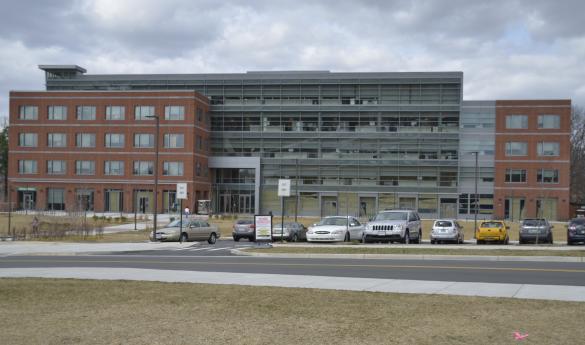
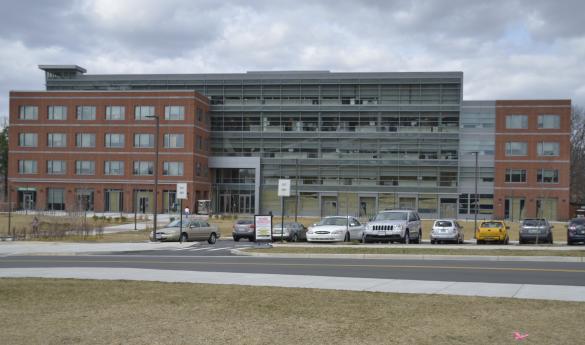
Photo of University Hall, where the University precinct is located, taken one day following the election. (Jake McLernon)

Ron Paul won the new University precinct on Super Tuesday with a total of only 22 votes.

Mitt Romney, who was declared the state-wide Virginia winner on Wednesday, received 10 votes in the precinct in which registered on-campus students can cast their ballot. The two GOP rivals were the only candidates on the March 6 ballot.

The total of 32 ballots means roughly 3 percent of registered voters in the precinct participate in the Republican Primary. A total of 1,144 people had registered to vote in the precinct as of March 3, according to the State Board of Elections registrant counts.

“We’re very ecstatic about the results [of Paul winning],” said Sonia Jeffers, events coordinator for Mason’s Youth for Ron Paul group. “We can see how much his popularity and message has spread.”

Prior to Tuesday’s vote, Youth for Ron Paul helped organize advertising and carpooling to get students to Springfield, VA for the Feb. 29 Ron Paul “Leap Day” rally. The group also worked with Mason’s College Republicans to register voters on campus and set up a kiosk in Johnson Center to hand out pocket Constitutions and Ron Paul fact sheets, according to Jeffers.

But Jeffers was surprised by the overall turnout.

“Those numbers are shockingly low,” Jeffers said.

A lack of awareness of the University precinct among on-campus residents, according to some in the Mason community, could have been a factor.

Approximately 6,000 students live on-campus who would be eligible to vote at the precinct’s polling location in University Hall, as long as they are registered at their campus address. The rest of the university’s 33,320 students include a majority commuter population whose precincts would differ based on where they reside. Additionally, a portion of the campus’s residents, could have voted absentee and mailed in their ballot.

Jeffers, who said she hadn’t been politically active until her involvement with Youth for Ron Paul this year, didn’t know about the on-campus precinct until Election Day.

“I had no idea [the University precinct] existed,” said Jeffers. “I was surprised because I didn’t know there was a polling location on campus.”

Tuesday’s primary is the second time ballots have been cast in the University precinct. Established in summer 2011, the precinct was first functional for the Nov. 8 general election, where 76 ballots were cast.

A commuter student herself, Jeffers voted off-campus near her home and said she hoped that other students who didn’t vote on-campus had cast absentee ballots or voted at off-campus precincts. She said she also heard of at least four students who tried to vote at the University precinct but were unable to meet eligibility requirements.

Darren Kessler, a junior at Mason, said he didn’t vote on Tuesday at least In part because he couldn’t identify a candidate that he really liked.

“There’s not really a candidate that stands out that I like,” said Kessler. “[But the vote total] is kind of a crazy thing to hear.”

College of Health and Human Services Professor Naomi Gerber said she notices a big difference between students’ political engagement during this year’s election cycle versus 2008.

“Many [faculty members] have talked at the water cooler about the difference between now and four years ago,” said Gerber. “I walk around and I don’t see fliers or kiosks opening.”

In addition to a lack of student activity, no GOP candidate, in a field which also includes former Senator Rick Santorum and former House Speaker Newt Gingrich, has held a rally on campus since the election cycle began. Obama, the Democrat incumbent in November’s general election, last held a large event at Mason in the spring of 2010 addressing students on his health care initiative.

Although Jeffers said Paul’s rally in nearby Springfield drew great support —around 2,000 attendees according to reports—she hoped Paul would come to the Fairfax campus and speak at the Patriot Center where more students and community members might attend.

“We were trying really hard to get him to campus,” said Jeffers.

Former Massachusetts Governor Mitt Romney, who holds the most delegates in the GOP field, came to Fairfax in late October. His rally, less than a mile from Mason’s main campus, was held to support Virginia state legislators prior to the Nov. 8 general election.

Calling voter turnout at the University precinct “pathetic,” Gerber said she is concerned because she considers the issue of engagement an important one.

A Maryland resident, Gerber said she recently received an email from a Maryland campaign person who was attempting to gather Marylanders to help “stimulate” voter registration in Virginia. She said this might suggest that voting apathy is a statewide issue.

“It seems like Virginia has been identified as a place where a lot of people don’t vote,” said Gerber, who added that she would love to see campus enthusiasm return to where it was in 2008 when both Democratic candidates, Senator Hillary Clinton and then-Senator Barack Obama, came to Mason’s campus prior to the election.

“There was so much energy and enthusiasm,” Gerber said. “It was palpable.”

This article was originally published on 3/9/2012 on Connect2Mason, George Mason University’s student online news source. It is by Adam Sylvain, C2M Managing Editor. The photo is of University Hall and is by Jake McLernon.


Enhanced by Zemanta

Super Tuesday 2012

http://storify.com/nosliwneelloc/super-tuesday-2012

Mid-day Report: Super Tuesday Primaries

Today, March 6, is Super Tuesday. The polls are underway but, at least in the state of Virginia, voter turnout has been on the low side.

According to The Washington Post, counties like Loudoun are not even expected to reach the projected 10 percent voter turnout, noticeably down from the 2008 presidential primary, which saw numbers closer to 32 percent. In some counties, the numbers are currently as low as 1.5 percent.

One significant factor behind the lack of enthusiasm among Virginia voters for the 2012 Republican presidential primary is the absence of any apparent suspense or competitiveness. Only two candidates, Mitt Romney and Ron Paul, qualified for the Virginia ballot, and Romney is expected to win by a large margin.

The other states holding primaries or caucuses today are Alaska, Georgia, Idaho, Massachusetts, North Dakota, Ohio, Oklahoma, Tennessee and Vermont.

Ohio is one of the most-watched states on Super Tuesday, and The Washington Post reports that Santorum and Romney appear to be in a virtual tie there.

Newt Gingrich must win Georgia, his home state, in order to still be considered a genuine candidate. Though he had a head start and was polling with a double-digit lead over Romney and Santorum, few people believe that he has an real chance at winning the nomination, let alone beating President Obama. Polls in Tennessee and Oklahoma both showed Santorum with the lead over Romney.

Enhanced by Zemanta

Voting on campus at Mason

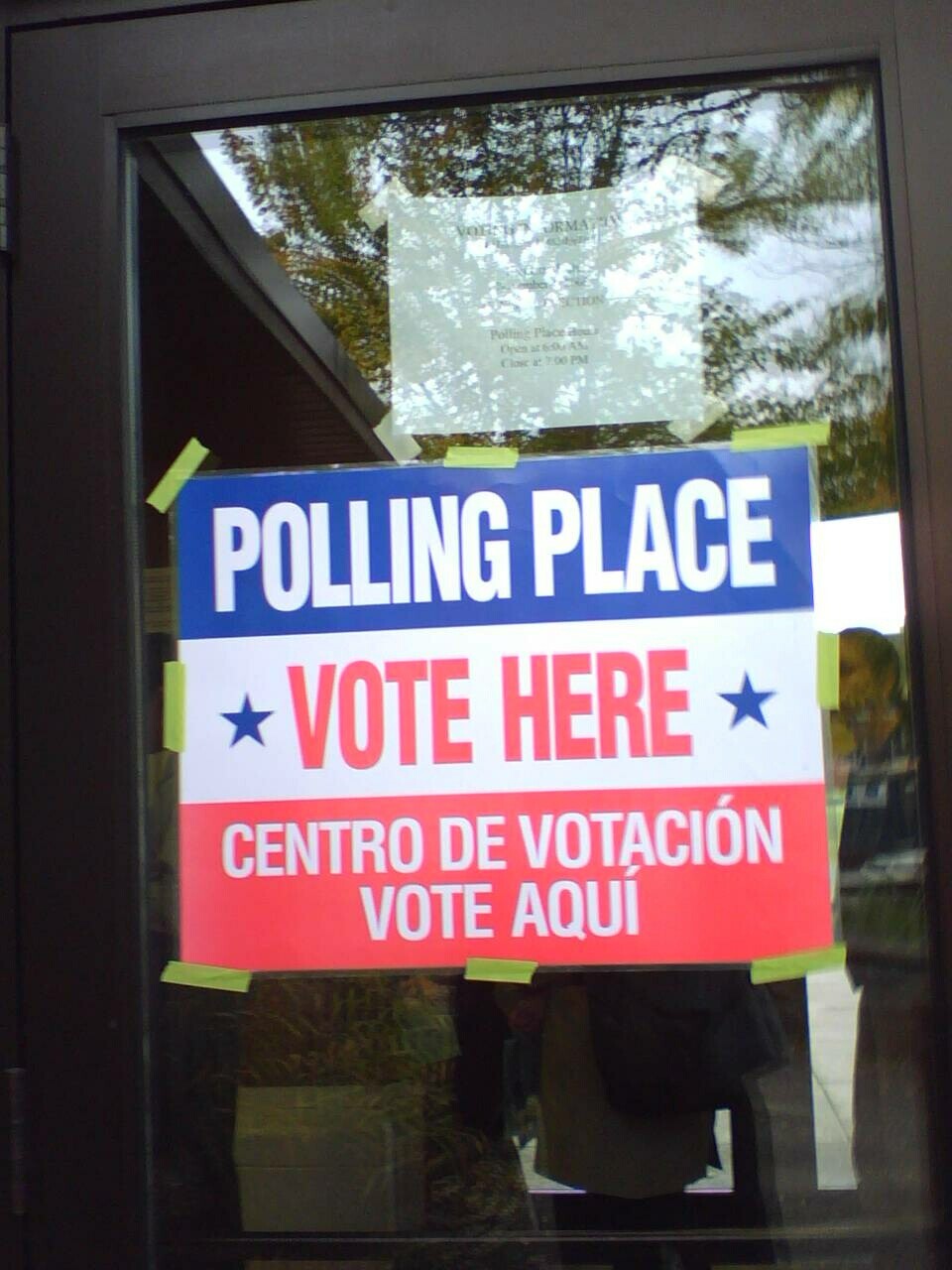
Election season is coming up fast. Voting will be easier than ever for George Mason students, who can now use an on-campus polling place.

Voting at George Mason is easy. If you need to register to vote or you are registered to vote in a different state or location, you can pick up a voter registration form at several locations around the George Mason University campuses. List your dorm/college address as your permanent address in order to vote at Mason’s on-campus polling site.

Photo courtesy of Mrs. Gemstone on flickr

The polling will happen in the new University Hall building. Polls will be open from 6:00 a.m. to 7:00 p.m.

Even if your registration included a photo ID, you should bring a government-issued photo ID to insure that the process goes smoothly. Your driver’s license or passport is preferred. If you do not have either you should bring your Mason ID and any other government-issued ID you might have.

Before going to vote, especially if it has been a while since you registered, you should check to make sure your registration is still valid. You can do so online through Virginia’s Election and Registration Information System.