Mason Votes

Conservatives React to Election Disappointment

Questions Remain as “Red Wave” Fails to Materialize

By: Jacob Pritchard, Mason Votes 2022 Online Editorial Team
Photos by: Mitchell Richtmyre/Fourth Estate

In the 2022 midterm elections, the Republican Party garnered a weak victory in the House instead of the predicted “Red Wave,” and failed to take the Senate.

Many Republicans and other conservatives at Mason have strong thoughts on the unforeseen results of the 2022 election.

“We are disappointed. We were hoping for much more of a volume in terms of a Red Wave,” Chairman of the College Republicans Joe Szymanski said. “That did not happen. We are pleased that we took the United States House of Representatives. We are not happy with the level of majority that we are going to have, and we are pretty disappointed that we did not take the United States Senate.”

This “Red Wave” was expected because of historic trends in American politics. For decades, whenever a new president was elected, his party did poorly in the next round of midterm elections. Many predicted this effect would be amplified this cycle, as Americans headed to the polls with a 40-year high economic Inflation near the top of their minds. 61% of Americans thought President Biden was directly responsible for the current inflation rate, according to Newsweek.

However, the Democratic Party retained their majority in the Senate. The Republican Party won a slim majority in the House of Representatives by gaining 9 seats, the first time in two decades that a non-incumbent party gained less than 10 seats in a midterm election.

In Virginia’s 11th Congressional District, where George Mason’s Fairfax campus resides, Democratic incumbent Gerry Connolly won by nearly 34% over his Republican opponent Jim Myles.

Since the Republicans did not gain as much as they were anticipated to,  despite Biden’s supposed unpopularity on economic issues, many questions remain.

John Jennings is a Mason student who was the campaign manager for Fairfax mayoral candidate Sang Yi prior to this interview.

“There were a lot of unexpected results,” Jennings said. “Of course, no one is saying ‘Yes!’ when they lose an election. There are results that I am happy about that other conservatives I know may not be as happy about. Candidates on the extremes, on both the left and the right, lose. We need to focus on kitchen table issues.”

Conservative discussion in the weeks following the election has mostly focused on what should happen for the 2024 elections. Primary topics of discussion revolve around specific candidates to run in 2024, and different strategies to run in 2024.

“I think actually trying to make sure we have concise statements on what we want to pursue and push when we want to get into control majorities,” Szymanski said.  “If we can kind of fix that around next time for 2024, we’ll have a much better result.”

_____________________________________________________________

Photos by: Mitchell Richtmyre/Fourth Estate
Reactions to Dobbs in the Aftermath of the Midterm Elections

Reproductive Rights Motivated Many Students to Vote

By: Clarita Orosco, Mason Votes 2022 Online Editorial Team
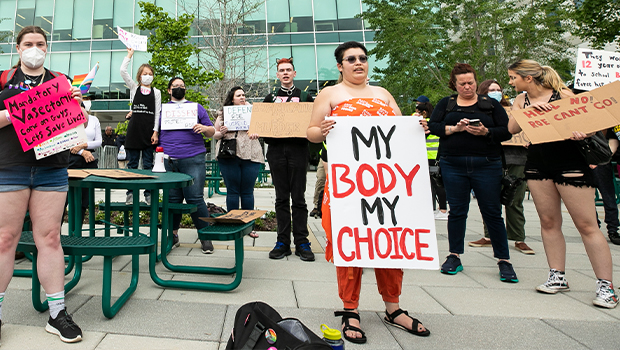
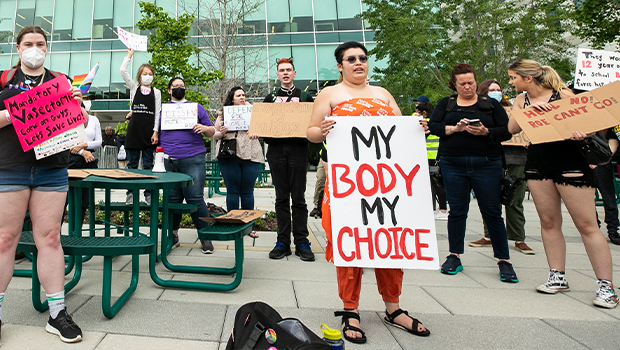
Mason students protest against the Supreme Court’s recent Dobbs decision that eliminated federal abortion rights at the Mason Square plaza in Arlington. Photo by: Ron Aira/Creative Services

This past summer, on June 24th and after 50 years of precedent, the Supreme Court overturned the landmark case known as Roe v. Wade. Protests were held in DC, as well as all over the nation.

In Dobbs v. Jackson Women’s Health Organization, the court ruled that the U.S. Constitution does not in any way prevent states from outlawing abortion, contradicting the 1973 ruling, in which Warren E. Burger’s court ruled that one of the rights covered by the 10th amendment was a right to privacy, and that discussions between patients and doctors about abortions were protected from state interference under that right. The current court under Chief Justice John Roberts ruled that no right to privacy is explicitly laid out in the text of the constitution, so the right to abortion is not federally protected, and states can pass laws banning or protecting it as they see fit. 

As soon as the Dobb’s case ruling was announced, Mason’s Women and Gender Studies (WGST) Center released a statement to, “offer solidarity and comfort to all who needed it,” said Holly Mason, Associate Director of WGST, in an email.

They then focused on creating safe spaces virtually and in-person where, “students, faculty, and staff” could discuss the issue comfortably.

During these meetings Holly saw that, “Students wanted to know who they can talk to, where they can turn for mobilization/protest/and support, and they wanted to know what related resources exist at Mason and in the surrounding areas.”

On November 8th, Student Media, Mason Cable Network, and Mason Votes conducted an exit poll survey in front of Merten Hall where students went to cast their in-person ballots on Election Day. It found that “Abortion,” was the top concern for 22% of respondents.

“Republicans have been using abortion as their playing card for years and years,” said Molly Sullivan (CS ‘24). “As have Democrats. All the Democrats are like, ‘We’re going to codify Roe.’ and the Republicans have said ‘We’re going to shut down Roe.’”

Sullivan is one of the co-presidents of GenerationAction, also known as GenAct, a group on campus that enables activists to raise public awareness about reproductive health and women’s rights. She is also the VP of American Medical Women’s Association, and holds other e-board positions in other student groups.

Even though she has voted consistently in the past she finds this year’s election was history making.

She voted not only for herself but also in the honor of those, “that will be affected by this change in regulation, in marginalized low-income communities.”

Alex Elliott (SIS ‘24) was “really frustrated with the direction of the United States,” when the Dobb’s case ruling was announced.

“It’s going to affect me, but as a white cisgender women, it’s going to impact more marginalized communities,” she said.

Even though she is a committed voter, the overturning of Roe v. Wade brought a new topic to the table when she went out to vote.

Something both Sullivan and Elliot want is to spread awareness and educate others about safe sex contraceptives along with debunking the misinformation that surrounds abortion.

_____________________________________________________________

Learn more about on-campus health care and resources through Student Health Services: shs.gmu.edu/healthed/birthcontrol

_____________________________________________________________

Photo by: Ron Aira/Creative Services

How Did Mason Vote in 2022?

Over 250 Mason Students Voted at Merten Hall on Election Day

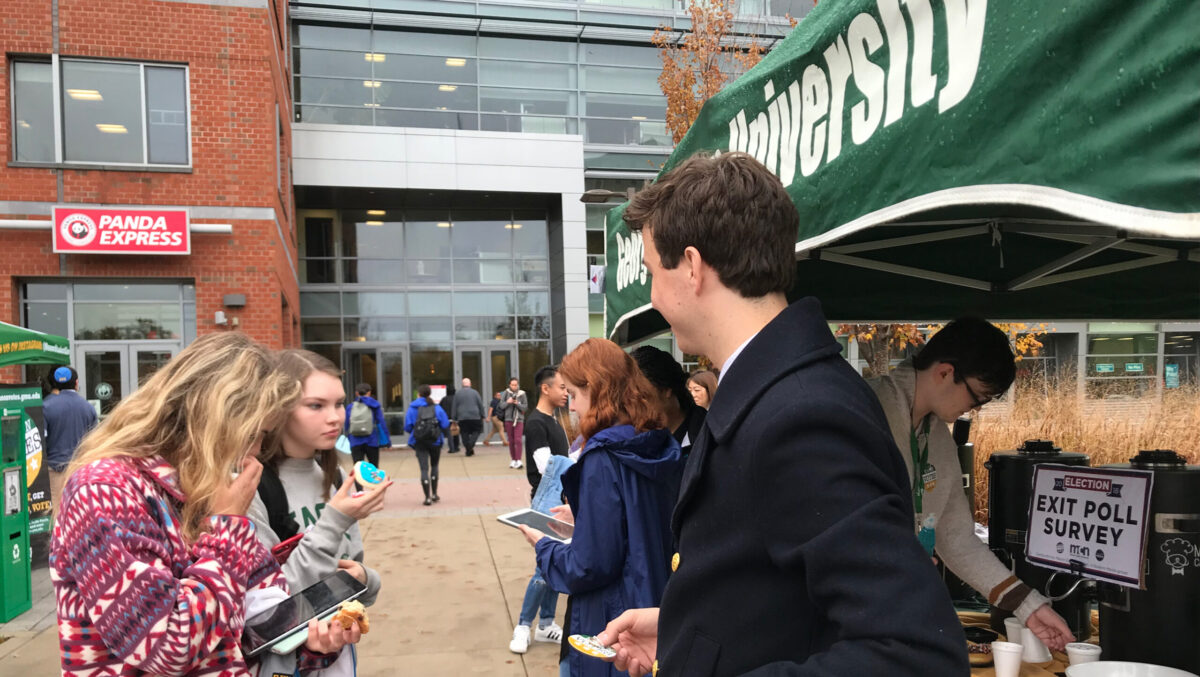
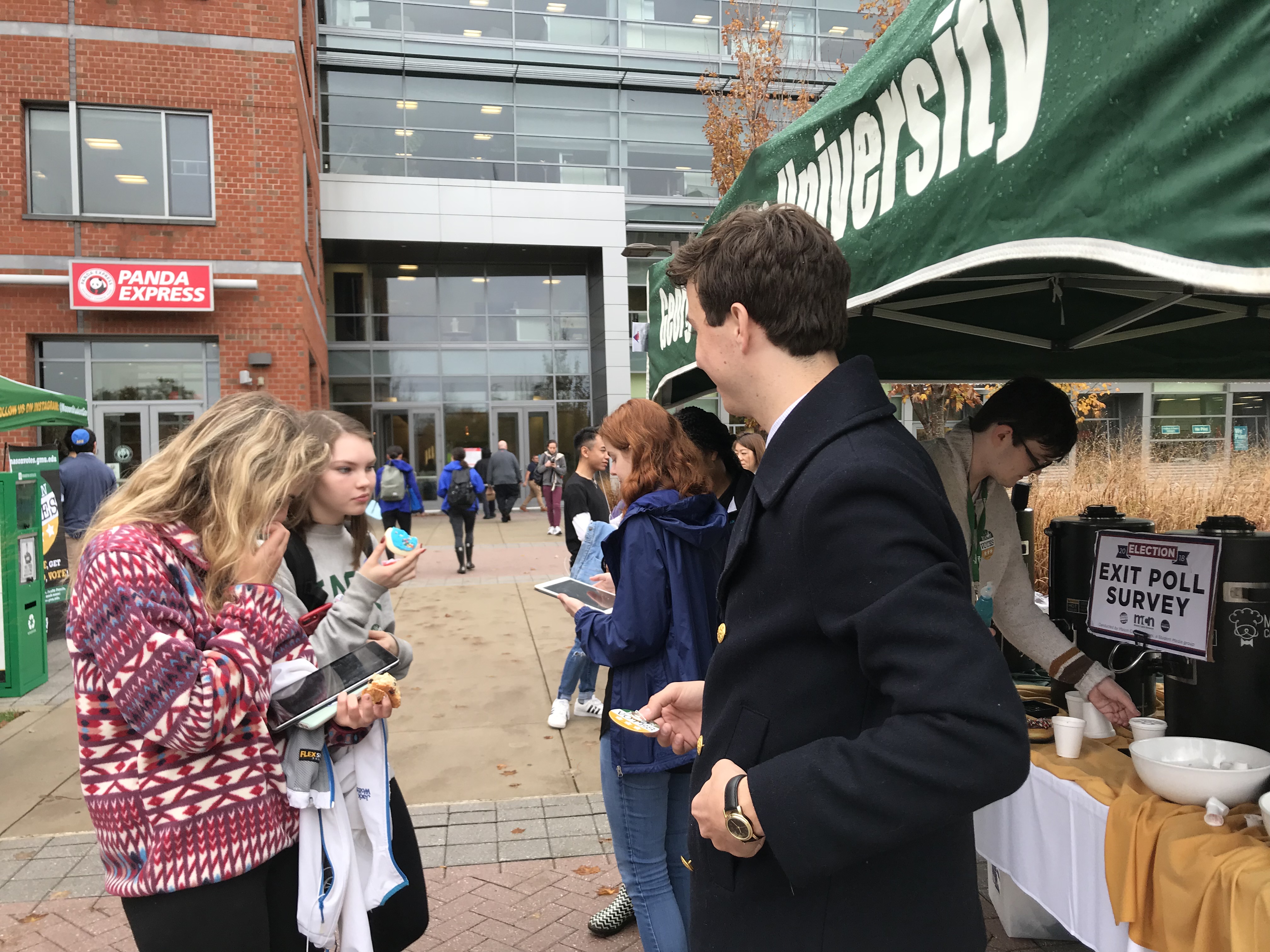
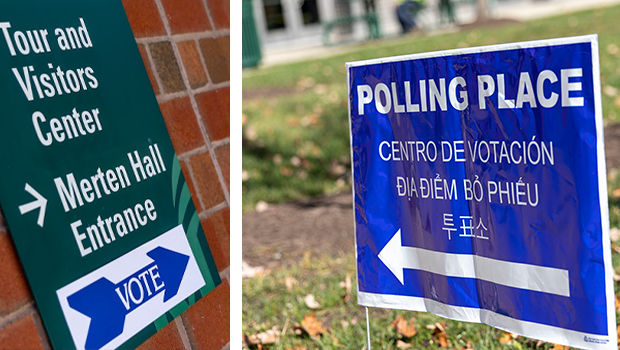
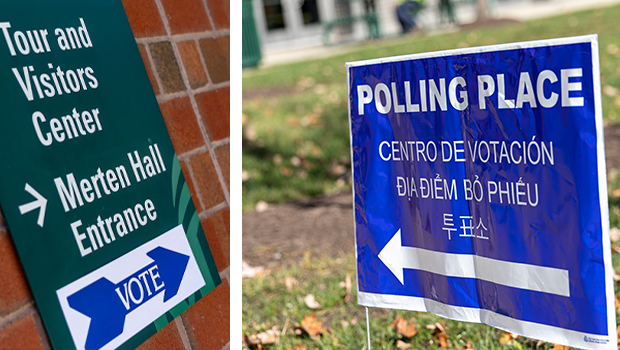
252 students cast regular ballots at Merten Hall on Election Day 2022. More than 100 additional students voted using provisional ballots due to the new same day registration option. Photos by: Mitchell Richtmyre/Fourth Estate
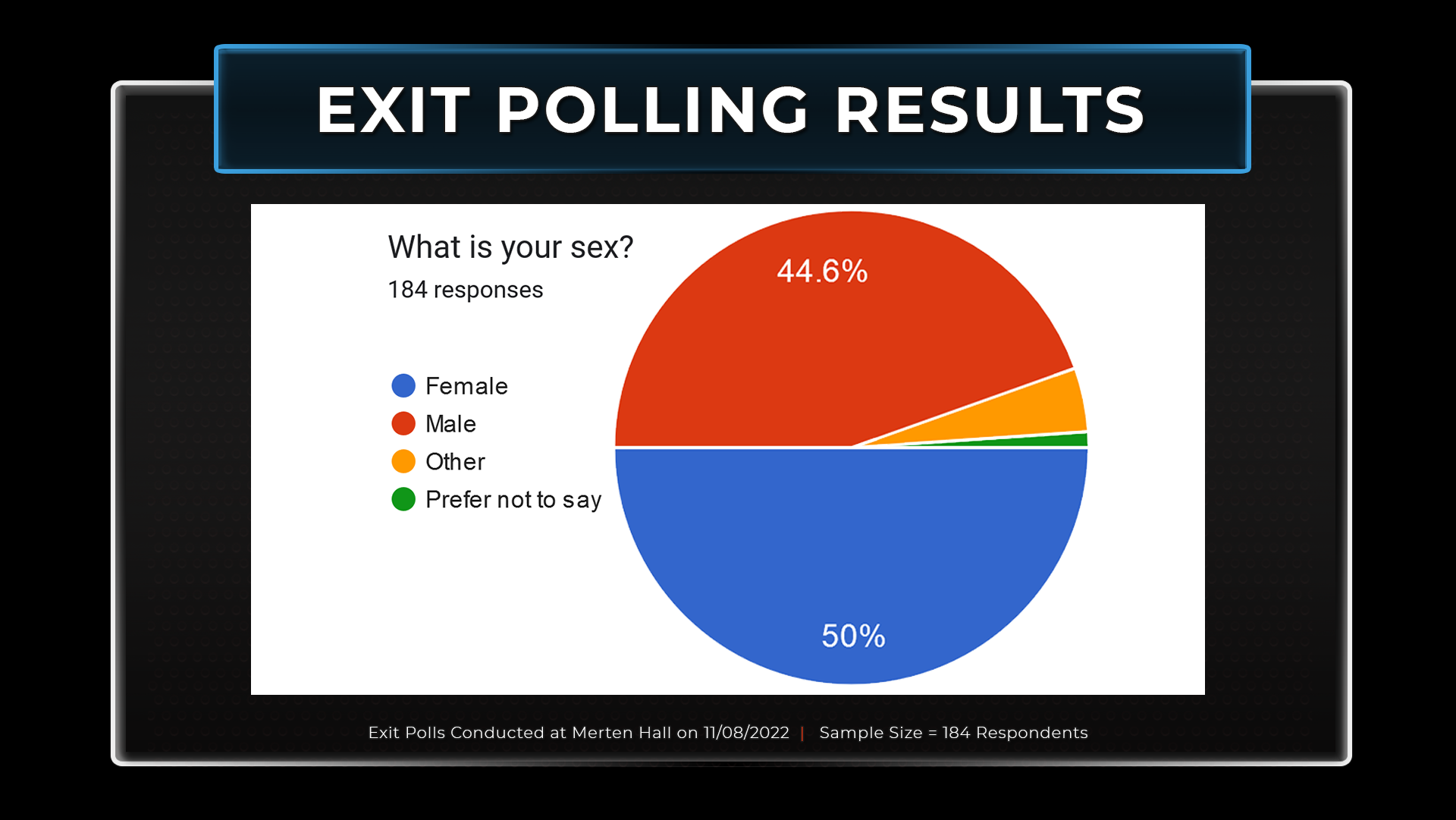
Student Media, Mason Cable Network, and Mason Votes conducted exit polling outside Merten Hall on November 8th to learn more about what issues and candidates were motivating student voters in 2022.

Students were asked to complete a short exit survey after voting at Mason’s on-campus polling place (University Precinct), and the results were analyzed during Mason Cable Network’s LIVE election night broadcast.

Watch the 2022 election night broadcast: youtube.com/watch?v=j1tM0Dry1eg

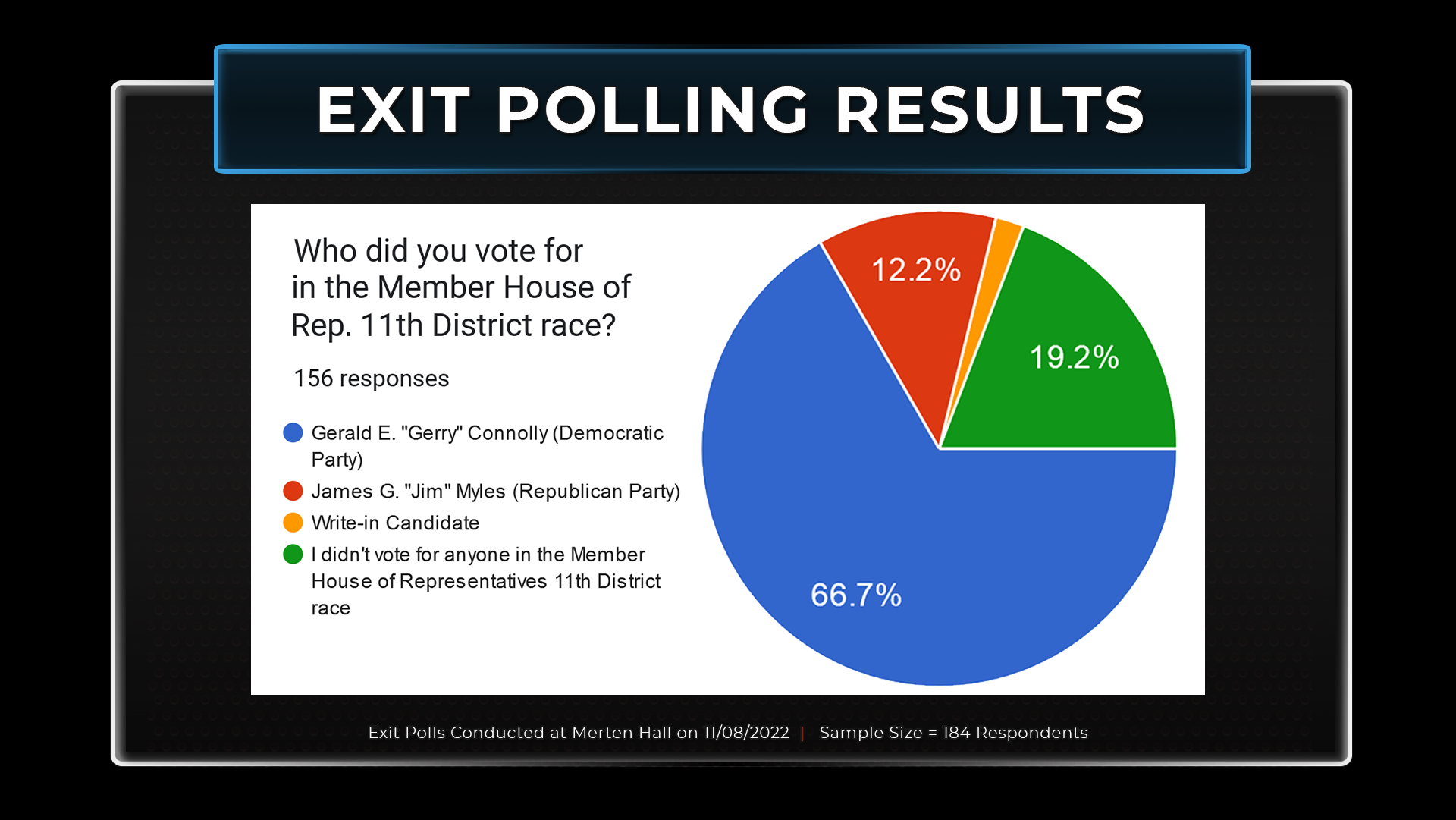
Mason voters overwhelmingly supported the Democratic candidate for the U.S. House of Representatives in Virginia’s 11th Congressional District, with 84.52% of the vote going to longtime incumbent Gerry Connolly. Republican challenger Jim Myles received 15.48% of the Mason vote. Both candidates visited Mason’s Fairfax campus within the last month of the election to speak with potential voters.

New in 2022 was a “same day” voter registration option in Virginia. According to the Virginia Department of Elections: “Beginning with the 2022 General Election, the General Assembly approved legislation that provides the ability to register at any time, up to and including Election Day.”

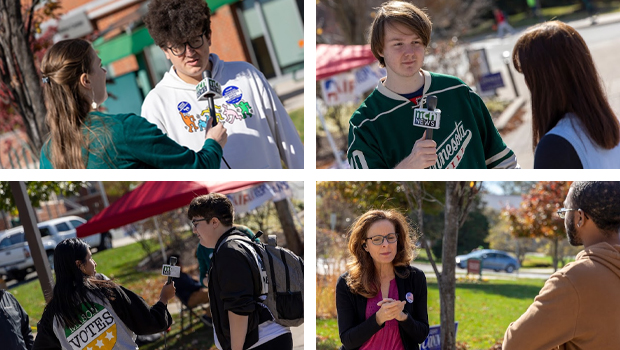
Student reporters from Mason Votes interviewed student voters and faculty members as part of their 2022 midterm election coverage. Photos by: Mitchell Richtmyre/Fourth Estate
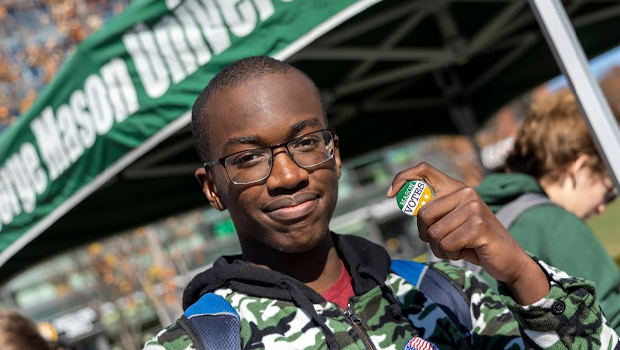
Perhaps unsurprisingly, many Mason students (a group that includes many first-time voters and voters registering with new on-campus addresses) took advantage of the same day registration option, with more than 100 same day registrations reported from the University Precinct alone. Fairfax County Board of Elections sent an extra employee to the Merten Hall polling place just to handle same day registrations.

One caveat to same day voter registration is the use of provisional ballots, which are not counted on Election Day. Provisional ballots are subject to approval by a local electoral board and voters whose provisional ballots are not approved will receive a notice in writing from the general registrar.

252 regular ballots were cast by Mason students on Election Day, with more than 100 additional provisional ballots yet to be counted. Learn more about same day registration and provisional ballots: elections.virginia.gov/registration/same-day-voter-registration

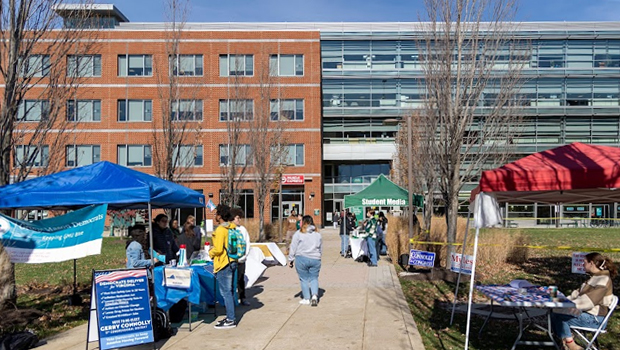
Multiple organizations had a presence outside Merten Hall on Election Day 2022 including Student Media, Mason Votes, Mason Cable Network, CECiL, Student Government, GMU Democrats, and College Republicans. Photo by: Mitchell Richtmyre/Fourth Estate

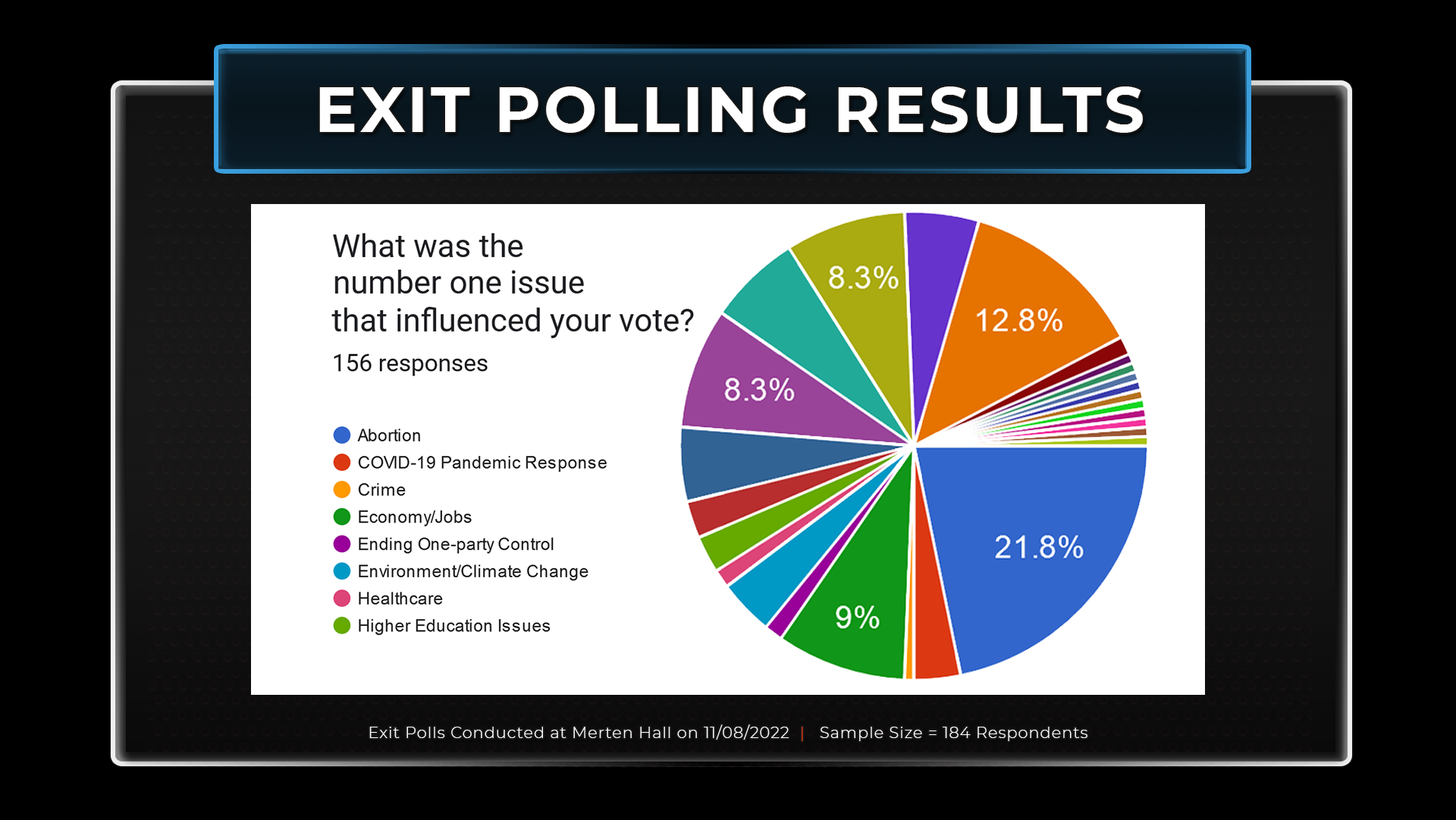
According to the results of our 2022 exit poll survey, the most important issue to Mason students when casting their vote was “Abortion,” with nearly 22% of respondents selecting that as their top concern.

When combined with the second-highest ranked category of “Women’s Issues,” nearly 35% of Mason voters seemed to have the recent Dobbs Supreme Court decision top-of-mind when voting: (21.8%-Abortion, 12.8%-Women’s Issues, 9%-Economy/Jobs, 8.3%-Social Justice, 8.3%-LGBTQ+ Issues, 5.1%-Taxes, 5.1%-Inflation, 3.8%-Environment/Climate Change, 3.2%-COVID-19 Pandemic Response, 2.6%-Immigration Issues, 2.6%-Higher Ed. Issues, 1.3%-Healthcare, 1.3%-Democracy).
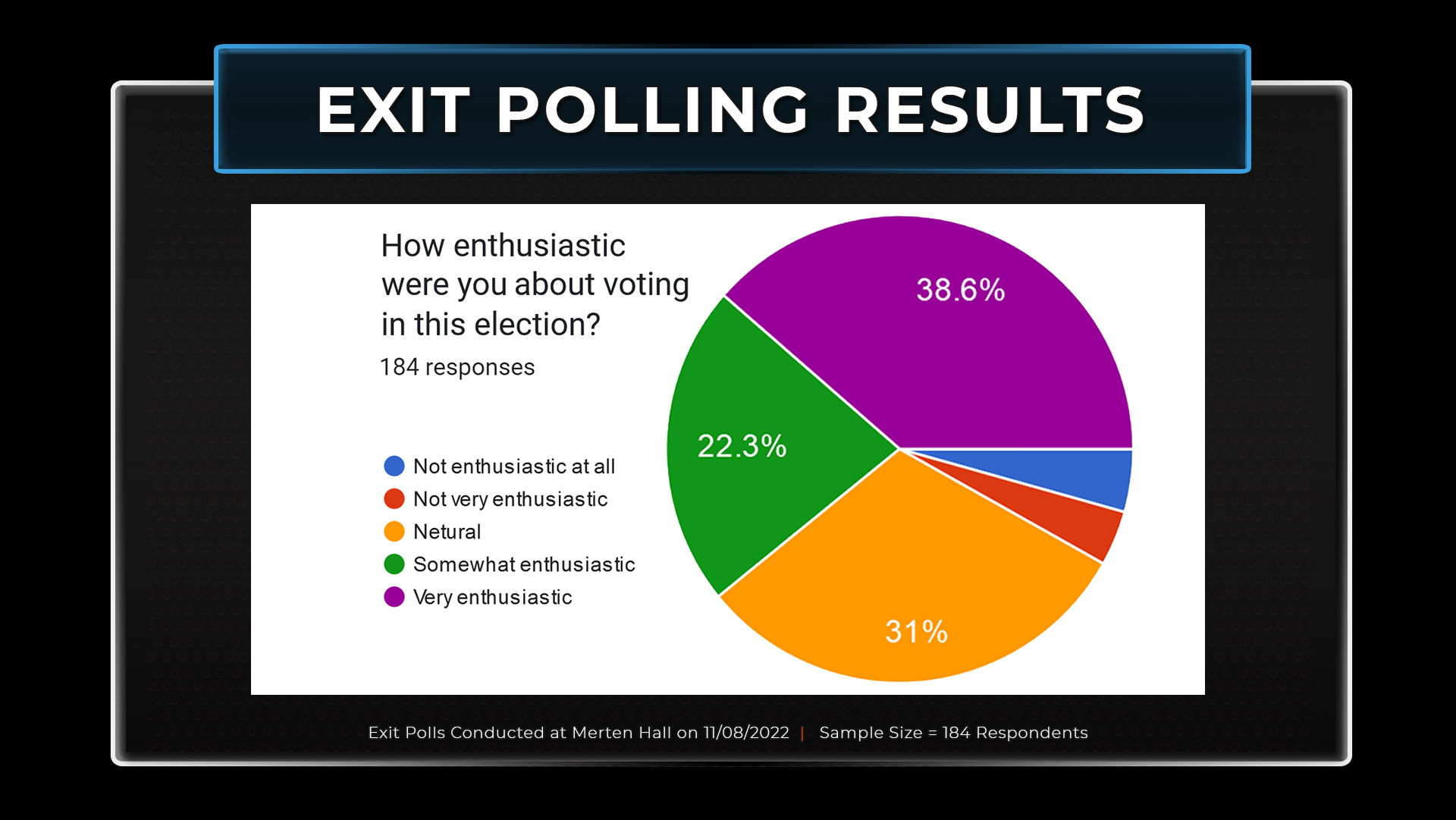
Enthusiasm is a topic for concern for both parties during any midterm election cycle, but a majority of survey respondents at Mason reported being “very” or “somewhat” enthusiastic about voting in 2022. 31% said they were “neutral” about voting, but turned out anyway: (38.6%-Very Enthusiastic, 22.3%-Somewhat Enthusiastic, 31%-Neutral, 3.8%-Not Very Enthusiastic, 4.3%-Not Enthusiastic At All).

_____________________________________________________________

Curious how Mason voted in 2022?

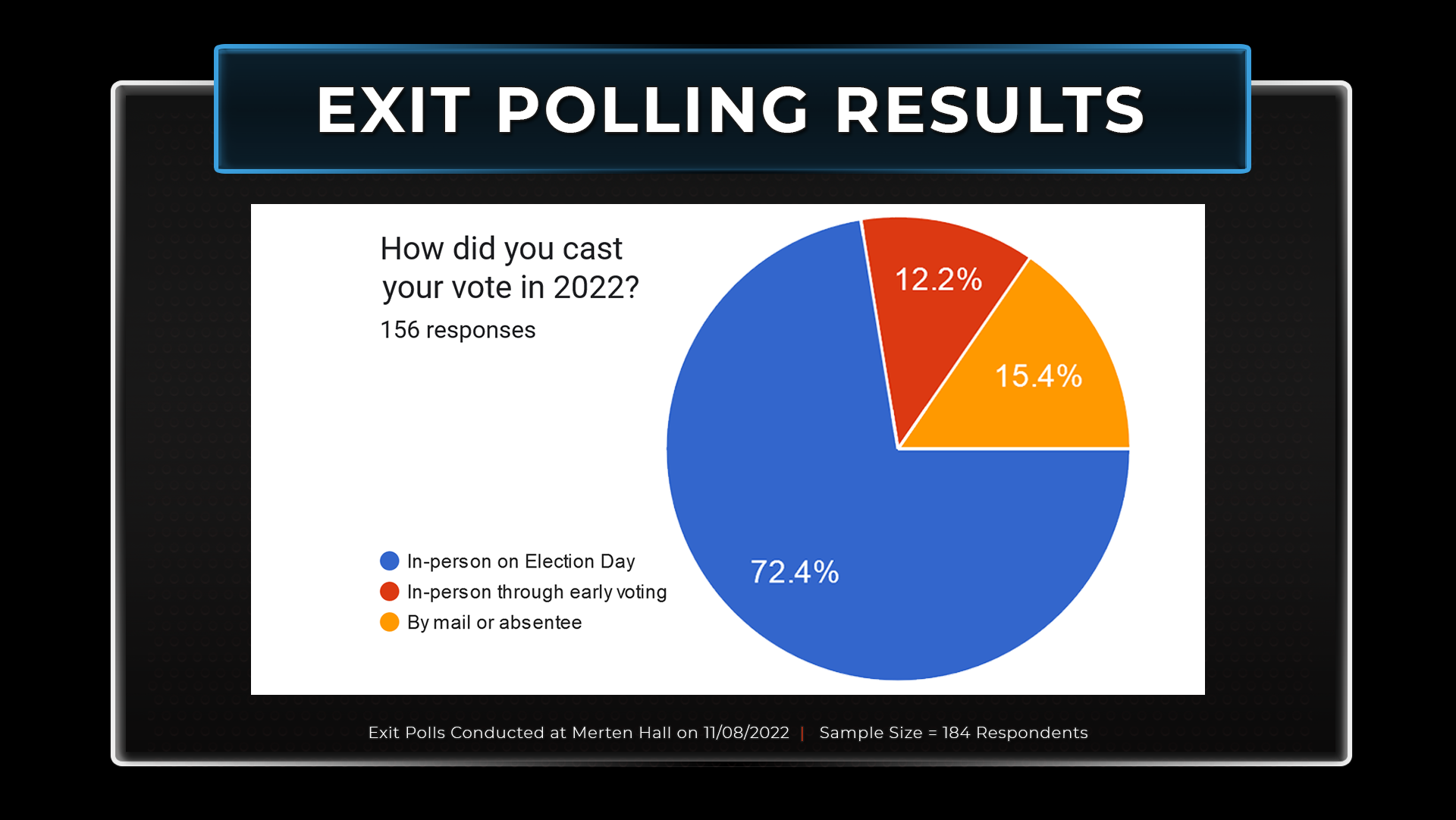
Check out the results of our 2022 exit polling below:

(Click on an image to enlarge the size)


VIDEO: LIVE 2022 Election Night Coverage!

Students from Mason Cable Network, Fourth Estate, and Mason Votes Collaborated to Create a LIVE 2022 Election Night Broadcast.
WATCH NOW on YOUTUBE: youtube.com/watch?v=BGOJaBLzwsI

Can I Vote at Merten Hall on Election Day?
If You Live On Campus, the Answer Is YES! But Keep Reading…

Merten Hall is home to Fairfax County’s University Precinct, Mason’s on-campus polling place.

If you’re a Mason student living in an on-campus residence hall, you may be wondering if you can vote at Merten Hall on Election Day (Tuesday, November 8th).

The short answer is yes, but there are a few things you should know…

Virginia’s voter registration deadline was October 17th, but if you didn’t register on time (or aren’t sure if you’re registered), don’t despair.

New in 2022: Same Day Voter Registration

According to the Virginia Department of Elections: “Beginning with the 2022 General Election, the General Assembly approved legislation that provides the ability to register at any time, up to and including Election Day.”

This new legislation means that Mason students who missed the October 17th registration deadline AND live on the Fairfax campus can still register in-person “on the spot” on Election Day at Merten Hall and vote at the University Precinct using a provisional ballot.

Learn more about same day voter registration and provisional ballots: elections.virginia.gov/registration/same-day-voter-registration

If you don’t live on Mason’s Fairfax campus, you can still utilize same day registration, but must vote on Election Day at the assigned polling place for the area where you reside.

Find your assigned polling place: elections.virginia.gov/casting-a-ballot/polling-place-lookup

What is a Provisional Ballot?

According to the Virginia Department of Elections: “Provisional ballots are used by voters who do not appear on the list of registered voters at their polling location. Provisional ballots are not processed by a vote counting machine at the time of voting, but rather are subject to approval by the local electoral board prior to the ballot being counted.”

Learn more about provisional ballots: elections.virginia.gov/registration/same-day-voter-registration

Can I Use My Mason Student ID to Vote?

Yes, your Mason student ID is welcome on Election Day!

List of acceptable forms of ID: elections.virginia.gov/media/formswarehouse/voter-id/outreach-materials/documents/Voter-Identification-Chart-Rev-4-28-21.pdf

What If I Forget My ID on Election Day?

According to the Virginia Department of Elections: “If you get to your polling place without acceptable ID, you can sign an ID statement affirming your identity, you will be able to vote a regular ballot. If you do not sign an ID statement to affirm your identity you may vote a provisional ballot. You will be provided instructions to ensure your vote will count.”

_____________________________________________________________

Election Day is Tuesday, November 8th…

Don’t Forget to VOTE!

_____________________________________________________________

Disclaimer: This post is intended to provide important voting information for Mason students, but always refer to the official Virginia Department of Elections website for the most accurate and up-to-date voter information/guidelines: elections.virginia.gov

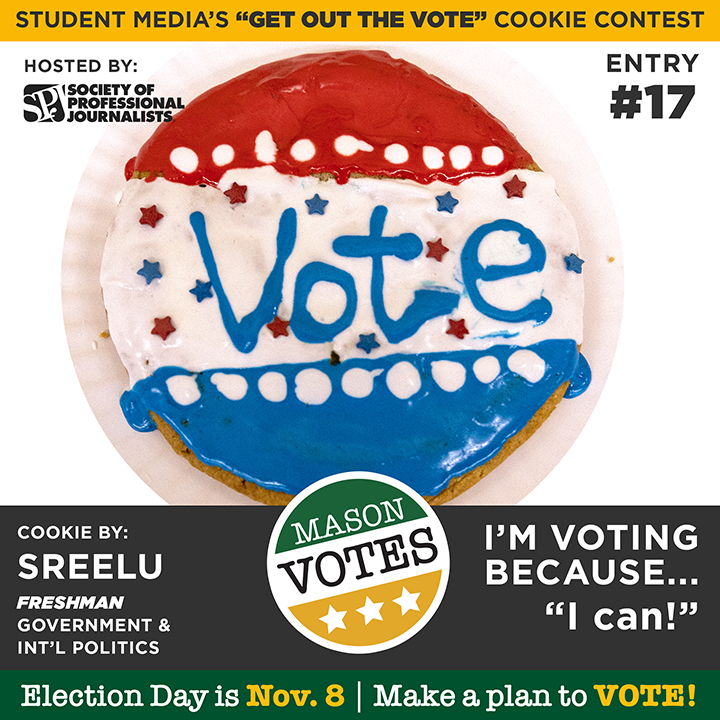
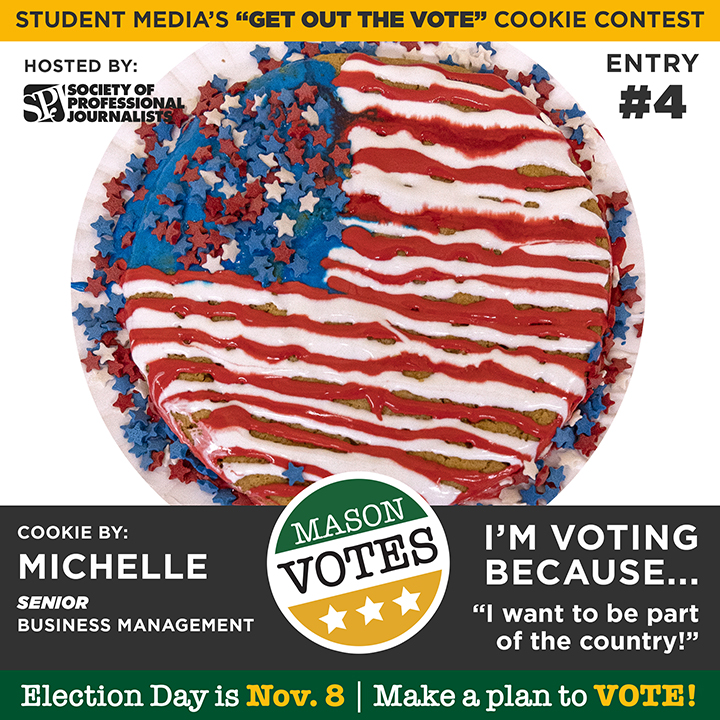
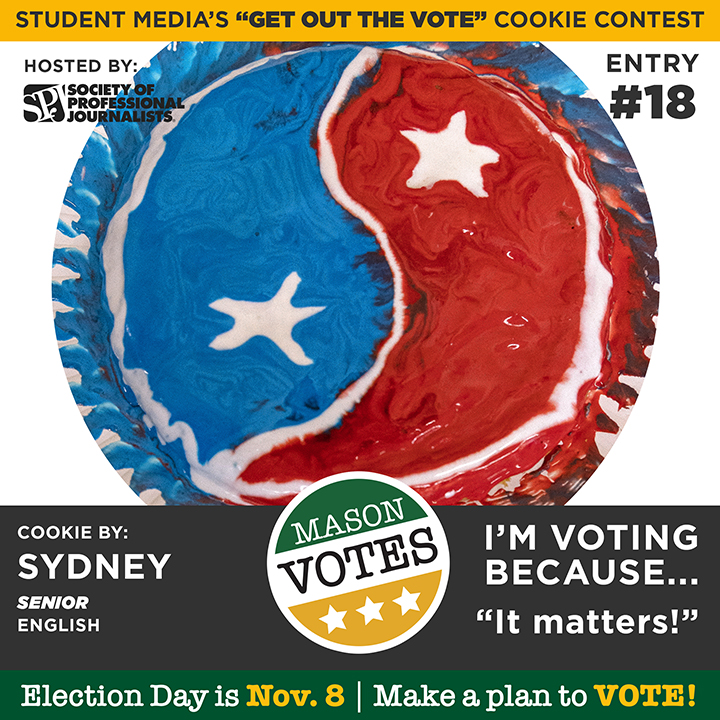
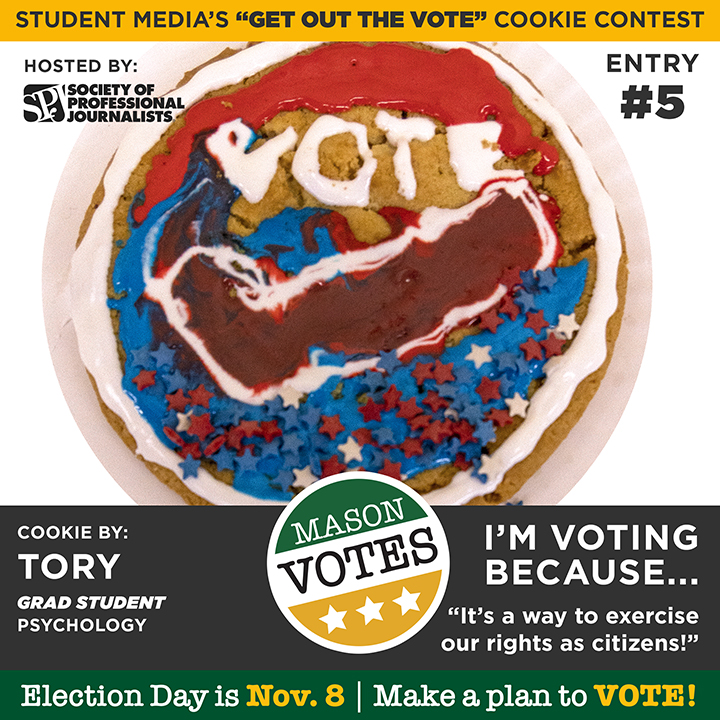
2022 “Get Out the Vote” Cookie Contest

A Tasty Reminder to VOTE on Tuesday, November 8th

Special thanks to the Mason Bookstore and Spice Corner for donating prizes for our contest winners!

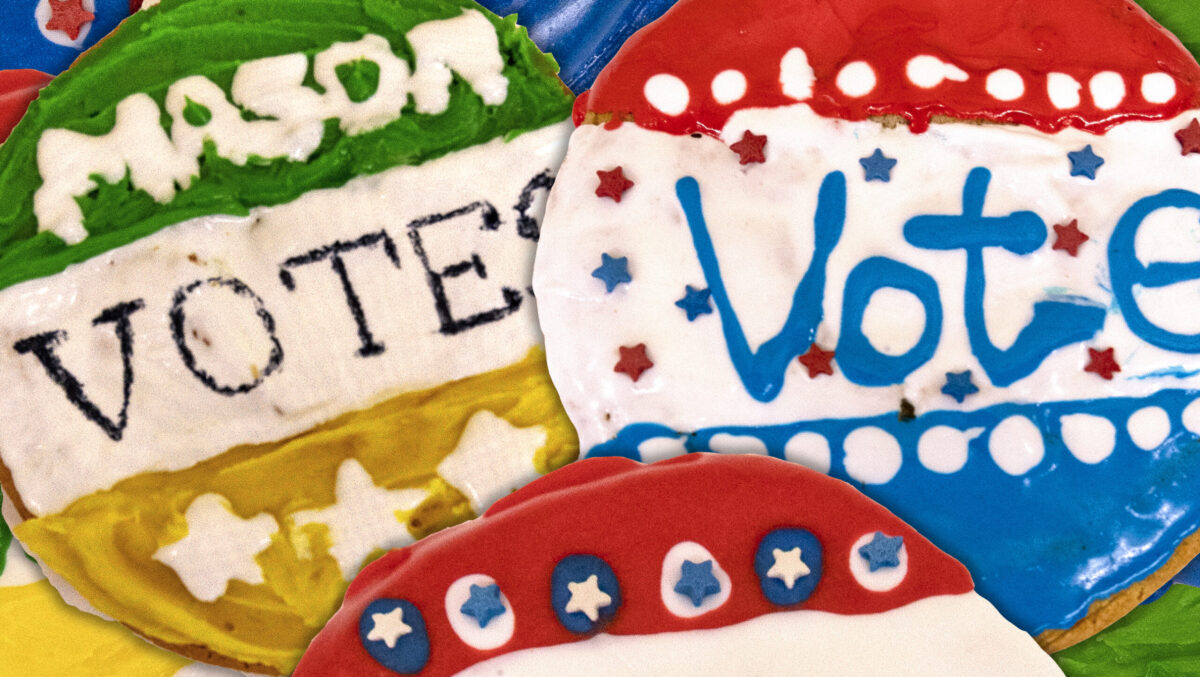
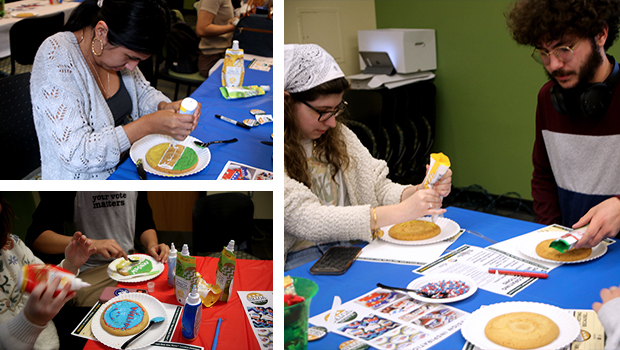
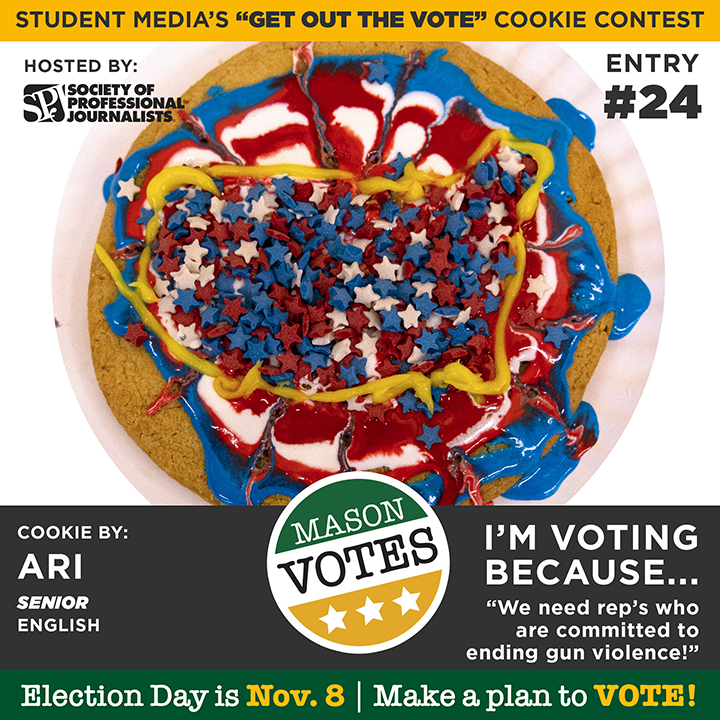
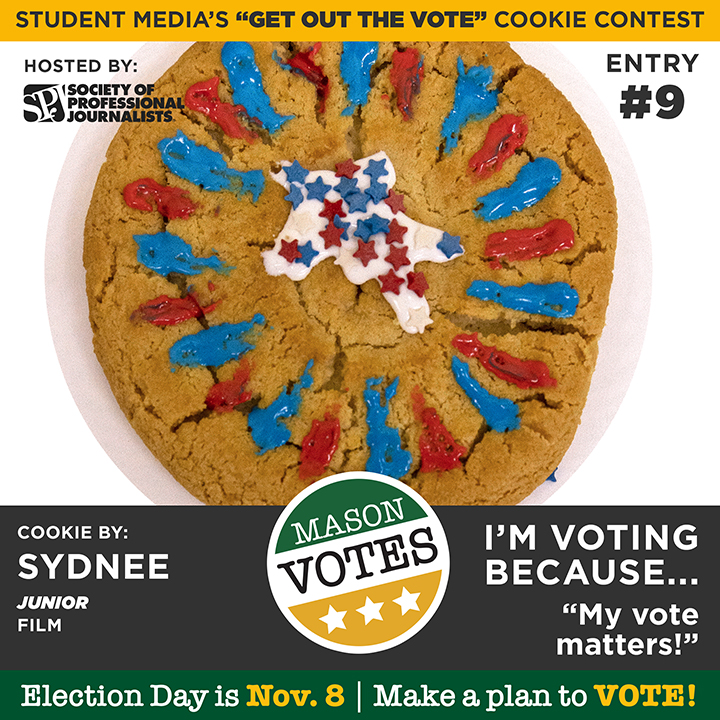
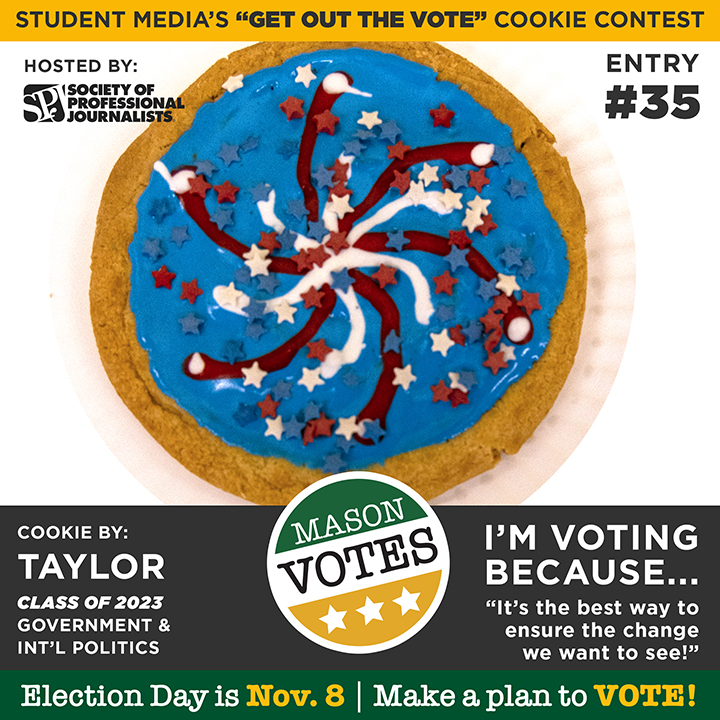
Student Media, Mason Votes, and Mason’s student chapter of the Society of Professional Journalists teamed up to host an election-themed cookie decorating contest one week before Election Day 2022.

40+ students stopped by the event to decorate a cookie and share their creation via social media as a way to encourage the Mason community to vote on Tuesday, November 8th.

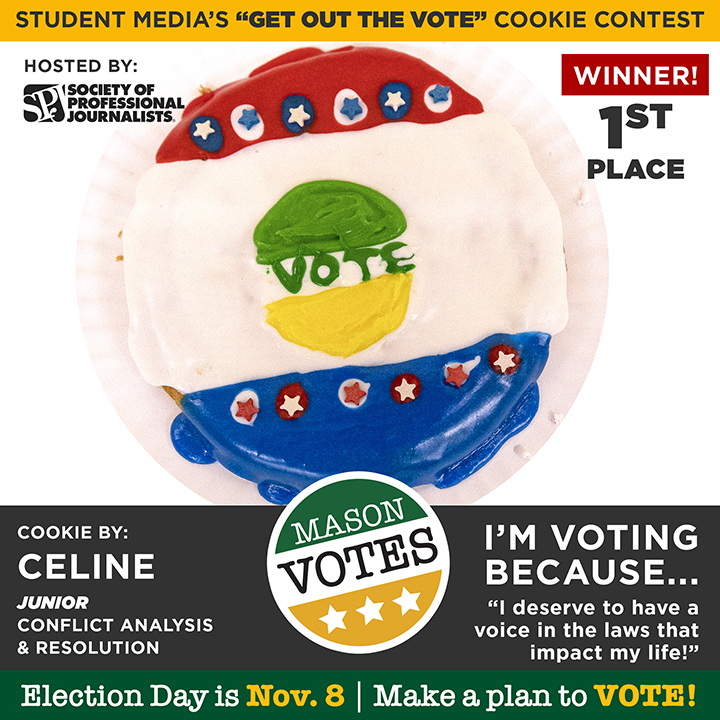
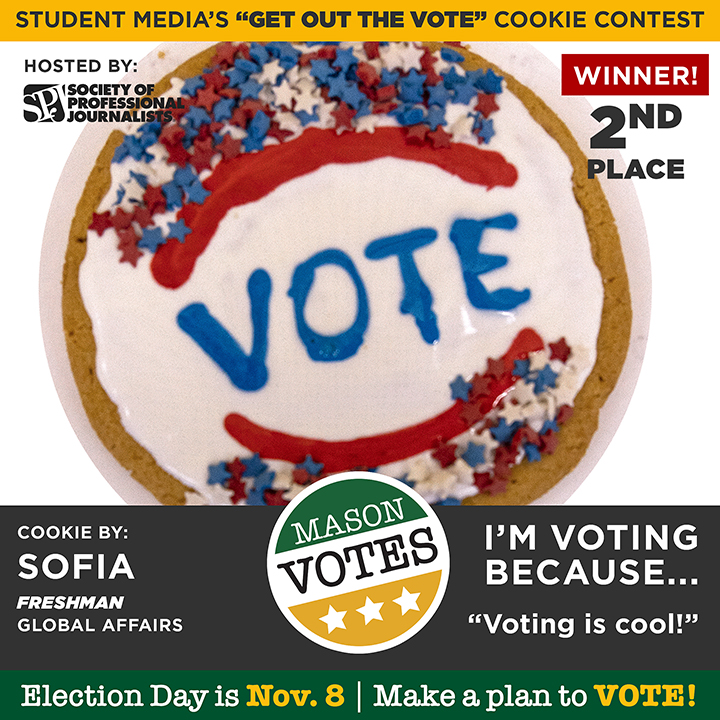
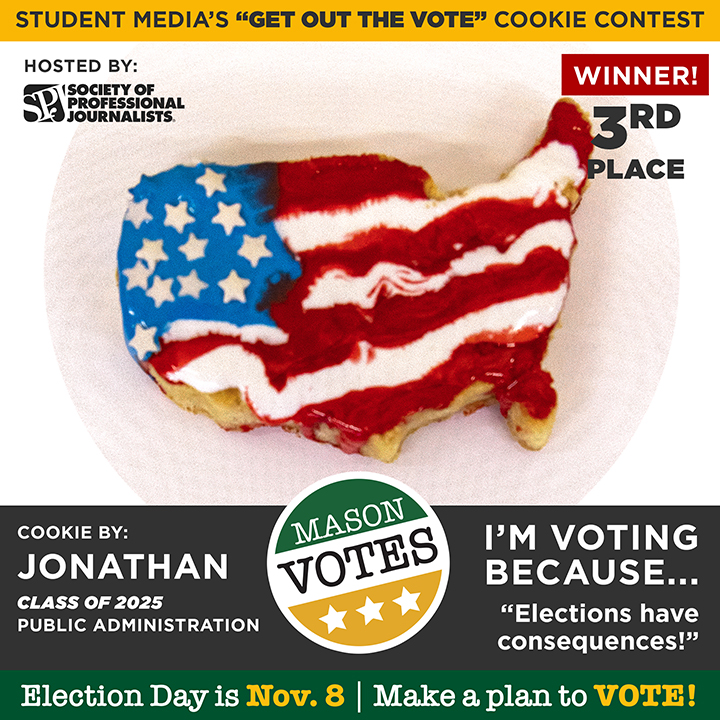
All entries were judged on three criteria: creativity/originality, construction, and theme.

And the winners are…

Check out a few of the other “Get Out the Vote” cookies created by Mason students:

_____________________________________________________________

Election Day is Tuesday, November 8th…

Don’t Forget to VOTE!

_____________________________________________________________

Event Photos by: Madalyn Godfrey

Cookie Photos by: Mitchell Richtmyre

VIDEO: Student Voices on 2022 Elections

Mason Students Share What’s Motivating Them in 2022

The students of COMM 145 (Newspaper Workshop I) interviewed their peers on why voting is important and which issues were influencing their vote in 2022.
Here is what they found…

Special thanks the students of COMM 145: Madalyn Godfrey, Carson Alger, Claire Kim, and Peter Hoang.

Video edited by: Patrice Pannell

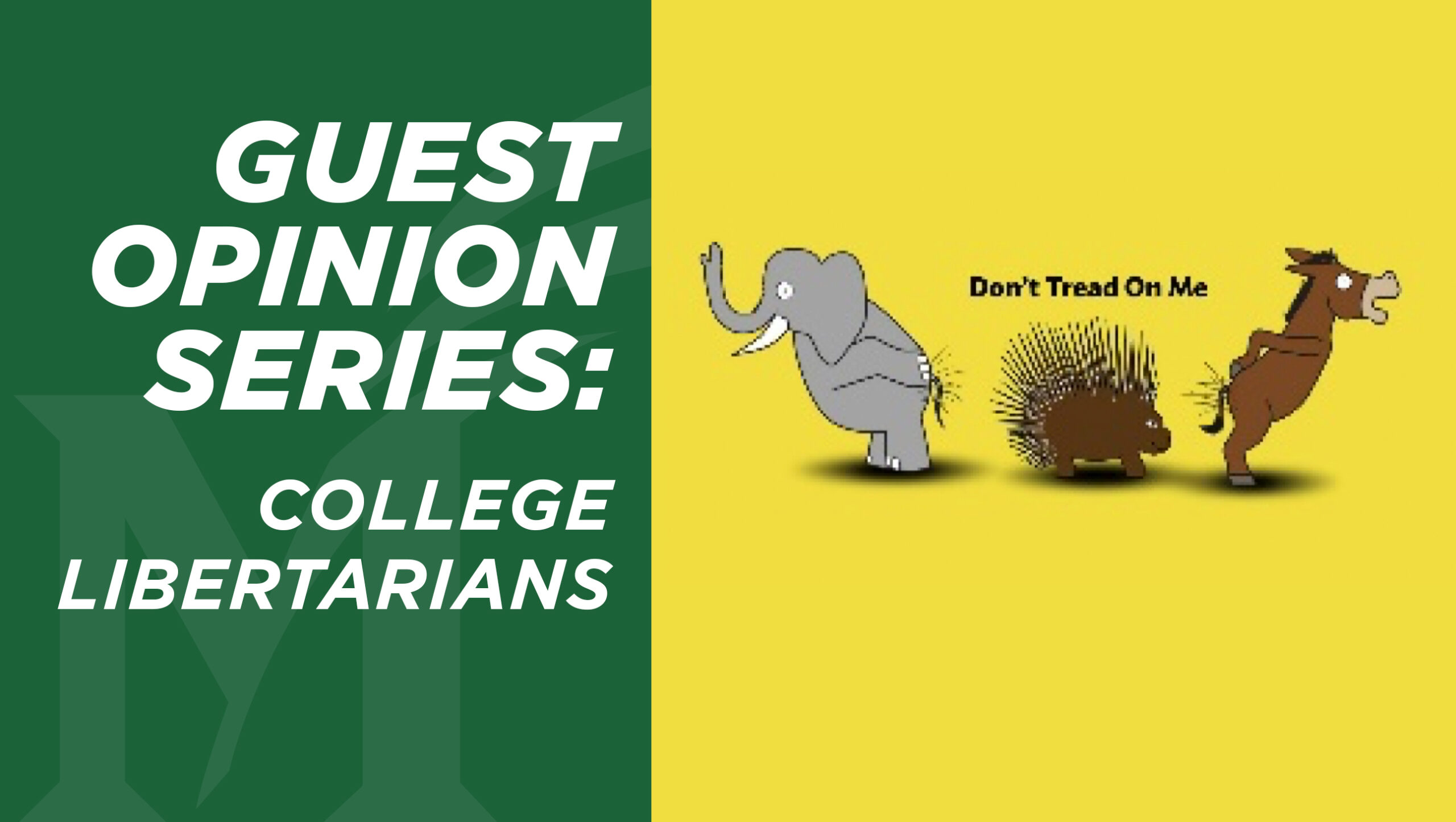
Guest Opinion Column: College Libertarians

“All of Your Freedoms All of the Time” or Why You Should Register Libertarian

By: Richard Fast (Econ PhD), College Libertarians President
Logo courtesy of: College Libertarians

What is a Libertarian? “I’ve heard of them, I just don’t know what they stand for.” “Librarian? Y’all having a party now?” “Something about Alex Jones.” “Hey, you’re with the Aleppo guy. I remember that!” “I’ve seen you guys on the ballot. What do you all believe in?”

These are some of the responses I get when tabling on campuses for College Libertarians. Very simply, a Libertarian is someone who wants to live in peace and prosperity, and wants the same for everyone else, too. This rests on the Non-Aggression Principle, which, much like the Golden Rule, asserts as long as individuals refrain from violence, coercion, or fraud, they should be free to pursue their ends without external constraint. What differentiates Libertarians from the two old parties is: 1) Democrats want to raid your wallet or purse, but allow you social freedoms. 2) Republicans want to be the boss of your bedroom, but allow you economic freedoms. (3) Libertarians want you to keep your money, and not mind your personal affairs. Libertarians seek a world in which people are viewed as autonomous individuals seeking to live fulfilling lives through choice in how they work, who they love, and where they choose to live and learn.

This also applies to foreign policy. Libertarians seek, as Thomas Jefferson put it, “peace, commerce, and honest friendship—entangling alliances with none.” The point is, the government should treat its citizens like the competent adults they are.

When I see folks tabling for the R’s or D’s, they don’t need to explain themselves. Everyone already knows what they stand for, or claim to stand for. While both major parties have switched ideologies over the centuries, virtually every voter can be assured of one thing when either a Republican or Democrat is elected: more violence, more rights violations, more taxes, and more evisceration of hard-fought freedoms. Over 150 years of Republicans and Democrats in office has demonstrated over and over that neither party cares about Americans and their dreams, their ideals, and their future. The reason why people know what R’s and D’s stand for, but may not know what Libertarians stand for, is because R’s and D’s have rigged the electoral system such that hardly anyone but R’s and D’s can get on the ballot. The government doesn’t like competition.

But that’s exactly what Libertarians provide: a third option, and in national politics, the most viable third option on the ballot. In 2016, Libertarians received 3.27% of the popular vote for President, while the Green Party received about 1%. Sure, 3% may not sound like much, but what it implies is that Libertarians had three times more support than the fourth largest party in the U.S. The difference in proportionality was nearly the same in 2020. That’s why if Americans truly want to break the duopoly (politically, an abusive relationship), their best bet is to vote Libertarian, the third-party candidate most likely to succeed. We have competition in the marketplace (no one, except Bernie Sanders, would tell you 14 brands of deodorant is too much), so why not in the ballot box?

The Libertarian Party of Northern Virginia is fortunate to have ballot access at this time. Third parties can lose ballot access (meaning, their candidates get dropped from the ballot) if they don’t reach a certain voter percentage within a set number of years. Once those requirements are close to being met, the government raises the bar higher to ensure third party and independent candidates do not stay on the ballot. While various states allow write-in options for candidates that are not listed, in many instances those write in candidates are not counted and added into the totals unless they meet certain criteria before election day. These criteria are often put in place by Republicans and Democrats to ensure no third party or independent candidate gets on the ballot or is counted properly in vote totals. The Libertarian Party is fighting tirelessly against these onerous restrictions and regulations that are, effectively, censoring dissenting voices across the United States.

Why are Republicans and Democrats so powerful when they barely represent a majority of voters? Let’s look at some numbers. Most surveys show about one-quarter of U.S. voters are registered as Republican (or self-identify as Republican in states that do not register voters by party), about one-third are registered or self-identify as Democrats, and about two-fifths are registered as independent or no party. Combined, the percentages for R’s and D’s come out to about 58% of all registered voters; more than half, but not two-thirds. Third party registrations, including Libertarian, make up about 5% of the total.

Founded in December, 1971 in Colorado, the Libertarian Party is the only political party that wants you to be able to have your cake and eat it too. No longer do you have to choose between more social freedoms (D’s) or more economic freedoms (R’s). A vote for Libertarians is a vote for both. Libertarians want polyamorous LGBT married couples to be able to homeschool their adopted children while self-employed, protecting their marijuana plants with AK-47’s. This example humors folks, and I’m glad it does, but it’s to make a point: Libertarians are the only party fighting for all your freedoms all of the time.

As you head to the polls, or fill out your mail-in ballot, consider the history of the last 150 years of Democratic and Republican tyranny. Both parties supported the death penalty, drafting young men to fight a war they did not believe in, stealing money (through taxes) they did not earn to give to their friends in Big Government and Big Business, in civil asset forfeiture in which the police can seize whatever you own, in forcing people of different backgrounds and ethnicities to live and work separately. Both parties, at one time or another, supported all of these terrible rights violations. The Libertarian Party is the only party that stands for peace, freedom, individual rights and privacy in all aspects of your life.

To learn more about the Libertarian Party of Northern Virginia, check out www.lpnova.org

To join College Libertarians at GMU, e-mail Richard Fast at [email protected]

_____________________________________________________________

This is part of an on-going series of guest opinion columns profiling major politician organizations on campus. All guest columns are independently written, and don’t necessary reflect the view point of Mason Votes, which is a non-partisan organization. All guest submissions are edited for grammar and length. If you would like to submit a piece, email [email protected].

Getting Political @ Mason

Student-Run Organizations Encourage Civic Engagement on Campus

By: Madalyn Godfrey, Mason Votes Special Contributor

Fall has arrived on Mason’s campus and change is in the air. Leaves are changing colors as the temperature cools down and congressional seats may be changing colors as voters head to the polls on Tuesday, November 8th.

Recognized as being a “Voter-Friendly” campus, Mason reported a 52.4% voting rate in the previous 2018 midterm elections, according to Tufts’ National Study of Learning, Voting, and Engagement. As students turn their attention towards the upcoming elections, various student-run political organizations across campus are increasing their voter turnout and awareness efforts.

Hearing from College Republicans at GMU, Democrats at Mason, and College Libertarians at Mason, each organization has their own set of initiatives to increase voter turnout, while offering information and advice for eligible voters.

Joseph Szymanski, the Chairman of College Republicans, spoke on behalf of the organization saying “[College Republicans] are helping anyone who is not yet registered to vote to get the information and items needed to do so.” The group encourages Mason students to use their option of an absentee ballot, as well as take advantage of early voting rules.

“It’s easy. Do it,” Szymanski said, speaking on registering to vote and going to vote. “No matter your age, if you have an opinion, you should let it be known by going out and voting for the candidate that aligns best with your views… You’re deciding who’s going to be doing the legislative work for the next two, four, or six years,” said Szymanski, while expressing the importance of voting.

For Democrats at Mason, Olivia Nealon, the Chief of Staff, said on behalf of the organization that “[Democrats at Mason] are passionate about making [the voting process] an easy process for students.” The organization is helping students every Wednesday in the Johnson Center, and will remind students to register and vote, including on Election Day.

“[Democrats at Mason] has been focusing on the upcoming elections, and helping get students involved in these elections in Virginia and across the country… Giving students the opportunity to get involved in these elections help make them more passionate and engaged in the voting process” said Nealon, regarding how the organization is spreading awareness. Nealon added, “It’s time for the younger generation to make their voices heard,” while speaking on the importance of voting.

President Richard Fast of College Libertarians at Mason, on behalf of the organization, said “College Libertarians are reminding voters that there are other options besides the two old parties. We spread [voter] awareness primarily through social media and word of mouth.” The organization is also telling students the importance of voting in midterm elections as it “sets the tone for the general.”

Additionally, Fast advises students to “vote for the candidate who you agree with the most, not the candidate that is most likely to win. There is value in a protest vote. Even if the third party candidate ‘has no chance,’ a sizable third party vote share could affect the issues of future elections. Voting for a third party candidate is one way, but not the only way, to change the electoral system in this country.”

Despite supporting different candidates for the upcoming midterms, each organization offers advice for students who are eligible to vote. From Szymanski, on behalf of College Republicans, “Vote in a way that you have the most effect.” “Be aware of all the deadlines!” says Nealon, on behalf of Democrats at Mason. Lastly, “Keep an open-mind, research candidates’ positions, and make an informed decision” said Fast, on behalf of College Libertarians.

Whether students want to help move America forward, have their voice be heard, and/or take back their rights and freedoms; College Republicans at GMU, Democrats at Mason, College Libertarians at Mason, and other political student organizations, are available resources for students at Mason in helping them perform their civic duty.

_____________________________________________________________

Explore more student groups via Mason360: mason360.gmu.edu/club_signup

Get to Know Some of Mason’s Political Student Orgs

Profiles of Four Campus Groups That Want Your Vote

By: Gabriel Yossick, Mason Votes 2022 Online Editorial Team


GMU Democrats

  • The GMU Democrats serve as the Democratic Party’s representative on-campus.
  • They have worked with candidates like Jennifer Wexton (D-VA.10), Abigail Spanberger (D-VA.7), and Catherine Read for Fairfax City Major.
  • A normal general body meeting during the fall revolves around raising voter registration awareness. The spring season focuses on discussion-based topics.
  • Learn More: mason360.gmu.edu/gmudemocrats/home
“We are for inclusivity, of all people, and that is really the biggest thing,” said Olivia Nealon (Honors ’25), GMU Democrats Chief of Staff.


College Republicans

  • The College Republicans’ mission is to bring the Republican Party to Mason.
  • They have worked with the Yesli Vega and Hung Cao campaigns, both running in the 7th and 10th districts respectively on canvassing and phone banking.
  • During the fall semester, the club is in election mode, while the spring semester offers professional development for club members.
  • Learn More: mason360.gmu.edu/crepublicans/home
“We are here for the candidates. That is what the College Republicans is about,” said Joe Szymanski (Schar ’23), Chairman for the College Republicans.


Young Democratic Socialists of America

  • The Young Democratic Socialists of America (YDSA) is a club founded on socialist and anti-capitalist beliefs.
  • The club consists of different committees that cover a variety of issues like political education and outreach.
  • They hold clothing drives for refugees arriving from Florida and Texas for the upcoming winter.
  • Learn More: mason360.gmu.edu/gmuydsa/home
“Socialism is not when the government does stuff… it’s mainly when the workers or the average Joe has an equal say in how the government is run,” said Jai Carpenter (CES ’23), Vice President of the YDSA.


College Libertarians

  • The College Libertarians are representatives of the Libertarian party at Mason.
  • They worked with the Steven Porter campaign for Herndon town council.
  • The club is not registered yet, but the club holds movie nights and general interest meetings. Official elections for the club will occur when the club is fully registered, likely in mid-November.
“The libertarian philosophy revolved around what’s called the non-aggression principle,” said Richard Fast (CHSS, PhD), President Pro Tem of the College Libertarians. Which, in “essence, is I don’t hit or steal from you, and you don’t hit or steal from me.”


_____________________________________________________________

Explore more student groups via Mason360: mason360.gmu.edu/club_signup