Mason Votes

VA Voter Registration Deadline is Monday, Oct. 16th!

Deadline to Register to Vote in Virginia is Monday, October 16, 2023.

Don’t Forget to Register or Verify:
elections.virginia.gov/registration

If you have already registered in Virginia:

Check your registration and confirm that you are registered at your current address, find your polling location, or update your registration online at elections.virginia.gov before Oct. 16, 2023.

If you need to register in Virginia:

Qualifications for voter registration: US Citizen, resident of Virginia, and 18 years old on or before November 7, 2023 (born on or before November 7, 2005).

Voter Registration Deadline: Monday, October 16, 2023 is the deadline to register to vote or update an existing registration. Learn more: elections.virginia.gov/registration

Online: You may submit your registration and absentee ballot requests online only, if you have a Virginia DMV record:

  • If you have a Virginia driver’s license, you can register online. Go to: elections.virginia.gov and use the secured citizen’s portal. It takes about 2 minutes to register online, you will need your Virginia driver’s license number. The last day to register or update your registration to be eligible to vote in the Nov. 7 General and Special Elections is Oct. 16 postmarked by mail or in person by 5:00 p.m., or online by 11:59 p.m.
  • If you don’t have a Virginia driver’s license, go to elections.virginia.gov to fill in the registration form, print it, sign it, and send it to the Department of Elections by mail. Your registration form must be postmarked by Oct.16, 2023.

Students living on the Mason’s Fairfax campus: You may register to vote from your campus address and provide your current resident hall name and dorm number. You will need to change this voting address when you move.

IMPORTANT NOTE for on-campus student voters in Fairfax:

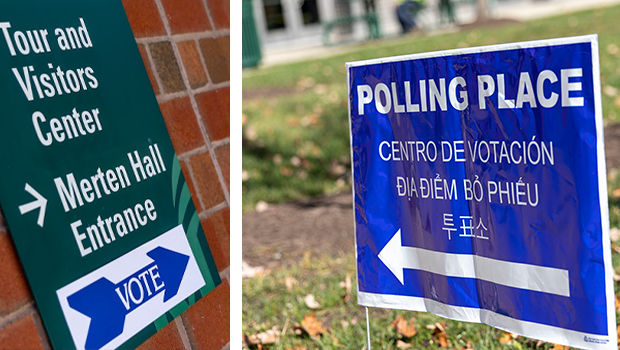
ONLY students registered at their current Fairfax campus address may vote at the University Precinct located in Merten Hall on Election Day.

All other Mason students and faculty must vote at their registered home precincts, either inside the county, within the Commonwealth or your home state.

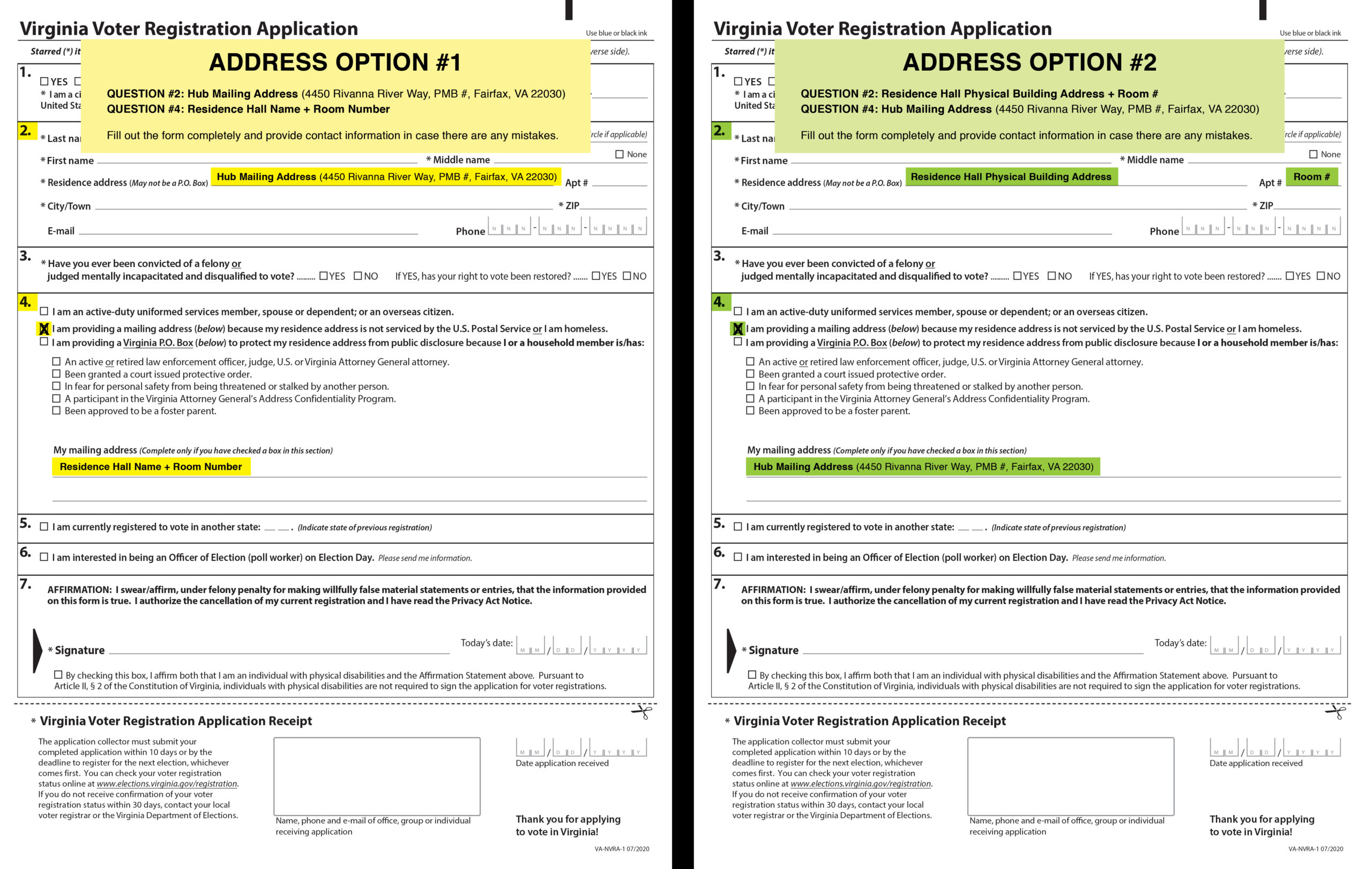
On-campus resident addresses on voter registration applications for Mason students can be provided in two ways (both are correct):

  • ADDRESS OPTION #1: Provide the Hub mailing address (4450 Rivanna River Way, PMB #, Fairfax, VA 22030) as the address for Question #2 on the voter registration application, AND provide your current residence hall name and room number under Question #4 on the voter registration application.
  • ADDRESS OPTION #2: Provide your current residence hall’s physical building address for Question #2 on the voter registration application, AND provide the Hub mailing address (4450 Rivanna River Way, PMB #, Fairfax, VA 22030) as the mailing address under Question #4 on the voter registration application.

Don’t know the physical address of your residence hall? Click here to find it on the list >

Click here to view examples of Address Option #1 & Address Option #2 >
_____________________________________________________________

Disclaimer: This post is intended to provide important voting information for Mason students, but always refer to the official Virginia Department of Elections website for the most accurate and up-to-date voter information/guidelines: elections.virginia.gov
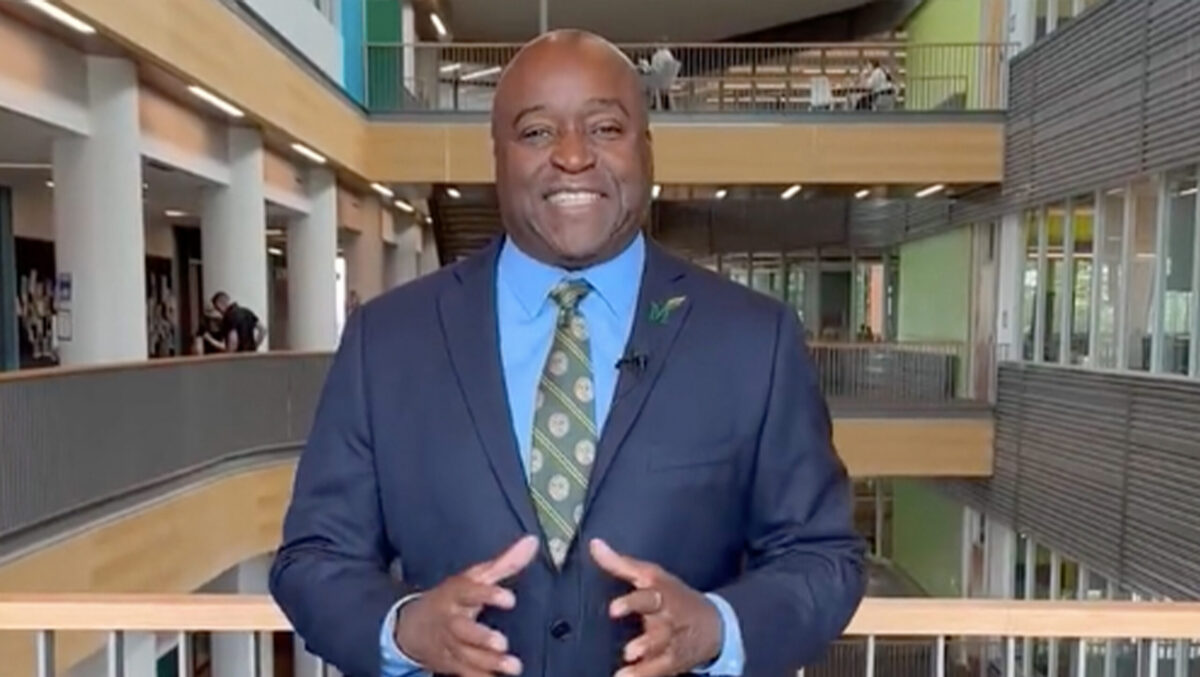
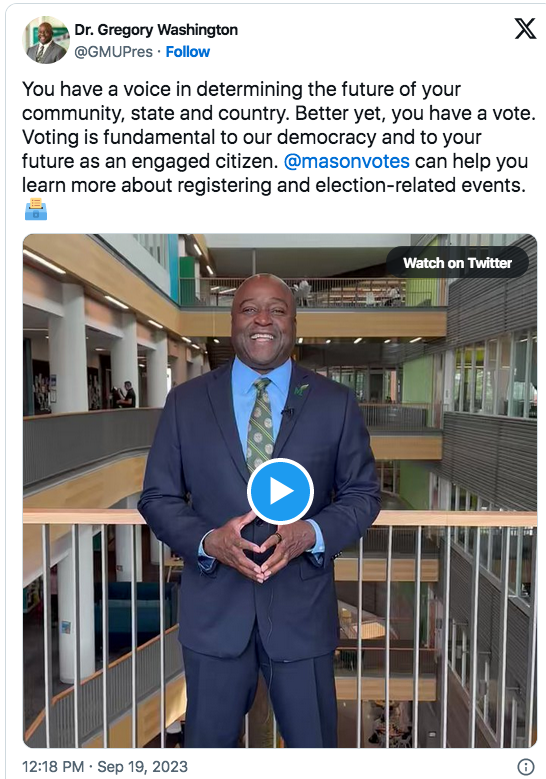
President’s Message on National Voter Registration Day 2023

Watch President Washington’s video message to the Mason community on National Voter Registration Day 2023 >

Patriots,

You have a voice in determining the future of your community, state and country. Better yet, you have a vote. Voting is fundamental to our democracy and to your future as an engaged citizen. 

That’s why each year I remind you about #NationalVoterRegistrationDay. That day is today. This is an opportunity for you to register to #Vote in the November 2023 elections.

The Virginia State Department of Elections now accepts the Mason Mobile ID, as well as a physical Mason ID, for voter identification.

Oct. 16 is the deadline in Virginia to register to vote, or to update an existing registration. 

If you register with your campus address, you can vote at a polling place in Merten Hall, on the north end of the Fairfax Campus. @mason_votes can help you learn more about registering and about key issues and election-related events happening around Mason.

President Gregory Washington (@presidentgregorywashington)

Constitution Day 2023

Mason’s Constitution Day event is Friday, September 15, 2023: RSVP via Mason360: cglink.me/2d7/r2134256

Each year, Americans celebrate the signing of the U.S. Constitution by the founders in September 1787.

Learn more about the Constitution: studentmedia.gmu.edu/constitutionday

___________________

Constitution Day 2023 Event Info:

Date: Friday, September 15, 2023

Time/Location: 12-2pm in The Hub Corner Pocket (middle level)

Host: Student Media

RSVP via Mason360: cglink.me/2d7/r2134256

Event Description: Join Student Media as we help the Mason community celebrate the signing of the U.S. Constitution. The event is happening in The Hub Corner Pocket and we’ll have FREE pizza and gameplay, pocket Constitutions, activities, trivia, and more!

All students, faculty and staff are all welcome to attend.

Check out our Constitution Day resource page to learn more and watch a video of Mason students, faculty, and staff sharing what “We the People…” means to them: https://studentmedia.gmu.edu/constitutionday/

National Voter Registration Day 2023

#NationalVoterRegistrationDay is Tuesday, September 19, 2023!

Are you registered?

Don’t forget to register to vote or update your existing registration. Learn more: elections.virginia.gov/registration

There’s no time like NOW to make sure you are registered to vote or to update your voter registration with your current address. Visit vote.gov to find out how.

Watch President Washington’s video message to the Mason community on National Voter Registration Day >

According to U.S. Census data from 2020, as many as 1 in 4 eligible Americans are not registered to vote. Every year millions of Americans find themselves unable to vote because they miss a registration deadline, don’t update their registration, or aren’t sure how to register. National Voter Registration Day wants to make sure everyone has the opportunity to vote.”

Virginia residents can learn more and register via elections.virginia.gov/registration

Non-Virginia residents can find guidelines for their state via usa.gov/election-office

Qualifications for voter registration in Virginia:

  • Be a resident of Virginia (a person who has come to Virginia for temporary purposes and intends to return to another state is not considered a resident for voting purposes).
  • Be a U. S. Citizen.
  • Be 18 years old (any person who is 17 years old and will be eighteen years of age at the next general election shall be permitted to register in advance and also vote in any intervening primary or special election).
  • Not be registered and plan to vote in another state.
  • Not currently declared mentally incompetent by a court of law.
  • If convicted of a felony, your right to vote must have been restored.

More info about #NVRD from nationalvoterregistrationday.org: National Voter Registration Day is a nonpartisan civic holiday celebrating our democracy. First observed in 2012, it has quickly gained momentum ever since. Nearly 4.7 million voters have registered to vote on the holiday to date. Celebrated every September, National Voter Registration Day seeks to create broad awareness of voter registration opportunities to reach tens of thousands of voters who may not register otherwise. The holiday has been endorsed by the National Association of Secretaries of State (NASS), the National Association of State Election Directors (NASED), the U.S. Election Assistance Commission (EAC), and the National Association of Election Officials (The Election Center).

#MasonVotes #VOTE #NationalVoterRegistrationDay

Quick Guide to Voting as a Mason Student >

10 Years In, Mason Lobbies Is Stronger Than Ever

Students Return to In-Person Lobbying in 2023

By: Orlando Cabrera, Mason Votes Online Editorial Team
Mason students gather for a photo in front of the Capitol in Richmond. Photo by: Orlando Cabrera

RICHMOND, VAOn a brisk January morning, two days after the start of the Spring semester, a bus pulls off East Broad Street onto Eleventh Street. The day begins in the East Reading Room of the Library of Virginia. Virginia Secretary of Education, Aimee Guidera, Senator Jeremy McPike, and Democratic Caucus Chair Charniele Herring served as the welcoming party for Mason students of varying backgrounds. This warm welcome by university representatives marked the tenth annual Mason Lobbies effort and the first in-person lobbying effort under President Washington’s administration.  

Part-time legislature is an unpredictable game in the world of politics and Virginia’s system more so. With a biennial budget process on even years, the time dedicated to legislating is even more limited on the off years, reducing the effective governing time to 60 days every year. These constraints not only limit governing, but an important aspect of civic participationadvocacy.

Nonetheless, George Mason University administrators, government relations staff, and Student Government representatives gathered for the first time since the beginning of the pandemic. Contending with limited time, an enthusiastic group of student activists and advocates were prepared to push Mason’s policy priorities across Capitol Hill. From the first moment stepping off the bus, Mason leadership was working to get to scheduled meetings in a timely manner, but also set walk-in meetings with legislators from across the commonwealth and the political spectrum.

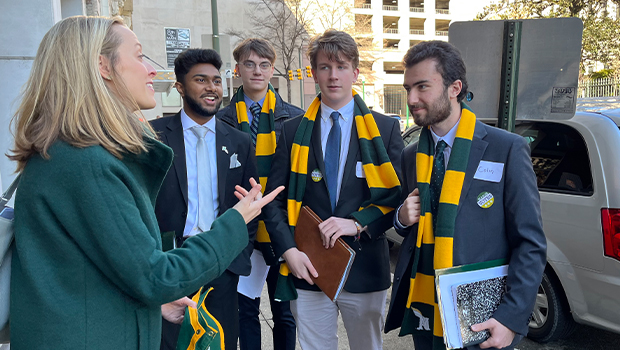
Government Relations Associate Director Lauren Posey speaks with students as meetings wrap up for the morning. Photo by: Orlando Cabrera

“A lot of college-aged people today are very aware of voting and the importance of voting, so I think that’s square one of civic participation—is current events in government. But I think that events like Mason Lobbies take civic participation, especially for young people a little bit further,” reflected Student Government Chief of Staff Lauren Battey. The question on January 26th was what that step further would look like after a pandemic with new student leadership who had never experienced in-person advocacy in Richmond on the scale of Mason Lobbies.

Throughout the morning, Mason students and administrators traversed Capitol Hill, navigating the halls of the General Assembly’s temporary office space in the Pocahontas Building on the south end of the Capitol complex. Students quickly showed a talent and professional knack for speaking with legislators and their staff. The breadth of topics covered by these students was notable, ranging from university resources and student aid to LGBTQ+ visibility and housing affordability. More impressive was the dedication of students, particularly international and out-of-state students, to the University’s status as an affordable and intersectional institution for those looking to study in the nation’s capital region.

In a meeting with Senator Jeremy McPike, Mason students were engaged on issues ranging from University priorities to the dedication of the institution to refugees from Afghanistan, Ukraine, and other regions of concern.

The topics varied widely but the answer, according to student leaders, is the samefunding and affordable tuition. Senator McPike was receptive, expressing his support for the University as both an alumnus and a legislator.

“It’s been great to see the growth of Mason and the continued growth in diversity as well,” explained Senator McPike. “When I was there, I remember just being amazed and walking on campus and it was just everybody.  I think the global campus has just continued to grow and thrive, so keep digging in!”  

Following the first round of meetings, students began to traverse the Pocahontas Building, arranging walk-in meetings and attending subcommittee hearings. Student Body President Sophia Nguyen walked from desk to desk, approaching lawmakers and their staff for impromptu meetings. By the end of the morning, she roped five lawmakers into unscheduled meetings to discuss Mason’s needs.

Although Mason Lobbies is an effort to increase Mason’s institutional resources, it is also an opportunity for Student Government to advance its platform. In this first in-person Mason Lobbies since 2019, Ms. Nguyen sees no dead space between her policy priorities and the University’s needs. “I think of filling the funding gap as part of the solution to giving a voice to groups that are underserved,” explained Nguyen. “More funding means that we keep professors and staff here to grow stronger relationships between administration and student groups.” 

When Nguyen ran to lead Mason’s student body on a platform of equity and inclusion, she anticipated her role as a leader to be the intermediary between underserved groups and administrators. She sees closing the funding disparity between public institutions across the commonwealth as a key step in her platform, creating an environment where Mason staff and administrators are incentivized to stay and and equipped to build ties with students and student organizations.  She also has a lot of hope coming out of Mason Lobbies given increased civic participation among students. 

“There is a huge difference between talking to administrators and these representatives because it seems like there is a huge step up,” Nguyen said in reference to the experience of lobbying in-person.  “I do see good things coming out of Mason Lobbies, of course we had one of the biggest turnout in forever since we’ve had an in-person Mason Lobbies. So I’m expecting some good change to come from George Mason University, but I don’t have the right answer.”

Student Body Vice President Celine Apenteng coordinates with other executive board members ahead of walk-in meetings. Photo by: Orlando Cabrera

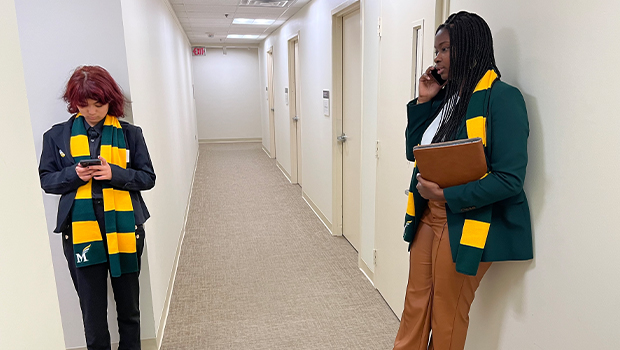
On the third floor outside one of many House subcommittee rooms, Celine Apenteng stood against a wall on the phone with the executive board and student senate leaders to determine where participants could be most useful. Within moments, she began pacing toward the fourth floor to meet Mason’s Government Relations team and administrators to discuss the progress made throughout the morning before she and the executive board would be introduced before the chambers.  

President Washington was equally occupied on Mason Lobbies Day with another audience. Following his early presence in Richmond as the day began, President Washington was bound back to the District of Columbia by late morning for a key meeting with President Biden regarding higher education initiatives ahead of the State of the Union. From Richmond to Washington, the University was covering its bases to ensure that students would continue to be supported and that investments in future students, faculty, and staff would support efforts to increase the university’s standing among Virginia institutions.  

Lieutenant Governor Sears formally welcomes a delegation from George Mason University Student Government. Photo by: Orlando Cabrera

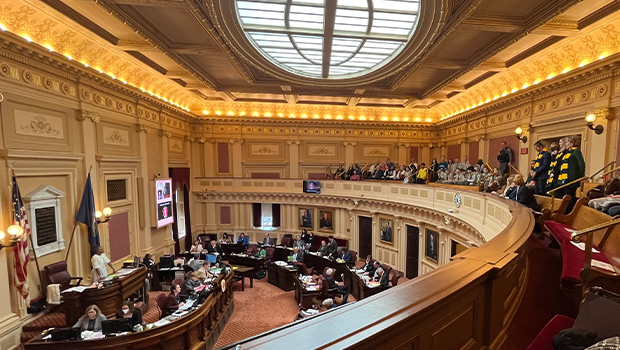
As the morning ended, Student Government Association executive board members made their way to the chambers of the House of Delegates and Virginia Senate. One-by-one the Senators and Delegates meandered back into their respective chambers, some with lunch in hand after a morning packed with meetings with Mason students and other interest groups. In the Senate, Lt. Governor Sears paced across the floor preparing with the clerk and greeting Senators as they entered. Within 20 minutes, the Senate reached a quorum and before addressing pending legislation, greeted groups visiting the Capitol with the warm welcome of their Senate. Moments later, the House of Delegates performed a similar function with other members of the board.  

It would be disingenuous to call Mason Lobbies political hardball, but having students and administrators present has a positive effect on policy that cannot be understated. The activism of students and administrators to discuss the basic needs of the University and to increase the profile of an appropriations deficit is a way to humanize a deeply rooted inequity in the way that public institutions are funded. Mason Lobbies offers a face for university priorities, but a human consequence to the deficit between Virginia’s higher education institutions.

Mason’s success is as strong as its advocates, and an engaged student bodyone that understands the full value of civic participationis a strong tool in the arsenal for that success. Mason Lobbies, therefore, is an effective and essential form of softball politics that exposes the full effect of policy while providing an experience to engaged students and young leaders stepping into a unique political environment. One decade in, George Mason University’s lobbying effort is strong and well respected from Fairfax to Richmond.

_____________________________________________________________

Photos by: Orlando Cabrera

Conservatives React to Election Disappointment

Questions Remain as “Red Wave” Fails to Materialize

By: Jacob Pritchard, Mason Votes 2022 Online Editorial Team
Photos by: Mitchell Richtmyre/Fourth Estate

In the 2022 midterm elections, the Republican Party garnered a weak victory in the House instead of the predicted “Red Wave,” and failed to take the Senate.

Many Republicans and other conservatives at Mason have strong thoughts on the unforeseen results of the 2022 election.

“We are disappointed. We were hoping for much more of a volume in terms of a Red Wave,” Chairman of the College Republicans Joe Szymanski said. “That did not happen. We are pleased that we took the United States House of Representatives. We are not happy with the level of majority that we are going to have, and we are pretty disappointed that we did not take the United States Senate.”

This “Red Wave” was expected because of historic trends in American politics. For decades, whenever a new president was elected, his party did poorly in the next round of midterm elections. Many predicted this effect would be amplified this cycle, as Americans headed to the polls with a 40-year high economic Inflation near the top of their minds. 61% of Americans thought President Biden was directly responsible for the current inflation rate, according to Newsweek.

However, the Democratic Party retained their majority in the Senate. The Republican Party won a slim majority in the House of Representatives by gaining 9 seats, the first time in two decades that a non-incumbent party gained less than 10 seats in a midterm election.

In Virginia’s 11th Congressional District, where George Mason’s Fairfax campus resides, Democratic incumbent Gerry Connolly won by nearly 34% over his Republican opponent Jim Myles.

Since the Republicans did not gain as much as they were anticipated to,  despite Biden’s supposed unpopularity on economic issues, many questions remain.

John Jennings is a Mason student who was the campaign manager for Fairfax mayoral candidate Sang Yi prior to this interview.

“There were a lot of unexpected results,” Jennings said. “Of course, no one is saying ‘Yes!’ when they lose an election. There are results that I am happy about that other conservatives I know may not be as happy about. Candidates on the extremes, on both the left and the right, lose. We need to focus on kitchen table issues.”

Conservative discussion in the weeks following the election has mostly focused on what should happen for the 2024 elections. Primary topics of discussion revolve around specific candidates to run in 2024, and different strategies to run in 2024.

“I think actually trying to make sure we have concise statements on what we want to pursue and push when we want to get into control majorities,” Szymanski said.  “If we can kind of fix that around next time for 2024, we’ll have a much better result.”

_____________________________________________________________

Photos by: Mitchell Richtmyre/Fourth Estate

Reactions to Dobbs in the Aftermath of the Midterm Elections

Reproductive Rights Motivated Many Students to Vote

By: Clarita Orosco, Mason Votes 2022 Online Editorial Team
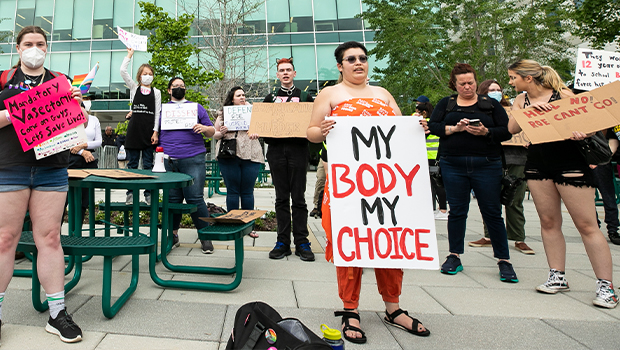
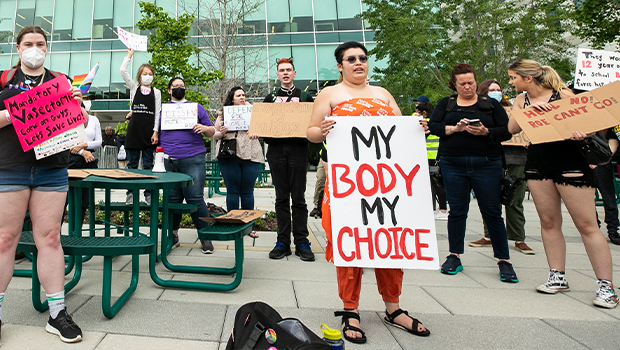
Mason students protest against the Supreme Court’s recent Dobbs decision that eliminated federal abortion rights at the Mason Square plaza in Arlington. Photo by: Ron Aira/Creative Services

This past summer, on June 24th and after 50 years of precedent, the Supreme Court overturned the landmark case known as Roe v. Wade. Protests were held in DC, as well as all over the nation.

In Dobbs v. Jackson Women’s Health Organization, the court ruled that the U.S. Constitution does not in any way prevent states from outlawing abortion, contradicting the 1973 ruling, in which Warren E. Burger’s court ruled that one of the rights covered by the 10th amendment was a right to privacy, and that discussions between patients and doctors about abortions were protected from state interference under that right. The current court under Chief Justice John Roberts ruled that no right to privacy is explicitly laid out in the text of the constitution, so the right to abortion is not federally protected, and states can pass laws banning or protecting it as they see fit. 

As soon as the Dobb’s case ruling was announced, Mason’s Women and Gender Studies (WGST) Center released a statement to, “offer solidarity and comfort to all who needed it,” said Holly Mason, Associate Director of WGST, in an email.

They then focused on creating safe spaces virtually and in-person where, “students, faculty, and staff” could discuss the issue comfortably.

During these meetings Holly saw that, “Students wanted to know who they can talk to, where they can turn for mobilization/protest/and support, and they wanted to know what related resources exist at Mason and in the surrounding areas.”

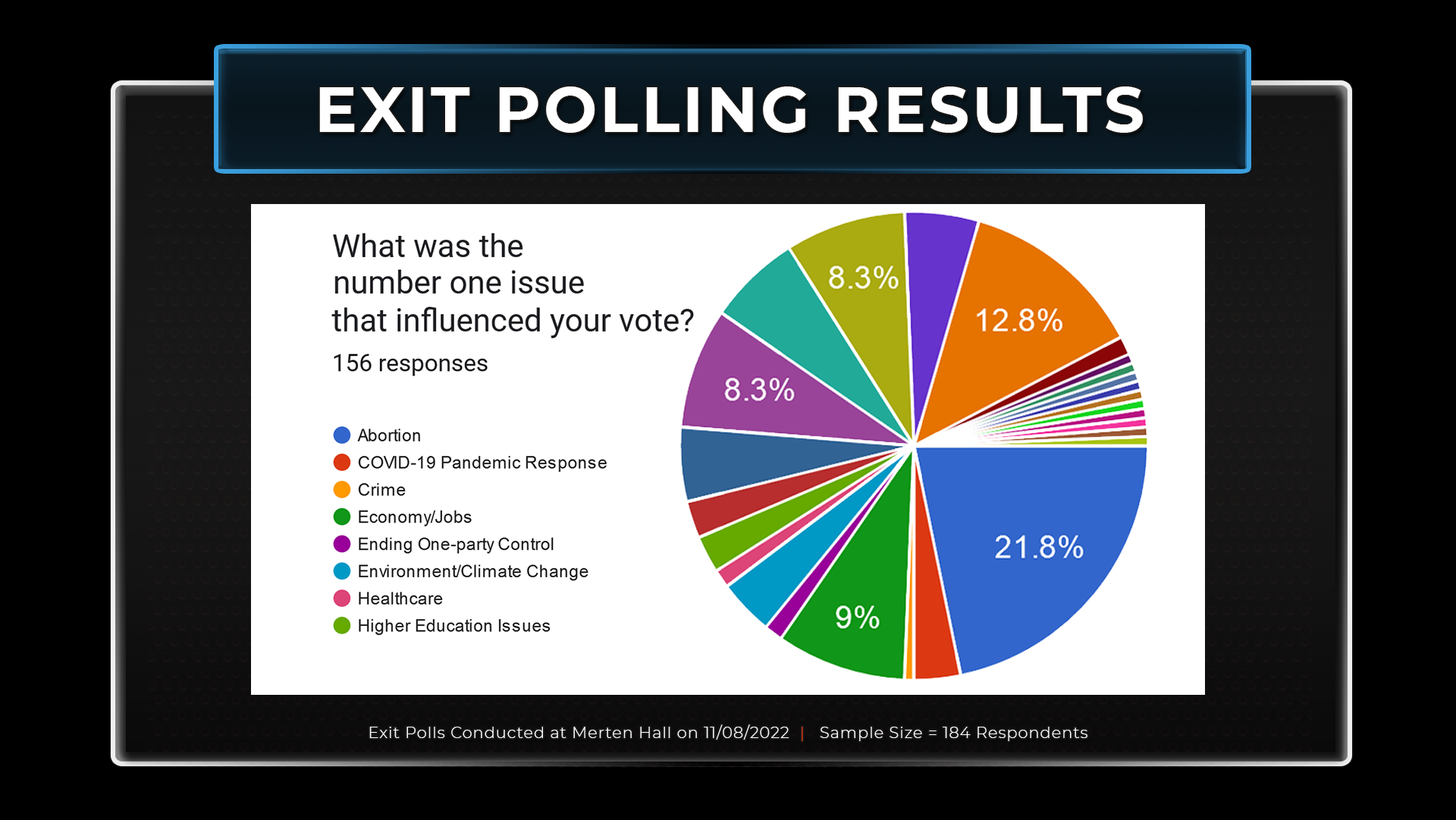
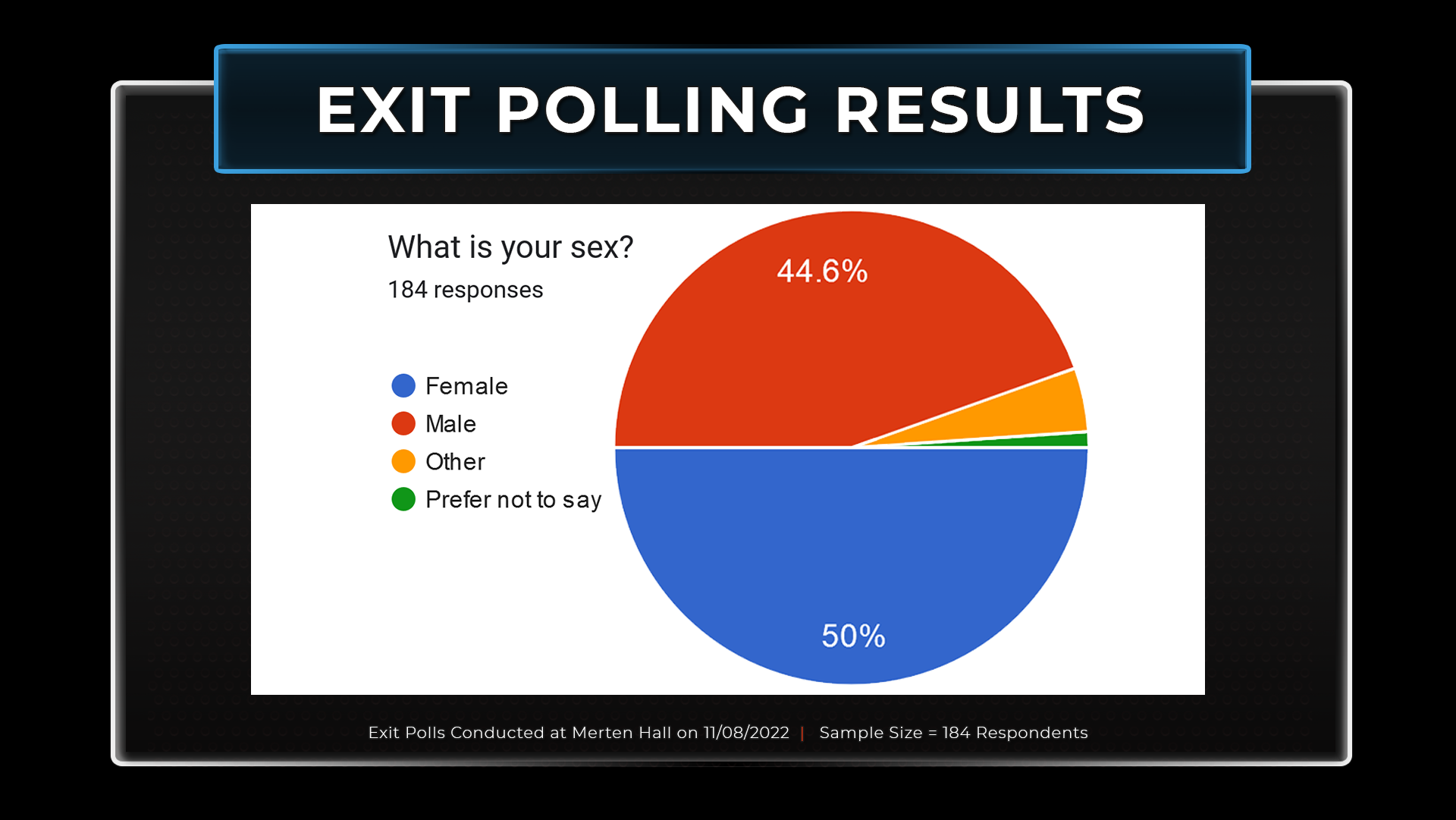
On November 8th, Student Media, Mason Cable Network, and Mason Votes conducted an exit poll survey in front of Merten Hall where students went to cast their in-person ballots on Election Day. It found that “Abortion,” was the top concern for 22% of respondents.

“Republicans have been using abortion as their playing card for years and years,” said Molly Sullivan (CS ‘24). “As have Democrats. All the Democrats are like, ‘We’re going to codify Roe.’ and the Republicans have said ‘We’re going to shut down Roe.’”

Sullivan is one of the co-presidents of GenerationAction, also known as GenAct, a group on campus that enables activists to raise public awareness about reproductive health and women’s rights. She is also the VP of American Medical Women’s Association, and holds other e-board positions in other student groups.

Even though she has voted consistently in the past she finds this year’s election was history making.

She voted not only for herself but also in the honor of those, “that will be affected by this change in regulation, in marginalized low-income communities.”

Alex Elliott (SIS ‘24) was “really frustrated with the direction of the United States,” when the Dobb’s case ruling was announced.

“It’s going to affect me, but as a white cisgender women, it’s going to impact more marginalized communities,” she said.

Even though she is a committed voter, the overturning of Roe v. Wade brought a new topic to the table when she went out to vote.

Something both Sullivan and Elliot want is to spread awareness and educate others about safe sex contraceptives along with debunking the misinformation that surrounds abortion.

_____________________________________________________________

Learn more about on-campus health care and resources through Student Health Services: shs.gmu.edu/healthed/birthcontrol

_____________________________________________________________

Photo by: Ron Aira/Creative Services

Guest Opinion Column: Young Democratic Socialists of America

What Is Socialism?

By: Anton Brown, Young Democratic Socialists of America Member
Logo courtesy of: Young Democratic Socialists of America

Perhaps the immediate impulse is to ask “what does the dictionary say?” Merriam Webster states that socialism is “any of various economic and political theories advocating collective or governmental ownership and administration of the means of production and distribution of goods.” Wikipedia defines socialism as “a left-wing to far-left economic philosophy and movement encompassing a range of economic systems characterized by the dominance of social ownership of the means of production as opposed to private ownership.” Finally, the American Heritage Dictionary claims socialism is “any of various theories or systems of social organization in which the means of producing and distributing goods is owned collectively or by a centralized government that often plans and controls the economy.”

With these definitions, one begins to see a pattern. According to the writers of these definitions, socialism is opposed to private ownership over the means of production. What are the “means of production?” They are, in short, the ways by which things are produced. In other words: the workplace on the small scale, and all of the workplaces within an economy on the large scale. So then, according to these definitions, we see that their claim is that socialism advocates for collective or governmental ownership over the workplace, rather than such enterprises being under the control of an individual or corporation.

Now, with this understanding, we can now safely eliminate one thing socialism is not. Socialism is not “when the government does stuff,” as some humour, nor is it the presence of social programs. Whilst, of course, providing social programs certainly has many benefits, such views are not inherently socialist. Far from it. Plenty of capitalist systems incorporate these social programs into their economies, such as those of Finland, Canada, and Germany. In all such cases, ownership over the means of production remains predominantly privatized.

So then what is socialism? Socialism is democracy within the economy. On the small scale, it is the establishment of workers’ councils within each workplace. This allows the workers to advocate for themselves and decide how their workplaces will operate. On the large scale, this means democracy in the way resources are allocated. Rather than the owners of companies or state planners making decisions on how to run the economy, such decisions are left up to the entirety of the population to decide. This is the authentic socialism that we must work towards today.

But then, one may ask “what does socialism look like?” That is an easy question to answer. Imagine how your workplace would function without managers or executives. The ones calling the shots are not some far away oligarchs, but instead you and your peers. Perhaps every week you all come together to discuss and vote on changes to workplace policy, human resources problems, and preparing for upcoming projects or plans. Perhaps it is not as formal, perhaps it is managed instead through spontaneous, informal discussions that are decided by consensus. Perhaps there are alternative models, though regardless the foundational principles are the same. The people directing the workplace are the same as those who produce within it, and those very people are the ones appropriate the value of the work being done.

Under socialism the workers’ status as a worker is mitigated. They are not a cog in a machine that does a set task for a price so that another may profit. Instead they are freely cooperating individuals. One cannot perform all of the labor necessary to produce what is needed for society to function, so they collaborate. In order to ensure they are properly respected, they are placed upon the even playing field of democracy. No individual ownership is involved, like there is under capitalism, because it necessarily requires collective efforts to produce. Therefore, to respect the humanity and equality of all participants, they all cooperatively control the workplace.

It is this future that socialism envisions. Instead of a world where an individual or state can dictatorially proclaim ownership and supremacy over people’s labor, it is the people themselves who become masters of their work. No longer will there be alienation between the worker and their creation, for there will be no middleman to extract profits out of their efforts. Thus, those who work are rewarded for their time and energy by having the power to decide how the workplace functions, how they would like to be compensated for their work, and how the fruits of their labor ought to be distributed.

Similarly, the entirety of the people will find a new power in their hands: the power to control the economy itself. Already, the ruling capitalist class uses its considerable influence to aid itself through tax cuts, exponentially increasing police and military funding, and forcing the working class to fund bailouts and investments into itself. Thus, when the people seize power over the economy, they too shall have the ability to advocate for themselves. The distinction lies in the inherently different interests of the people and the ruling class. Whilst the latter prefers to selfishly gorge itself for the purpose of ever increasing its wealth and power, the latter’s interest lies in advancing the will of itself, that of the people. Democratic control over the economy would result in improved social programs, repairing and constructing new infrastructure, as well as benefits to ensure that everyone is able to live in as much comfort as realistically possible. At long last, the will of the overwhelming economic majority will be enacted and a new sea of prosperity will wash away the filth of inequality and exploitation. Like a swirling storm, the flames of hatred and alienation will be subdued. Thus, as the old adage proclaims, “workers of the world, unite! You have nothing to lose but your chains!”

Learn more about the YDSA via Mason360: mason360.gmu.edu/gmuydsa/home

_____________________________________________________________

This is part of an on-going series of guest opinion columns profiling major politician organizations on campus. All guest columns are independently written, and don’t necessary reflect the view point of Mason Votes, which is a non-partisan organization. All guest submissions are edited for grammar and length. If you would like to submit a piece, email [email protected].

How Did Mason Vote in 2022?

Over 250 Mason Students Voted at Merten Hall on Election Day

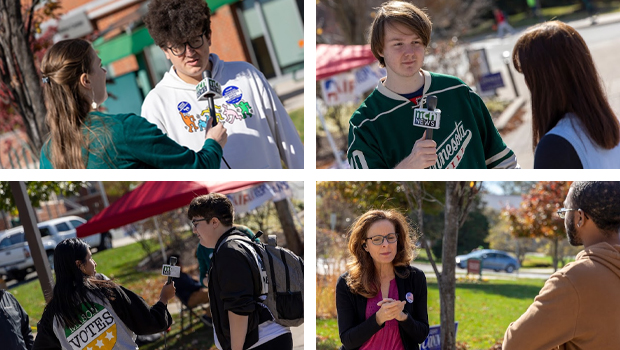
252 students cast regular ballots at Merten Hall on Election Day 2022. More than 100 additional students voted using provisional ballots due to the new same day registration option. Photos by: Mitchell Richtmyre/Fourth Estate

Student Media, Mason Cable Network, and Mason Votes conducted exit polling outside Merten Hall on November 8th to learn more about what issues and candidates were motivating student voters in 2022.

Students were asked to complete a short exit survey after voting at Mason’s on-campus polling place (University Precinct), and the results were analyzed during Mason Cable Network’s LIVE election night broadcast.

Watch the 2022 election night broadcast: youtube.com/watch?v=j1tM0Dry1eg

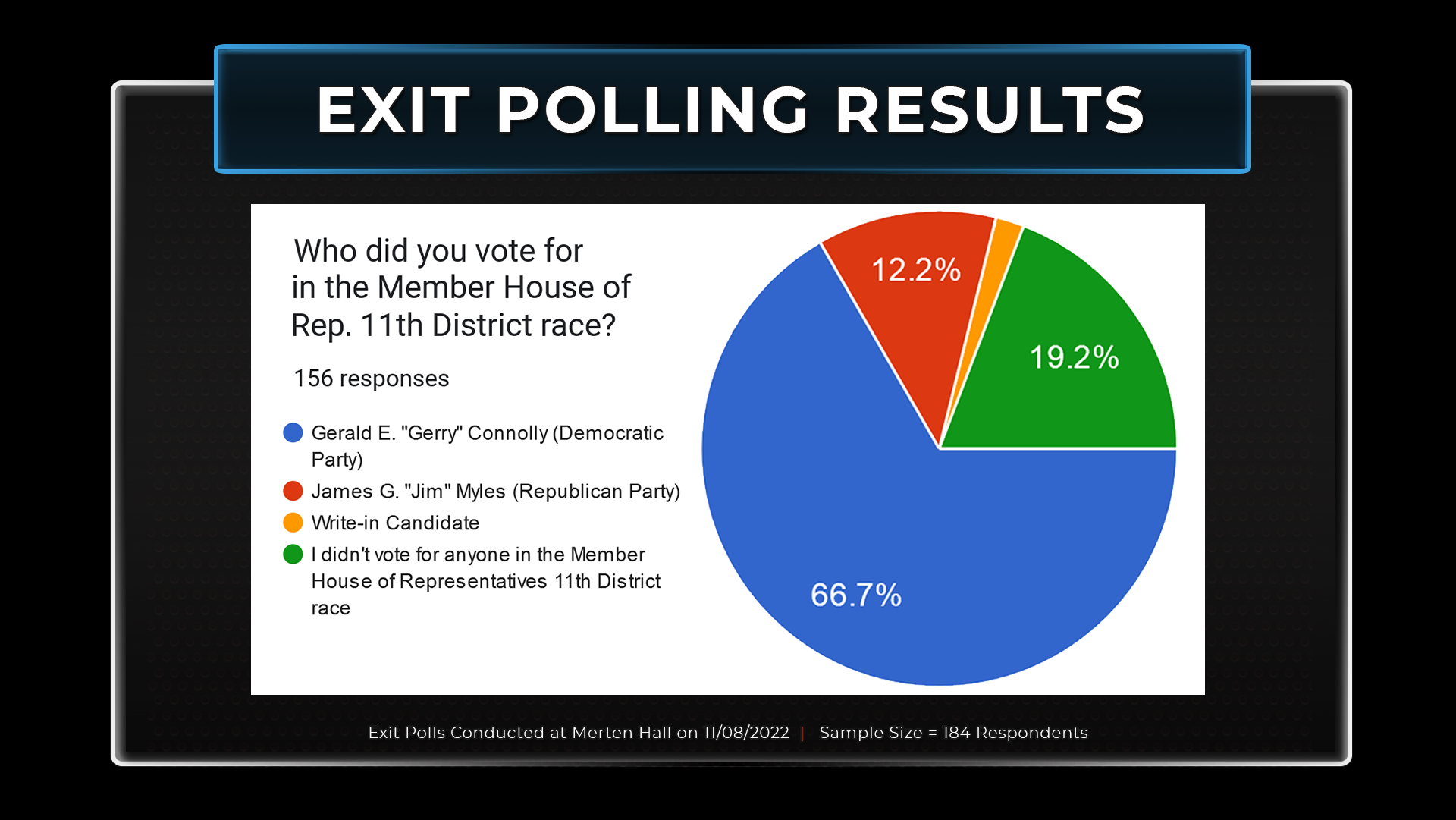
Mason voters overwhelmingly supported the Democratic candidate for the U.S. House of Representatives in Virginia’s 11th Congressional District, with 84.52% of the vote going to longtime incumbent Gerry Connolly. Republican challenger Jim Myles received 15.48% of the Mason vote. Both candidates visited Mason’s Fairfax campus within the last month of the election to speak with potential voters.

New in 2022 was a “same day” voter registration option in Virginia. According to the Virginia Department of Elections: “Beginning with the 2022 General Election, the General Assembly approved legislation that provides the ability to register at any time, up to and including Election Day.”

Student reporters from Mason Votes interviewed student voters and faculty members as part of their 2022 midterm election coverage. Photos by: Mitchell Richtmyre/Fourth Estate

Perhaps unsurprisingly, many Mason students (a group that includes many first-time voters and voters registering with new on-campus addresses) took advantage of the same day registration option, with more than 100 same day registrations reported from the University Precinct alone. Fairfax County Board of Elections sent an extra employee to the Merten Hall polling place just to handle same day registrations.

One caveat to same day voter registration is the use of provisional ballots, which are not counted on Election Day. Provisional ballots are subject to approval by a local electoral board and voters whose provisional ballots are not approved will receive a notice in writing from the general registrar.

252 regular ballots were cast by Mason students on Election Day, with more than 100 additional provisional ballots yet to be counted. Learn more about same day registration and provisional ballots: elections.virginia.gov/registration/same-day-voter-registration

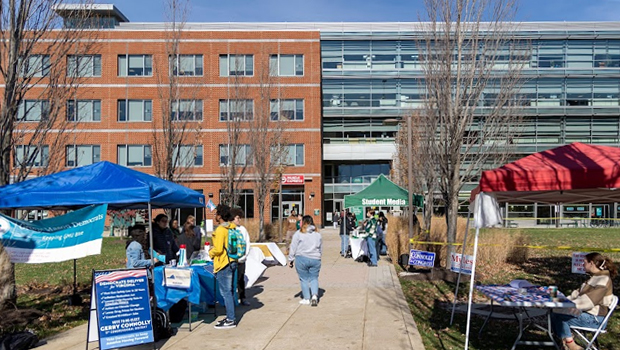
Multiple organizations had a presence outside Merten Hall on Election Day 2022 including Student Media, Mason Votes, Mason Cable Network, CECiL, Student Government, GMU Democrats, and College Republicans. Photo by: Mitchell Richtmyre/Fourth Estate

According to the results of our 2022 exit poll survey, the most important issue to Mason students when casting their vote was “Abortion,” with nearly 22% of respondents selecting that as their top concern.

When combined with the second-highest ranked category of “Women’s Issues,” nearly 35% of Mason voters seemed to have the recent Dobbs Supreme Court decision top-of-mind when voting: (21.8%-Abortion, 12.8%-Women’s Issues, 9%-Economy/Jobs, 8.3%-Social Justice, 8.3%-LGBTQ+ Issues, 5.1%-Taxes, 5.1%-Inflation, 3.8%-Environment/Climate Change, 3.2%-COVID-19 Pandemic Response, 2.6%-Immigration Issues, 2.6%-Higher Ed. Issues, 1.3%-Healthcare, 1.3%-Democracy).

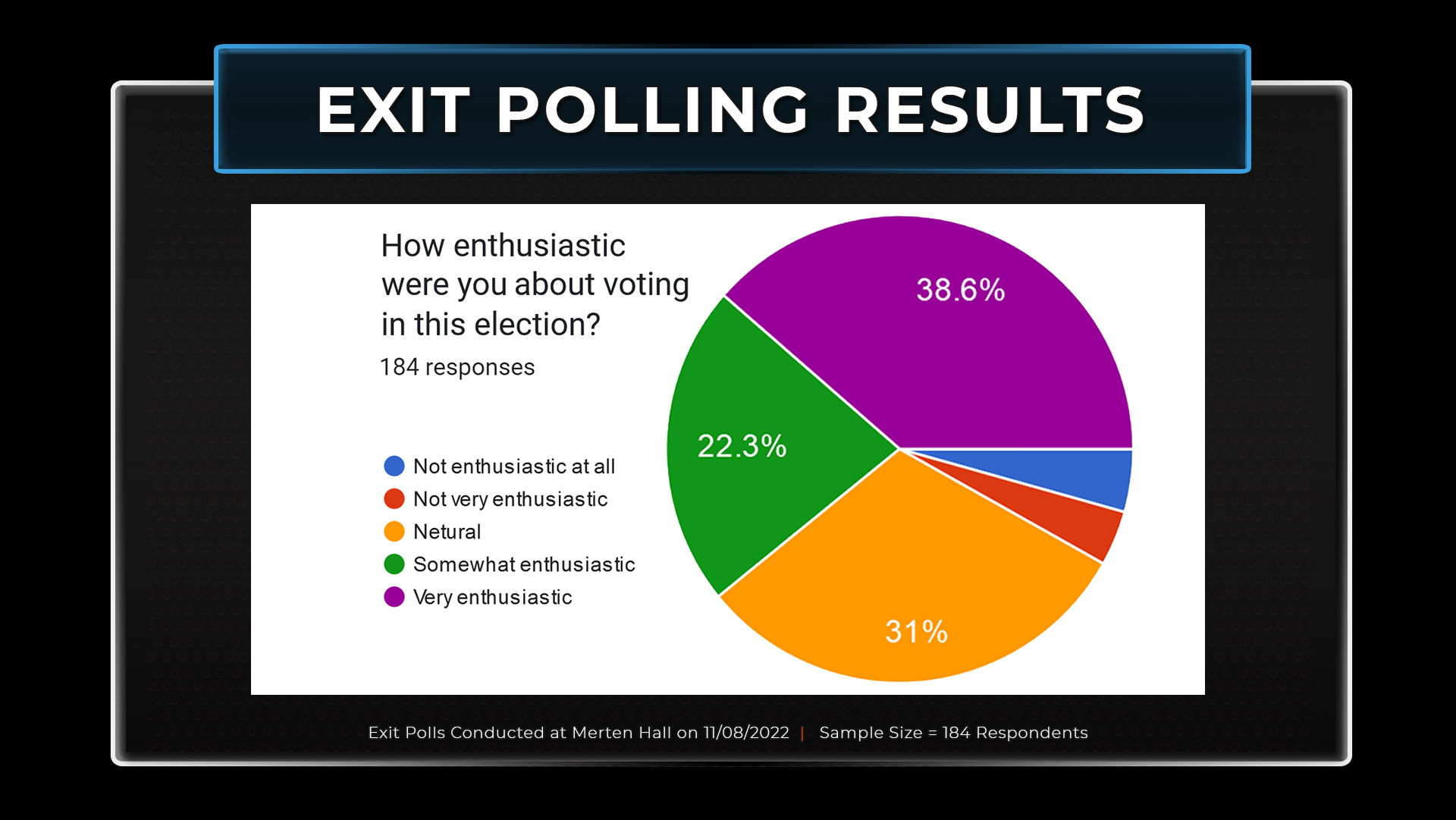
Enthusiasm is a topic for concern for both parties during any midterm election cycle, but a majority of survey respondents at Mason reported being “very” or “somewhat” enthusiastic about voting in 2022. 31% said they were “neutral” about voting, but turned out anyway: (38.6%-Very Enthusiastic, 22.3%-Somewhat Enthusiastic, 31%-Neutral, 3.8%-Not Very Enthusiastic, 4.3%-Not Enthusiastic At All).

_____________________________________________________________

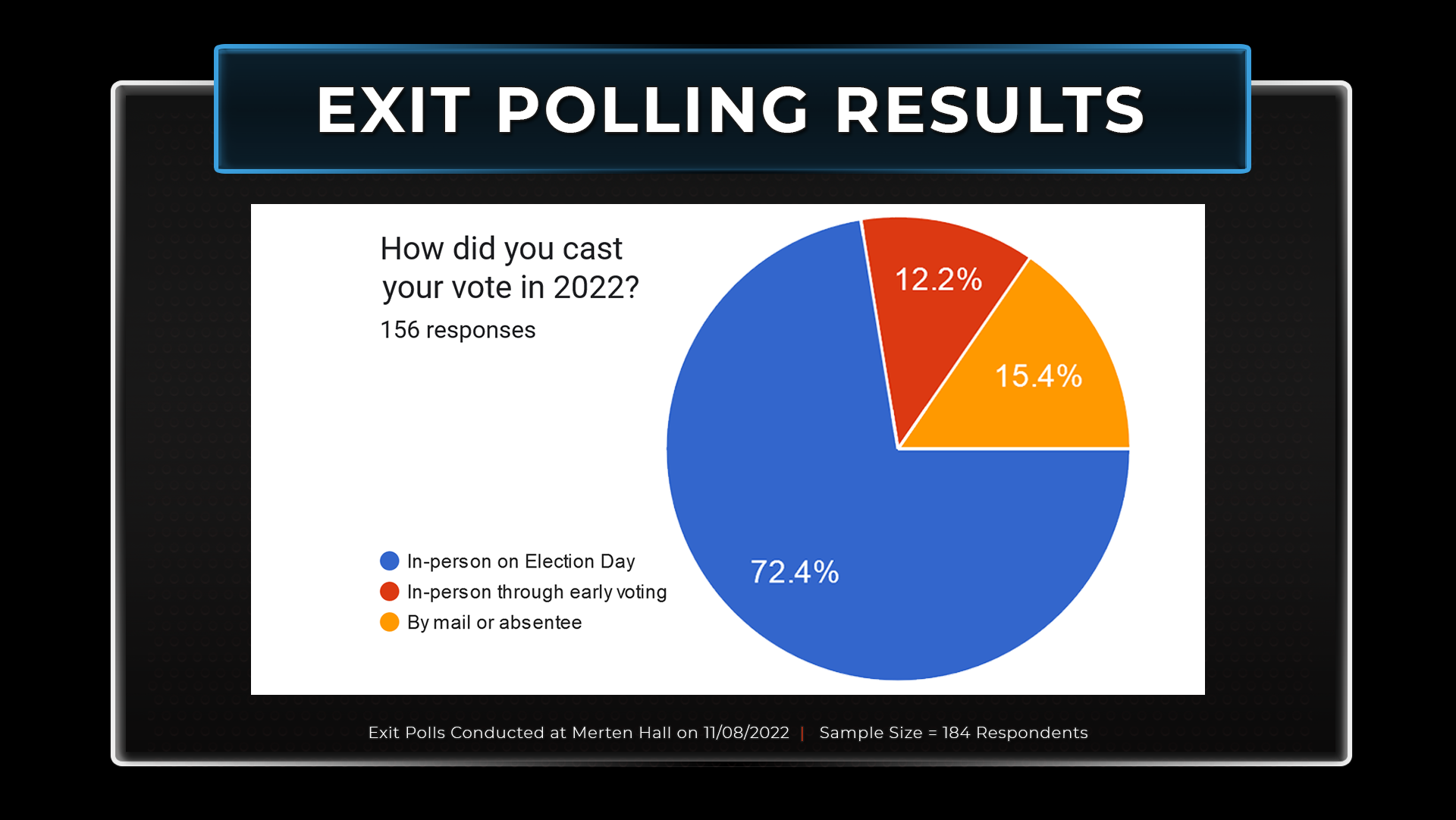
Curious how Mason voted in 2022?

Check out the results of our 2022 exit polling below:

(Click on an image to enlarge the size)


VIDEO: LIVE 2022 Election Night Coverage!

Students from Mason Cable Network, Fourth Estate, and Mason Votes Collaborated to Create a LIVE 2022 Election Night Broadcast.

WATCH NOW on YOUTUBE: youtube.com/watch?v=BGOJaBLzwsI