Mason Votes

VIDEO: COMM 145 Election Interviews

Mason Students Share What’s Motivating Them in 2020

Students in Communication 145 (Newspaper Workshop I) were assigned to interview their peers on why voting is important and which issues were influencing their vote in 2020. Here is what they found…

Special thanks the students of COMM 145: Cameron Baker, Yara Belhaj, Gabriela Garcia, Samantha Gingrich, Shannon Harzula, and Zoe Hundertmark.

Video edited by: Zach Hamilton
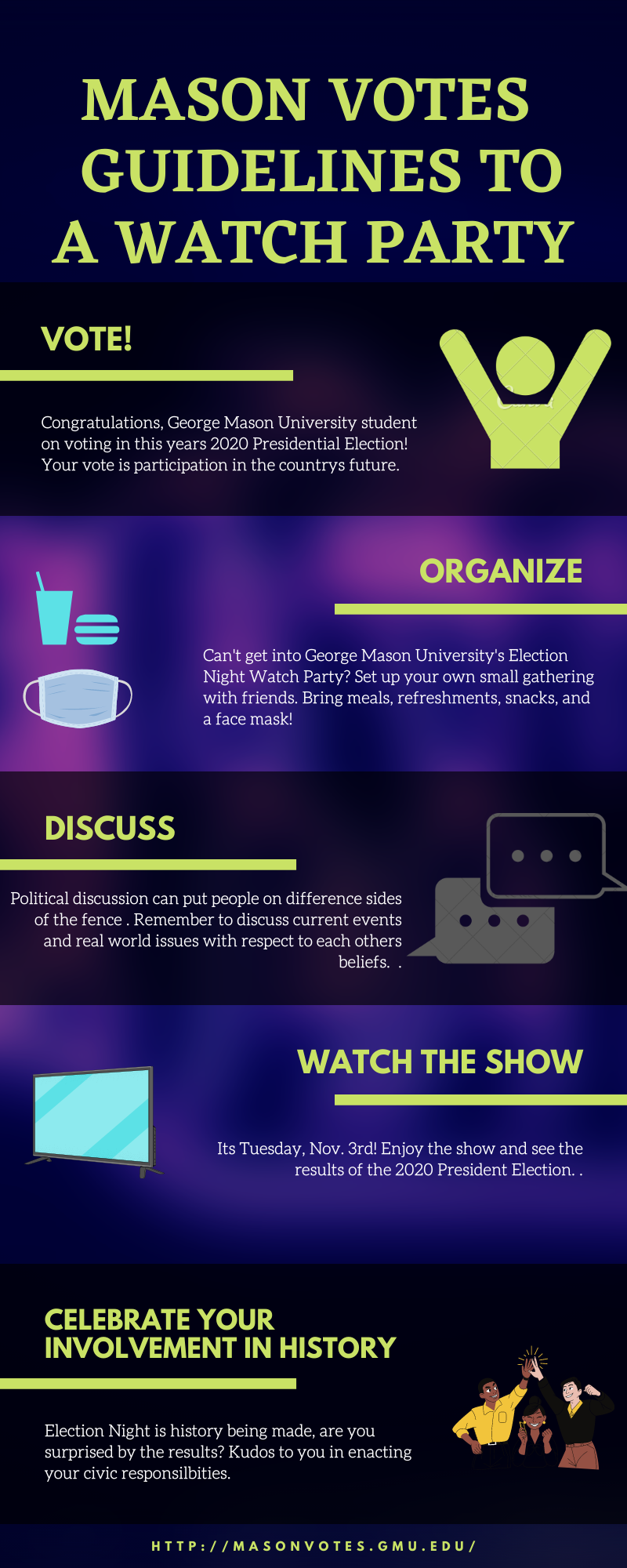
Create an Election Night Watch Party from Home!

Celebrate Your Participation in the Historic 2020 Election

Infographic by: Leeban Dahir, Guest Contributor, COMM 391 Student (Writing for Public Relations)
Planning to watch the results from home on election night? Create your own Election 2020 Watch Party and celebrate your historic 2020 vote in style!

_______________________________________________________________________________________

Don’t forget to tune in to Mason Cable Network (MCN) and Mason Votes’ LIVE election night coverage at 7:30pm on YouTube (youtube.com/MasonCableNetwork) or on campus channel 8.1. The show will feature voices and opinions from Mason students, interviews from MCN and Mason Votes, and expert faculty guests.

_______________________________________________________________________________________

If you are on the Fairfax campus and want to watch results with others, RSVP for Mason’s Election Night Watch Party: masonvotes.gmu.edu/events/election-night-watch-party

7-11pm | The Hub Ballroom  | Fairfax

RSVP via Mason360: cglink.me/r872032


OPINION: “Why I’m Voting for Trump”

How Donald Trump Earned My Vote

By: Alex Madajian, Fourth Estate Staff Writer

This story was originally published on gmufourthestate.com. Fourth Estate is Mason’s official student-run newspaper.

Image by: Camille Brayshaw/Fourth Estate

I grew up in a conservative household where I learned to value hard work, personal responsibility, inherent value of the individual, and respect for God and country. I remember arguing against proponents of Donald Trump as he ran in the primaries. After he won, I refused to vote for him, going against the pressure from my friends and family. I wasn’t going to vote for Hillary Clinton — I simply refused to fall into the trap of voting for someone that I didn’t believe in. So I decided to take the moral high ground and boycott the system.

In addition to his long history of trademark New York City crudeness, I had convinced myself of three things about Trump. First, that he would never win. Second, that if he did win, he wouldn’t get anything done. And third, that if he did get anything done, it would not advance my conservative values.

I clearly remember when that changed. The election was called at about midnight in California time. That was the first time the thought crossed my mind that Trump not only could be president, but that he was my president. Since then, my three objections have fallen like dominoes.

His conservative accomplishments are quite numerous, but some which greatly stand out to me are the judges he’s nominated, the tax cuts, record-breaking economic prosperity, America becoming a net energy exporter for the first time since 1952, exiting the Paris Climate Accord, eliminating the leader of ISIS and removing the Affordable Care Act’s individual mandate, just to name a few.

But he has two big accomplishments that stand out the most: He has exposed the failures of liberal media and destroyed the credibility of the Democratic Party establishment. The Democratic Party did everything they could to deny him the election, obstruct his agenda, remove him by impeachment and smear him endlessly. Up to this point, they have predominantly failed.

The most frequent grievance I hear is with his personality. It’s true, he does have his petty, rude, obnoxious, thoughtless and childish moments. Yet I do believe that it’s what America deserves.

Many yearn for a politician who is a standard-bearer for decency. Joe Biden promises to “restore the soul of our nation,” but that is where he is dead wrong. Politicians do not restore souls, and if you think they do, you are deceiving yourself. They are reflections of who we are.  If we look hard in the mirror, we are an immoral, petty, chauvinistic society, and changing our politicians won’t change that. People in positions of power are a symptom, not a cause, of society’s moral failings.

The way I see it, the biggest difference between Donald Trump and Joe Biden is that Trump will be explicit about what’s really happening, whereas Biden is experienced at playing political games to hide unflattering realities.

It feels like I’m watching my beloved country be torn apart. On one side, I see my family, faith, culture and principles. On the other, I see the liberal media, political and cultural elites, and academia. The only thing standing in their way is the president. Some have argued that Biden will defend my conservative values, but the fact is, Biden is a product of the political elites; he’s a creation of the very forces out to annihilate what I value.  “Nice guys” like Mitt Romney are not who I want standing in the way of these people. I want a warrior to champion and defend my cause. That flawed warrior, I believe, is Donald Trump, and I am proud to vote for him on Nov. 3.

Fourth Estate Editor’s note: This piece is part of an Election Day special. Click here to read staff writer Savannah Martincic explain why she is voting for Democrat Joe Biden.

OPINION: “Why I’m Voting for Biden”

Why I Settled for Biden

By: Savannah Martincic, Fourth Estate Staff Writer

This story was originally published on gmufourthestate.com. Fourth Estate is Mason’s official student-run newspaper.

Image by: Camille Brayshaw/Fourth Estate

In 2016, I was left feeling embittered by a political system and a society that allowed someone like Donald Trump to be elected. At only 16, I felt frustrated that I had no say in such a monumental election.

But this election is different. This year, I have a vote. And this year, I cast that vote for change.

I started this election cycle as a staunch Elizabeth Warren supporter. It wasn’t just that she was a woman, but that she had good policies on the things most important to me like environmental injustice, healthcare, universal childcare and student loan debt relief.

But the day she dropped out, I realized that we would likely be left with two old white men in their 70s as our choices in the general election. I’ll even admit I cried when I read the remarks she made to her campaign staff that day. But the next day, I realized I had only one choice: to settle for Joe Biden.

While I’d much rather vote for a third-party candidate and say “screw partisanship,” I recognize that the American presidential election process is not designed to favor a third-party winner. (Thanks, electoral college.) But settling for Biden is not voting for the lesser of two evils — for me, it’s voting against evil.

Since 2016, Trump supporters have stood by him while he has proven time and time again that he is a xenophobe, a homophobe, a transphobe, a racist, a misogynist and a climate change denier. All the while, Trump’s incompetence has caused this country to suffer greatly. From his mishandling of the pandemic and his inability to denounce white supremacy during the first debate to his administration’s downplaying of climate change, Trump has cost this country too many lives and has rolled back much of the progress made in the previous administration.

I recognize that the Biden-Harris ticket is far from progressive or perfect. They certainly have a few political skeletons in their closets, but I choose to also consider the views they hold today and the plans they have for tomorrow — because for me, this election isn’t about Joe Biden or Kamala Harris. It’s about the planet, the LGBTQ+ community, Black lives, healthcare, women’s rights, immigrants and so much more.

We have a lot of work to do, and while electing Biden and Harris will not solve every issue plaguing us in Trump’s America, it will make the chance of progress greater. And I choose to vote for a chance of progression, not certain regression.

Biden and Harris can make a difference because I know on day one, they will be ready to respond to the needs of the American people, especially those who have been hurt by Trump’s bigotry. I know that on day one, they will be ready to set this country on a better path.

No matter if it is in a few months or four more years, Trump’s presidency will end and the smoke will clear. And all his supporters will have to face the many lives they hurt with their vote.

But not me.

I want to be on the side of history that voted for environmental, reproductive and racial justice, for immigrant rights, for the LGBTQ+ community and for healthcare. My vote will be for a president who will not act like a middle school bully on social media, who will not make the United States the laughingstock of the world, who will not refuse to denounce white supremacy, who will not brag about grabbing women by their p—–s. I want to be able to look at my loved ones and say that I voted for their future and their safety. That’s why I’m voting for Joe Biden, and I hope you will too.

Fourth Estate Editor’s note: This piece is part of an Election Day special. Click here to read staff writer Alex Madajian explain why he is voting for Republican Donald Trump.

OPINION: Open Wounds and The Body Politic

2020 Was a “Heavy” Year For America

By: Alex Russell, Mason Votes 2020 Online Editorial Team

Blatant disregard for human life, a persistent display of xenophobic and racist ideology, incessant fear-mongering, and a general attitude that can best be described as callously aggressive, have unfortunately become corrosive themes that now define the work of the current administration.

Spreading outward in a ripple effect with President Trump at the center, is a continuous barrage of detrimental cause-and-effect reactions that have grown to occupy a sizeable fraction of the American cultural, social, and political infrastructure.

Largely unpunished police violence against unarmed American civilians, an insufficient and irresponsible federal response to the COVID-19 pandemic, and recent spikes in white nationalist hate group activity are some of the most painful problems on the minds of voters as November 3rd approaches, and an unavoidable reality in the current chapter of the American Experiment.

Some of these ills, like the virus, are new, but some, like the police killings of unarmed African American citizens and a newly emboldened generation of white supremacists, are dark, chronic poisons coursing through the nation’s veins. Both are equally dire.

2020 was, for many, a heavy year. A disastrous year. A cursed year. News stories that would normally occupy large chunks of time on the airwaves are fighting for time against a host of other stories of similar size and consequence. The past four years of American history have suffered from a toxic congestion of tragedy, scandal, and immorality.

As time plods on, we realize more and more the codependent nature of all major aspects of our political and social landscape, and the costs are staggering. Every weaponized statement (“Proud Boys, stand back and stand by,” was President Trump’s remark at the first 2020 presidential debate and was interpreted as a rallying cry by militant hate groups), every scandal (there have been too many to list here), and every policy decision that fails to uphold our shared values are part of a disturbing pattern of behavior that, at best, functions in the limited self-interest of its creators and at worst pushes the quality of American life back decades.

The candidates’ careers and reputations aren’t the only things on the line this November. Indeed, the very building blocks of our country’s political and cultural identity (and real, human lives), are at stake, too.

Immigration was touted as one of the central areas that then-candidate Trump promised to tackle and reform back in 2016. Fear-mongering and xenophobic rhetoric were just ugly overtones in the beginning, but bluster eventually became law. The Trump Administration’s “no tolerance” policy at the U.S./Mexico border has separated hundreds of families (many of whom were seeking help and asylum), with scores of children taken from their parents who have yet to be reunited to this day.

Asylum seeking (officially dubbed Temporary Protected Status, or TPS) is a legal, long-standing procedure by which those who are seeking assistance and shelter and cannot safely return to their country of origin due to events such as ongoing armed conflicts, environmental catastrophes, or other circumstances of similar magnitude, can find the sanctuary they need in the United States.

According to the National Immigration Forum, “TPS holders from El Salvador, Honduras, and Haiti contribute a combined $4.5 billion in pre-tax wages or salary income to our nation’s gross domestic product.” According to survey data from 2017, 88.5% of people from El Salvador and Honduras, who have benefited from TPS, were able to find employment. Many of them, according to the Immigration Forum, found jobs in a number of fundamental areas like food services and construction. Yet the Trump Administration has consistently worked for years to undermine existing legal protections and procedures set up to assist immigrants in need, thereby ignoring their contributions to our economy.

Children of all ages have suffered (and will likely suffer the effects of such trauma for the rest of their lives) from the unnecessary and inhumane family separation policy, and those responsible for its implementation have proved themselves unable to accomplish an undertaking of this size and complexity with the care and attention it requires. This procedure, carried out by U.S. Immigration and Customs Enforcement (ICE) and the Department of Homeland Security, is greatly exacerbated by the already dysfunctional immigration system at the southern border. According to the Guardian, a very narrow set of criteria is applied to those seeking asylum, which is intrinsically very difficult to meet. Claimants have to sustain themselves through an arduous, nerve-wracking process and often lack adequate legal representation when they finally get a hearing in immigration court.

The Trump Administration has been taking serious and disastrously-successful steps to hurt and undermine the TPS process. In many ways, as the situation keeps getting worse, it has become apparent that the administration is trying its hardest to essentially deter immigration from Central and South American nations altogether. It doesn’t seem entirely prudent to recall the President’s “s***-hole countries” remark from a few years back (since it has been eclipsed by an avalanche of subsequent offensive words and deeds), but it nonetheless serves as a less-than-eloquent summation of our administration’s attitude towards immigration at the U.S./Mexico border.

“America First” was the general flavor of the first Trump campaign, but any hopes that overt nationalism might unify the nation have since vanished into thin air. Just a quick glance at the past few weeks-worth of headlines, debates, and rallies is all the proof you need that our nation is anything but unified.

Although the deteriorating immigration system seems like a faraway thing or a legislative topic too large for ordinary people to focus on, it is nonetheless a problem deeply embedded in contemporary American life. Immigration has proven itself to be much more than just an “issue” in this year’s election. It is an open wound that, if not tended to soon, has the potential to infect the whole body politic.

The passing of Justice Ruth Bader Ginsburg last month, one of the many blows we’ve suffered as a nation during this already packed and painful year, left an empty seat on the Supreme Court and one less determined, powerful, and resounding voice for progressive humanitarian causes in our government.

This moment of national mourning and loss was quickly overshadowed by a rushed attempt on the part of Senate Republicans to insert a replacement that would cement a conservative 6-3 majority on the Court. In an election season marked by charged passions and heavy uncertainty, the rush to confirm a replacement for the late Justice Ginsburg just days before a general election has only increased division.

Judge Amy Coney Barrett was confirmed by the Senate last Monday, October 26th, making her the 103rd Associate Justice of the United States Supreme Court. Barrett’s prior judiciary experience at the federal level was as a judge on the United States Court of Appeals for the 7th Circuit from November of 2017 to October of 2020. Her track record from that three-year period, according to Human Rights First (based on 25 immigration cases reviewed by this organization), was decidedly reflective of a conservative ideology. Based on data from those 25 cases, Barrett “affirmed, or declined to review, decisions that went against” immigrants seeking asylum. Often her decisions “upheld many” of the rulings made by the immigration judges who were appointed by the current administration.

Barrett’s track record, appointment, and confirmation to the Supreme Court are, to put it mildly, a big deal. This is a part of recent political history that will have consequences for a long time to come. “Norms” and “rules” are not just words that can be thrown around in meek dissent—they mean something.

The foundational values of our country, the bricks that keep the whole notion of democracy and government “of the people, by the people, for the people” standing, have begun to crumble under a nauseating series of ego-driven political maneuvers over the past four years. Like a drawn-out chess game, there have been displays of strategy and planning, but now, perhaps more potently than ever, we can see the consequences that accompany every move.

No chess master would advise this much sacrifice.

_____________________________________________________________

Editor’s Note: Mason Votes is a nonpartisan website and we publish student opinion from all sides of the political debate. Email us at [email protected] to submit your work for consideration.


2020 Election Security: Hayden Center Panel Discussion

Michael V. Hayden Center Hosts Panel Discussion Addressing Foreign Interference

By: Sudiksha Kochi, Fourth Estate Staff Writer

This story was originally published on gmufourthestate.com. Fourth Estate is Mason’s official student-run newspaper.

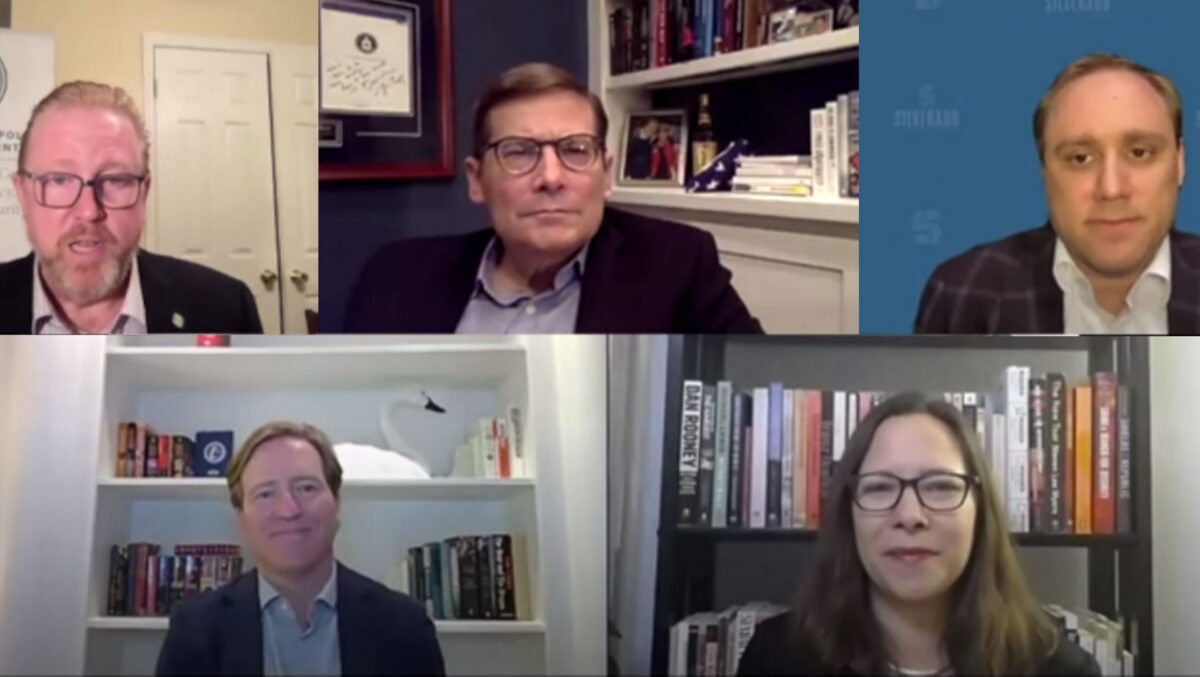
With Election Day coming up in November, voters all around the United States are casting their early ballots and, more importantly, asking the question of “Will my vote count?” To address this question, General Michael V. Hayden of the Michael V. Hayden Center for Intelligence, Policy and International Security invited Christopher Krebs of the Department of Homeland Security, Laura Rosenberger of the Alliance for Securing Democracy and Dimitri Alperovitch of Silverado Policy Accelerator for a session on Oct. 12 to discuss foreign interference in the 2020 presidential election and the steps that are being taken to ensure the protection of votes.
Rosenberger began the discussion by outlining several dimensions of potential foreign interference in the election, with the first dimension being cyber operations.

“Cyber operations are aimed at either weaponizing information, as we saw through the Hack of League Operations that Larry mentioned that Dimitri and his team at Crowdstrike were so important in helping contribute and investigate in 2016, to influencing public opinion or distorting public discourse around the election conversation,” Rosenberger said.

Rosenberger explained that another dimension that has received a lot of attention recently is the information operations predominately run by social media, which distorts information using both covert and overt means.

“This is often referred to in the 2016 context predominantly through the operations of the Internet Research Agency, also known as ‘troll farm’ as people would shorthand it,” Rosenberger said.

The last dimension that Rosenberger described, which has been discussed the least, is the covert use of financial and non-financial resources to influence the course of a campaign or an election.

“There is evidence that foreign actors have used those tactics in dozens of countries around the world, and we probably haven’t spent enough time dealing with that particular pathway to interfering in the election,” Rosenberger said.

Krebs expressed the idea that foreign interference tends to focus on the election infrastructure itself, including the systems involved in getting a voter through the process to vote.

“You have seen the U.S. government take a series of actions over the past several weeks and months, targeting and trying to get in front of some of this activity and sanctions,” Krebs said.

Compared to the 2016 presidential election, Krebs believes that the level of foreign activity in this election is “dramatically different.”

“In 2016, it was quite clear, both through signals intelligence as well as on-networks instant responses through forensic activity, that the Russians were very active in hitting the election networks, whether it was in Illinois or Florida,” Krebs said. “At this point, we are not seeing that same level of high-stakes coordinated campaign targeting our election infrastructure, but that is not to say that there is no activity.”

Alperovitch expressed a similar reaction and explained that he is feeling positive about the upcoming election.

“If you look at this time period and 2016, we [had] already seen by this time in 2016 the hack of the DNC [Democratic National Convention] and the leak of the DNC emails,” Alperovitch said. “By this time in 2016, a lot of things [had] already happened that we are just not seeing this year at all.”

Rosenberger explained that a concerning part of this election is the amplification of domestic voices in the information operations space.

“When we have domestic political actors or domestic voices in general, those opinions and those statements are First Amendment protected,” Rosenberger said. “When we have foreign actors that are amplifying either divisive content or content from domestic actors that are aiming to cast out on the integrity of elections, that complicates the ability to defend.”

Rosenberger explained that a possible solution to foreign government interference is the ability of the U.S. government to be more creative and clear about what they are trying to accomplish.

“If what you are trying to accomplish is seeking to delegitimize other governments for its own ends rather than defending the institutions of democracy around the world, that leads you down one pathway,” Rosenberger said. “But if what you are trying to do is to defend democratic values and democratic institutions, that leads you down a different pathway in terms of the offensive tools you may pull out of your toolkit.”

Examining Question 1 (VA’s Redistricting Commission Amendment)

Redistricting Reform on the 2020 Ballot in Virginia

By: Zoe Hundertmark, Guest Contributor, COMM 145 (Newspaper Workshop I) Student
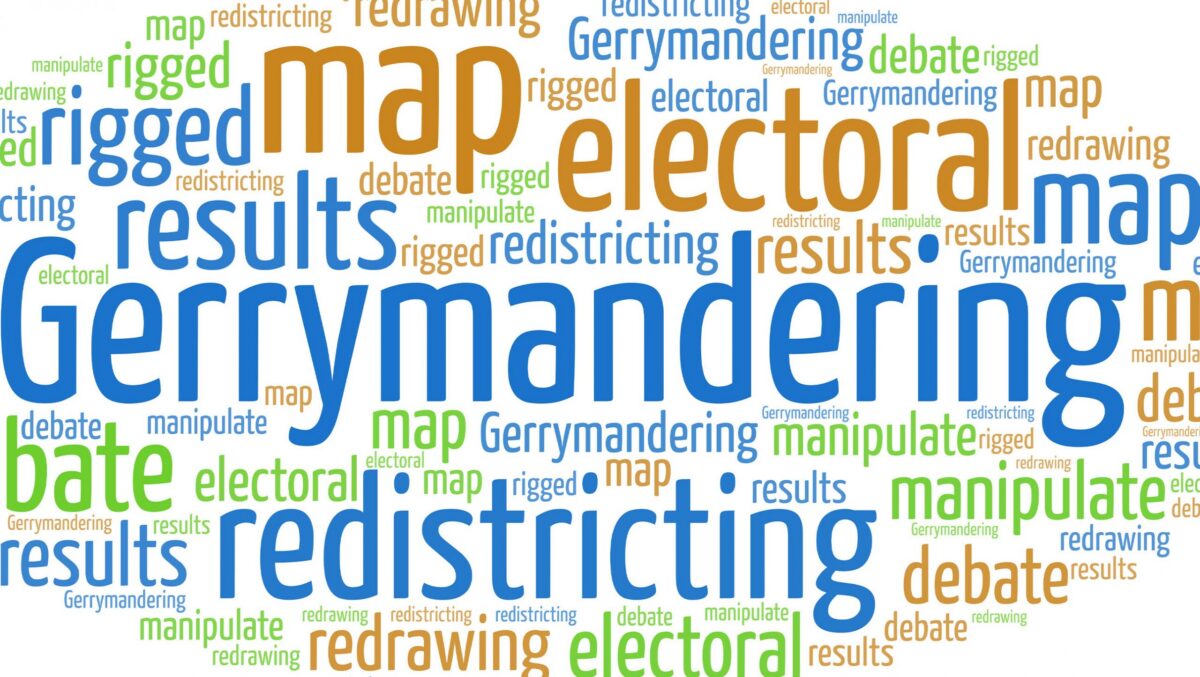
Gerrymandering word cloud by: www.epictop10.com (CC BY 2.0)

Featured on the Virginia ballot for tomorrow’s general election is a proposed amendment to the state’s constitution that would create a bipartisan redistricting panel.

The proposed amendment on the Virginia ballot reads as follows:

Should the Constitution of Virginia be amended to establish a redistricting commission,
consisting of eight members of the General Assembly and eight citizens of the Commonwealth, that is responsible for drawing the congressional and state legislative districts that will be subsequently voted on, but not changed by, the General Assembly and enacted without the
Governor’s involvement and to give the responsibility of drawing districts to the Supreme Court
of Virginia if the redistricting commission fails to draw districts or the General Assembly fails to
enact districts by certain deadlines?

In basic terms, the proposed amendment is attempting to create a more bipartisan process for the drawing and approval of election districts. If the law were to pass, the new bipartisan commission in charge of outlining election districts would consist of 16 individuals, 8 Virginia citizens and 8 General Assembly members.

The new amendment would also require equal representation among the General Assembly members appointed to the commission, with an equal number of individuals from both the state Senate and House of Delegates and an equal number of members from each political party.

The selection of the Virginia Citizens for the new commission is a bit more complicated. It involves the creation of 4 candidate lists from party leaders in the Senate and the House, and the formation of a selection committee comprised of 5 retired circuit court judges, who then chooses the final 8 Virginia Citizens off of the candidate list.

Under the proposed amendment, the redistricting committee would submit their plans to be approved by the General Assembly. However, if the election redistricting plans are not submitted and approved within a certain timeframe, the responsibility of drawing the election districts would fall to the Supreme Court of Virginia.

Currently, the responsibility of outlining election districts falls to the General Assembly and the Governor, therefore whichever party holds the majority can modify the districts in their favor. Because many believe the current process gives too much power to the majority party, inclusion of these redistricting changes on the Virginia ballot stems from an effort to decrease unfair gerrymandering from both political parties. The supporters of this amendment also want to allow citizens to take an active role in the redistricting process.

According to an article from The Washington Post, “The proposed amendment was advanced by Republicans last year when they were the legislature’s majority party and has caused a rift among Democrats, who are now in control of the General Assembly.” Virginia State Democrats are against the implementation of this amendment as they now hold the majority, and this has led to criticism about being hypocritical. Although Virginia State Democrats oppose the amendment as well as most of the Democrats in the House, “nine Democrats in the House and all but two in the Senate joined Republicans in supporting the amendment”

The amendment also faces opposition from members of the Virginia Legislative Black Caucus, as they emphasize “that the amendment does not require diverse representation on the commission and does not incorporate language from the federal Voting Rights Act laying out guidelines for racial equity”. The Virginia State Conference of the NAACP echoes this concern and officially announced their opposition in late September.

Whether the amendment passes or not is up to the voters, but according to a January 2020 Mason-Dixon poll, 72% of Virginia voters support the proposed amendment and the creation of a bipartisan redistricting commission.

In a recent article from Quartz, The Princeton Gerrymandering Project along with other voting rights organizations endorsed the amendment stating, “Passage of the Virginia amendment would be an unmistakable sign that reform is viable in Virginia, viable in the South, and viable in the rest of the country.”

If this amendment does end up passing and being implemented there will be increased citizen involvement in the redistricting process, and it will be harder to influence political gerrymandering. However, many different individuals and organizations have made valid arguments on potential negative points to this amendment, which could lead it to be less effective in preventing the unfair gerrymandering it set out to diminish.

_____________________________________________________________

Gerrymandering word cloud by: www.epictop10.com (CC BY 2.0)

Early Voting Totals Surge to Over 86 Million. Have YOU Voted?

Virginia Reports 423% Increase in Early Voting

By: Derek Bowers, Mason Votes 2020 Online Editorial Team

One the eve of Election Day 2020, over 86 million Americans have voted early, smashing records and surpassing 2016 early voting data.

As both excitement and nerves surrounding the 2020 election grow, many states throughout the country are reporting that their early voter turnout has also grown. Virginia is one of these states, reporting a 423% increase in early votes cast as of October 29, 2020. The majority of these voters, over 1.5 million, have cast their ballots in person, while the rest have used absentee (mail in) ballots, leading to over 2.4 million voters casting a ballot so far. This makes up about 37% of entire registered voters in the state that have already cast their vote. In contrast, only 567,000 people cast early votes in 2016, with a total of 72% of the electorate voting in the election.

This sharp increase is even more pronounced in once “politically safe” states like Texas, where early voting totals have already eclipsed the entire 2016 general election turnout for the state. In the 2016 general election, 8.96 million people cast their ballot, but as of October 30, 2020 over 9 million people had already cast their vote early in Texas. They are the second state in the US to do this, joining Hawaii in breaking voter turnout records.

Most of this increase in early voting numbers is attributed to younger voter turnout. In Virginia, more than 281,000 young voters have already cast their vote, joining more than 1 million young voters who have already voted in Texas. This trend continues for the majority of battleground states, showing great excitement and high stakes for the upcoming election driving voter turnout in record numbers already.

With more than 86 million people in the US already casting their vote early, we are gearing up to see potentially record turnout in a very pivotal election. While the impact of these early vote numbers on the final outcome of the election is still uncertain, one thing is for sure, young people are making their voice heard and turning out in record numbers to make it happen.

Mason Votes encourages you to make your voice heard and vote on or before Election Day (November 3, 2020)!

  • Remember not to mail your ballot at this point. Instead, drop it off at your nearest polling place or official drop box.
  • If you choose to vote in person: plan ahead, make sure to bring a valid ID, and wear a mask.
  • If you aren’t sure where to vote or where to drop off your mail in ballot, visit elections.virginia.gov or find your state in the directory at usa.gov/election-office.

Stay safe and healthy, Patriots!


What Just Happened? A Look Back at the 2020 Debates

Disillusionment Unites Both Sides

By: Safiya Khan, Mason Votes 2020 Online Editorial Team
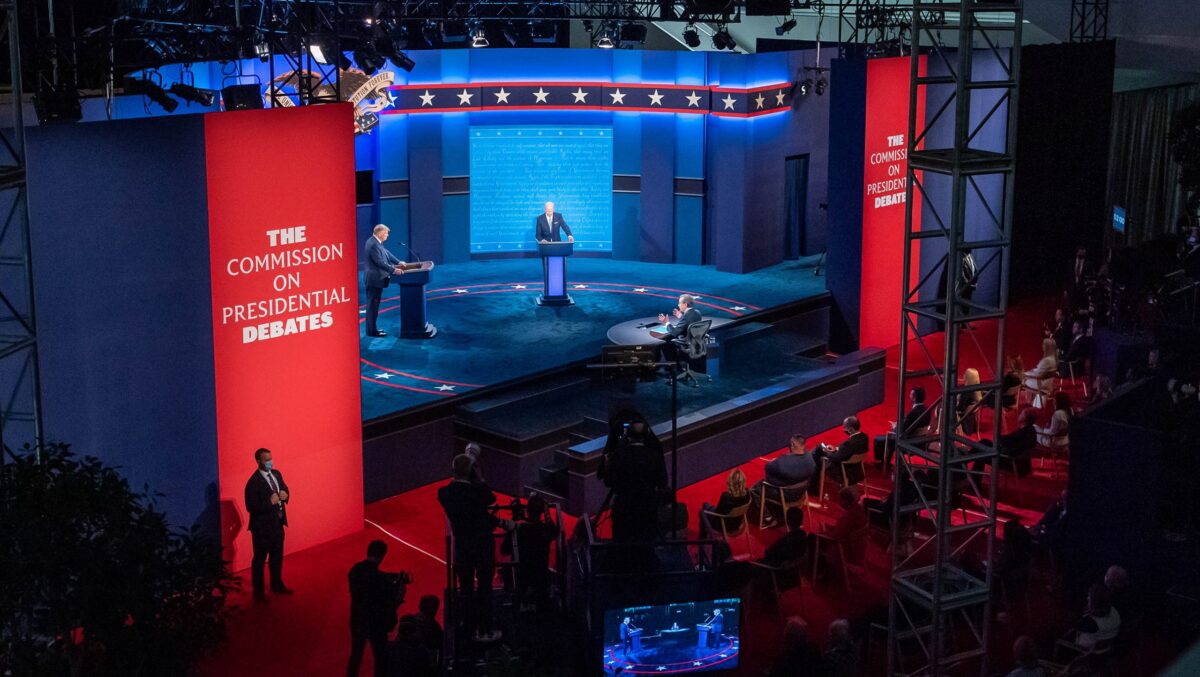
A bird’s-eye view of the first 2020 Trump/Biden debate moderated by Chris Wallace of Fox News in Cleveland, OH. Biden for President Photo by Adam Schultz (CC BY-NC-SA 2.0)

Most political observers knew that the 2020 election was going to be a contentious affair, but few were prepared for the spectacle of the first 2020 debate in Cleveland, OH that was roundly criticized as a new low for American democratic discourse. Marked by chaos, interruptions, and personal attacks, the first debate of 2020 was a disservice to citizens who traditionally look to the debates as a civic forum that informs their vote.

A Pew Research Center survey conducted during the spring of 2019 found that more than 85% of U.S. adults said that the political conversation in the country “has become more negative and less respectful.” The same survey revealed that 60% felt political discussion “has become less focused on issues” and 76% agreed it was “less fact-based.” And that was before the Cleveland debacle.

With 85% of the public united in their disgust for the extreme polarization and rancor of American politics in recent years, it is unclear if even the most civil or “normal” debates possess the power to change anyone’s mind.

First Presidential Debate

For the first debate between Trump and Biden September 29th, FiveThirtyEight partnered with Ipsos to interview the same group of people before and after the event to track its impact on Americans’ views of the election. When asked about each candidate’s performance, Biden’s “good” rating was 60% versus Trump’s 33%. However, when the focus group was asked, “how likely are you to vote for each candidate?,” Republicans averaged a 3.8 out of 10 before, but dropped to 3.7 post-debate, and Democrats averaged an initial 5.0 out of 10 that increased slightly to 5.2 afterwards, indicating that neither side was particularly moved by what they witnessed. While American’s were not impressed with the Trump’s performance, it is yet to be seen if this will actually influence people’s votes.

Vice Presidential Debate

The vice presidential debate on October 7th between Pence and Harris resembled a more traditional affair in that it was much more civil. While both candidates side-stepped some questions altogether, there was more discussion about policy and strategy than the first presidential debate. Fox News released a poll hours before the debate showing results of a national survey where Pence had 47% favorable vs. 48% unfavorable views, and Harris had 53% favorable vs. 40% unfavorable views (they did not provide post-debate results). Following the debate, a poll conducted by SSRS and CNN showed that 59% of viewers thought Harris won, while 38% thought Pence won. It is worth noting that snap polls following any debate are imperfect indicators and it is likely that both sides thought their own candidate won.

Presidential Town Halls

After the second presidential debate was cancelled, both candidates had separate town halls on October 15th. Trump’s event was hosted by NBC and Biden’s by ABC, with both airing head-to-head at 8pm EST. Nielsen ratings showed that Biden’s town hall on ABC reached 13.9 million viewers and Trump’s town hall reached a total of 13 million viewers between NBC, MSNBC, and CNBC. This is said to be a result of many calls to boycott NBC for airing Trump’s the same time as Biden.

Biden appeared to be very policy driven and intent on connecting with citizens asking questions, while Trump appeared to be more on the defensive end.

Second Presidential Debate

The second and final presidential debate took place on October 22nd and seemed like a return to normal compared to its predecessor.

With the fewest debates since 1996, the 2020 election cycle has been unique in many ways. By the start time of the final debate, 50 million Americans had already voted and the country is poised to become more polarized than it’s ever been (with the exception of the Civil War era). This calls into question whether the final debate (or any of them) really made a difference in voter turnout and citizen’s votes.

Regardless of who you think won the debates or how you plan to vote, it is imperative that you make sure your voice is heard…in 2020 and beyond!

_____________________________________________________________

Biden for President Photo by Adam Schultz (CC BY-NC-SA 2.0)

VIDEO: How Polarized Are We?

Election 2020 Interviews with Mason Students

By: Nadia Faour, Mason Votes 2020 Online Editorial Team

Video edited by: Zach Hamilton