Mason Votes

VP Kamala Harris Visits Mason on National Voter Registration Day

Vice Presidential Visit Spotlights Student Civic Engagement

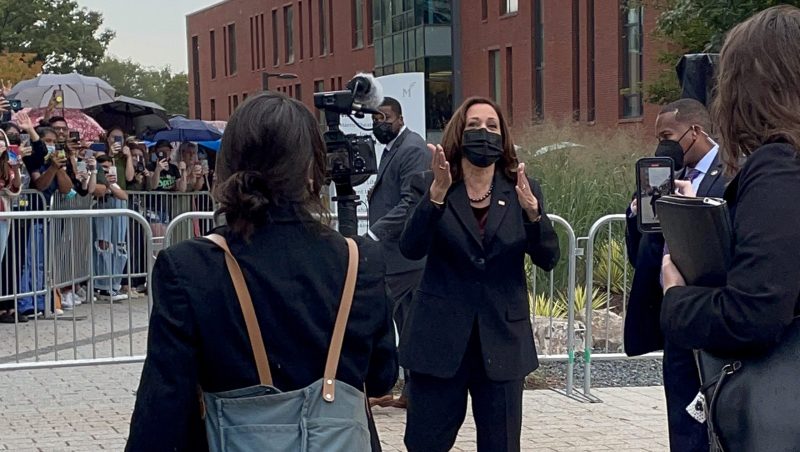
Vice President Kamala Harris greets Mason students at a National Voter Registration Day event on Wilkins Plaza. Photo by: Bryan Childers

FAIRFAX, VA — Vice President Kamala Harris visited George Mason University’s Fairfax campus on Tuesday, September 28th to commemorate National Voter Registration Day and encourage students to vote:

“Democracy is at its strongest when everyone participates.”

“Elections matter. Your organizing ability and your power really matters.”

Watch video of VP Harris’ visit to Mason on C-SPAN: https://www.c-span.org/video/?515012-1/vice-president-harris-commemorates-national-voter-registration-day

Harris began her visit by sitting in on Dr. Samuel Frye’s “Community, Culture, and Change” course (SOCI 395), where she discussed the need to protect voting rights, the history of voter discrimination in America, and the importance of community empowerment through coalition building. “When you vote, it matters, and you get things done…but we need you to stay active because there are so many big issues at play right now and so many rights that are at risk,” Harris told students. “We all have something at stake in this issue…and it’s not about telling people how to vote, it’s just saying that your vote is an expression of your voice and we should never support anything that stifles somebody’s voice or takes their power.”
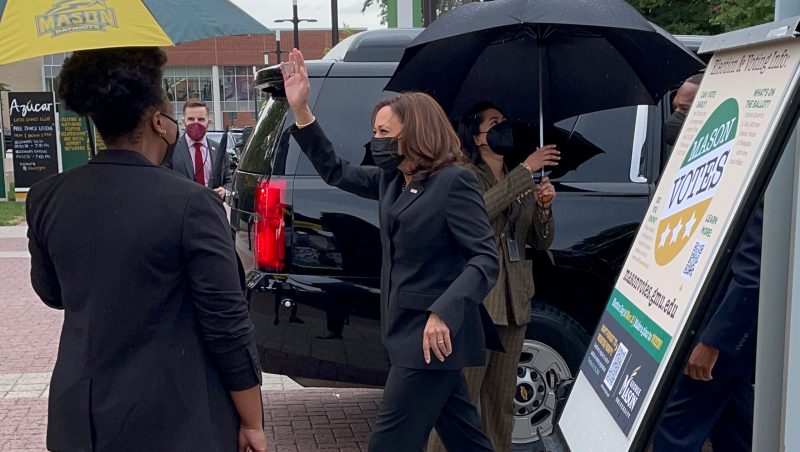
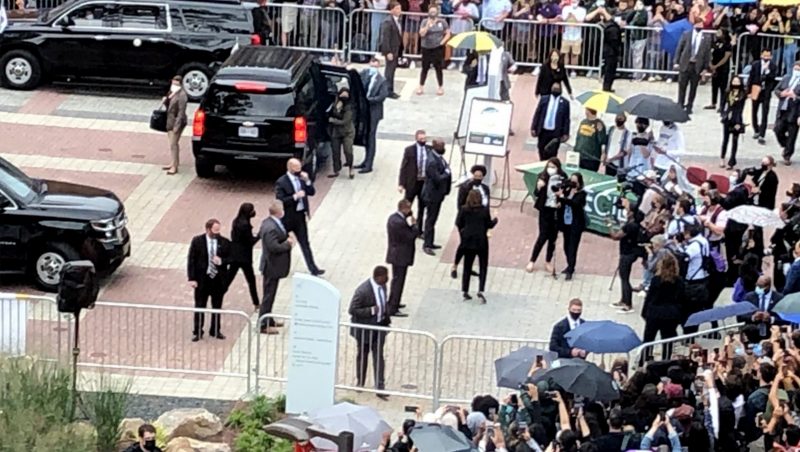
Following the indoor class discussion, Harris made a brief appearance at a National Voter Registration Day event taking place on Wilkins Plaza. “Are you all registered to vote?” she asked the crowd after emerging from her motorcade, holding up a sign promoting voter registration and receiving loud cheers and applause in response.

During an interaction with student leaders at one of the voter registration tables, Mason Votes’ own Bryan Childers asked the vice president for a quote about the importance of voting on behalf of Fourth Estate, Mason’s student-run newspaper:

“It is critically important that everyone registers to vote as an expression of your power as an individual in the context of the collective, to make things happen or not happen in your life. The issues that are at play include whether we are going to support public education, are we going to respect a woman’s right to make decisions about her own body, are we going to have leaders who respect the sanctity of the right to vote and pass the laws that make it easier for people to vote, not more difficult? This is the power of your vote, to determine the outcome of those issues depending on how you vote. But we can’t talk about how you vote unless you register to vote, so let’s start there!”

______________________________________

Are YOU registered to vote?

Virginia’s deadline for registering to vote or verifying/updating an existing registration is Tuesday, October 12, 2021.

Visit elections.virginia.gov/registration to learn more.

Click here to learn more about voter registration and voting as a Mason student >

Click here to learn more about National Voter Registration Day >

______________________________________

Overhead event photo by: Rodger Smith

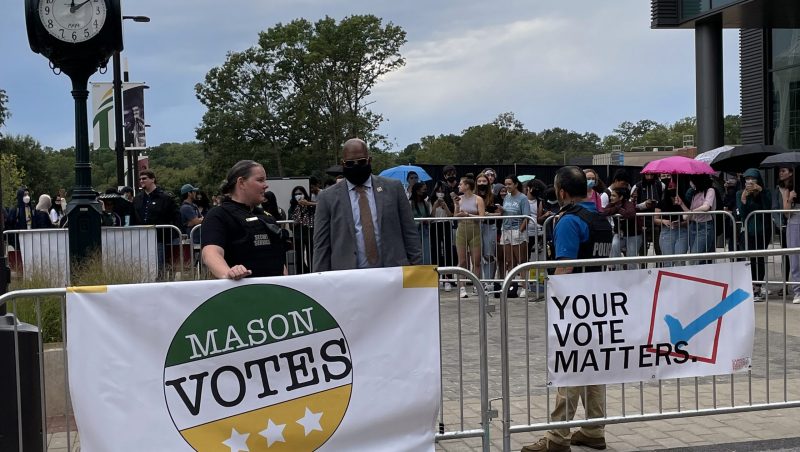
All other photos by: Bryan Childers
National Voter Registration Day 2021

#NationalVoterRegistrationDay is Tuesday, September 28, 2021!

Are you registered?

Tuesday, October 12, 2021 is the deadline to register to vote or update an existing registration. Learn more: elections.virginia.gov/registration

There’s no time like NOW to make sure you are registered to vote or to update your voter registration with your current address. Visit vote.gov to find out how.

“Every year millions of Americans find themselves unable to vote because they miss a registration deadline, don’t update their registration, or aren’t sure how to register. National Voter Registration Day wants to make sure everyone has the opportunity to vote.”

Virginia residents can learn more and register via elections.virginia.gov/registration

Non-Virginia residents can find guidelines for their state via usa.gov/election-office

2021 qualifications for voter registration in Virginia: US Citizen, resident of Virginia, and 18 years old on or before November 2, 2021 (born on or before November 2, 2003).

Learn more about 2021 election deadlines: https://www.elections.virginia.gov/casting-a-ballot/calendars-schedules/upcoming-elections.html

More info about #NVRD from nationalvoterregistrationday.org: National Voter Registration Day is a national holiday celebrating our democracy. It was first observed in 2012 and has been growing in popularity every year since. Held on the fourth Tuesday of September, National Voter Registration Day will take place on September 28, 2021. The holiday has been endorsed by the National Association of Secretaries of State (NASS). It is further supported by the National Association of State Election Directors (NASED), the U.S. Election Assistance Commission (EAC), and the National Association of Election Officials (The Election Center).

#MasonVotes #VOTE #NationalVoterRegistrationDay

Mason Recognized As “Voter-Friendly Campus”

Strong Student Voter Turnout Earns Mason ‘Voter-Friendly’ Campus Recognition

By: Jeanene Harris, Communication Officer/Mobile Journalist, Office of Communications

This story was originally published on March 17th, 2021.

George Mason University, the largest and most diverse public research university in the Commonwealth of Virginia, was named a “Voter Friendly Campus” as the result of a campus-wide strategy to increase voter turnout. Mason is one of more than 231 colleges and universities across 37 states and the District of Columbia to earn this designation.

“Mason has experienced steady increases in student voter participation over the past decade, so I view this designation as a recognition of that progress and validation that campus-wide initiatives like Mason Votes actually do have a positive impact on civic engagement,” said Jason Hartsel, assistant director of Student Media and communication and marketing faculty member.

Mason students living and registered on campus vote at the University Precinct in Merten Hall, which is in the 11th Congressional District. In November 2020, 347 people voted in the presidential election in the University Precinct.

According to Tufts’ National Study of Learning, Voting and Engagement (NSLVE), Mason voting rates in midterm elections, which typically see much lower turnout than presidential cycles, more than doubled from 2014 to 2018, from 24.6% to 52.4%, respectively, and Mason’s presidential voting turnout exceeded the national average by about 15 percentage points in both 2012 and 2016.

“Voting is so important because we elect individuals who potentially have the power to change our own lives or the lives of other communities,” said Mason Student Body President Shelby Adams. “Being a Voter Friendly campus shows that, as students, we recognize a change needs to come, and we are willing to be a part of that change.”

The Center for Information and Research on Civic Learning and Engagement reports that 52% to 55% percent of voting-eligible young people, ages 18-29, cast a ballot in the 2020 presidential election.

The Voter Friendly Campus designation aims to showcase efforts that help students overcome barriers to participating in the political process and develop a culture of democratic engagement on campus and in the local community. The initiative is led by the national nonpartisan organizations Fair Elections Center’s Campus Vote Project (CVP) and NASPA–Student Affairs Administrators in Higher Education. The designation is valid through December 2022.

Despite the global pandemic, Mason increased its academic collaborations, with the additions of members from the Office of Community Engagement and Civic Learning and Coalition Building and Diversity Education, and partnered with the League of Women Voters and the Fairfax County Board of Elections.

Student Media received a grant from the Parents Fund in Fall 2020 to offer experiential learning scholarships to students serving on the 2020 Mason Votes Online Editorial Team. As a result of more original content offerings, masonvotes.gmu.edu saw a significant increase in web traffic during the 2020 election.

“Students feel passionate about issues like social justice, immigrant rights, gender equality, ballot access, and many others, but implementing positive change in those spaces is only possible through meaningful participation in the political process,” said Hartsel.

Mason Cable Network’s 2020 Live Election Coverage, which was live for about eight hours on Election Day and through 3:30 a.m. the next day, also proved to be successful.

“Not only did we have a successful broadcast that provided meaningful content to the Mason student body, but we blew everyone’s expectations out of the water,” said Mason News Network General Manager Cruz Sanchez.

To encourage long-term civic engagement, Mason established a post-election committee to ensure a safe place to discuss the results of the election and people’s reactions to it.

“No matter the outcome, the committee found it pertinent to establish post-election events to cater to student’s needs,” said Noah Mack, a first-year student in the Schar School of Policy and Government.

Learn more about the “Voter Friendly Campus” initiative at www.voterfriendlycampus.org.

_____________________________________________________________

Click here to read the original article on the George Mason University website.

Northam Says “Yes” to Marijuana Legalization in Virginia

Racial Justice Advocates Call for Equitable Distribution of Tax Revenue 

By: Zoe Hundertmark, Guest Contributor, COMM 145 (Newspaper Workshop I) Student
Gov. Ralph Northam speaks at a press conference about COVID-19 in April 2020. Photo by: VCU CNS (CC BY-NC 2.0)

November’s election included big wins for the legalization of marijuana and decriminalization of drugs, with a host of ballot measures passing in multiple states.

New Jersey, Arizona, South Dakota, and Montana all passed legislation to legalize marijuana. Mississippi passed legislation to legalize medical marijuana. Oregon legalized psilocybin mushrooms for therapeutic purposes and decriminalized possession of all currently illicit drugs, and Washington, D.C. decriminalized the possession of a wide range of psychedelics.

Following the wave of drug reforms that passed on November 6th, Virginia Governor Ralph Northam announced that he is in full support of the legalization of marijuana in Virginia and is going to propose legislation during next year’s legislative session.

“It’s time to legalize marijuana in Virginia,” said Northam in a November 16th press release. “Our Commonwealth has an opportunity to be the first state in the South to take this step, and we will lead with a focus on equity, public health, and public safety. I look forward to working with the General Assembly to get this right.”

Earlier this year, Virginia passed legislation to decriminalize marijuana, but not to legalize it. Northam made it clear that one of the reasons he is now supporting legislation to legalize marijuana is due to the unequal punishments for marijuana-related crimes among people of color.

When looking at nationwide statistics, white and Black Americans use marijuana products at very similar rates. However, when comparing white and Black Americans in the number of arrests, the number is vastly different. In fact, Black Americans are arrested for cannabis offenses at a rate of nearly 4:1, compared to white Americans.

The ACLU supports the notion that marijuana legalization is a racial justice issue, citing hundreds of thousands of people, the majority of whom are Black or Latinx, impacted by marijuana arrests each year. Furthermore, they stress that the legalization of marijuana needs to also include reparations for the damage the targeted criminalization caused, including the negative stigma, and economic impact that can result from a marijuana conviction.

In addition to increased public support and the economic benefits from potential tax revenue, Northam noted the benefits of marijuana-derived substances in treating children with epilepsy and other disorders he experienced during his time as a pediatric neurologist as a factor that led him to publicly support legalization.

Although the process of legalization could take up to two years before a marijuana market is fully operational, from what Northam has stated, it will eventually take effect. When it does, how will the new source of tax revenue generated from the marijuana market impact Virginia communities?

According to a study conducted by the Joint Legislative Audit & Review Commission, legalization could generate more than $300 million per year in tax revenues by the fifth year of operations and create more than 11,000 jobs.

Mark Gribbin, an analyst with the Joint Legislative Audit & Review Commission, stated that “Virginia could use tax revenue from marijuana sales to further existing community assistance programs.”

Delegate Lee Carter, representing Virginia’s 50th District in the House of Delegates, believes all tax revenue generated from the legalization of marijuana should go towards reparations for Black and Indigenous Virginians: “The impending legalization of cannabis presents an opportunity for Virginia’s government to begin making amends for its complicity and active participation in some of the most horrific human rights abuses in this nation’s history.”

State Senator Jennifer McClellan, representing Virginia’s 9th District, echoed Carter’s comments: “Legalization in Virginia must redress past disproportionality in marijuana enforcement and ensure Black/Brown Virginians have an opportunity to benefit from the new commercial market.”

Olivia Naugle, a legislative analyst for the Marijuana Policy Project (MPP) explained that other states with legalized marijuana reform have used the tax revenue to fund and improve the development of community programs. These programs include public education, mental health and drug abuse prevention services, and dropout and bullying prevention programs.

“MPP strongly urges that states invest a substantial portion of cannabis tax revenue in communities that have been disproportionately impacted by marijuana prohibition and the broader war on drugs,” Olivia said.

It appears that both prominent Virginia politicians and legal experts agree that the revenue generated from the marijuana market should be used to benefit those that were targeted by the criminalization of marijuana and subsequently negatively impacted.

Legislation to legalize marijuana in the Commonwealth will be introduced sometime next year according to Governor Northam, but only time will tell if the Virginia government can create equitable policy on this issue that will benefit the individuals hurt most by years of criminalization.

_____________________________________________________________

Photo by: VCU CNS (CC BY-NC 2.0) cropped

Conceding the Presidency More Than an Antiquated Political Tradition

A Peaceful Transition is Essential to the American Experiment

By: Alex Russell, Mason Votes 2020 Online Editorial Team
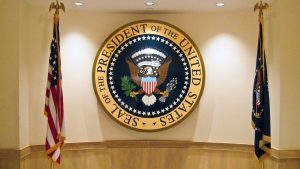
Seal of the President of the United States. Photo by: Sharon Mollerus (CC BY 2.0)

The mechanics of the peaceful transfer of power of the U.S. presidency to a new administration is something we don’t think about very often. Every four years, we take for granted that the candidate who doesn’t win an election will concede defeat and graciously work with the incoming leader to ensure a smooth transition that maintains continuity of government. This “passing of the torch” from one administration to another is a fundamental component of our system of government that sends a powerful message to the rest of the world: Democracy works.

A peaceful transfer of executive power exemplifies the ideas of compromise, civility, and unity that the nation and its leadership have observed without exception since the time of the Founding Fathers. “Peaceful” and “transition” are two words key to the general idea of what America is.

A “free and fair” election is at the center of the American whole, made up of many moving parts that were designed with changing times in mind. This is why we have a process designed to help amend the Constitution as necessary. American democracy was conceived as an always-changing enterprise, a living thing, a continuous experiment.

Moving forward after a presidential election (hopefully with a sense of diplomacy and expediency) is the best way to ensure that crucial steps and ideas are preserved. It’s been referenced almost to death, but standing together in order to “preserve the Union” is a concept as integral to what this country is as gravy is to mashed potatoes, or peas to pods, or Jonah to the whale. To borrow a phrase, it is “self-evident.”

While not an explicit part of American law or the U.S. Constitution, conceding the presidency with respect for the winning candidate and in service of the larger mission of carrying on the work of democracy is a time-honored tradition that highlights two important things: the democratic processes at the heart of our country work as they were designed to, and that a new public servant elected by a majority of the voters will take the reins of executive power to move the nation forward and ensure national security.

Changing over the leadership of an operation as big and multi-faceted as the government of the United States requires an orderly transition of power buttressed by good-faith collaboration and open communication. A lack of access to classified information and resources from the outgoing White House occupants only exacerbates challenges that the incoming administration will face as they pivot from campaigning to governing.

John R. Vile, professor of history at Middle Tennessee State University, told National Geographic that it’s not the Army or the Navy that keeps the country together, “it’s the notion that we are bound together by certain great principles and that our similarities are more binding than our differences are.”

A famous example of a concession done right was demonstrated by late Senator John McCain (R-AZ), who ran against former president Barack Obama in 2008. He was not just acknowledging Obama’s win and his own loss, but he was also underscoring the importance of the binding links between the two major parties, even if antagonism colors a majority of their interaction.

McCain reiterated the power of the people’s vote, and congratulated his opponent (and fellow public servant) on winning an “historic election.” “The American people have spoken, and they have spoken clearly,” McCain elaborated, noting that “Senator Obama…achieved a great thing for himself and for this country. I applaud him for it.”

Ron Elving, writing for NPR, has pointed out how “the concession is not…for the sake of its maker. It does nothing for the losing candidate” but that it’s actually “for the sake of everyone who needs closure,” like “the losing candidate’s family, staff, campaign workers and party rank and file.” Elving concludes that a timely and dignified concession speech (or statement of some sort) is not just a representation of the country’s internal political dynamics persevering through changing administrations, but that it’s also a signal of what the losing candidate “cares most about.”

It’s now been roughly two weeks since Joe Biden became the President-elect, and President Trump has shown little to no sign that he will acknowledge the shift in leadership, let alone offer a concession. Accusations of voter fraud, brought up by himself and his supporters through Twitter, Fox News and press conferences (just to name a few examples), do nothing to help the country move forward, console those who were passionately rooting for the other side, or help unify and heal a country that has endured so much hardship in such a compressed period of time.

None of the objections and challenges to the election results brought by the Trump team are projected to change the outcome of the 2020 election. No concrete evidence of widespread ballot tampering or illegal activity in relation to the election have been confirmed or established, and all signs still point to the fact that, as long and stressful as the week of November 3rd was, the system at the heart of our democracy worked correctly and lawfully.

A public concession acknowledging that in a few months someone else will be in charge of running the executive branch of government clears the air in a way, letting supporters of both candidates know that the democratic process is carrying on, that voting does indeed matter, and that the country, as flawed as it might be in ways big and small, stands resolute behind the power of the people to choose their own leaders from local dogcatcher to the highest strata of power.

It’s clear that the divide in political ideologies is as present today as it was four years ago, but change, however slow and muddled, has begun to take shape. Dragging out the concession process by proliferating unsubstantiated claims that the election was “rigged” and stalling the process of healing that America so desperately needs is not in keeping with even recent presidential history. Rather it is an unfortunate set of shortsighted maneuvers that are ultimately as self-defeating as they are corrosive to America’s soul and all the work that has been carried out thus far to preserve and strengthen it.

_____________________________________________________________

Photo by: Sharon Mollerus (CC BY 2.0)

The Other Big Winner in 2020: Legal Marijuana

Five States Approve Marijuana Legalization Measures

By: Derek Bowers, Mason Votes 2020 Online Editorial Team
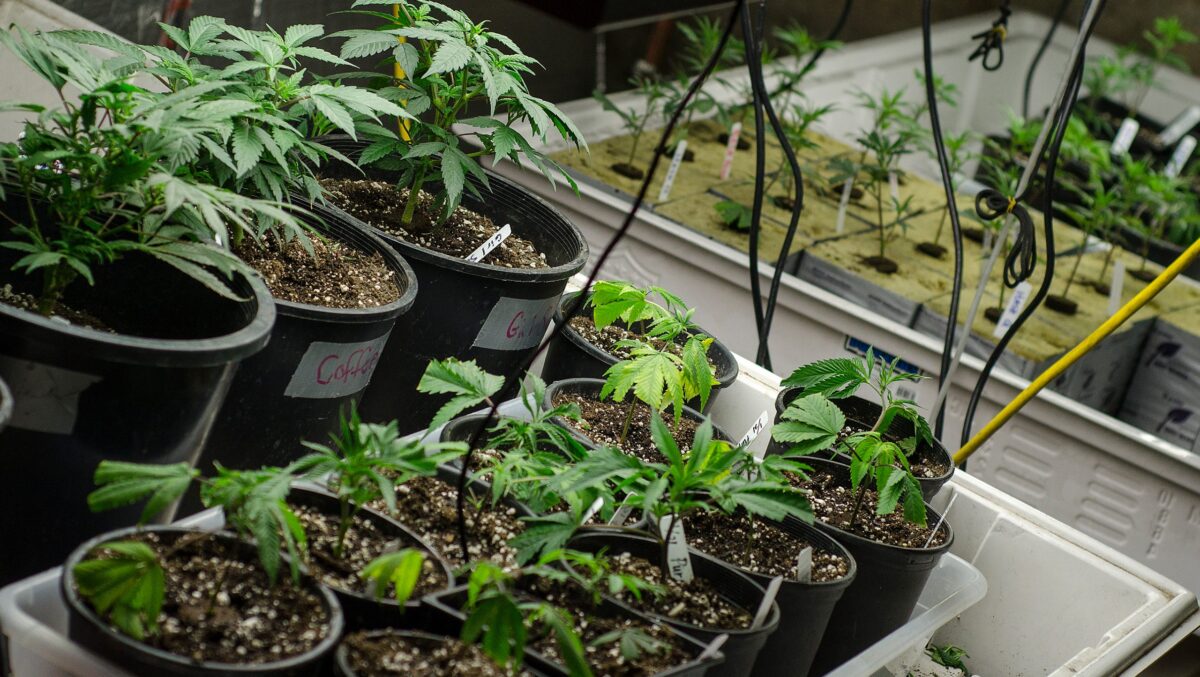
A legal marijuana grow operation in Colorado. Photo by: Brett Levin (CC BY 2.0)

As the dust settles on the 2020 presidential election, another winner emerges to join President-Elect Biden, legalized marijuana.

Through state ballot questions presented to voters, four states voted to legalize recreational marijuana for its citizens, and by healthy margins. Voters in Arizona, Montana, New Jersey, and South Dakota all voted to amend their state constitutions to include legalized marijuana for adults 21 and over. Look for these measures to begin rolling out and taking effect as state legislatures finalize the intricacies of the measures in 2021.

South Dakota was the standout here, as they didn’t even have medical marijuana prior to this election. Voters in this state approved two separate ballot measures that legalized both medicinal and recreational marijuana, illustrating Americans rapidly evolving views on legalization. This also shows that voters don’t seem to be split on marijuana legalization by party, as President Trump won the state of South Dakota.

Prior to the election, there were 11 states with legalized recreational marijuana, and these additions now bring that to a total of 15 states. Washington, D.C. has also legalized marijuana in recent years. Their regional impact will be large, with many of the states surrounding these now “legal” states potentially being influenced to reform their drug policies and consider legalizing marijuana as well. For example, elected officials in New Mexico have already began calling for their legislature to consider a bill to legalize marijuana, no doubt influenced by bordering “legal” Colorado and now Arizona.

Americans’ growing change in views on marijuana are being seen in regions that have held out on entering the national discussion around legalization. Mississippi approved medical marijuana, making it a standout among southern states, proving that Americans views on marijuana and drug policy are evolving as more young people enter the electorate.

_____________________________________________________________

Photo by: Brett Levin (CC BY 2.0)

How Did Mason Vote in 2020?

Joseph Robinette Biden is President-Elect and Kamala Devi Harris is Vice President-Elect

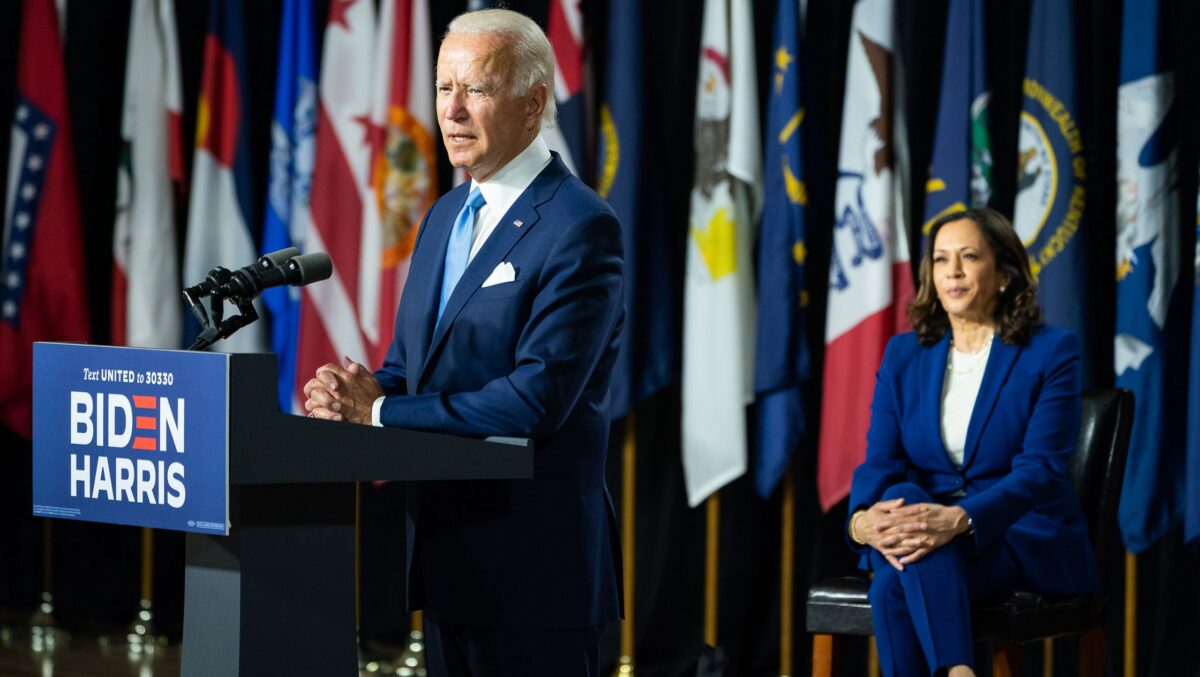
President-Elect Biden announced Kamala Harris as his vice presidential running mate on August 12, 2020 in Wilmington, DE. Biden for President Photo by Adam Schultz (CC BY-NC-SA 2.0)

After a tense week of ballot counting and uncertainty, Democrat Joseph Robinette Biden was elected the 46th president of the United States on Saturday, November 7th as it became clear he had secured the 270 electoral college votes necessary to defeat Republican incumbent Donald Trump. Click here for full video of the Harris and Biden victory speeches on YouTube (WSJ).

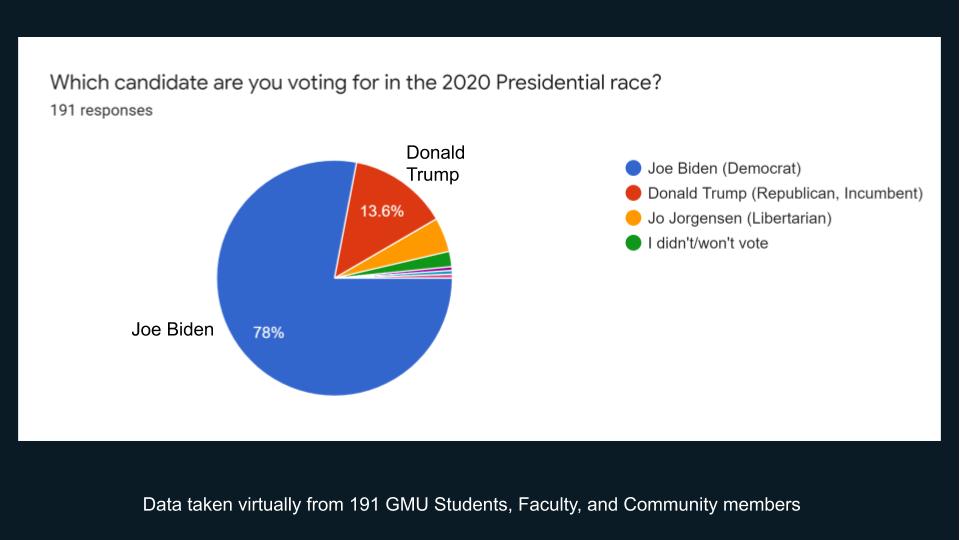
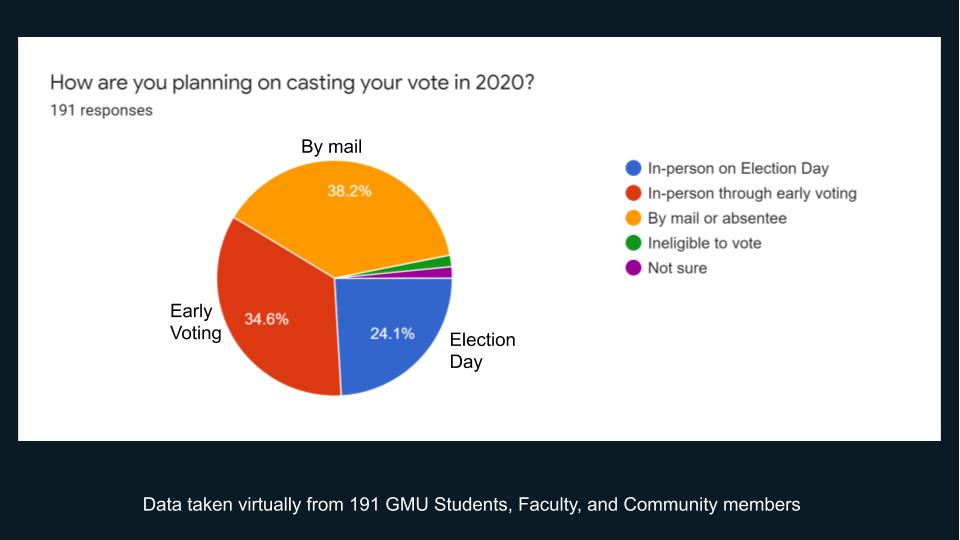
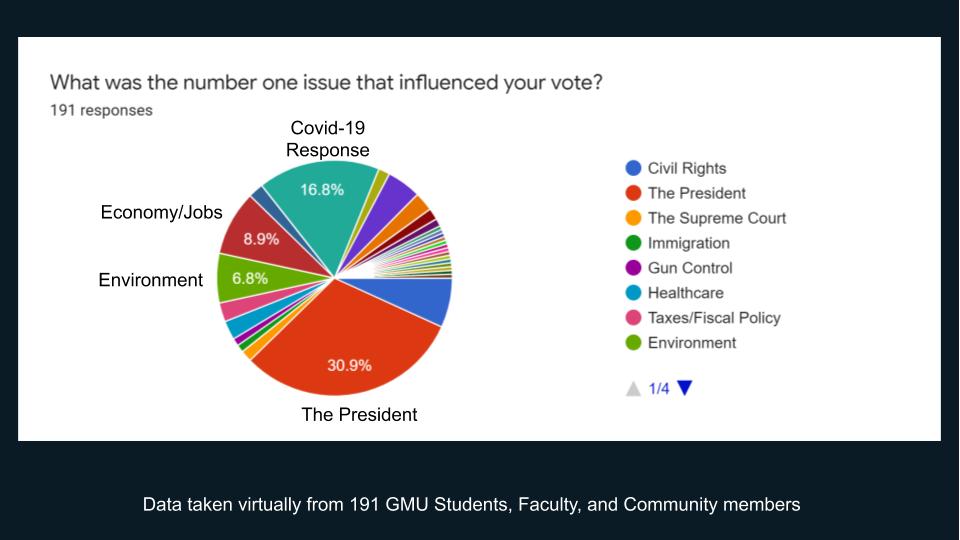
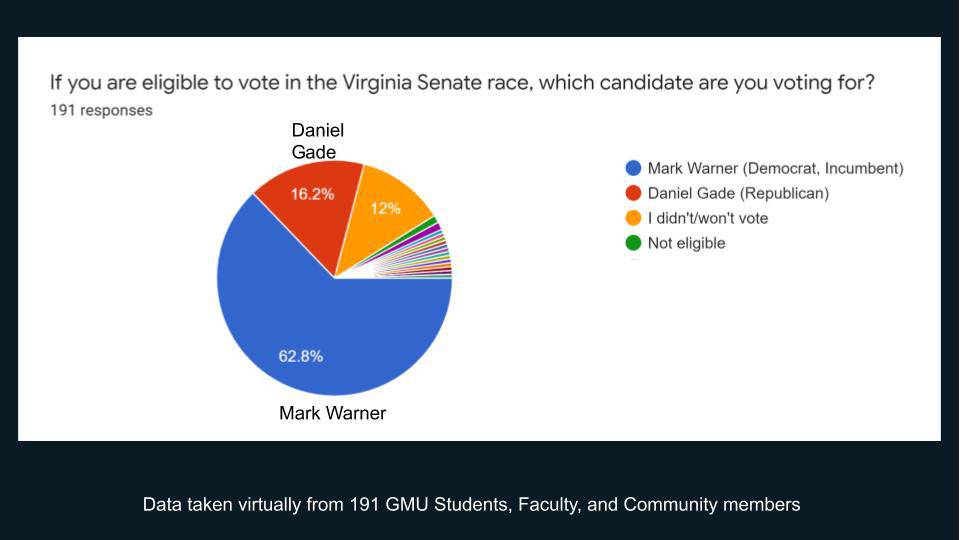
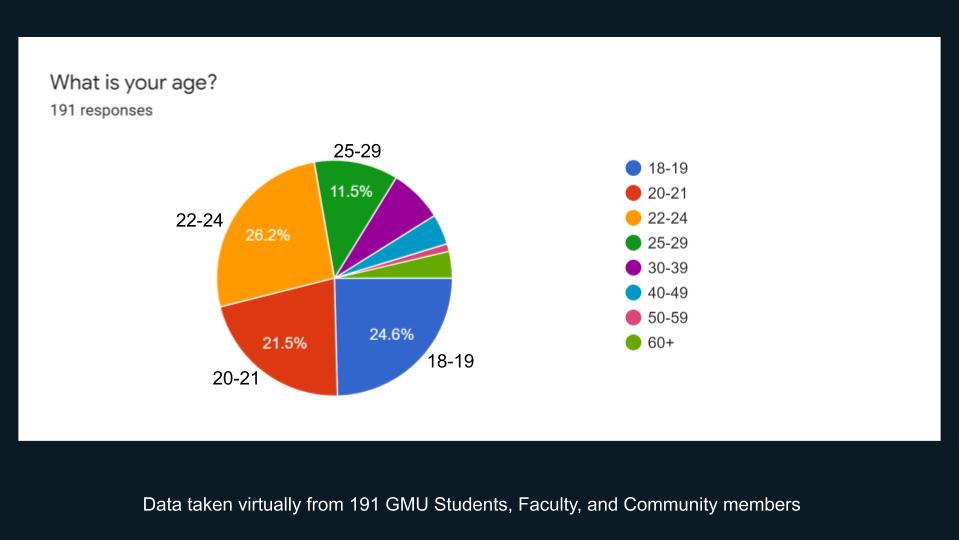
Curious how Mason voted in 2020?

Check out the results of Mason Cable Network‘s 2020 Election Survey below:

Survey data is based on 191 responses from Mason students, faculty, staff, and community members.

_____________________________________________________________

Slider image credit: Biden for President Photo by Adam Schultz (CC BY-NC-SA 2.0)

Survey graphics by: Cruz Sanchez

Watch: LIVE 2020 Coverage!

Students from Mason Cable Network and Mason Votes Collaborate on LIVE 2020 Election Night Broadcast

Watch individual interviews with Mason experts: youtube.com/playlist?list=PL-nrkJmJOwW38RppNZL9M7Pr7MhZM7QUI

Watch the full broadcast via YouTube below (youtube.com/MasonCableNetwork): youtube.com/watch?v=tr3p2tKmEFs&feature=emb_title

Q&A: GMU for Biden Student Organization

“Joe and Kamala will lead with grace, intelligence, and empathy”

Interview by: Orlando Cabrera, Mason Votes 2020 Online Editorial Team
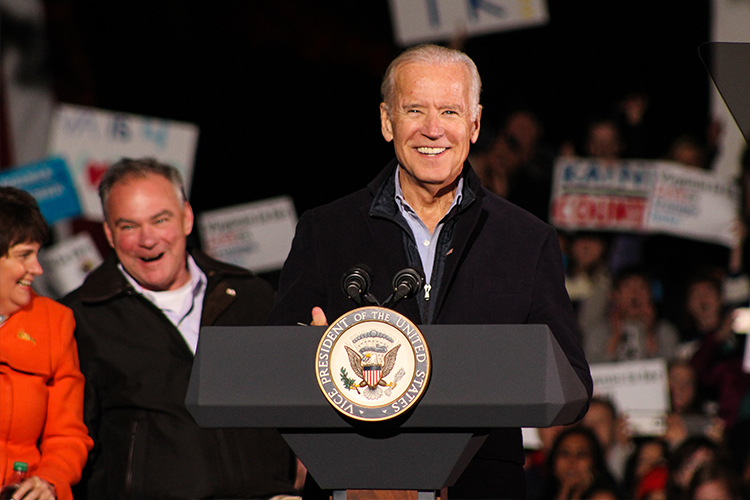
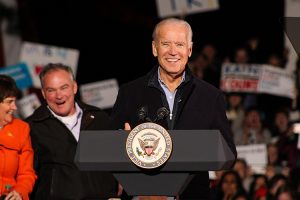
Vice President Joe Biden campaigns with Senator Tim Kaine (D-VA) at a “Stronger Together” rally at Mason’s Fairfax campus on the eve of the 2016 election. Photo by Mimi Albano

Q: Mason for Joe is an organization operating at one of the few in-person schools this semester, George Mason University. Despite COVID-19 spikes in Virginia and elsewhere, your group seems particularly active in an otherwise remote campaign. What precautions have your volunteers and leaders been taking to minimize community spread and maintain a health campaigning environment?

A: The severity and danger of COVID-19 is something that both GMU for Biden and the Biden Campaign takes very seriously. COVID-19 has made campaigning a very different experience than in elections past. Similarly to how we have all had to adapt to life among this virus, we have had to adapt and find new ways to reach students and voters in the Fairfax community. GMU for Biden has held our weekly meetings, phone and text banks, and debate watch parties over Zoom in order to prevent any unsafe, in-person contact. Any other events that we have hosted or attended, from the DC Women’s March, seeing Kamala Harris’ husband Doug Emhoff speak in Alexandria, or tabling on campus, have taken place outside while following the CDC’s social distancing guidelines. The health and safety of our members, volunteers, and the community is our first priority.

__________________________

Q: Your organization is comprised primary of young voters, a bloc that clearly favors Joe Biden, but young voters have never been a consistent or reliable demographic in Presidential politics- perhaps with the exception of 2008. What makes your organization so confident that a candidate like Joe Biden can mobilize college-going and young voters?

A: Although young voters haven’t necessarily had great turnout in previous elections, GMU for Biden is confident that young voters will turnout greater this year than in any previous presidential election in recent history. Not only have we seen first-hand the amount of Mason students who have dedicated much of their free time and efforts to volunteering with us and being a part of our team, but also all of the people who have supported our organization this semester by coming to our on-campus events, showcasing their Students for Biden signs, and interacting with our social media- which gained over 600 followers in less than two months. Joe Biden is running a campaign that focuses on many issues that are very important to young voters, such as combating climate change, fighting for racial and gender equality and equality for the LGBTQ+ community, and college affordability and student loan debt forgiveness. Joe Biden and Kamala Harris will implement policy that will expand access to opportunities for all young people without the fear of crippling debt, a lack of jobs, and rising cost of living. The Biden/Harris ticket understands the challenges that America’s youth are facing and will face in the future and are focusing several integral parts of their campaign towards combating those challenges.

__________________________

Q: Racial equity and justice are certainly a topic on the ballot this election, but framed entirely differently by each of the candidates. President Trump has made a clear turn toward domestic security, lambasting rioters and looters after the wrongful death of George Floyd and shooting of Jacob Blake, to mobilize his supporters in police unions and the law enforcement community. Vice President Biden, by contrast, has made a distinction between peaceful protest and rioting, praising the majority of individuals demonstrating peacefully in the streets of cities like Portland, Kenosha, and New York. Despite these drastically different approaches to this year’s unrest, Joe Biden still has faced criticism and skepticism from young black and brown voters for past legislation and statements. What might you say to those voters who feel that Joe Biden is a relic of the institutions they distrust?

A: One of the many reasons why GMU for Biden was formed is because our members recognize that we live in a country that does not work for everyone, and this has only been exacerbated over the past four years. We see the potential in what America can be, but in order to achieve that potential we must confront the systemic issues in this country’s history and that we still struggle with today. One of the greatest problems America has had throughout its history that continues to thrive today is systemic racism. Joe Biden is running a campaign that we see is capable of addressing and taking important steps to combat racism in America. A Biden/Harris ticket will reform policing and the police system, in which racism is embedded at its foundation. Biden will also invest in black businesses and non-profits, require workplace diversity transparency, minimize racial disparities in credit scoring, and work to end predatory loans, housing disparities, and gerrymandering. These are only a few steps that the Biden Harris campaign is taking to make America a place with equal opportunities for everyone, no matter the color of their skin. Joe Biden has said that what made him decide to run for president was the tragedy in Charlottesville, where Neo-Nazi’s sparked violence during a peaceful protest, and the current president’s response to the event saying there were “fine people on both sides.” Joe Biden will be a president that will work tirelessly to ensure that racism is not tolerated in America and will set that example from the top.

__________________________

Q: Joe Biden is set to win the Commonwealth of Virginia, but many states are still on the table.  What is Mason for Joe doing to ensure victory in key states like Georgia, Arizona, North Carolina, and Pennsylvania?

A: GMU for Biden has dedicated much of our volunteer time phone banking and text banking into swing states when are aren’t calling and texting into Virginia. We have participated in weekly phone banks into Pennsylvania, along with making calls into North Carolina for Pat Timmons-Goodson and Joe Biden and into Florida during our phone bank with special guest Del. Jennifer Carroll Foy. On November 2nd we will be making calls all day into several different states including: Florida, Iowa, Wisconsin, Texas, and Arizona.

__________________________

Q: This past Saturday, a Biden/Harris bus was almost run off the road by a caravan of Trump supporters on a highway in Texas. This Sunday, Trump supporters around the country blocked traffic, most notably on New Jersey’s Garden State Parkway. What reassurance can you give to voters who fear intimidation, violence, or retaliation at the polls? 

A: The events of this past Sunday were appalling to say the least. We understand Americans fear about not only the direction this country is headed right now, but also for their own safety and the safety of their community leading up to the results of this election. The message that we have to Americans who crave normalcy, respect, and decency in this country is to VOTE on November 3rd and bring others to vote with you! The only way we can work toward bringing back these values is to elect Joe Biden and Kamala Harris as our next President and VP. We have the utmost confidence that Joe and Kamala will lead with grace, intelligence, and empathy, things that America deserves in its highest office.

__________________________

Editorial Team Note: Mason Votes is committed to providing a platform to the broad spectrum of political opinions at our University. Multiple attempts by Mason Votes to arrange virtual, telephonic, and written interviews with the GMU College Republicans were made, but went unanswered. The invitation for comment or an interview remains open.

__________________________

Read past Mason Votes coverage of 2020 candidates visiting Mason:

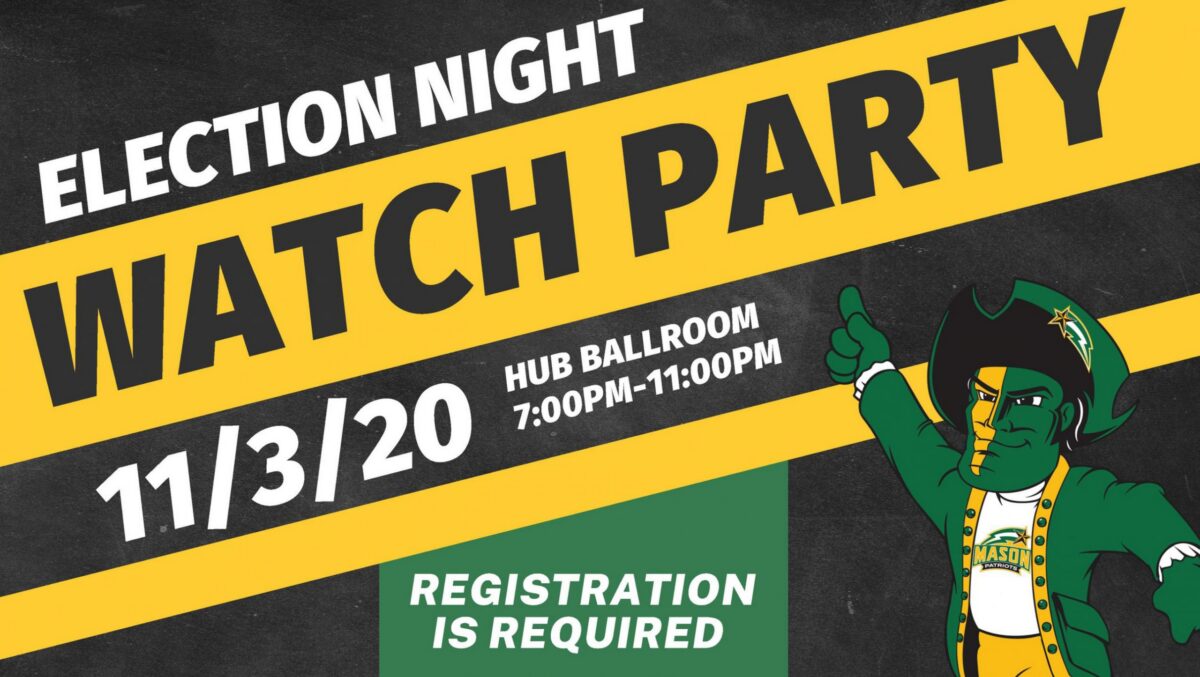
On-Campus 2020 Election Night Watch Party

Registration Required! 7-11pm in The Hub Ballroom

If you are on the Fairfax campus and want to watch results with others, RSVP for Mason’s Election Night Watch Party: masonvotes.gmu.edu/events/election-night-watch-party

7-11pm | The Hub Ballroom & Corner Pocket  | Fairfax Campus

FREE Wing Zone & Snacks!

RSVP via Mason360: cglink.me/r872032