Mason Votes

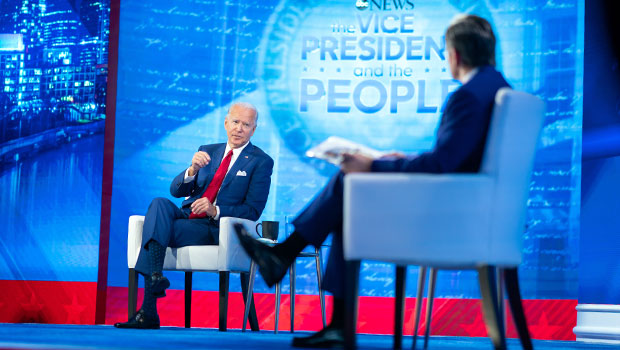
Joe Biden Participates in ABC News Town Hall

The Vice President and the People

By: Nadia Faour, Mason Votes 2020 Online Editorial Team
Vice President Joe Biden participates in an ABC News town hall event in Philadelphia, PA on October 15, 2020. Biden for President Photo by Adam Schultz (CC BY-NC-SA 2.0)

With less than three weeks until the election, the Commission on Presidential Debates announced that the second presidential debate was canceled after a failed attempt to continue with the event in a virtual format following Donald Trump’s positive COVID-19 diagnosis earlier this month. In lieu of the originally planned debate featuring both candidates, Joe Biden participated in a solo town hall event in Philadelphia and spoke with potential voters about his plans and policies.

During last week’s “Vice President and the People” town hall moderated by ABC News’ chief anchor George Stephanopoulos, Biden fielded questions from Pennsylvania democrats, republicans, and independents on a wide range of topics from coronavirus response to environmental policy.

Biden dove right into policies his administration would implement if elected, answering the first question about how he would handle the COVID-19 pandemic by emphasizing the importance of mask mandates at local and state levels: I go to every governor, I go to every mayor, I go to every councilman, I go to every local official, say, mandate the mask.” Biden also explained how he would prioritize preparation for schools and business to be able to better handle the spread of the virus and avoid another economic shut down.

One unanswered question from Biden was a clear stance on court packing. The former vice president addressed this issue by explaining that his stance will depend on what happens in the Senate with the nomination of judge Amy Coney Barrett. It is currently still unknown exactly how the Barrett hearings will resolve, but Biden stated that he will give a clear position on this issue before election day: “They do have a right to know where I stand. And they will have a right to know where I stand before they vote.”

Environmental policy is an issue that many Americans are concerned about and will continue to be a topic of discussion long after this election has come and gone. The vice president’s approach to environmental policy would push for investments in renewable energy sources: “…by the year 2035 we’ll be able to have net zero emissions of carbon from the creation of energy.” Biden said that as president, he would invest $600 billion into “made-in-America” infrastructure that would focus on clean and renewable energy and create good-paying jobs along the way.

Throughout his campaign, Biden has continually insisted that he will not ban fracking and does not endorse all aspects of the Green New Deal. Stephanopoulos pressed Biden on how his plan would not ban fracking but end fossil fuel emissions: “The New Green Deal calls for elimination of all non-renewable energy by 2030. You can’t get there. You’re going to need to be able to transition, George, to be able to transition to get to the place where we invest in new technologies that allow us to do things that get us to a place where we get to net zero emission, including in agriculture. I’ve laid out a detailed plan.

Throughout the evening Biden stressed his desire to foster unity in the nation under his administration. “I’m running as a proud Democrat, but I’m going to be an American president. I’m going to take care of those that voted against me as well as those who voted for me, for real. That’s what presidents do. We’ve got to heal this nation, because we have the greatest opportunity of any country in the world to own the 21st century. And we can’t do it divided.”

Click here to read Mason Votes’ coverage of Donald Trump’s “dueling town hall” event.

_____________________________________________________________

Biden for President Photo by Adam Schultz (CC BY-NC-SA 2.0)

Day 2 Recap: Supreme Court Nominee Amy Coney Barrett

Day 2 Recap (Tuesday, October 13, 2020)

By: Safiya Khan, Mason Votes 2020 Online Editorial Team
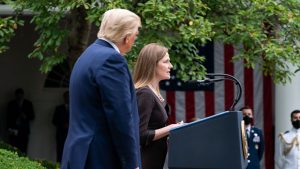
President Trump Nominates Judge Amy Coney Barrett for Associate Justice of the U.S. Supreme Court. Official White House Photo by Andrea Hanks (CC PDM 1.0)

On Tuesday, October 13th, Supreme Court Nominee Amy Coney Barrett sat for the second day of hearings in front of the Senate Judiciary Committee for over eleven hours, portraying herself as an independent judge lacking an agenda.

Here are some important highlights from day two’s hearings:

Judge Barrett declines to clarify stance on Roe vs. Wade

Similar to previous nominees hearings, Barrett refused to discuss her stance on specific cases citing the “Ginsburg rule.” When asked if she thinks the landmark case Roe vs. Wade should be overturned, she declined to answer. She also emphasized “I’ve made no commitment to anyone about how I would decide any case,” and that she would bring her originality and perspective to the role if confirmed, despite the perception that she shares former Justice Scalia’s opposition to Roe. (In the Rose Garden ceremony announcing Barret’s nomination she praised her mentor Scalia saying, “his judicial philosophy is mine too.”)

Judge Barrett apologizes for her phrasing of LGBTQ+ rights

Judge Barrett used the term “sexual preferences” when describing the LGBTQ community and her stance on the protection of their civil rights. Part of her answer included, “I have no agenda, and I do want to be clear that I have never discriminated on the basis of sexual preference and would not ever discriminate on the basis of sexual preference.”

After Senator Mazie Hirono of Hawaii stated the term is often used by anti-gay activists to justify their belief that one’s sexual orientation does not require legal protections as they suggest it is a choice, Judge Barrett later apologized for her remarks. She clarified saying, “I certainly did not mean and would never mean to use a term that would cause any offense in the L.G.B.T.Q. community,” Judge Barrett said. “So if I did, I greatly apologize for that.”

Judge Barrett acknowledges the criminal justice system has implicit bias.

When asked how she as an originalist views racism, Judge Barrett stated “it is an entirely uncontroversial and obvious statement” that “racism persists in our country.” When pressed to further elaborate, after being directly asked, “Yes or no question, do you believe that there is implicit racial bias in the criminal justice system?” Judge Barrett acknowledged that with a criminal justice system as large as the United State’s it is unlikely to not have some implicit bias in it.

Senator Harris questions Judge Barrett’s views on reproductive rights and healthcare

The top two Democratic arguments for reproductive rights and healthcare were the center of the proceedings when Senator Kamala Harris asked Judge Barrett for a “yes or no answer” if she was made aware prior to her nomination of President Trump’s promises to nominate judges who would seek to nullify the current healthcare law. In response, Judge Barrett continued her answering pattern stating, “I want to be very, very careful…I’m under oath.”

Letter from Notre Dame faculty members to Barrett requesting she halt her confirmation process

A law professor at Notre Dame, Judge Barrett was questioned about a public letter about 90 of her colleagues wrote to her stating “it is vital that you issue a public statement calling for a halt to your nomination process until after the November presidential election.” and giving three primary reasons. The full letter can be found here.

Senator Cory Booker of New Jersey acknowledged the letter saying, “They wrote an impassioned letter for the sake of our democracy, publicly writing that you withdraw from this nomination process and have it be halted… this is not normal.”

Why is this important?

While Judge Barrett did partially follow the precedent of other nominees, these hearings are a crucial opportunity for the American people to learn about the next potential future Supreme Court Justice and how her appointment directly affects their daily lives. By declining to give clear answers on specific cases such as Roe vs. Wade, The Affordable Care Act, and possible election intervention by the Supreme Court itself (see Bush v Gore), Judge Barrett’s refusal to answer key questions has the potential to impact the integrity of the election in the minds of the American people.

As the election looms closer and closer (just 18 days away), it is becoming more and more apparent just how abnormal this election is.

Read the Mason Votes recap of Day 1 of the Barrett hearings here: masonvotes.gmu.edu/2020/10/14/senate-hearing-for-supreme-court-nominee-amy-coney-barrett/

_____________________________________________________________
Official White House Photo by Andrea Hanks (CC PDM 1.0)

Election Night Confusion: What Patriots Need to Know

Election Night Confusion: What Patriots Need to Know

By: Safiya Khan, Mason Votes 2020 Online Editorial Team
Photo by Marco Verch/wuestenigel (CC BY 2.0)

The election is not 19 days away…the election is now. Every day, hundreds of thousands of Americans send in their absentee ballots or vote early at their local registrar’s office.

As November 3rd rapidly approaches, it is important that voters mentally prepare themselves for an election night without a clear winner. Media organizations usually have enough information to declare a winner on election night based on actual ballots counted and projections (estimates) of outstanding ballots yet to be counted. But the unusual circumstance of conducting a national election during a global pandemic may mean that Americans have to wait days, or even weeks, before a clear winner emerges.

Some states prohibit counting of early or mail-in votes before Election Day, and the deadline for returning mail-in ballots varies by state, making an accurate and complete national count on election night all but impossible. For example, mail-in ballots in Virginia must be postmarked by Tuesday, November 3rd and received no later than noon on Friday, November 6th. Ohio is accepting ballots up to ten days after Election Day, as long as they were postmarked by Monday, November 2nd.

This means that clear results will not be known for at least a few days. With no obvious winner, it can be expected that misinformation will spread in abundance, leading to potential legal challenges by the campaigns and prompting citizens to question the integrity of the election.

We have already seen efforts by the Trump administration to undermine election integrity in the minds of voters by by instituting major mail processing and delivery changes at the United States Postal Service. New leadership, new procedures, and misleading tweets have all been used to foster doubt about the reliability of mail-in ballots.

While platforms such as Facebook and Twitter have taken precautions in an attempt to prevent election misinformation, there is still a lot of misleading content slipping through the cracks.

To some degree, partisan noise and misinformation is unavoidable, but here are a few steps Patriots can take to potentially help reduce the confusion and questions on election night:

Vote Early

Early voting is taking place at all local registrar offices in Virginia until October 31st, the Sunday before election day. Virginia’s officials made the decision to open voting as early as September 18th, giving citizens the option to vote up to 45 days in advance. No form is needed when showing up to the registrars’ office, just a valid photo ID.

Vote by Mail (Absentee)

Vote from the safety of your own home by requesting an absentee ballot before the deadline of Friday, October 23rd at 5pm. Make sure to follow all instructions and return your ballot before the deadline! You can find more information in a recent Mason Votes article titled “Make a Plan to Vote,” that has links to request a ballot, track your ballot, and some tips for voting in-person on election day.

Vote In Person

If you are not high risk and would prefer to vote in person, wear a mask and show up to the polls as if it were any other election but be sure to expect long lines. All that is needed is a valid photo ID. And patience!

While this election night will be unlike any other, we all have the power to make sure our vote is counted and avoid distraction by staying informed.

Make your voice heard by voting in Election 2020 using the method that is best for you!

Read our student Guide to Voting for early vote locations, deadlines, and links to request a ballot.

_____________________________________________________________

Photo by Marco Verch / wuestenigel (CC BY 2.0)

2020 VP Debate Reaction

Mike Pence and Kamala Harris Debate in Utah

By: Nadia Faour, Mason Votes 2020 Online Editorial Team

A lot has changed since September 29th when Trump and Biden faced off in the first presidential debate of the 2020 election. (One Mason student described that event as “the most aggressive presidential debate” they had ever seen).

Just three days after that now-historic debate, President Trump announced that he and First Lady Melania had both tested positive for COVID-19.

Trump’s late night Twitter disclosure prompted many to question the wisdom of hosting subsequent debates as planned, citing potential threats to public health and concerns about the safety of those participating.

The Commission on Presidential Debates has officially cancelled the second presidential debate after a failed attempt to pivot to a virtual format, but the only 2020 Vice Presidential Debate continued as scheduled and in person on Wednesday, October 7th in Salt Lake City, Utah.

Plexiglass dividers, a mask-wearing requirement for all attendees, and a new 12-foot distance requirement between the two candidates on stage all made it impossible for the American people to ignore the novel coronavirus’ association with the White House and the Trump-Pence ticket.

USA Today’s Susan Page served as moderator and addressed the issue within the first few minutes of the debate, asking both candidates to explain how their respective administrations would handle the pandemic.

Senator Kamala Harris (D-CA) took the opportunity to discuss what she thinks the Trump administration did wrong in their approach to dealing with the virus, saying that “the American people have witnessed what is the greatest failure of any presidential administration in the history of our country.”

“Harris’ greatest argument was coming for Trump’s record of handling COVID,” said Mason student Carisa Mclaney.

Mike Pence rebutted Harris’ claim, bringing up the success of the president’s travel ban to China early on in the pandemic and accusing democrats of opposing his decisive action: “President Donald Trump has put the health of Americans first.”

Moderator Page emphasized the need for civil discussion early on, but a pattern of Harris criticizing the Trump administration and Pence defending it quickly emerged, with polarizing attacks and subtle hostility on display throughout the 90-minute debate.

Mclaney noted the differences in style between Trump and his running mate: “Pence is more practiced in political speech and remains more reserved, while Trump is more disruptive in a non-professional and rambunctious manner.”

Mason student and secretary of the GMU Republicans student organization, Joe Szymanski, said he thought that the vice presidential debate focused more on “policy instead of personality” by putting key issues on the table, including climate change, healthcare, abortion, and foreign policy.

Something many Americans look for from a vice presidential debate is any potential differences in policy between the presidential candidate and their VP pick.

“For Biden and Harris, there’s quite a number of issues the two don’t fully agree on,” said Mclaney, but “Trump and Pence share a significant number of policy positions, which was bound to have played a part in Pence’s selection as VP.” Szymanski stated that he “doubts there are any” issues that Trump and his VP pick disagree on.

So who won the 2020 VP debate? The answer varies based on who you ask…

Szymanski commented that the debate was “was extremely close. Both really did bring their A game. But I had to give the edge to Vice President Pence. [He] just controlled the messaging a little better.”

Mclaney said, “I think that Kamala won the debate because she’s able to hit back, especially with her one-liners. She was also able to navigate a debate with an interrupting and dismissive man-splainer, one that we as women are too familiar with, with her head held high.”

Another mason student who preferred to remain anonymous agreed that the debate was very close: “I don’t think this debate had a clear winner and loser, both candidates argued their points well and it really came down to policy differences.”

The debate closed with a question from an 8th grader named Brecklynn who asked: “If our leaders can’t get along, how are the citizens supposed to get along?”

Although this could be viewed as a naïve question from a young person, it was also on the mind of many Mason students contacted during reporting for this article.

One Mason student who requested anonymity summed up the thoughts of many: “[I’m] disappointed by the behavior of both candidates for letting differences get in the way of discussing how to actually help Americans.”

Students React to First 2020 Presidential Debate

Students describe how they felt after watching Donald Trump and Joe Biden go head-to-head during the debate on Sept. 29

By: Sudiksha Kochi, Fourth Estate Staff Writer

This story was originally published on gmufourthestate.com. Fourth Estate is Mason’s official student-run newspaper.

Democratic presidential nominee Joe Biden and Republican President Donald Trump faced off in the first presidential debate of the 2020 election in Cleveland, Ohio on Sept. 29, with “Fox News Sunday” anchor Chris Wallace moderating the event. Throughout the debate, the two candidates interrupted each other, bickered on issues beyond the time limit and chaotically exchanged viewpoints. 

The topics addressed included the Supreme Court, the candidates’ records, COVID-19, the economy, the climate and the integrity of the election.

Students watching the debate expressed their opinions on what happened. Global Affairs sophomore Shreya Dandu stated that like many other people, she thought that the debate was a big mess.

“To me, I felt like I was watching two people continuously fight and interrupt each other [rather] than watch[ing] people talk about their agendas,” Dandu said. “All I can remember were the insults and interruptions thrown at each other rather than actual policy proposals.” 

Dandu said that Trump should have stopped interrupting and insulting Biden and Wallace.

“Regardless of who you support, I think that Trump insulting Biden’s sons was just way out of hand,” Dandu said. “There are certain lines you just can’t cross, and I just couldn’t help but think that was extremely unpresidential of him. His outright refusal to denounce white supremacy also speaks volumes to me.”

Dandu said that Biden could have given more concrete answers on his topics.

“While I am planning on voting for him, I noticed he dodged questions about packing the court,” Dandu said. “While I understand he didn’t answer because he doesn’t want to cause more divisions within the Democratic party and that he doesn’t want to alienate voters, I think that people should know where he stands on that issue.”

Health Administration sophomore Nadia Moallin expressed a similar reaction.

“In all honesty, I thought the debate was a complete mess in terms of policy implications, respectability, and everything in-between,” Moallin said. “The entire time I felt overstimulated with jabs coming from both Biden and Trump and even Wallace, that I wasn’t even aware of what the topic was during the conversation. I don’t think this is a left or right issue. In my opinion, there was no way that was informational.”

“It seems as though Trump and Biden were butting heads the entire time to look more superior, that they forgot the main reason they were on stage in the first place,” Moallin said.

While Moallin believes that this election specifically has not changed the nature of politics in the United States, she explained that this election has made voters more aware of the polarization occurring in front of us.

“There is no more looking away and being undecided,” Moallin said. “Most people who were watching the debate were not using the debate as an indicator of who to vote for, most already knew. The more and more polarized American politics become, the less of a chance a middle ground will ever be reached.”

Government and International Politics sophomore Vanessa Gutierrez agreed.

“I think the nature of politics has changed dramatically because the United States has become extremely polarized, and there is evident lack of communication and respect that goes deeper than politics,” Gutierrez said. “More people feel the need to defend their values and beliefs [and] that usually comes out hostile.”

Wallace stated to CNN that he “wishes he had stepped in more seriously sooner” to avoid the fallout.

“That was frustrating,” Wallace stated in a CNN article. “It was frustrating for me because I tried hard to prepare for a serious debate, much more frustrating and more importantly for the American people because they didn’t get the debate they wanted that they deserved.”

Wallace also stated in a CNN article that he believes Trump was the primary cause of the turmoil. According to The Washington Post noted that, Trump repeatedly interrupted Biden and Wallace, attacked Biden’s son Hunter, refused to condemn white supremacy and presented doubts on the legitimacy of the ballots.

“I had baked this beautiful, delicious cake and then frankly the President put his foot in it,” Wallace said to CNN.

___________________________________________________________________________________________
This article appears on Mason Votes with the permission of the editors of Fourth Estate.

Read more from Fourth Estate: gmufourthestate.com

Make a Plan to VOTE!

Early and Absentee Voting is Already Underway in Virginia

By: Derek Bowers, Mason Votes 2020 Online Editorial Team

With the November 3rd less than 30 days away, now is the time to make your plan to vote. The state of Virginia offers early voting both in person and through absentee (mail in) ballots.

To register to vote or update your registration, find your local polling place, and apply to vote absentee (by mail) use Citizen Portal: https://vote.elections.virginia.gov/VoterInformation

You can check the location of your local voter registration office here to contact your local election officials: https://vote.elections.virginia.gov/VoterInformation/PublicContactLookup

EARLY VOTING

You are able to vote early in person from now until the Saturday before election day (October 31, 2020). Read our student Guide to Voting for early vote locations and details.

There is no application needed to do this, and you will not be required to provide justification. However, a valid ID is required to be presented at the polling location when casting your vote.

ABSENTEE VOTING (by mail)

Most absentee ballots have already been sent out, as the State mails them 45 days in advance of the election, but you are able to request one until Friday, October 23, 2020 at 5 pm.

To request an absentee ballot, head to the Department of Elections Citizen Portal: https://vote.elections.virginia.gov/VoterInformation.

If you would prefer a paper copy of the absentee ballot form, it is available at this link: https://www.elections.virginia.gov/media/castyourballot/SBE-701-703.1.pdf and can be mailed, faxed, or emailed to the Virginia Department of Elections.

Virginia also requires a proof of valid ID to be submitted with this application or it can be presented when dropping off your absentee ballot at a polling place.

As a reminder, due to court decisions this year all Virginia residents will NOT require a witness signature on their absentee ballot. The state has confirmed that no ballot will be rejected due to a missing witness signature.

CASTING YOUR BALLOT

Absentee ballots can be mailed back by utilizing the prepaid postage on the envelope and dropping it in a USPS mailbox. Ballots can also be dropped in a clearly marked ballot drop box, or can be dropped off on election day at your local polling place by 7:00 PM.

All absentee ballots returned by mail must be postmarked by election day and received by noon within 3 days of the election to be counted.

If you would like to track the status of your ballot, and see when your vote is counted, Virginia offers a ballot tracking link on their elections website: https://ballotscout.org/partners/5a8f1161-23a0-4fa0-8ec9-3e090e97e9b3/va-search

In the case that there are any issues or errors with your absentee ballot, you will be contacted by your local election registrar to make corrections.

TIPS & REMINDERS

Keeping in mind the ever-changing situation with COVID-19, Virginia also offers an emergency absentee ballot in the case that residents, their spouses, children, and/or parents are hospitalized. This must be requested by 2 pm the day before election day (November 2, 2020).

ADA Accessible voting and curbside voting are available as well. The Dept of Elections recommends that you contact your local polling place or election officials to make these arrangements.

As always, mask wearing and social distancing is recommended and may by required if voting or dropping off your ballot in person.

Stay safe and healthy Patriots, and make your voice heard!

Pence and Harris Face Off in Salt Lake City

Pence and Harris Face Off in Salt Lake City

By: Jayla Brown, Mason Votes 2020 Online Editorial Team

With only 27 days left until the 2020 Presidential Election, the debates are dominating the conversation and tension is high for tonight’s vice presidential face off in Salt Lake City, Utah.

On Wednesday, October 7, 2020, at 9 p.m. EST Vice President Mike Pence and Senator Kamala Harris will be going head to head on a range of issues central to the choice facing voters in 2020.

According to The Commission on Presidential Debates (CPD), the vice presidential debate will continue as scheduled, despite many in the White House testing positive for COVID-19 over the weekend (including both President Donald Trump and First Lady Melania Trump, Press Secretary Kayleigh McEnany, advisor Stephen Miller, and others).

Both Vice President Mike Pence and Senator Kamala Harris have tested negative for COVID-19 and protocols are in place to ensure the safety of those in attendance, including plexiglass shields and a 12-foot distance between the candidates.

Tonight’s VP debate will be held at the University of Utah in Salt Lake City, Utah in front of a small crowd. An estimated 150-200 people will be attending this event.

On September 2, The CPD announced that the Susan Page, the Washington Bureau Chief for USA Today, will be moderating the debate. This will be her first time hosting this event.

The debate will span 90 minutes with no commercial breaks. Nine topics will be covered, each topic being allocated ten minutes. Page will ask an opening question and each candidate will then have two minutes to respond. The remaining time in the segment will be used to further discussion on the topic.

After the first presidential debate, the CPD will be implementing changes in debate format for a ‘more orderly discussion.’

_____________________________________________________________________________________________
Ways to Watch:

Watch with others in the Corner Pocket on Mason’s Fairfax campus from 9 p.m. to 10:30 p.m.

Those watching from home can tune into any of the major networks to watch tonight’s live debate coverage, including ABC, NBC, CBS, FOX, CNN, MSNBC, FOX News, PBS, and C-SPAN.

Stream the debates from home (check with your cable provider or find a free live stream from all major networks) and get caught up on past debates via YouTube: https://www.youtube.com/playlist?list=PLU12uITxBEPFAvcROsHJwIopn-Q-FMTSp

Happy Constitution Day 2020!

On September 17, 1787, the delegates to the Constitutional Convention met for the last time to sign the document they had created.

Today, we celebrate this achievement and reflect on what the United States Constitution means to each of us.

To help the Mason community observe Constitution Day 2020, Student Media has put together a resource page with links to learn more about America’s founding documents, test your knowledge about the Constitution and the First Amendment, and more!

Constitution Day Resource Page: studentmedia.gmu.edu/constitutionday

Video: What Does “We the People” Mean to Mason Students & Staff?

Click on the video below to hear their responses:


How to Vote During a Pandemic

How to Vote During a Pandemic

On Wednesday, September 16, 2020, Mason Votes co-hosted a virtual panel discussion featuring Schar School professors Dr. Jennifer Victor and Dr. Robert McGrath, and Mason student and chief election officer Jean Thoensen.

For those who weren’t able to tune into the live Zoom broadcast, organizers recorded the discussion and a full video of the virtual panel can we viewed below:

Do Your Part: How to Become a Poll Worker in 2020

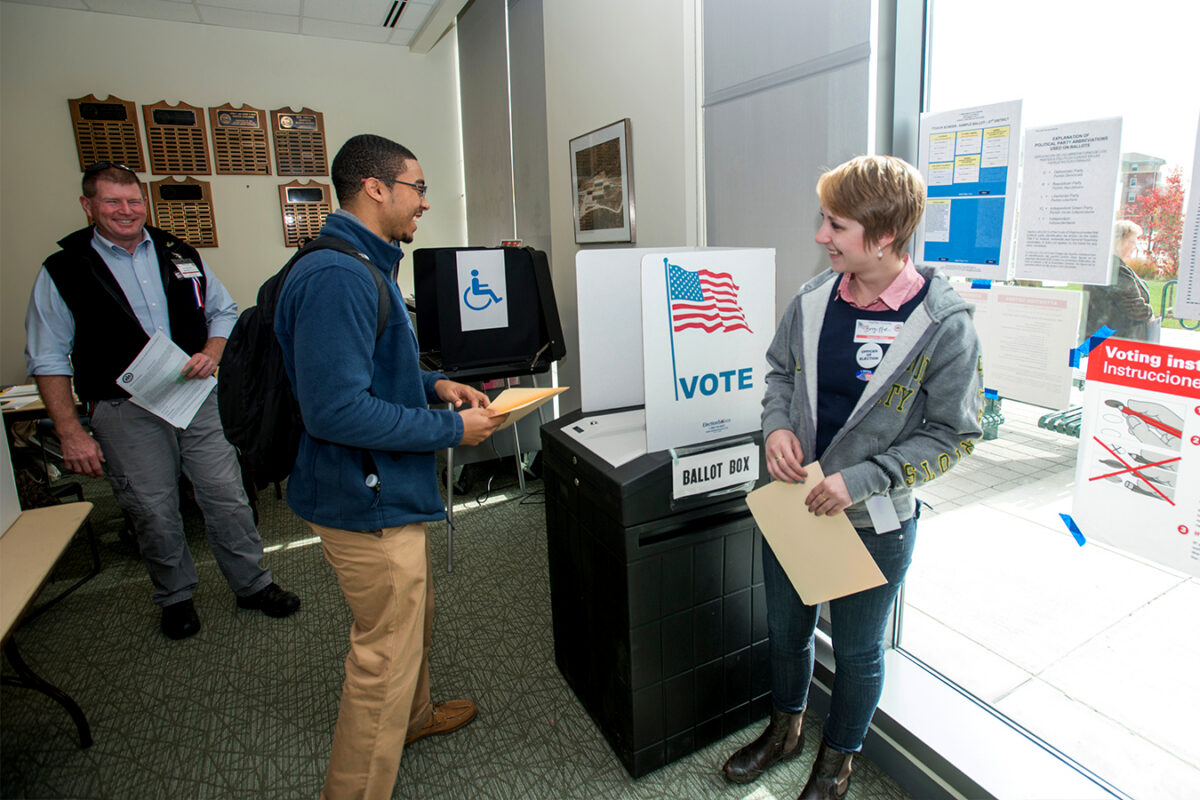
One way to do your part to make sure that the 2020 election goes as smoothly as possible is to become a poll worker.

A well-staffed polling place is less likely to experience long lines on Election Day, helping more people vote by reducing barriers to participation. Research from past elections indicates that long lines at the polls tend to impact lower-income and minority voters the most, as well those who live in areas with a high population density. One 2017 study found that “in predominantly minority communities, the lines are about twice as long as in predominantly white ones.”

With COVID-19 continuing to wreak havoc on communities across the country, local election officials are eager to recruit young poll workers after experiencing a drop-off in participation among older election volunteers during recent primaries. High school and college students who don’t fall into the high-risk categories for COVID-19 (elderly Americans and those with preexisting conditions) are being actively recruited by groups like Power to the Polls and the Poll Hero Project to “step up and serve their country” this November.

Volunteers are always welcome, but many poll workers are paid for their time (including in Fairfax County).

According to Fairfax County’s website: “Fairfax County is the largest jurisdiction in Virginia with 243 precincts countywide. It takes thousands of enthusiastic and trained election officers to help ensure that we have efficient and well-run elections. Election officers are paid $175 for working a full Election Day. Election officers must work at least one general election before being considered for an assistant chief election officer ($225) or chief election officer ($250).”

Learn how to become an election officer in Fairfax County: fairfaxcounty.gov/elections/officers/new-officers

Search by state to learn more about becoming a poll worker in your community: eac.gov/help-america-vote