Mason Votes

How Did Mason Vote in 2021?

381 Mason Students Voted at Merten Hall on Election Day
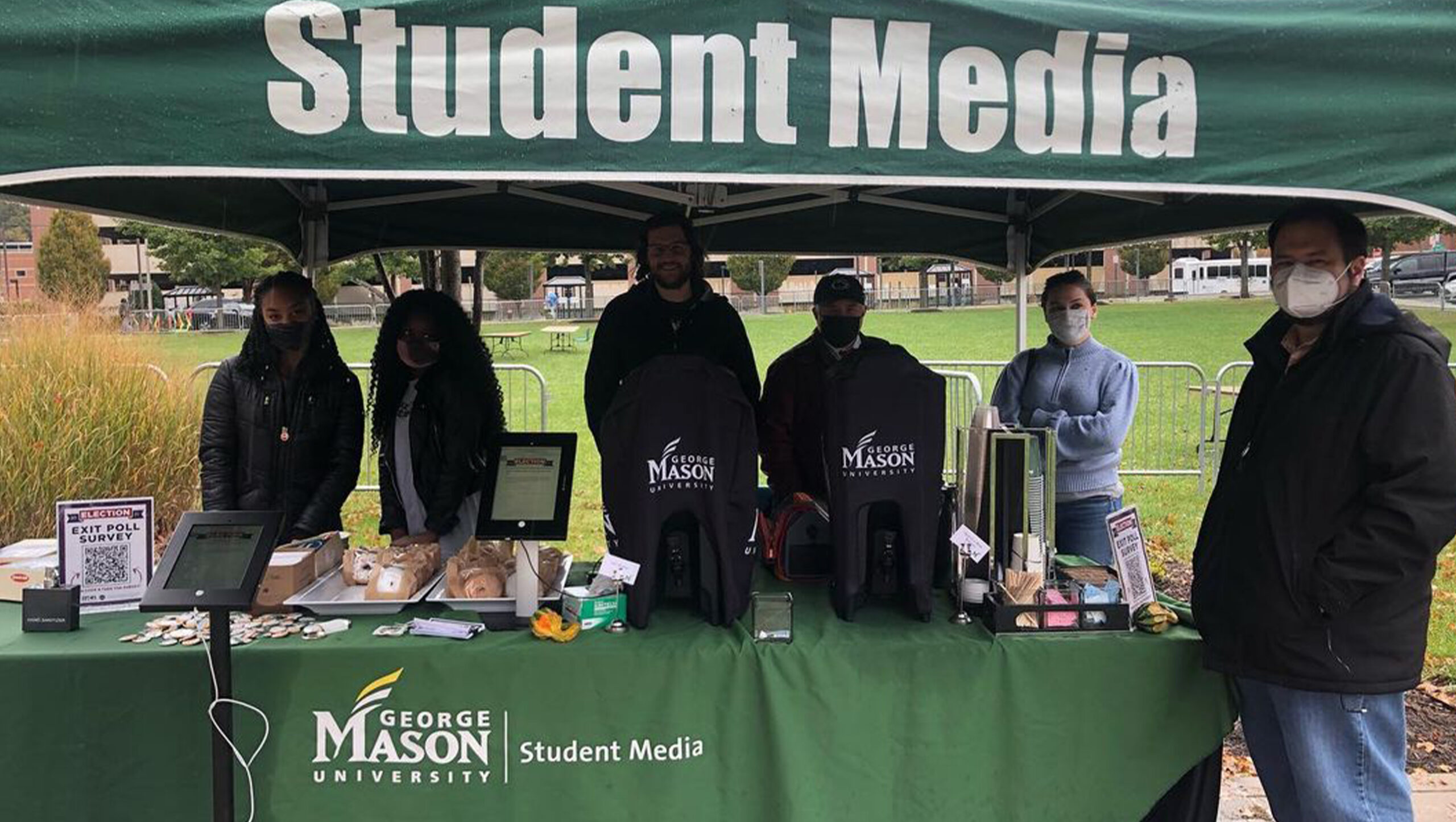
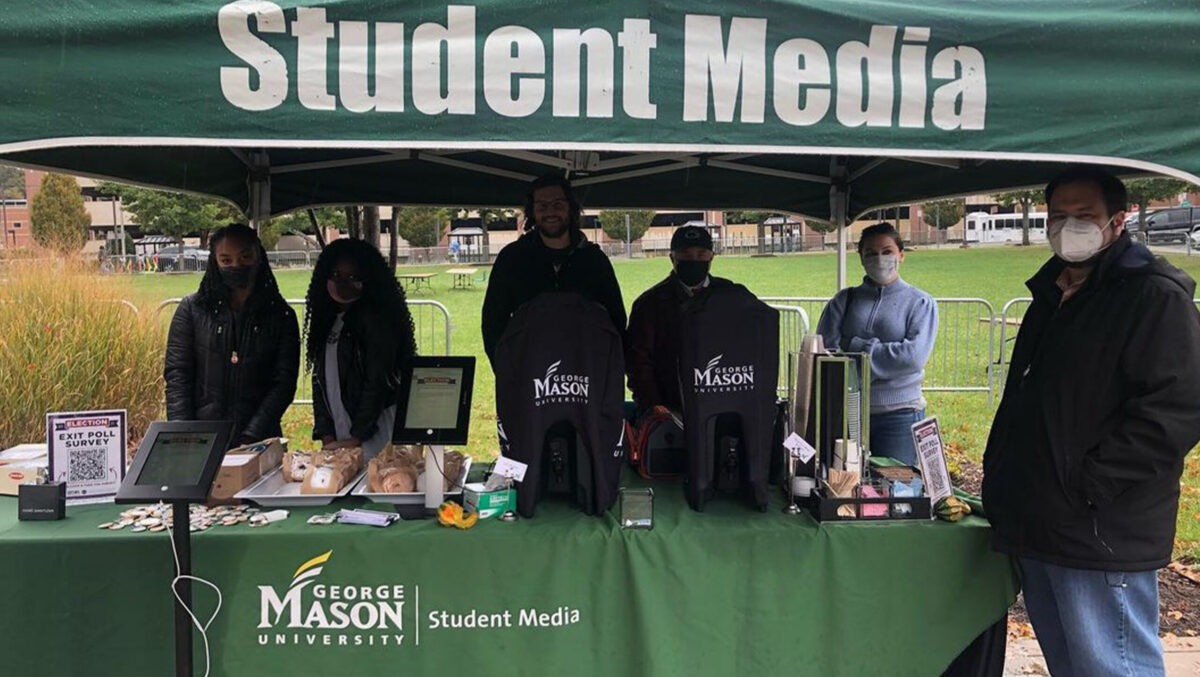
Students conduct voter exit surveys outside Merten Hall on Tuesday, November 2nd. Photo by: David Carroll/MCN

Student Media, Mason Cable Network, and Mason Votes conducted exit polling outside Merten Hall on November 2nd to learn more about what issues and candidates were motivating voters in 2021.

Students were asked to complete a short exit survey after voting at Mason’s on-campus polling place, and the results were analyzed during Mason Cable Network’s LIVE election night broadcast.

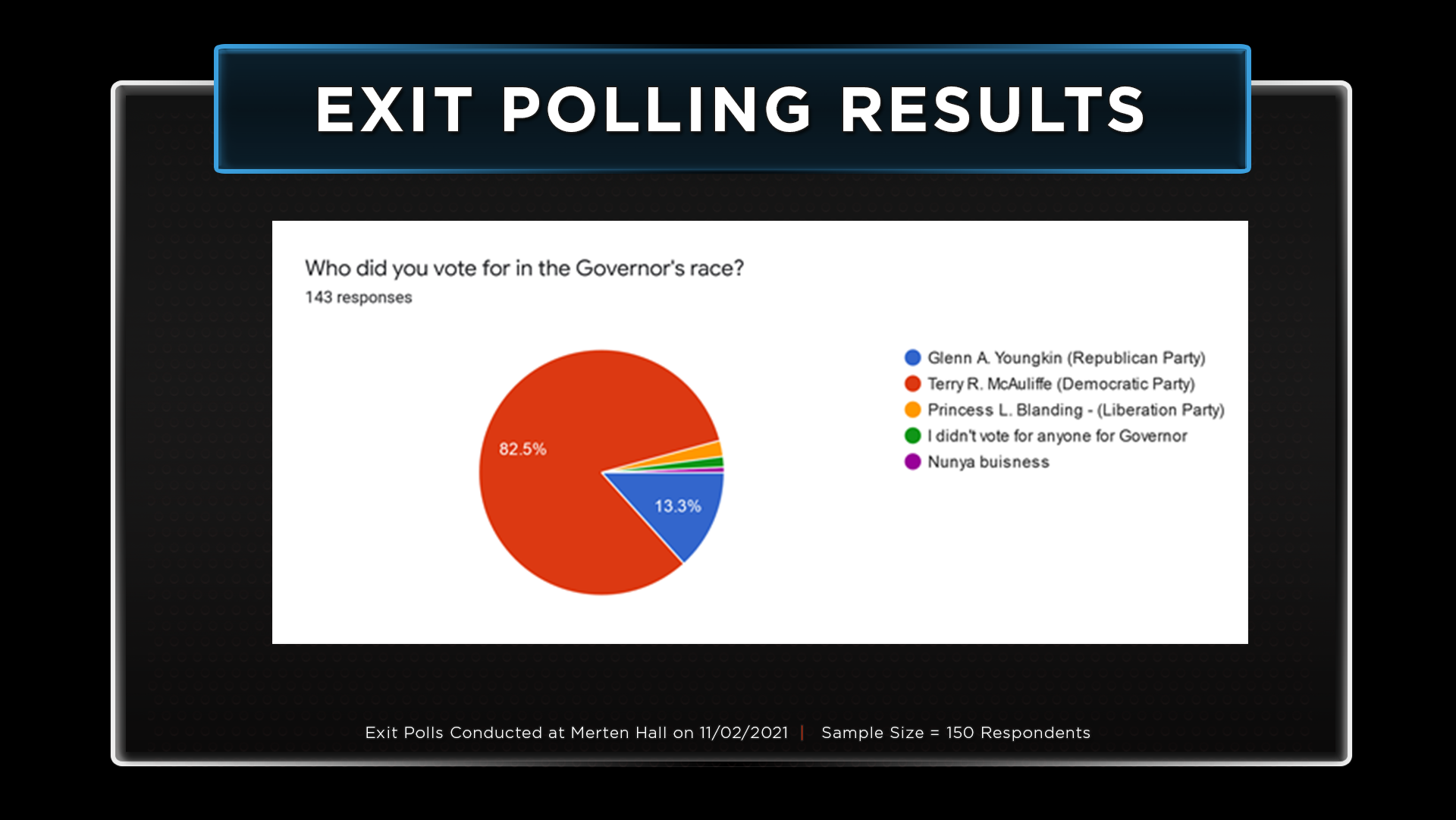
Mason voters overwhelmingly supported Democratic candidate Terry McAuliffe (82.5%-McAuliffe (D), 13.3%-Youngkin (R), 2.1%-Princess Blanding (L), 2.4%-Other/Didn’t Vote), but Republican Glenn Youngkin was elected to serve as the 74th governor of the Commonwealth of Virginia and will be sworn in on January 15, 2022.

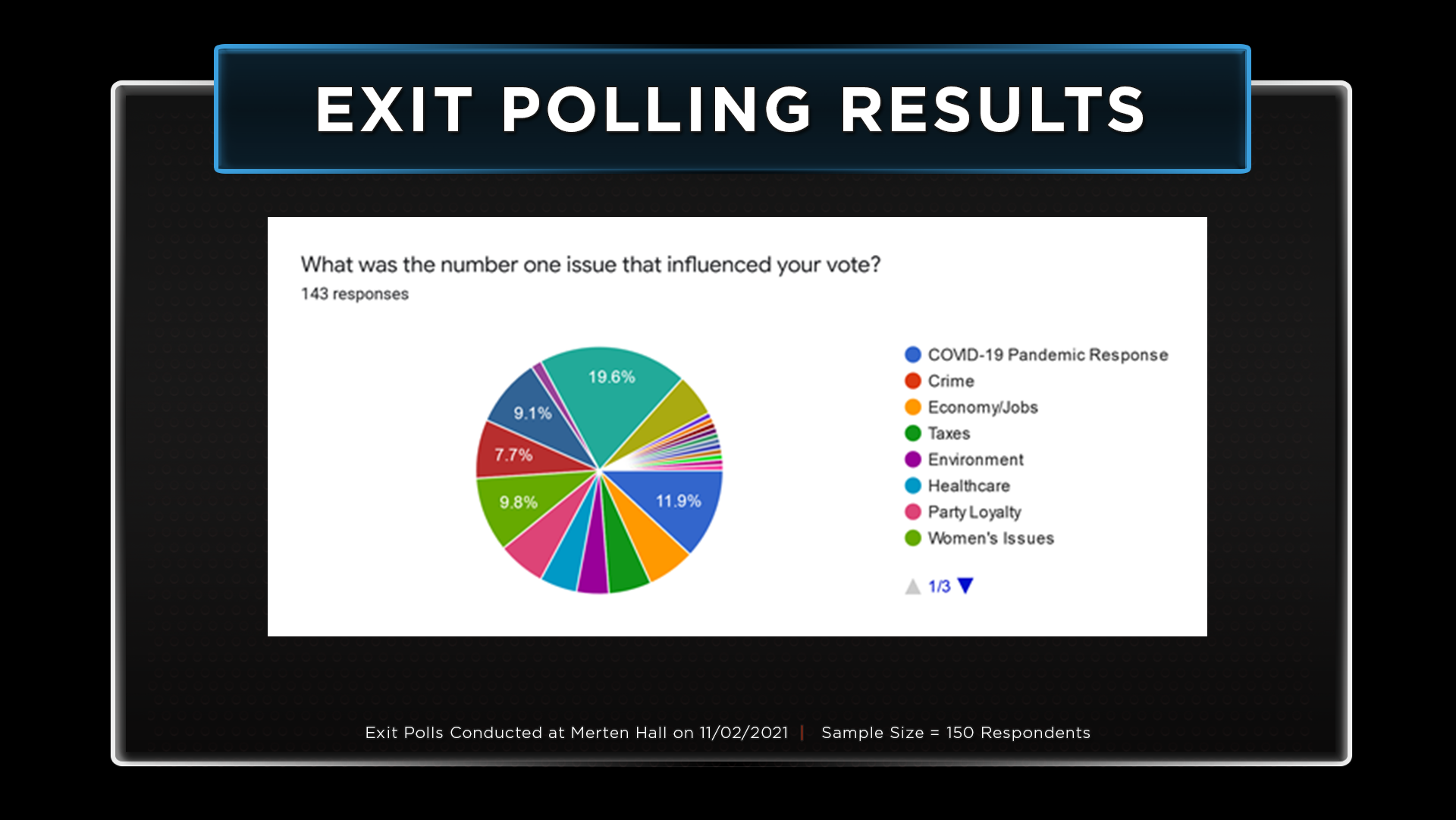
By far the most important issue to Mason students when casting their vote was Social Justice, with nearly 20% of respondents selecting that as their top concern: (19.6%-Social Justice, 11.9%-COVID-19, 9.8%-Women’s Issues, 9.1%-Abortion, 7.7%-LGBTQ+ Issues, 6.3%-Jobs/Economy, 6.3%-Party Loyalty, 5.6%-Taxes, 4.9%-Healthcare, 4.2%-Environment).

Enthusiasm was topic of concern for both parties during this off-year election cycle, but a majority of survey respondents at Mason reported being “very” or “somewhat” enthusiastic about voting in 2021: (42%-Very Enthusiastic, 32.7%-Somewhat Enthusiastic, 18%-Neutral, 6%-Not Very Enthusiastic, 1.3%-Not Enthusiastic At All).

_____________________________________________________________

Curious how Mason voted in 2021?

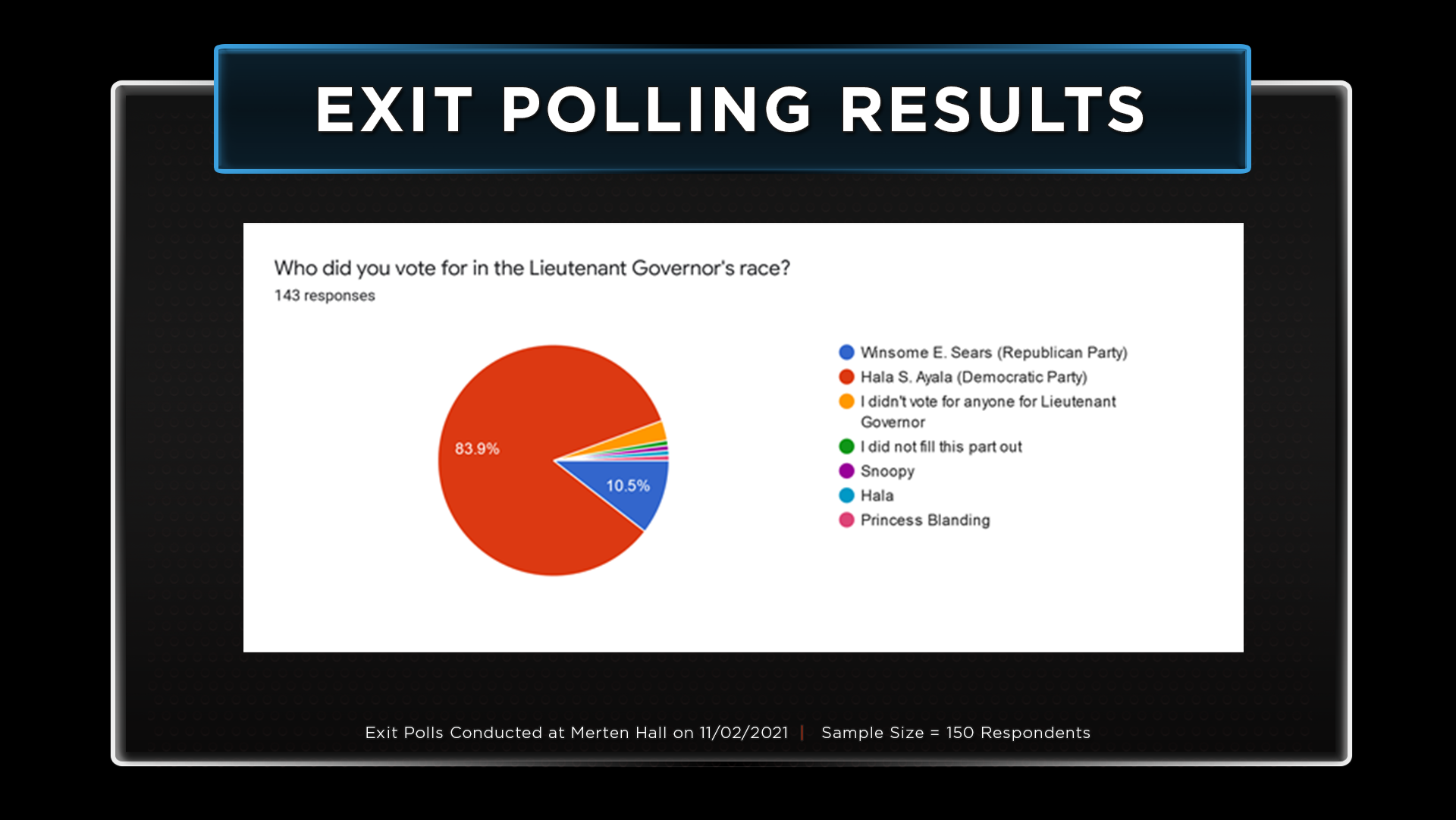
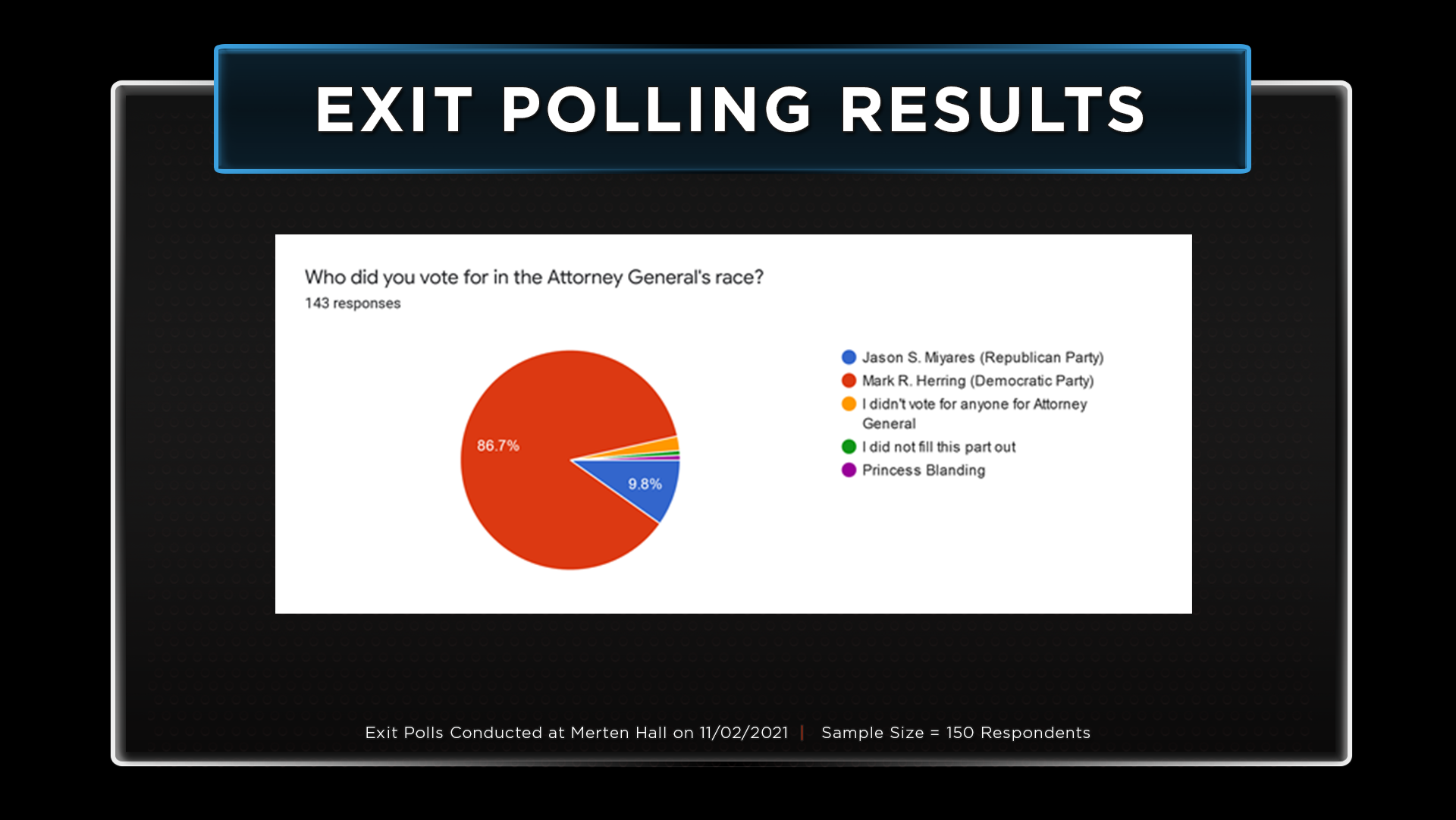
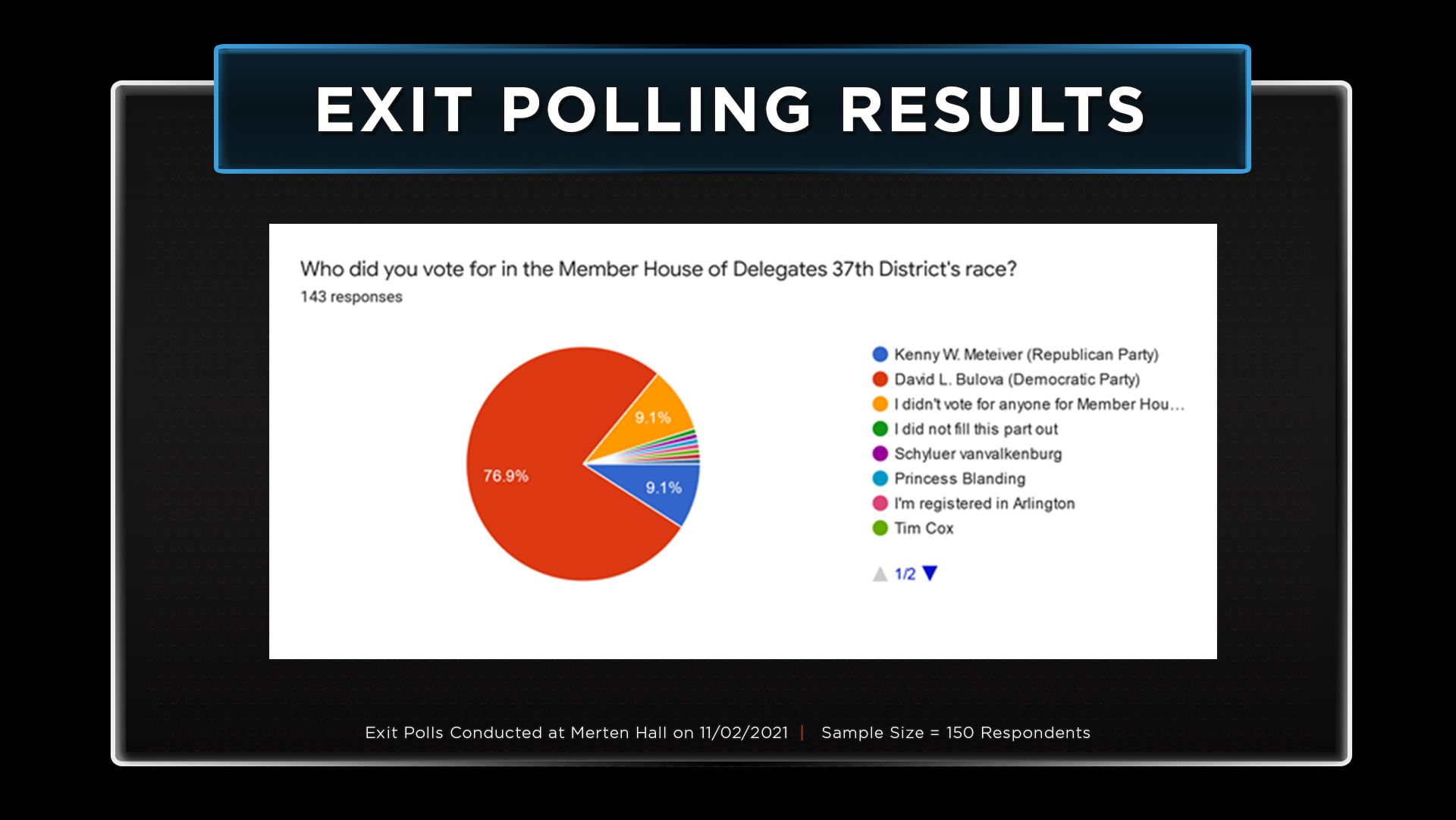
Check out the results of Mason Cable Network‘s 2021 exit polling below:

(Click on an image to enlarge the size)
_____________________________________________________________

Photo by: David Carroll/MCN
Post-Election Analysis: What Virginia Republicans Got Right

Youngkin Focused On Local Issues That Drove Enthusiasm

By: Jack Houston, Mason Votes 2021 Online Editorial Team

Republicans across the country are now celebrating what could be a sign of a “red wave” in 2022. While the results in Virginia could be a one-off, many are predicting a good election cycle for 2022 Republican candidates. However, this article won’t be focused on 2022. Rather, it will look at what Glenn Youngkin and the Virginia GOP got right this time around.

As I did in my analysis of the Democratic strategy, I’ll start with how the Virginia GOP selected its nominees. Unlike the Democrats, Republicans opted for a convention, instead of a Statewide Primary. This has negative aspects as well as benefits. On the negative side, a convention naturally limits the participants to registered Republicans who wanted to drive to the limited locations available. However, unlike the Democrats, the Virginia GOP chose to nominate its candidates via ranked choice voting (read more about ranked choice voting here). There were multiple reasons for this, one being the fact that ranked choice voting requires a broad base of support. This is opposed to plurality voting that determines winners based on who receives the largest share. As there were multiple candidates vying for the GOP nomination, there was a significant chance that the winner could have received a minority of the total vote. While not stated publicly, it’s likely that GOP Leadership feared that a candidate such as State Sen. Amanda Chase (who participated in the January 6th attack on the U.S. Capitol) could have won the nomination this way. By choosing to use ranked choice voting, they were able to nominate Glenn Youngkin, a political novice but savvy businessman with significant financial support and no negative history. Had a candidate such as Chase been nominated, McAuliffe’s strategy of tying the GOP candidate to Former President Trump would have been much more effective and likely would have won him the Governorship.

However, the GOP’s wins aren’t just a result of their convention. Glenn Youngkin proved to be extremely politically capable. While McAuliffe attempted to nationalize the campaign, Youngkin focused on local issues that were driving enthusiasm within his base as well as swing voters. In a year that favored the GOP to begin with, this was vital as he was able to mobilize these voters to support him. Additionally, unlike many other Republican candidates, Youngkin was able to thread the needle by keeping Trump at arms-length while not disavowing him. This meant that he didn’t offend Trump’s base while simultaneously giving moderates/swing voters “permission” to vote for a Republican.

To sum up, Youngkin was exactly the candidate that the GOP needed to win, especially in a state like Virginia that’s been trending blue. His focus on local, kitchen table issues made McAuliffe’s strategy of attempting to tie him to Trump fail. Had Youngkin fully endorsed the former president, it’s extremely likely that enthusiasm would have turned sharply against him, instead of McAuliffe. Additionally, the Virginia GOP’s decision to use ranked choice voting, instead of traditional plurality voting, helped them pick a candidate with broader support. Lastly, McAuliffe simply wasn’t the right candidate for the Commonwealth in 2021. While the dust is still settling, it’s becoming increasingly clear that voters want candidates with content, not just negative ads. Whether or not Democrats will heed this lesson in time for the 2022 Midterms is yet to be seen.

Click here to read my analysis of what Virginia Democrats got wrong in 2021 >


Post-Election Analysis: What Virginia Democrats Got Wrong

McAuliffe Ran a Lackluster Campaign

By: Jack Houston, Mason Votes 2021 Online Editorial Team

As the dust settles on the 2021 Virginia Election Cycle, Democrats across the country are wondering what went wrong. While the end result was a close race, in a state where President Biden won by over 10 points, this was a blowout for Republicans and might signal a larger trend nationwide. So, what happened?

To start, one of the mistakes was how the party selected its candidates and what they were looking for in one. Like most recent elections, electability appeared to be the first concern of primary voters. Terry McAuliffe had already been elected once during an election with the same trend as this year’s (that the president’s party loses the Virginia Governor’s Mansion). McAuliffe was also a well-known moderate from Northern Virginia, a Democratic stronghold, that could appeal to a broader group of voters. Additionally, he had a strong national backing and a significant amount of money and fundraising ability. While this looks good on paper, as the results show, it wasn’t enough to convince a majority of Virginians that he deserved a second term.

Here’s where his strategy begins to unravel. In an election with an unpopular incumbent, the “appeal-to-the-moderates” strategy is usually effective as most people want stability. This is shown in President Biden’s 2020 victory. However, 2021 was not 2020, and Biden’s own sagging approval ratings didn’t help McAuliffe. Virginians wanted more policy and energy from their candidate. However, in response to this, McAuliffe made the mistake of nationalizing the race and trying to tie Glenn Youngkin to former President Trump. This was done while Youngkin was focusing on local issues that many likely voters were concerned about. Emotion typically outplays policy in many elections, but in this case it didn’t. This, in addition to the education gaff that Youngkin was easily able to utilize, led to an electorate that rapidly turned on McAuliffe and the Democrats at large.

Now, was there any scenario in which the Democrats could have won statewide and retained their majority in the House of Delegates? Many are beginning to believe that there was. While McAuliffe handily won the Democratic Primary, there were other candidates up and down the ballot with fresh faces, new ideas, diverse backgrounds, and (as multiple pundits have pointed out) who were from regions other than Northern Virginia. While all of these details are important, the regional factor is one to be highlighted. Outside of Northern Virginia, there is a stereotype and often animosity to the “Establishment Northern Virginia Democrats,” who are often seen as just an extension of Washington, D.C. (even among other Democrats). Given McAuliffe’s national connections, this likely had an even greater impact and should be considered in future races. Had one of the other candidates been nominated, instead of McAuliffe, they might have been able to generate more enthusiasm.

To sum up, there’s no one reason that Democrats failed on Tuesday, but a majority of the responsibility falls on McAuliffe for running a lackluster campaign that many saw as aimed towards former President Trump, not Glenn Youngkin. This, along with trends that disfavored the Democrats, an unusually politically savvy Republican opponent (for Virginia), a failure to generate enthusiasm, and a lack of fresh ideas are likely what doomed the 2021 Democratic Ticket.

Click here to read my analysis of what Virginia Republicans got right in 2021 >

Mason Students Vote On Campus In Virginia Gubernatorial Election

381 Mason Students Voted at Merten Hall Last Tuesday

By: Sydney Johnson & Brad Byrne, Fourth Estate Staff Writers

This story was originally published on gmufourthestate.com. Fourth Estate is Mason’s official student-run newspaper.

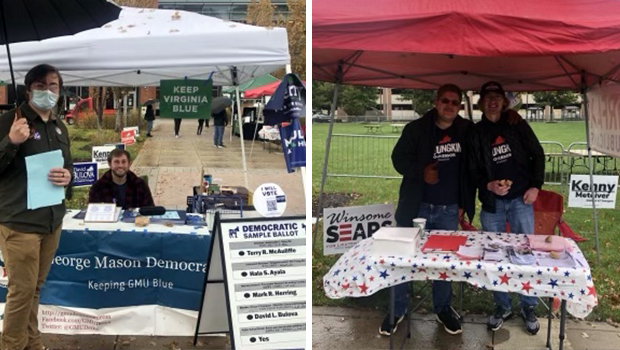
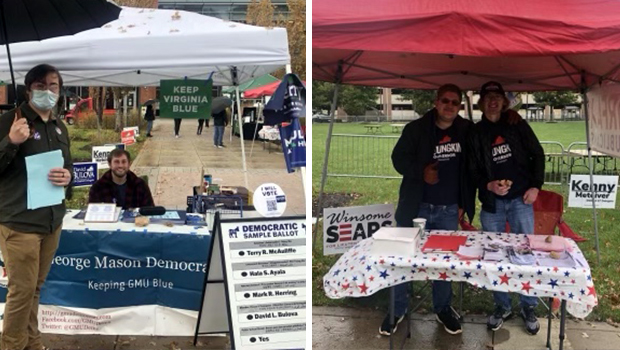
Student organizations including Democrats at Mason and College Republicans at GMU started canvassing outside of polling locations in the morning in order to encourage people to vote. Photos by: Sydney Johnson/Fourth Estate

The Virginia governor’s election took place on Nov. 2 as students, faculty and other members of the Mason community watched former Virginia governor and Democratic candidate Terry McAuliffe and Republican candidate Glenn Youngkin race against each other in the polls.

381 Mason students voted Tuesday at Merten Hall. The official results will be certified on Nov. 15, according to the Virginia Department of Elections.

Mason Votes, Student Media’s official election-coverage site, provided many student resources for in-person voting and online voting prior to Election Day. Students registered at their current campus address were encouraged to vote on Mason’s Fairfax campus, and were also encouraged to look up their voter registration on the Virginia State Board of Elections website.

McAuliffe started his career in politics working on the campaign of President Jimmy Carter, according to Mason Votes. McAuliffe’s efforts for his campaign include building a clean energy economy to address climate change and addressing the affordable housing crisis Virginian communities are facing.

Youngkin has participated with several non-profits during his career, including the Virginia Ready Initiative and Virginia Tech’s Innovation Campus Advisory Board, according to Mason Votes. Youngkin’s efforts for his campaign include creating 400,000 jobs and making sure every Virginian student graduates career or college ready.

Student organizations including Democrats at Mason and College Republicans at GMU started canvassing outside of polling locations in the morning in order to encourage people to vote. Both organizations have tied their campaign efforts with the candidates who are running in this year’s election.

“This election is very close. We believe the Democratic ticket has the best vision for Virgina,” said junior Liam Fischer, member of Democrats at Mason.

Junior Joe Szymanski, assistant vice chair of the GMU Republicans, said he is really hoping it was a successful night as the team had given it their best shot.

“I think he [Youngkin] had over 3-4,000 people at his rally last night. We, as Virgina Republicans, have given it our best in the past 12 years” said Szymanski.

_____________________________________________________________

Click here to read more Fourth Estate coverage of Mason news and events >

gmufourthestate.com

_____________________________________________________________

Photos by: Sydney Johnson/Fourth Estate

Election Stress and What to Do About It

Resources Are Available to Mason Students Who Need Support

By: Meg Thornberry, Mason Votes 2021 Online Editorial Team

Elections cause stress. Stress can take many forms. Some people may experience anxiety, a series of heightened fears and emotions. Others may experience fatigue, or burnout, a lack of enthusiasm, even for things they used to care about, an inability to engage with issues or events or feel strongly about them.

“The unknown outcome of elections may cause fear and uncertainty about the future; this is especially true for those who check the news very frequently. For some people, they fear that catastrophic things may happen to them if a certain candidate wins or loses. Mostly, election cycles cause stress because we are limited in how much we can control the outcome,” Mason’s Counseling and Psychological Services (CAPS) Director Dr. Jennifer Kahler said in an email.

Kahler noted that elections can be particularly stressful for marginalized students, both because of policies being discussed, and because of the bigoted rhetoric that can pop up around elections, especially on social media.

Pastor Drew Entz works with ARISE Campus Ministry, an LGBTQ+ affirming Christian campus ministry. He says that election time can be particularly stressful for the students he serves, because they tend to call attention to what makes people different from each other.

“[I] definitely have seen that, have sat with students, have talked to them, chatted with them about stress, because for many of them it’s not just an exercise on who you like more. That there are policies and politicians who often times speak out against students’ identities and who student students feel like they are. And so, there’s always a lot of stress,” Entz said.

Entz also says that some of the events of the last couple of years left people feeling like they had to deal with multiple emergencies at once, and that many, especially in progressive or pro-LGBTQ+ circles feeling like they have to take a break and step back for a while.

Professor Jack Curry worked for several newspapers and publications and now teaches journalism at Mason’s Department of Communication. He says that students are likely to feel stress due to the speed of the current news cycle and the speed at which they feel pressured to respond.

“It’s not only the event, but then the ripple effects that event creates. There’s so much, not only information, but static, that creates constant bombardment,” Curry said.

Curry also pointed out that there are not actually more current events going on than in the past, but that there are so many more opportunities for people inside and outside of traditional news media to get eyes on events as they happen that it can be both a blessing and a curse.

“You’re only burnt out if you’re tuned in,” Curry said.

Kahler said that people should seek counseling if stress starts to interfere with their ability to perform everyday tasks, like sleeping or doing school work. She also says that students can take steps on their own, like limiting media consumption, getting involved with the issues that really matter to them, and checking in with friends and classmates.

Resources for dealing with election stress, including links to two post-election “Relax and Unwind” sessions, can be found on the CAPS website.

Election Stress Resources: caps.gmu.edu/resources-and-self-help/election-stress-resources

_____________________________________________________________

CAPS 2021 Election Stress Drop-In Spaces

Join us for two “Relax and Unwind” drop-in virtual spaces to de-stress after the election:

Wednesday, November 3, 2021, from 1-1:30pm
Thursday, November 4, 2021, from 1-1:30pm

Click here to join the workshop >

_____________________________________________________________

Election Stress Coping Resources 

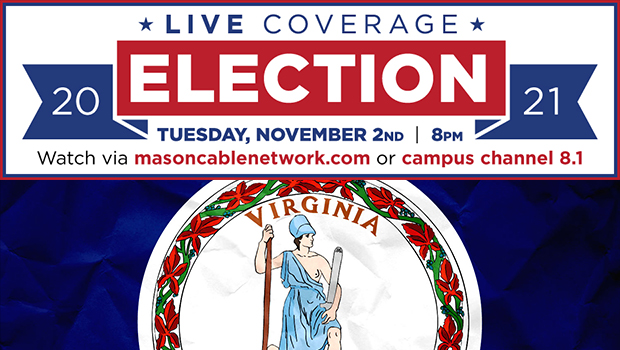
WATCH: LIVE 2021 Election Night Coverage!

Students from Mason Cable Network and Mason Votes Collaborated to Create a LIVE 2021 Election Night Broadcast

WATCH NOW:

_______________________________________________

Watch MCN’s 2020 election night broadcast below:


VIDEO: COMM 145 Election Interviews

Mason Students Share What’s Motivating Them in 2021

The students of COMM 145 (Newspaper Workshop I) were assigned to interview their peers on why voting is important and which issues were influencing their vote in 2021.
Here is what they found…

Special thanks the students of COMM 145: Luke Black, Reem Jamil, Matthew Link, Tristen Shaefer, Garrett Glatz, and Haseed Chowdhury.

Video edited by: Garrett Glatz

Virginia Reports Dramatic Surge in Early Voting

Democrats Have an Apparent Lead, but Nothing Is Set in Stone

By: Jack Houston, Mason Votes 2021 Online Editorial Team

Early voting in Virginia’s 2021 election is now over and we have the results…kind of.

To stress why early voting is so important this year, let’s look at the numbers from previous years. In 2017, Virginia’s total early votes amounted to 195,643. This year, according to the Virginia Public Access Project, over 1,142,155 voters have voted early (as of 10/30/2021).

This is a dramatic increase and may indicate an increase in overall voter participation in 2021. We won’t know what the total turnout rate will be until polls close on Election Day (you can vote from 6am-7pm on Tuesday, November 2nd) but this is leading to an abnormally high turnout, which is unusual for off-year elections.

For context, over two million Virginians cast early ballots in 2020, but turnout is expected to be much higher in presidential elections vs. off-year cycles, and the global COVID-19 pandemic had an anomalous impact on voting habits across the board.

While we have detailed numbers about how many voters have chosen to vote early, predicting who they’re voting for is more difficult because Virginia doesn’t require voters to register with a political party. This makes it somewhat difficult to use early votes as a metric for measuring enthusiasm or total turnout. Knowing this, there are methods for predicting which candidate is benefiting the most from early voting.

According to a recent Washington Post article, “About a third of the early ballots cast have been in heavily Democratic and voter-rich Northern Virginia.” However, there are two important things to note when processing this statement. The first is that these are simply votes from a traditionally Democratic region of the state (we don’t know for sure who these voters are voting for). Additionally, much of the electorate that votes early is also more enthusiastic and involved in elections in the first place (they were going to vote for their party no matter what). This doesn’t tell us much in an election likely to be decided by independents and swing voters. We won’t know for sure whether or not this enthusiasm translates to the general electorate until the votes are counted on Election Day.

While Democrats are likely happy with the large number of early votes in parts of the state that are friendly to them, it’s also important to note that this increase has extended to GOP-friendly territory as well. Republican candidate Glenn Youngkin has been traveling to all parts of the state (including Northern Virginia) and has seen large crowds everywhere he goes. Large crowds don’t directly translate to votes though, and this could again be made up primarily of voters who are extremely loyal to the GOP and would vote for him anyway.

The only thing we know for sure is that the number of early votes has risen sharply when compared to previous state elections. Democrats appear to have the edge, but that lead could disappear rapidly if this turns out to be a Republican wave election that the polls haven’t picked up on. Even though early voting is high, its total will still be significantly less than the total of votes made on Election Day.

If you haven’t voted already, you’re encouraged to do so on Tuesday, November 2nd, as nothing in this race is set in stone. Some are even predicting that it could come down to a significantly small number of votes, which means that EVERY vote matters!

_____________________________________________________________

Election Day is Tuesday, November 2nd!

If you haven’t already done so, make a plan to VOTE!

Click here to learn more about voting in 2021 >

Faculty Q&A with Char Miller

“The voters did their job last time, they got people elected.

By: Jacob Pritchard, Mason Votes 2021 Online Editorial Team
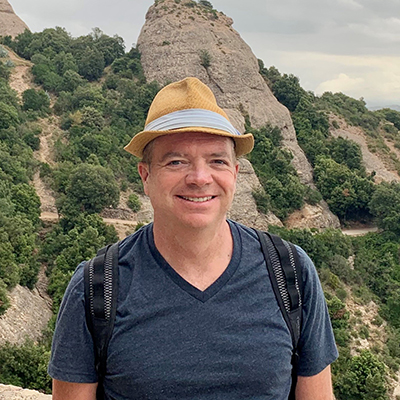
Char Miller’s work focuses on political aesthetics, sovereignty, and disciplinary technologies. Photo: schar.gmu.edu

Mason Votes sat down with Char Miller, an associate professor at Mason’s Schar School of Policy and Government, to get his views on the state of democracy, the 2021 election, and more:

Q: In what ways do you think Democracy has changed in the United States and Virginia in recent years?

A: I think one thing that I should note here is that I live in D.C., so it’s hard to say what’s changing, to me, in the state moment by moment. One thing that was on my mind this morning in watching the election play out in Virginia was the attention to Toni Morrison, and that a candidate would make banning Toni Morrison a central component of their program was kind of alienating. It’s very disconcerting because, if I had to name the most important American novelist, Toni Morrison would be an easy pick. Its about race and questions about race in America. Toni Morrison has an ability to portray race in a very stark and terrifying way, and the slavery and post-slavery experiences of African Americans. In that way it seems like a recent development, but also a traditionally American hesitancy to confront the crime of slavery. The more it’s changed, the less its changed.

Q: How do you believe people’s personal perceptions about Democracy have changed?

A: The things that have been on people’s front-burner may in fact be traditional. The thrust to change voting, and the rules governing voting, is surprisingly tolerated in our sense that democracy should be expanded and not contracted. It is also a very familiar response to voting. People have become more democratic in a lot of ways. If you pick the right place to look, there’s a lot of democratic moments happening. Black Lives Matter, for me, is a very important moment in demanding democracy, not in terms of voting, but in terms of equal representation in front of the law, in that everyone should be treated the same. That’s certainly an important aspect of democracy that I would want to apply and say here are public pronouncements of valuing democracy to be hitting the streets. Things like constraints in voting rights is a less optimistic story, it seems like there are forces mobilizing to limit democracy deliberately. There’s very valuable moments of demand and articulation for greater democracy that produces, or is a response to, very powerful attempts to reduce it.

Q: How do you think that politicians and parties running for office are reflecting on these changes?

A: As not a Virginia resident, I can’t vote, and maybe that’s a point to underscore in an article about Democracy. The people who live in the District of Columbia, the nation’s Capital, don’t get the right to vote in Congress. Given the stalling of Biden’s program in Congress, if maybe D.C. had the vote, that would be very different. You see a place here where anti-democratic exclusion of a portion of the population from voting has real consequences for the majority of Americans who voted for something, such as Biden’s agenda. I saw Obama’s speech for Terry McAuliffe. On one level, it seemed perfectly fine. If you want the things that the left leaning part of the Democratic Party want, then you got to be voting. I’m troubled by the speech, as it came out in a kind of shaming way of “this is why you have to get out to vote.” My response was that this failure is within the Democratic Party, they’re in charge of Congress and the Executive right now, they can’t deliver this. The voters did their job last time, they got people elected. I’m not sure that continuing to blame the part for being tired and not getting out to vote for their candidates is accurate. I think this rhetoric distracts from the failure of leadership within the Democratic party. There’s a comfort in the failure if it sounds good here, without being held accountable for said failures. Its not the voters that have failed here.

Q: What are some ways you think citizens or lawmakers can mobilize themselves to ensure that democracy stays strong?

A: Get the vote for D.C. In this moment, that would really matter with the stalling of Congress. Giving D.C. state-like representation in Congress would cause a very different dynamic. That would be a place to talk to politicians. Speaking specifically to the Democratic party, why wouldn’t you be working hard for that? That’s a real win. They already work hard to get out the vote, why not work equally hard to get the right to vote for people who are explicitly denied the right? There’s a lot of arguments you could make here, and I don’t see them working hard enough to do that. In doing this, you would have to be making democratic arguments. What we want from the government is not a representation of the land that makes up a state, but of the people that make up that state. D.C. is a city, but in terms of population, that’s the important thing. In terms of democracy, that’s the important thing. It’s an easy answer for “How do you make the nation more democratic?” You can give the “colonies” representation, like D.C. and Puerto Rico. That goes in that direction.

Q: Are there any resources you would like to share?

A: There’s a lot of resources, and groups to join. Shutdown D.C. is one of them, and so is Black Lives Matter. These tend to be people who know how protests are going to be organized, and where they’re going to show up. If students at Mason want to be active in that form of democratic politics, those are good resources.

_____________________________________________________________

Photo: schar.gmu.edu

Where Can Mason Students Vote on Election Day?

Only Students Registered at Their Current Campus Address Can Vote at the University Precinct in Merten Hall

By: Meg Thornberry, Mason Votes 2021 Online Editorial Team
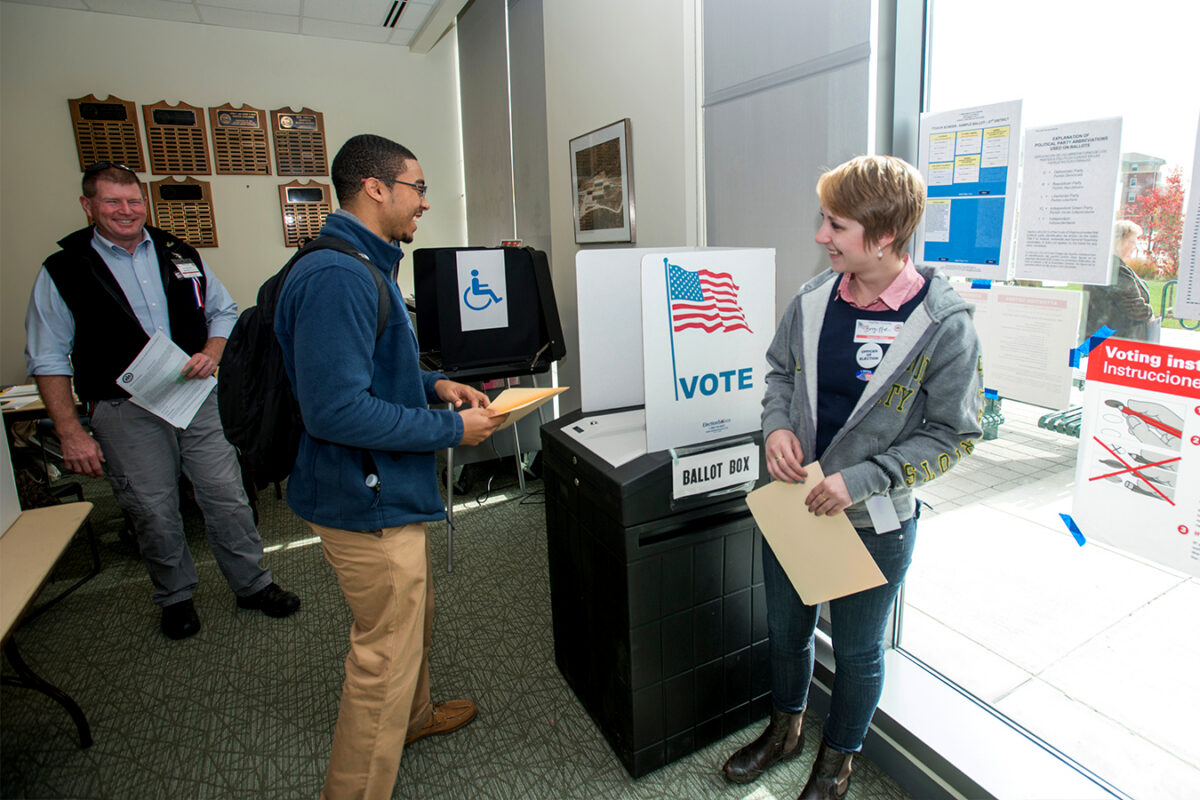
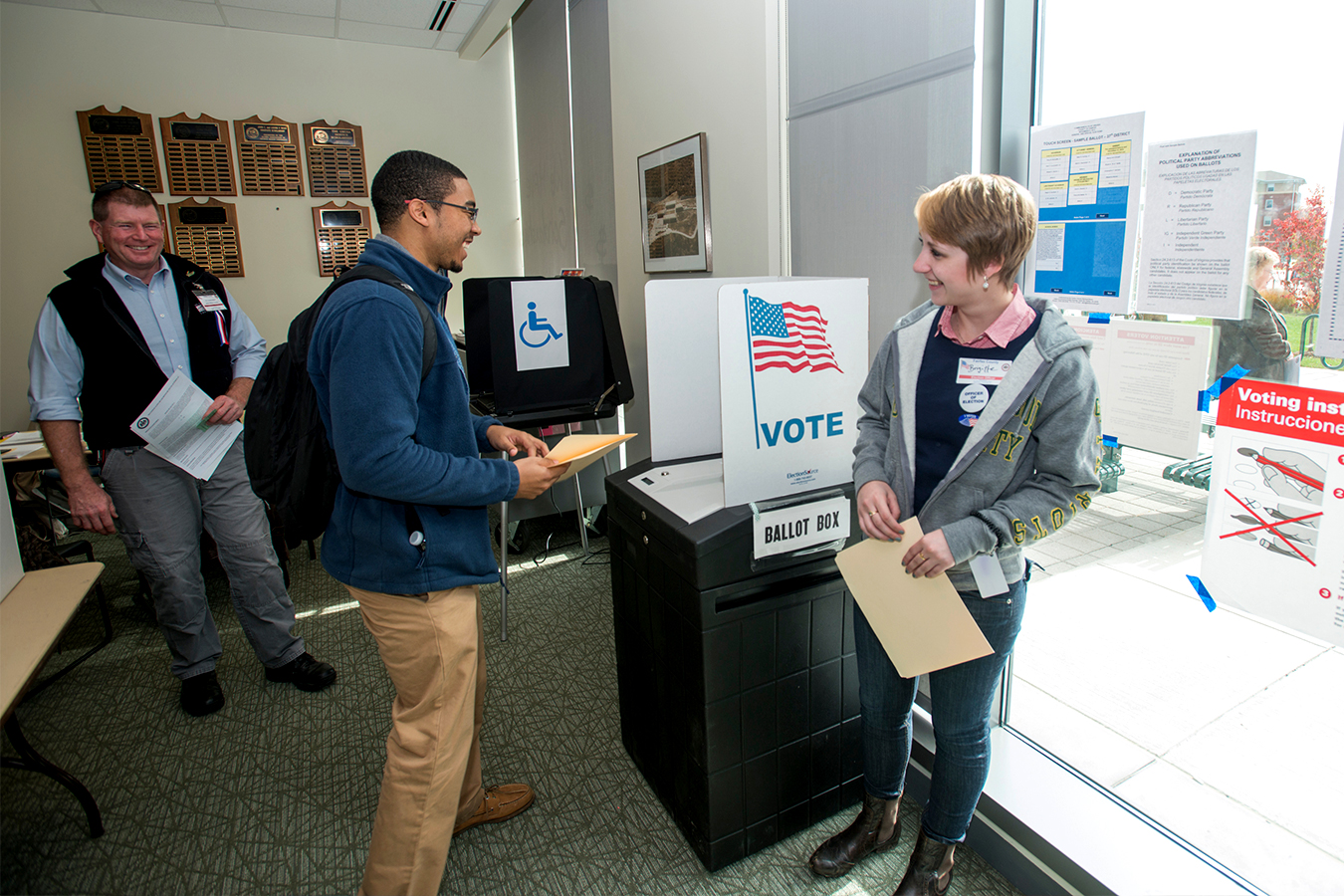
Mason students who are registered at their current campus address may vote on-campus at Merten Hall in Fairfax. Photo by: Alexis Glenn/Creative Services

In 2020, 71.8 percent of Mason students voted, significantly more than the 66 percent national average, according to a recent study conducted by the National Study of Learning, Voting and Engagement (NSLVE).

However, 35 of those students found themselves casting provisional ballots, used to record a vote whose eligibility is in question, because they tried to vote at Merten Hall despite not being registered to vote there.

Provisional ballots are provided to voters whose name doesn’t appear on the rolls when they show up to vote or are unable to provide identification. All provisional ballots are counted in Virginia, but take longer to be processed because they are reviewed by local election boards to confirm eligibility.

“It’s always been an issue for students, because they often forget where they are registered to vote. And the only place that they can vote is where they’re registered,” said Scott Konopasek, Fairfax County’s general registrar. “Students are often still registered at their parents’ address, even if they may not be there, or they may be registered on campus.”

Verify Your Assigned Polling Location Before Election Day

Only students registered at their current campus address may vote at the University Precinct located in Merten Hall on Mason’s Fairfax campus. All other Mason students and faculty must vote at their registered home precincts, either inside the county, within the Commonwealth, or in their home state.

Konopasek stressed that students should look up their voter registration on the Virginia State Board of Elections website to be absolutely certain they are voting somewhere they know their ballot will be counted.

Students who are registered to vote in another state can still drop off their absentee ballot on Election Day, but it is too late to apply for one. Mail-in ballots can also be dropped off at any polling place.

Click here to verify your assigned polling location in Virginia >

What to Expect on Election Day

After in-person voters confirm they are at the right place, they are checked in by a poll worker and given a ballot permit, which they take to another table to get the ballot itself.

“Marking a ballot is just like a Scantron—bubbling in the ovals for your choices. After marking their ballot, the voter takes it to the DS200 ballot scanner, where another poll worker is available to help them,” Fairfax County election official and Mason public administration student Jean Thoensen said in an email.

“The ‘I Voted’ stickers are back, much to the voters’ delight!” Thoensen said in an email.

Who Are All Those People Outside My Polling Place?

Political campaigns often hand out sample ballots showing voters what they would like them to check on their ballots. Virginia law requires that anyone trying to convince people to vote for a specific candidate, or electioneering, must stay at least 40 feet away from the entrance to any polling place, so voters may bring these sample ballots inside with them, but no other campaign or promotional materials.

“Nobody outside is part of my office. They’re political parties, so I have no control over what they tell you, or what they ask you, or how they use any information that they’re given. Or the accuracy or dependability of any information they provide you,” Konopasek said.

Voters are allowed to bring cell phones into polling places, and they can take photos of their own ballots, but of nothing else inside of the polling location. Still, it might be better to wait until after voting to snap a selfie.

_____________________________________________________________

Election Day is Tuesday, November 2nd!

If you haven’t already done so, make a plan to VOTE!

Click here to learn more about voting in 2021 >

_____________________________________________________________

Photo by: Alexis Glenn/Creative Services