
Mason Votes

Meet the Candidate: Glenn Youngkin (R)

Glenn Youngkin, Republican Candidate for Virginia Governor

Learn more about the candidate by visiting Youngkin’s campaign website: youngkinforgovernor.com
Meet Glenn:

Born: December 9, 1966 in Richmond, VA

First job: “washing dishes and frying eggs at a diner in Virginia Beach”

Education: Earned a bachelor’s degree in engineering from Rice University and an MBA at Harvard Business School

Family: “married for 26 years to his amazing wife Suzanne, Glenn is a dedicated father of four wonderful children”

Career Highlights: Spent 25 years working at private-equity firm The Carlyle Group and has served on the boards of several non-profits including the Virginia Ready Initiative, Virginia Tech’s Innovation Campus Advisory Board, the Museum of the Bible, and the Meadowkirk Retreat Center. Later served as Church Warden at Holy Trinity Church in Northern Virginia and is a member of the Business Council and the American Enterprise Institute’s National Council.

Full campaign website bio: youngkinforgovernor.com/meet-glenn

Campaign Statement:

“Glenn will make sure Virginia has better-paying jobs, the best schools, the safest communities, and a government that works for you. His game plan will create 400,000 jobs and make sure every student graduates career or college ready. Glenn will cut exploding costs for families and relieve the burdens of inflation and taxes. He will cut regulations to create jobs and make it easier for innovators and entrepreneurs to get small businesses moving again. He will restore our high standards for schools and our students, ban critical race theory, invest in our teachers and schools, and empower parents with real choices.”

Read more about “Day One Game Plan” on his campaign website: youngkinforgovernor.com/game-plan

_____________________________________________________________

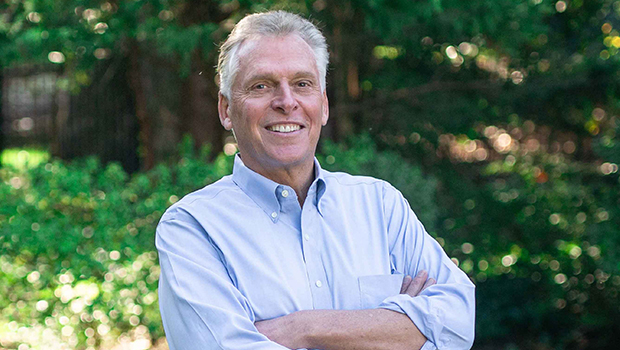
Photo and campaign logo: https://www.youngkinforgovernor.com/

Meet the Candidate: Terry McAuliffe (D)

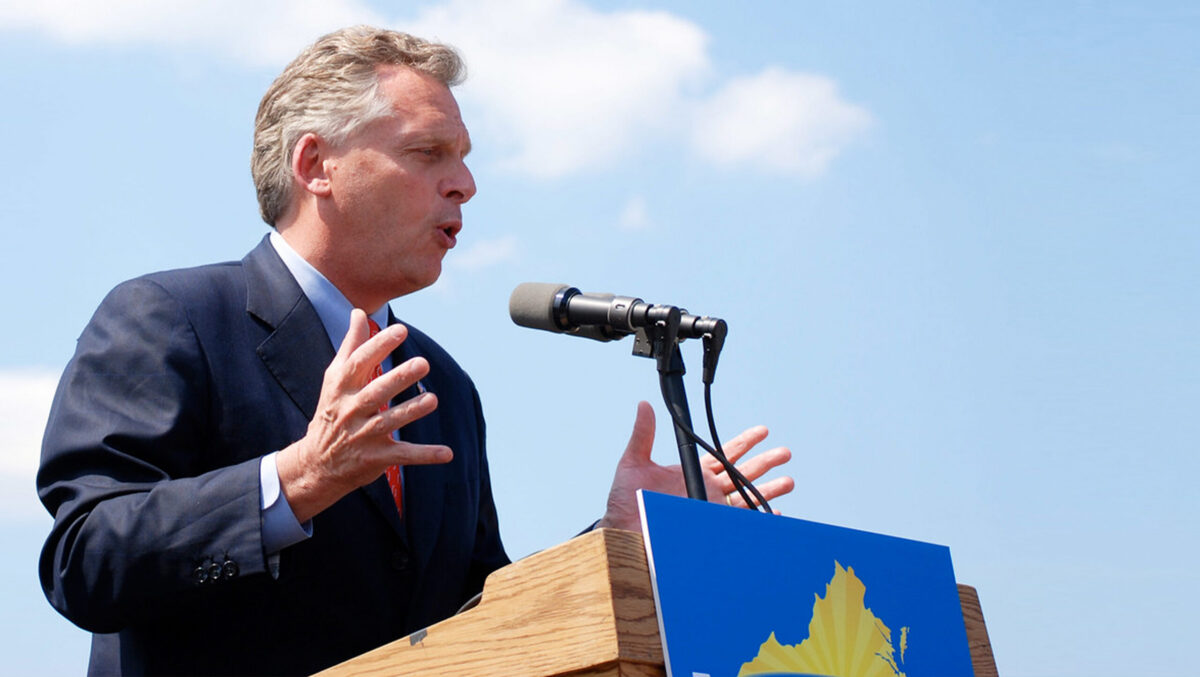
Terry McAuliffe, Democratic Candidate for Virginia Governor

Learn more about the candidate by visiting McAuliffe’s campaign website: terrymcauliffe.com

Meet Terry:

Born: February 9, 1957 in Syracuse, NY

First job: “started a business paving driveways for neighbors and local businesses at age 14”

Education: Earned a bachelor’s degree from Catholic University and a JD from Georgetown University Law Center

Family: “Terry and Dorothy have been married for over 30 years and have five children”

Career Highlights: Served as the 72nd Governor of Virginia from 2014-2018 and got his start in politics working on the campaign of President Jimmy Carter. Later served as chairman of the Democratic National Committee and ran presidential campaigns for both Bill and Hillary Clinton. Since leaving office, McAuliffe has campaigned for Democratic candidates across Virginia and helped “build the party infrastructure that led to flipping and keeping the Commonwealth blue.”

Full campaign website bio: terrymcauliffe.com/about

Campaign Statement:

“Terry believes that now is the time to push Virginia forward to build a stronger and fairer post-COVID economy. As Virginia’s next Governor, Terry will continue the fight for civil rights and voting rights, attract businesses to create the best jobs and raise wages, ensure all Virginians have access to quality affordable healthcare, build a clean energy economy to address climate change, and address the affordable housing crisis our communities are facing. Most importantly, Terry will make an unprecedented investment in education.”

Read more about “Terry’s Vision” on his campaign website: terrymcauliffe.com/issues

_____________________________________________________________

Photo and campaign logo: https://terrymcauliffe.com/

Kamala Harris Campaigns for Terry McAuliffe in Dumfries, VA

Top Democrats Join Virginia’s 2021 Gubernatorial Race

By: Alex Russell, Mason Votes Alumni Contributor
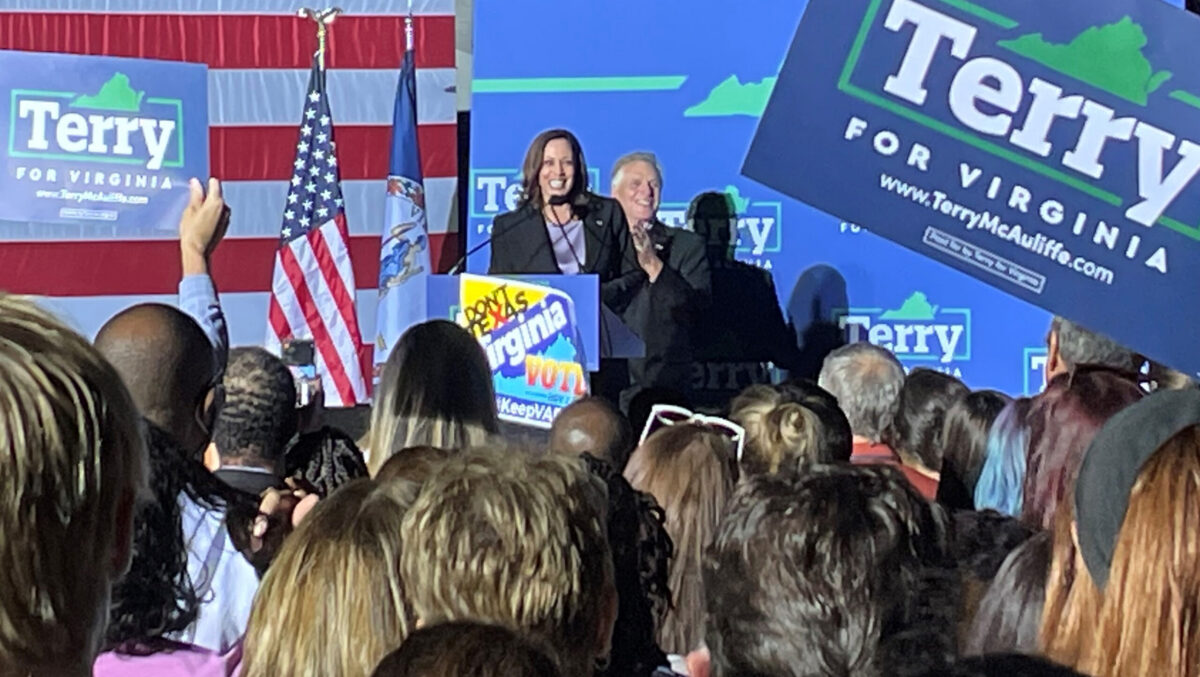
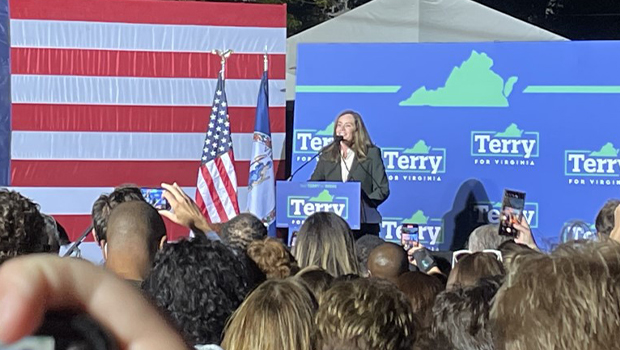
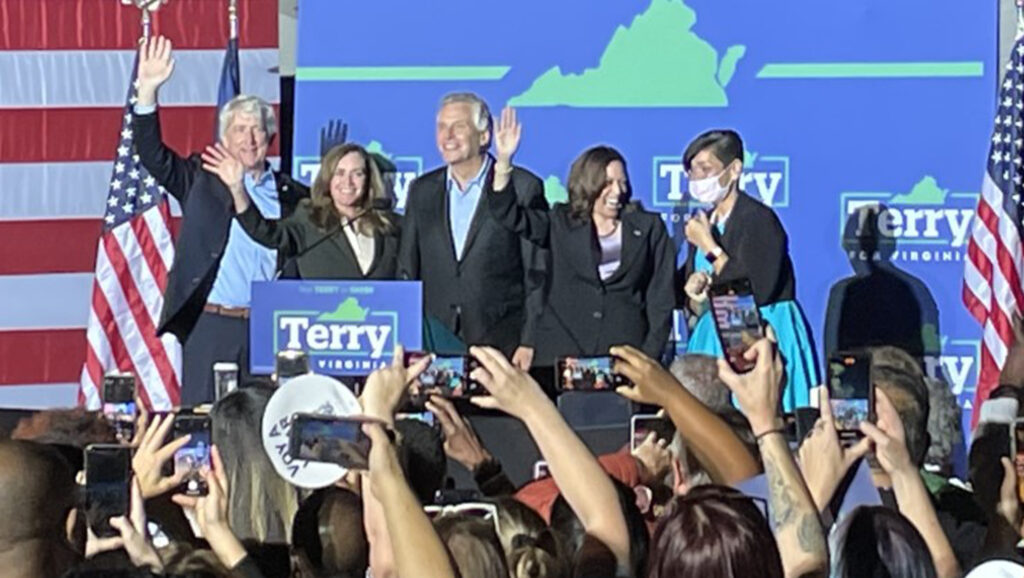
Vice President Kamala Harris campaigns on behalf of Democratic gubernatorial candidate Terry McAuliffe in Dumfries, VA. Photos by: Alex Russell

DUMFRIES, VA — Recent polling data shows support for Democrat Terry McAuliffe and Republican Glenn Youngkin split almost down the middle in the final week of the campaign. As national scrutiny of the Commonwealth’s high-stakes gubernatorial contest increases by the day, both sides are looking for any advantage they can get, calling in key surrogates to inspire enthusiasm among voters ahead of Tuesday’s election.

Top Democrats, including Vice President Kamala Harris and U.S. Senator Tim Kaine (D-VA), spoke at a campaign rally and “get out the vote” drive in the town of Dumfries, VA in support of Terry McAuliffe, the Democratic candidate for governor in the upcoming November 2nd gubernatorial election.

Billed as a “grassroots event,” the rally took place on Thursday, October 21st near Quantico Marine Corps Base in Prince William County at a fire station that once housed the recently-disbanded Dumfries-Triangle Rescue Squad.

The hundreds of supporters that had gathered were excited and, by showing of hands, many had already cast their votes as part of the ongoing early in-person voting happening in Virginia until October 30th. Click here to learn more about early voting in 2021 >

Harris opened up with humor and energy, stating, “You know what I want for my birthday? I want this man to be elected as the next governor of the Commonwealth of Virginia.” She then quickly altered her tone, remarking how “[in] four years, a whole lot can either be created or destroyed…four years can be a very long time for a lot of bad things to happen.” She stressed to the crowd that it is the responsibility of those present, the voters, to “ensure” that Terry McAuliffe is elected as Virginia’s next governor.

One of the preceding speakers, Hala Ayala, Democratic candidate for lieutenant governor, expressed many of the same themes as the Vice President, highlighting how the upcoming election “will say everything about who we are and what we stand for.”

Regarding her own campaign, candidate Ayala stated that “as lieutenant governor, I will preside over the [state] senate to advance and protect…the progresses we have made and keep Virginia moving forward,” stressing that, “in order to do that, it is essential we keep this state blue.” In closing, Ayala reiterated that “everything is on the line November 2nd.”

Delegate Luke Torian, who has served in the Virginia House of Delegates since 2010, representing the 52nd district in Prince William County and who is running for re-election this November, incumbent attorney general candidate Mark Herring (D), Senator Tim Kaine (D), and Dorothy McAuliffe, former First Lady of the Commonwealth of Virginia from 2014 to 2018, also made remarks.

When candidate McAuliffe took the stage, he quickly made the larger issues of the race clear, echoing the sentiments of that night’s previous speakers. He touched on his career, his track record, and his plans upon election to office, focusing on some of the biggest, pertinent, and unfortunately controversial issues on the ballot, like women’s reproductive rights.

“Folks, we’ve got an election coming up in a few days. We need your help. Everything is a risk that we fought for over the last eight years,” McAuliffe said, connecting his previous four-year term as governor (2014-2018) with the current campaign:

“My message was clear. We are an open, we are a welcoming state, and look what happened. Our economy took off… Income went up 14 percent and we reduced unemployment in every city and county in the Commonwealth of Virginia. That’s what you get with good Democratic leadership.”

“I am ready to take Virginia to the next level.”

Since the event featuring Vice President Harris, President Joe Biden spoke at a Virginia rally on behalf of McAuliffe the following week and former President Barack Obama cut a television ad supporting the Democratic candidate.

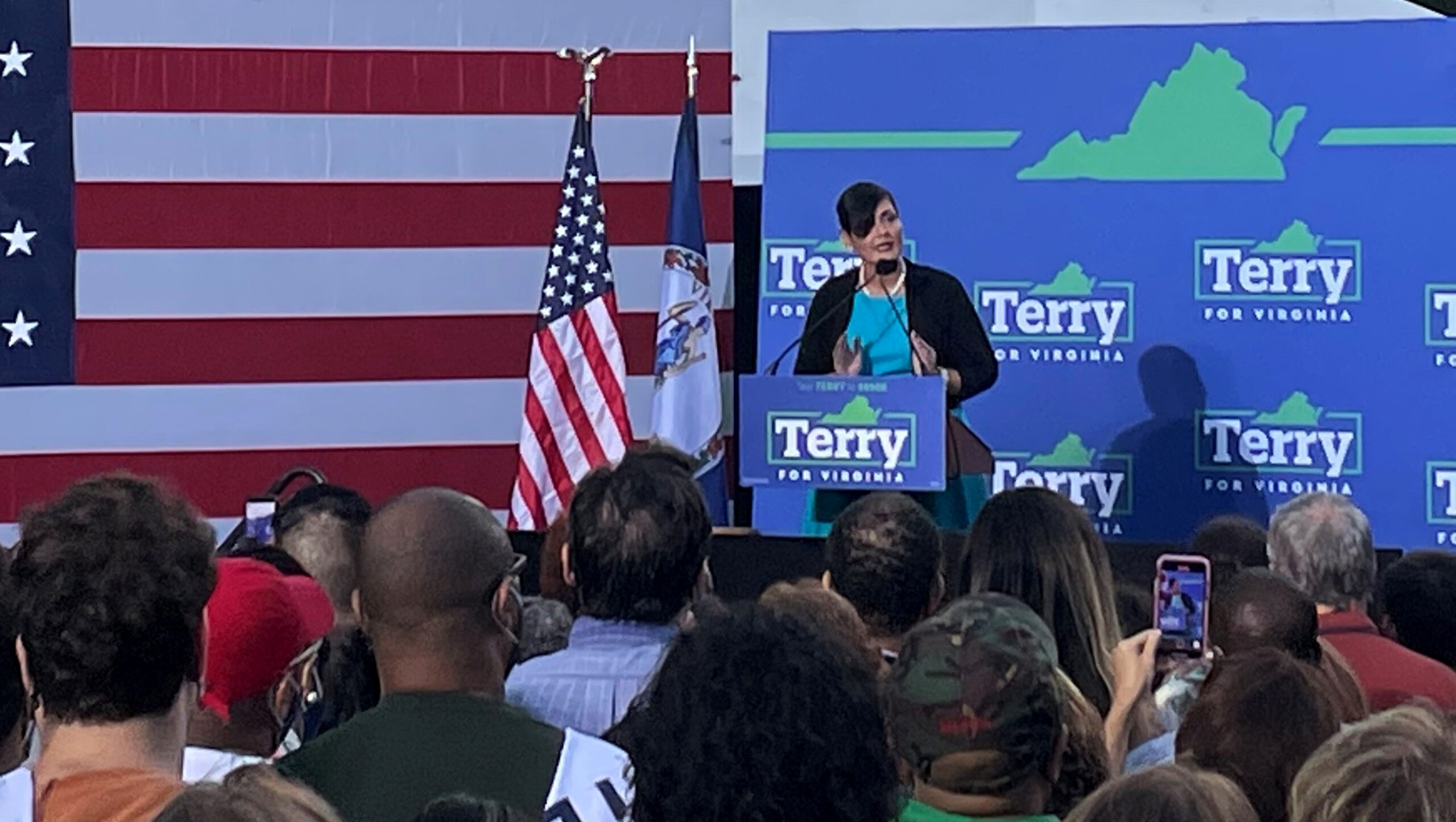
Hala Ayla, Democratic candidate for VA lieutenant governor.
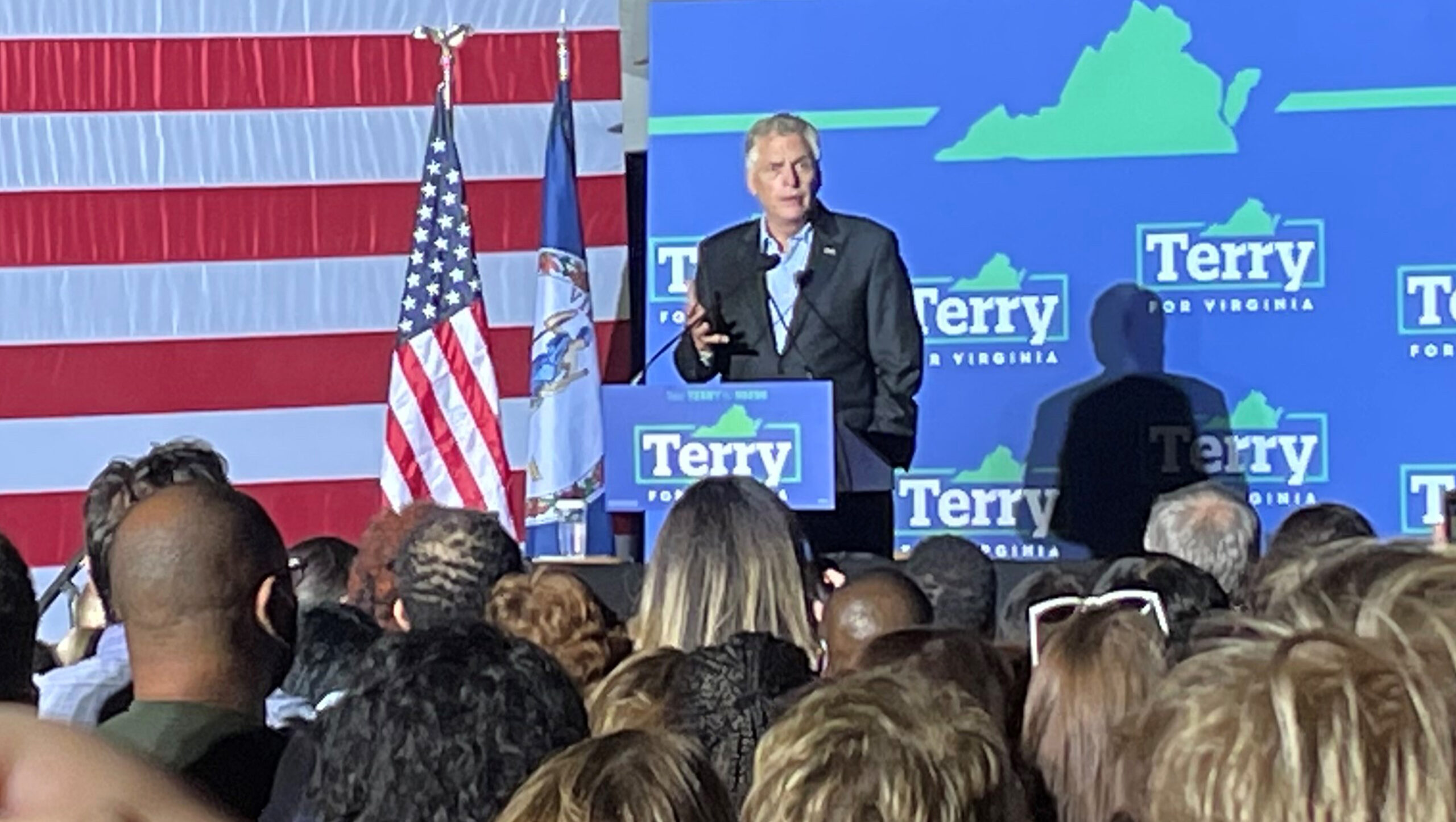
Terry McAuliffe, Democratic candidate for VA governor.
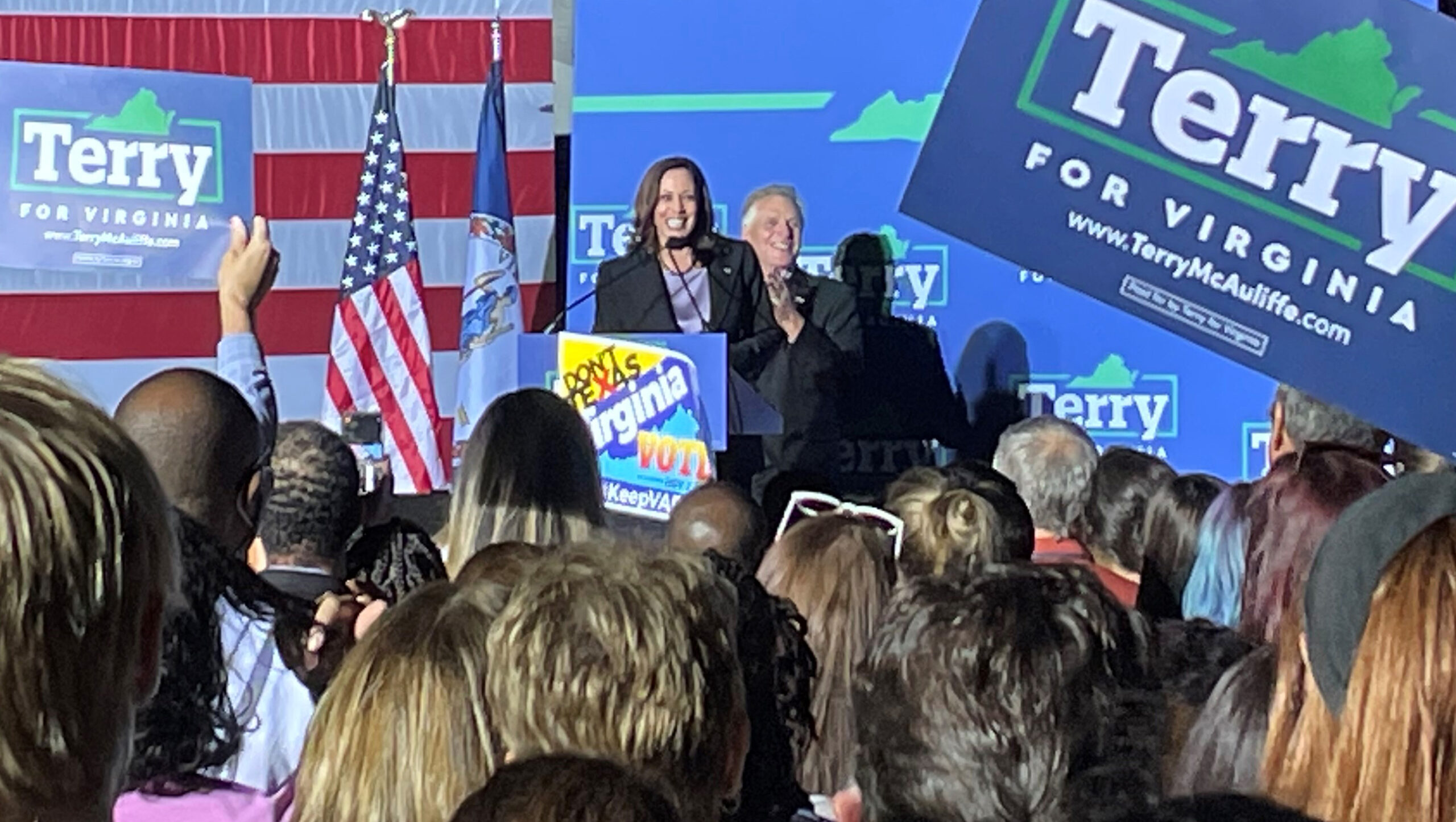
Vice President Kamala Harris.


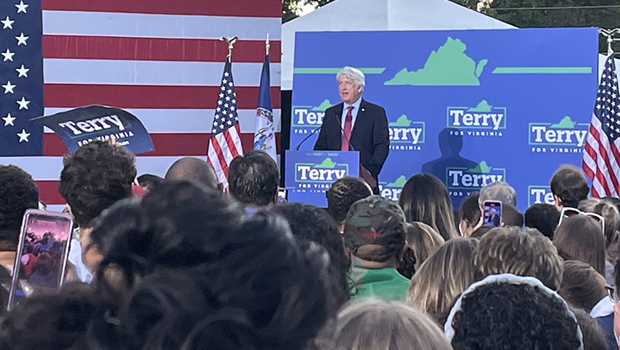
Mark Herring, Democratic candidate for VA attorney general.
U.S. Senator Tim Kaine (D-VA).
Former VA First Lady, Dorothy McAuliffe.


From left to right: Mark Herring, Dorothy McAuliffe, Terry McAuliffe, Kamala Harris, Hala Ayala.


_____________________________________________________________

Want to hear directly from the candidates? Attend a 2021 election rally!

Upcoming Terry McAullife (D) campaign events: mobilize.us/terryforvirginia

Upcoming Glenn Youngkin (R) campaign events: youngkinforgovernor.com/events

_____________________________________________________________

Election Day is Tuesday, November 2nd!

If you haven’t already done so, make a plan to VOTE!

Click here to learn more about your options >

_____________________________________________________________

Photos by: Alex Russell

Interview with Jean Thoensen

A Passion for Voting Inspired This Mason Student to Become a Fairfax County Election Officer

By: Meg Thornberry, Mason Votes 2021 Online Editorial Team
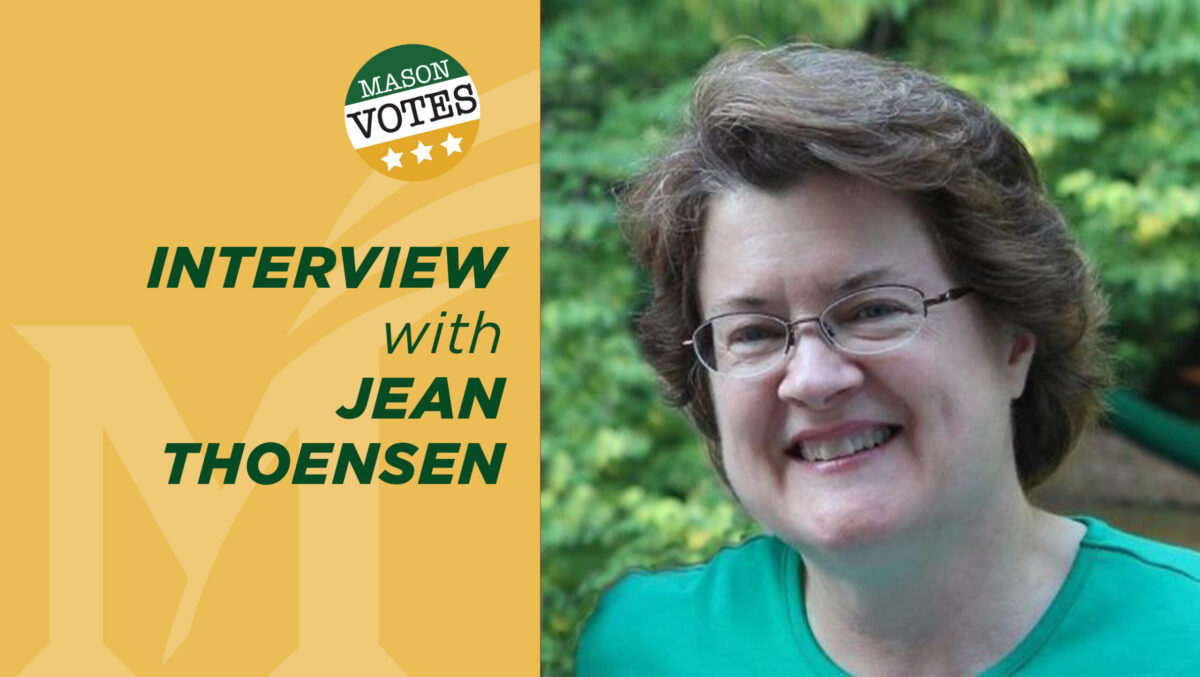
Mason student Jean Thoensen has served as a Fairfax County election officer for the past eight years and is pursuing a bachelor’s degree in public administration with a minor in government analytics. Photo courtesy of: Jean Thoensen

Jean Thoensen started working as an election officer because a neighbor invited her to. The next year, she took over from that neighbor as chief election officer. Eight years later, she is finally leaving her precinct. She’s been promoted, and agreed to sit down with Mason Votes to describe her new position and what she’s learned along the way.

A self-described “life-long college student,” the 60-year-old Thoensen is getting her bachelor’s in public administration with a minor in government analytics at Mason. She says that even after eight years as an election official, she’s still learning a lot from her classes, and that only increases her passion for voting.

“I am far more aware of the stratification of our society and how barriers were put in place to keep certain groups of people from voting,” Thoensen said in an email. “That has only strengthened my resolve to support the widest possible access to voting. Mason professors are always gracious about allowing me 10 minutes to speak in class each fall about voter registration and early voting/absentee voting by mail.”

This year, anyone registered to vote in Virginia can vote early if they want to, no excuse or approval needed. In-person early voting lasts until Saturday, October 30th. The number of early voting locations and their hours have expanded this year (fairfaxcounty.gov/elections/early-voting).

However, Thoensen predicts that the voter experience on Election Day will be “pretty much the same as it was last year.”

Click here to learn more about early voting in 2021 >

On Election Day, voters will be able to both vote in-person and drop off completed mail ballots. Those voting in person will need to check in with their full name, residential address and some form of photo ID.

“Virginia greatly expanded the IDs that are valid for voting in 2020,” Thoensen said in an email. “In fact, a Mason student or employee [photo] ID is valid for voting! If they don’t have any ID with them, they can sign an ID confirmation statement, which is a legal affirmation that they are who they say they are, and vote normally.”

Thoensen served as chief election official for her precinct in Centreville, VA through the 2021 primary elections. She has also worked at a number of early polling locations. This November, she is working as a “rover,” someone who helps at multiple locations, rather than staying at one all day. They also test and configure voting machines, taking crucial security and documentation actions every step of the way.

A poll worker’s day starts at 5:00 am, and doesn’t end until they’ve prepared a statement of results and shut down the polling station after voting closes at 7:00pm, often a two-hour process. Rovers will be on hand to solve any problems all of the stations along their assigned routes have at any point during this minimum 16-hour day.

“I work some grueling hours and am nearly ready to drop from exhaustion, but it is worth it to see as many people vote as possible, regardless of their political affiliation. Fairfax County has the best run elections office in the state, [in my honest opinion],” Thoensen said in an email.

_____________________________________________________________

Interested in becoming a Fairfax poll worker ? Click here to learn more >

_____________________________________________________________

Photo courtesy of: Jean Thoensen

Does Terry McAuliffe Have an Incumbency Advantage?

Serving Two Terms as Virginia’s Governor is a Rare Phenomenon

By: Jacob Pritchard, Mason Votes 2021 Online Editorial Team
Virginia is the only state in the nation who limits their governors to only one consecutive term in office, making incumbent governors serving or running for a second term a rare phenomenon. Photo by: Kate Wellington (CC BY 2.0)

Terry McAuliffe holds a strong and unique advantage coming into Virginia’s 2021 gubernatorial election. This is because he served a previous term as governor from 2014-2018. Two things of note arise from this fact.

There is a well-documented phenomenon among political scientists called “incumbency advantage.” This is where an incumbent politician who runs again is overwhelmingly likely to win re-election. Incumbency advantage arises from many different factors. Most notably, a strong name recognition advantages the incumbent. There is no better press than having your name already widely known. They also have a tangible track record to run on, which can help prop them up during the campaign as a “proven and tested” leader. Outside challengers often have a hard time gaining either of these advantages due to their lack of experience actually holding the office they are running for when compared to their opponent. In 2018, the U.S. House of Representatives had an 91% reelection rate, and the U.S. Senate had an 84% reelection rate. Overall reelection rates from 2008-2018 was 92.1%.

While a gubernatorial candidate like Terry McAuliffe being an incumbent in an election may seem ordinary in any other state, in Virginia it is extremely abnormal. This is due to Virginia being the only state in the nation who limits their governors to only one consecutive term in office, making incumbent governors serving or running for a second term a rare phenomenon. Essentially, once you serve once, you must wait another 4 years to run again. This discourages re-election campaigns in the state, as evidenced by how extraordinarily uncommon they are. The last time this happened was with former Governor Mills Godwin, who served from 1966-1970 as a Democrat and 1974-1978 as a Republican. Aside from this example, there is a very slim handful of Virginia governors who have run and served for two terms.

These two facts are substantial for Terry McAuliffe. His name is widely known throughout the state as a former governor. Since he is interconnected within state and national government due to his time in office, he naturally has a far higher networking reach than Glenn Youngkin, which provides him greater opportunity for exposure and fundraising efforts.

According to Real Clear Politics polling aggregates, McAuliffe had a spread of +11.2 job approval as governor, a starkly high number that potentially has risen over time as his term of office has elapsed and political fervor around him has subsided. Much of his track record is deemed as positive within the state, examples being net positive job growth and a reduction of homelessness rates by 27% during his tenure. His overwhelming victory in the Virginia Democratic gubernatorial primary can be seen as further evidence of his overwhelming popularity, as well as his wide name recognition when compared to other state politicians.

In short, McAuliffe has ridden the wave of incumbency so far, but his overall incumbency advantage may not be as potent as Democrats hope.

To toss his advantage, some may point to the case of Mills Godwin’s second term being a slim majority victory in 1973. Godwin won by a mere 1.4%, meaning his incumbency advantage was not entirely fierce or absolute. This slim victory can be attributed to other reasons, such as his switching of parties in between his terms, yet it points to a wider potential rejection of preferential treatment of former incumbents in Virginia. This is a worrying fact for McAuliffe, as it means that his former track record and tenure may not be enough to carry him to victory.

There is also the question of time elapsed between his terms. McAuliffe has been out of office for 4 years, an eternity in the political world. The American political landscape has drastically changed since he left office, with questions of isolationism and democracy being put under a new spotlight with the election and events of President Donald J. Trump. While McAuliffe has a largely positive track record, he is entirely untested in this new political landscape. To many new voters, who have gained the ability to vote from either moving here or coming of age, McAuliffe may be an entirely new face to them. Incumbency advantage typically works its ways stronger when the incumbent is running for a directly consecutive term for the same office they initially served in. McAuliffe only has one of these factors, and it may come to harm him.

With these facts in mind, does McAuliffe have an incumbency advantage? Has too much time elapsed? Has the landscape changed too much? Is it even possible to have incumbency advantage in Virginia? On November 2nd, these questions will be answered by Commonwealth voters as they head to the polls to elect the next governor.

_____________________________________________________________

Photo by: Kate Wellington/sharedferret (CC BY 2.0)

Is Virginia Still a National Bellwether?

Trends Suggest a Future More Blue Than Purple

By: Jacob Pritchard, Mason Votes 2021 Online Editorial Team
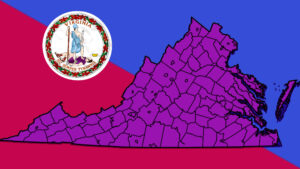
Virginia was once referred to as a “purple state” since voters had a track record of electing officials from both parties, but that trend has shifted in recent years as the Commonwealth becomes more reliably blue. Map image by: VCU CNS (CC BY-NC 2.0)

Virginia was a big deal. Arguably, it was politically the most important in the nation.

Virginia’s “big deal” status remained true due to its membership in the exclusive club of “purple states,” states who do not typically stick to voting for just one party in their elections, instead opting to vote for both parties frequently and intermittently. Electoral victors in the Commonwealth often win by the slimmest of margins, but it was clearly possible for both parties.

For many years Virginia has been viewed as a “bellwether” in national politics, possessing great predictive potential and electoral weight. NPR even went so far in 2012 to say that it could be Virginia’s “bag of 13 presidential electoral votes that will be the key to deciding who occupies the White House in January.” President Barack Obama famously ordered his campaign staff in Maryland to focus on Virginia instead of their own state’s outcomes in 2012.

Willingness to vote for both parties in national elections also trickled down to Virginia’s statewide elections. Starting in 1977, the winner of the Virginia governor’s race had always proven to be a member of the opposite political party than that of the incumbent president. Typically, in a midterm election (held two years after a presidential election), the president’s political party tends to lose a substantial number of seats in Congress. In short, the party winner of the Virginia governorship and the party winner of the Congressional majority almost always coincided with one another. This fact made the Virginia gubernatorial election a strong indicator for the midterm elections which came a year after.

However, in recent years, some things have changed for the Commonwealth’s status as a bellwether. The last time that Virginians elected a Republican candidate in a statewide election was 2009, with the victory of former Governor Bob McDonnell. 2021 marks the 12th year this trend has continued.

The last time Virginia voted for a Republican U.S. senator was in 2002, nearly 20 years ago. The last time Virginia voted for a Republican in a presidential race was in 2004. This is the single longest span of party dominance in Virginia statewide elections since the 1960s, when Virginia used to exclusively vote for Democrats in both their gubernatorial and congressional elections.

The most important factor in this current Democratic sweep is the demographic shifts seen in central and northern Virginia. Chesterfield County, Loudoun County, and Mason’s very own Fairfax County are examples of areas of Virginia that have seen radical population expansion when comparing the 2010 census numbers with the 2020 census numbers. A quality that all three of these counties share is the fact that they have taken on a new Democratic identity in recent years. All three voted for Republican George W. Bush in the 2000 election, with Fairfax going for him by approximately 2%. However, in 2020, they all went for Democrat Joe Biden, with Fairfax going for him by a stunning 42.2% margin. This would be a minor development if it weren’t for the fact that these counties hold a disproportionate amount of voting power due to their large population bases comparative to the rest of the state. This shift is not unique to just the three counties listed above; many localities that have seen a similar swelling of population have also seen a massive expansion in their Democratic voting base alongside it.

Another part of the reason Virginia has sharply turned Democratic is the unpopularity of certain statewide Republican figureheads. Notably, the corruption scandal of former Governor Bob McDonnell tarnished the reputation of the Republican party within the Commonwealth. In this scandal, Bob and Maureen McDonnell were indited on charges relating to illegal campaign gifts, which included luxury vacations and hefty loans totaling to $165,000 dollars from businessmen in the state hoping to gain preferential treatment. After this perceived betrayal of their support, many Virginians grew deeply wary of the Republican party. The low approval of the Donald Trump administration and the backlash attached to it, is an example of another disliked Republican figurehead. According to Real Clear Politics polling aggregates, the job approval of former President Donald Trump in Virginia was consistently in the 30% range, an extraordinarily low acceptance for a president. The disdain for Donald Trump in Virginia can be seen as a driving factor in its modern shift towards voting for the Democratic party.

Due to the recent outpouring of support for the Democratic party, the state broke its long-held tradition of voting against the incumbent President’s party in 2013, opting to elect Democrat Terry McAuliffe as Democratic President Barack Obama held office. McAuliffe beat challenger Ken Cuccinelli by a 2.5% plurality. While slim, it was substantial as a habit breaker.

In 2017, Democrat Ralph Northam won the governorship, while Republican Donald Trump was president. This was seemingly a return to form. However, something else substantial happened this election that often goes unrecognized. Ralph Northam beat his opponent Corey Stewart by 9%, a far higher margin that his predecessors. While not as high as Bob McDonnell’s 17% margin in 2009, it is still a substantially high victory margin in a Virginia election. It is also notable that Joe Biden won the state in 2020 by a margin of 10.44%, which is the largest victory percentage of a presidential candidate since George H.W. Bush in 1988.

The fact that Northam and Biden won by similar percent differentials, points to the potential stabilizing of Virginia with a firmly Democratic voting identity.

With these facts in mind, is it still truly possible to call Virginia a purple state when its normative identities and demographic realities have shifted so drastically towards one side? Can a state that is now so separated from the nation’s moderate political identity still hold a predictive power over it? Are the recent evolutions of the state’s voter base momentary or permanent? Countless difficult questions are posed by Virginia’s recent leanings and cannot truly be accurately answered until we see the results of the upcoming 2021 gubernatorial election.

_____________________________________________________________

Virginia map image by: VCU CNS (CC BY-NC 2.0) color changed & background/seal added

Virginia’s Final Week of Early In-Person Voting

Saturday, October 30th is the Final Day to Vote Early In Person!

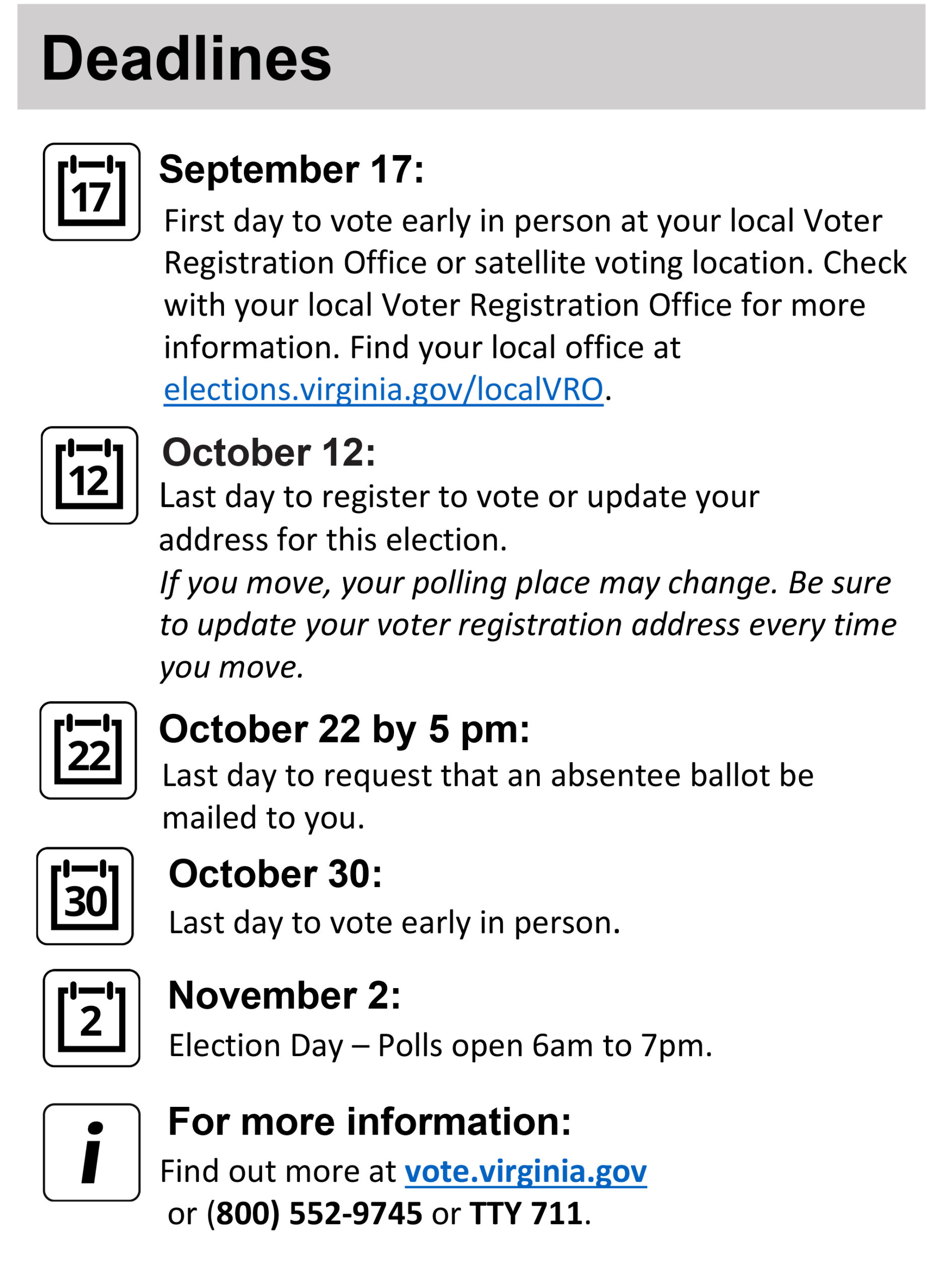
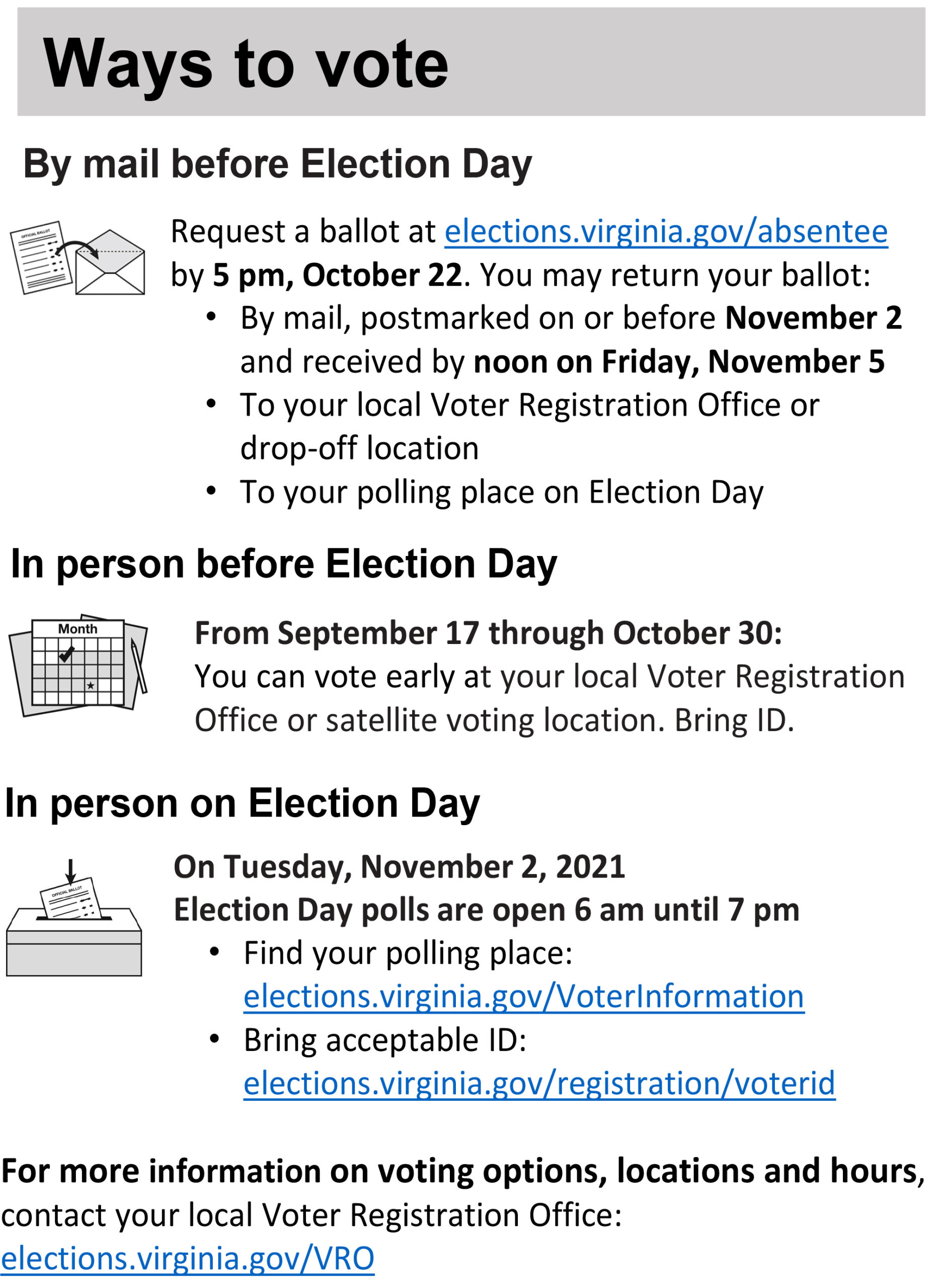
With the deadline to register to vote or request an absentee ballot behind us, Virginia is entering the final week of early in-person voting. In-person early voting begins 45 days before the election (September 17, 2021 through October 30, 2021). Learn More: fairfaxcounty.gov/elections/early-voting

The final day to vote early in person in Virginia is Saturday, October 30, 2021!

Can’t make it early? You can still vote in person on Tuesday, November 2, 2021. Polls will be open from 6am-7pm.

_____________________________________________________________

Want to vote early and avoid lines on Election Day? Here’s how:

Early in-person absentee voting is available for the November 2021 General & Special Elections at the following three locations until Saturday, October 30th (see hours for each location below):

  • Fairfax County Government Center – 12000 Government Ctr Pkwy, Suites 2 & 3, Fairfax, 22035
  • Mount Vernon Governmental Center – 2511 Parkers Lane, Alexandria, 22306
  • North County Governmental Center – 1801 Cameron Glen Drive, Reston, 20190

Thirteen additional early voting locations will be available daily from October 21st through October 30th:

  • Burke Centre Library – 5935 Freds Oak Rd, Burke, VA 22015
  • Centreville Regional Library – 14200 Saint Germain Drive, Centreville, VA 20121
  • Gerry Hyland Government Center – 8350 Richmond Hwy, Alexandria, VA 22309
  • Franconia Governmental Center – 6121 Franconia Road, Alexandria, VA 22310
  • Great Falls Library – 9830 Georgetown Pike, Great Falls, VA 22066
  • Herndon Fortnightly Library – 768 Center Street, Herndon, VA 20170
  • Mason Governmental Center – 6507 Columbia Pike, Annandale, VA 22003
  • McLean Governmental Center – 1437 Balls Hill Road, McLean, VA 22101
  • Providence Community Center – 3001 Vaden Drive, Fairfax, VA 22031
  • Sully Governmental Center – 4900 Stonecroft Boulevard, Chantilly, VA 20151
  • Thomas Jefferson Library – 7415 Arlington Boulevard, Falls Church, VA 22043
  • Tysons Pimmit Library – 7584 Leesburg Pike, Falls Church, VA 22043
  • West Springfield Governmental Center – 6140 Rolling Road, Springfield, VA 22152

IN-PERSON EARLY VOTING HOURS:

Weekdays:

  • Fairfax County Government Center: 8:00 a.m. – 4:30 p.m.
  • All other locations: 12:00 p.m. – 7:00 p.m.

Saturday, October 30th:

  • All locations: 9:00 a.m. – 5:00 p.m.

If you live outside Fairfax County (Mason is located in Fairfax County), find out your early voting locations and times by going to your City/County’s website:

_____________________________________________________________

GENERAL VOTING INFO:

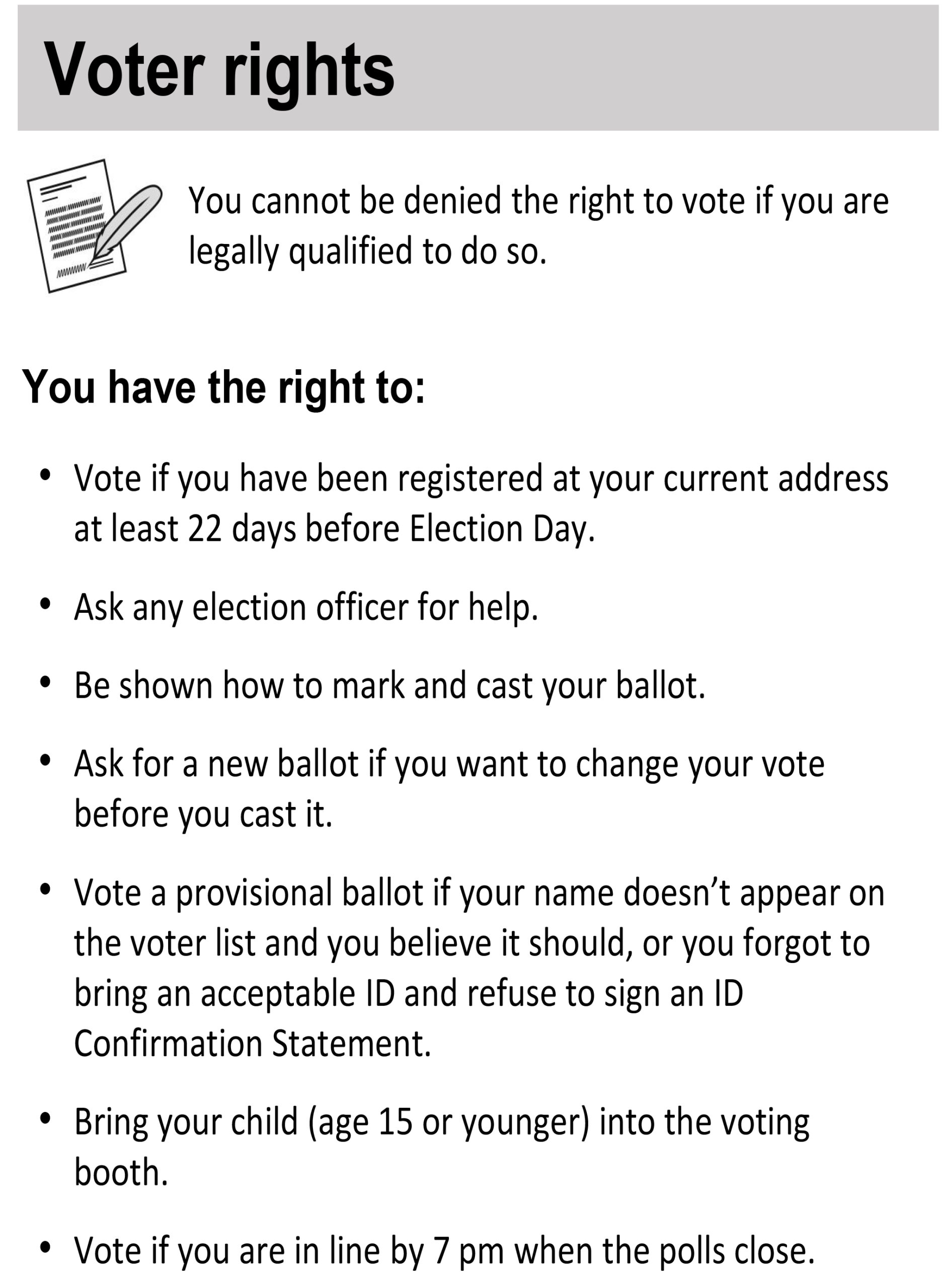
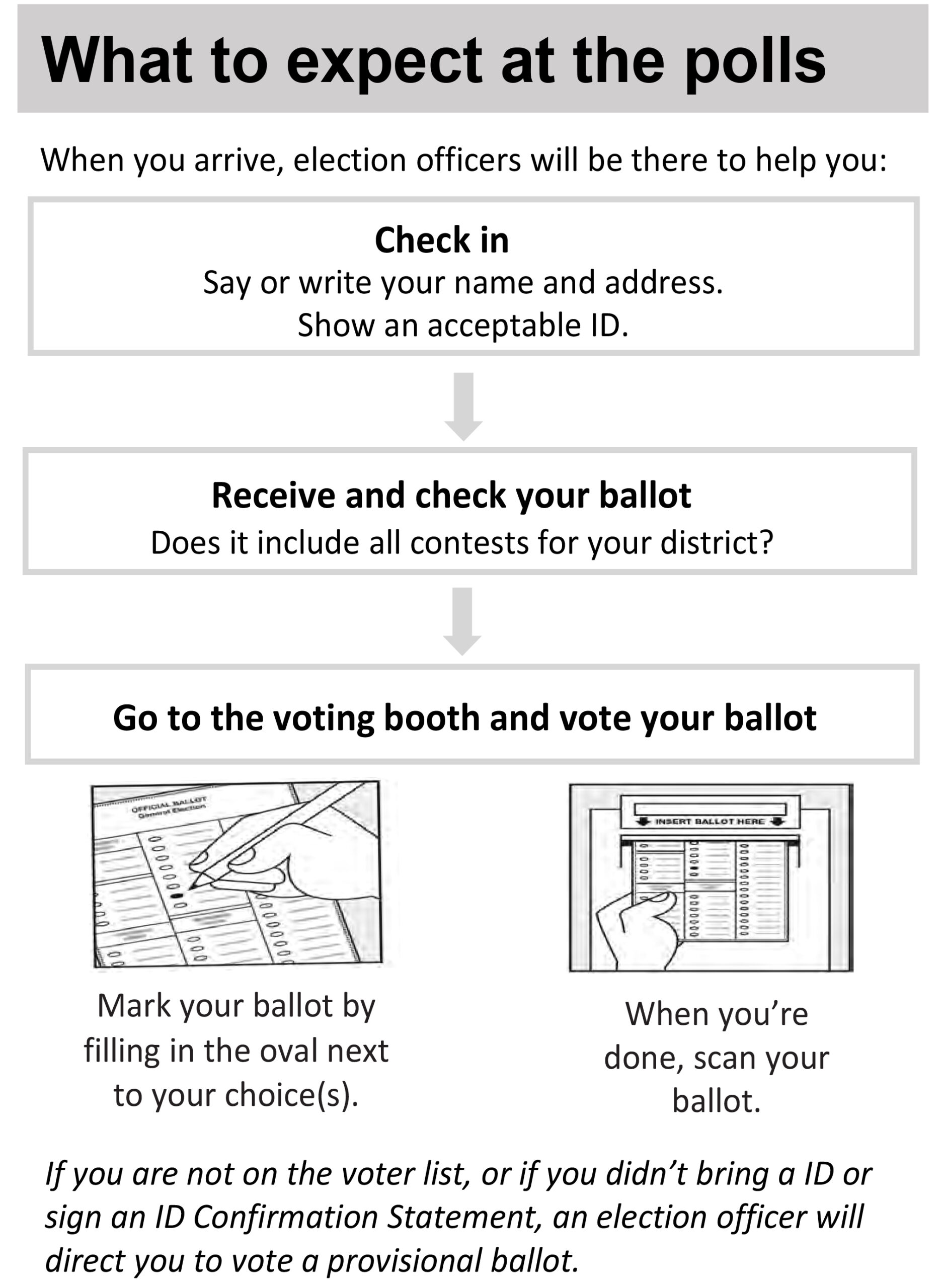
  • Photo ID is NOT necessary to vote; your George Mason University Student Photo ID is welcomed on Election Day. If you do not have a valid ID, you will be required to sign an affidavit certifying your identification.
  • Only students who register with their on-campus/Hub mail room address (residence hall AND room number) can vote at Merten Hall. All other Fairfax County registered voters must vote at their home precincts. Find your polling station at: elections.virginia.gov.

Still have questions about voting in 2021?

Click here to read the full “Guide to Voting as a Mason Student” >

Fairfax County Elections: fairfaxcounty.gov/elections/early-voting

Virginia Department of Elections: elections.virginia.gov

Lack of Choice Leads to a Search for Solutions

Voters Want More Third Party Options

By: Jack Houston, Mason Votes 2021 Online Editorial Team
A growing number of American voters, including 71% of millennials, think more third party candidates are needed. Photo by: kgroovy (CC BY-SA 2.0)

In 2017, the year of the last Virginia gubernatorial election, an NBC News/GenForward Poll showed that 71% of millennials believed that at least a third major political party was needed in the U.S. Current polls suggest that that trend hasn’t just sustained itself among young people, it’s expanded to both the younger Gen Z demographic as well as older populations.

So, four years later, has anything changed for this election cycle? The answer isn’t quite so simple. In one aspect of the electoral process, partisan primaries, the answer is yes.

In 2017, Republicans had three candidates to choose from and Democrats had two. In the 2021 Primaries, Republicans had seven and Democrats had five. This is a significant increase, especially given the ideological differences among the candidates within each primary. However, the choices in the general election remain the same: one Democrat, one Republican, and one third party candidate.

Considering participation in partisan primaries is historically much lower than that in general elections, why hasn’t this increased choice advanced to November? Put simply, the answer lies in how we count the votes and administer elections.

Currently, most elections decide winners based on which candidate receives a plurality of the vote, not a majority. This means that a candidate isn’t required to secure an overall majority of voters in order to proceed to the Governor’s Mansion (or whichever seat they’re seeking). In an election with two candidates, this isn’t much of an issue. But when more candidates get involved, it can get messy.

This is where the phrase “spoiler candidate” comes into play as a way to describe how a third candidate’s entry into a race can pull like-minded voters away from either side and ultimately elect an unwanted opponent. Candidates with somewhat similar platforms risk splitting their shared voter base and allowing another candidate with a minority of the overall vote to win the entire election.

Realizing this, most voters choose to vote strategically for the candidate most likely to win, even if they’re not their preference. This applies to multiple elections in Virginia this cycle, including the gubernatorial election.

There are a variety of unique solutions to this issue, but one such solution already has significant support from both major parties and some third parties. Ranked choice voting seeks to eliminate so-called spoiler candidates through its process of ballot tabulations based on how a voter ranks various candidates. If no candidate receives a majority of support in the first count, the candidate with the lowest vote count is eliminated and their votes are redistributed to their voters’ second choice until a candidate reaches the 50% threshold.

Given the elimination of the spoiler candidate in a ranked choice voting model, voters are more likely to vote for their actual preference instead of voting strategically, which could lead to more viable third party or independent choices on the ballot. In this case, a more diverse group of candidates could compete in general elections without fear of “spoiling” their sides’ vote. Ranked choice voting has already been used in the Virginia Republican Primary, New York Democratic Primary, as well various national elections.

Is ranked choice voting the best solution to public opinion favoring more choices? Maybe, maybe not. It has its own disadvantages including “exhausted ballots”. Knowing this, readers should also keep in mind other choices such as proportional representation, star voting, or approval voting.

While no system is perfect, a growing number of Americans are looking for a solution that gives them more choices on the ballot and one of these models might be the answer.

_____________________________________________________________

Photo by: kgroovy (CC BY-SA 2.0)

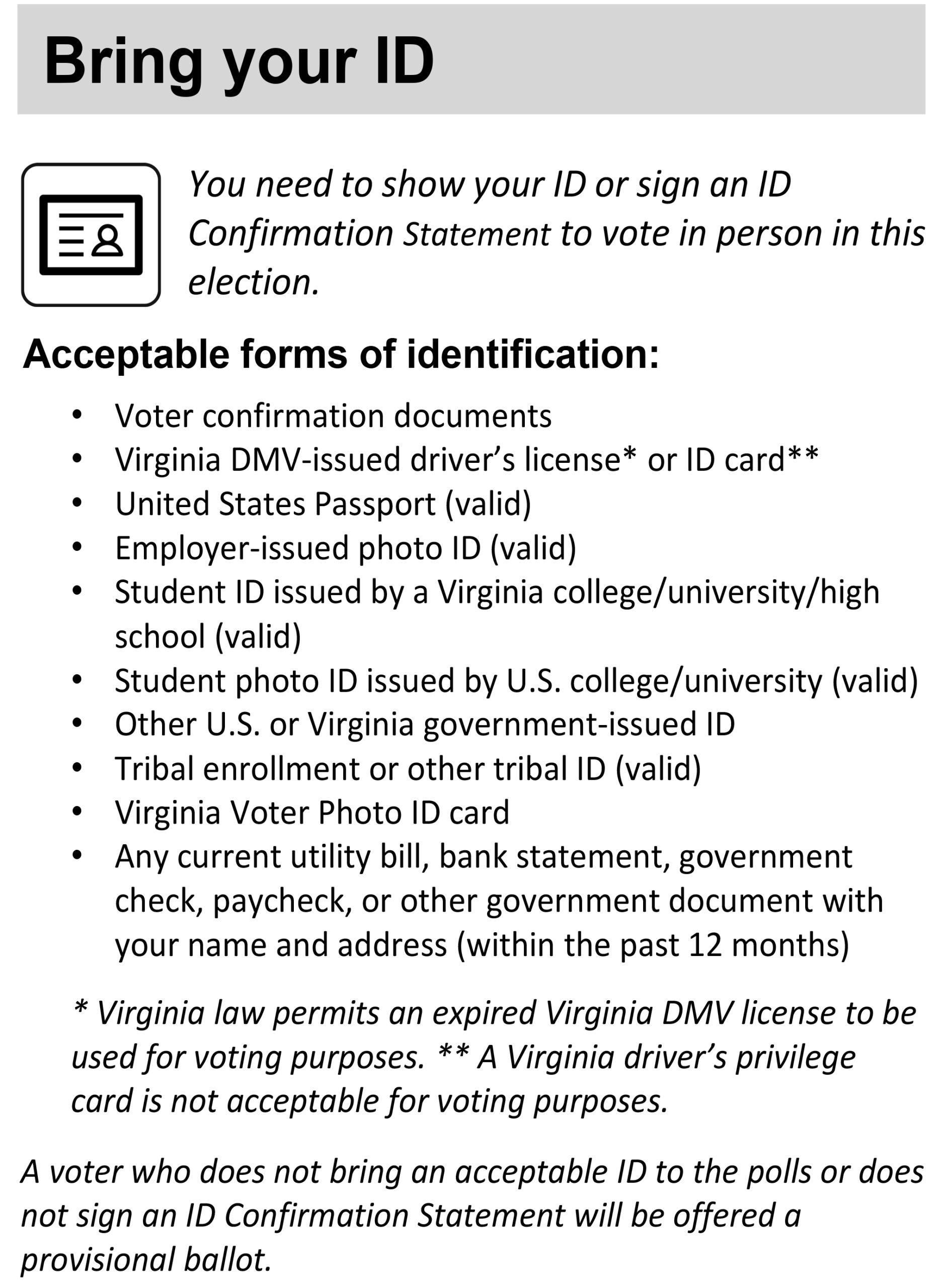
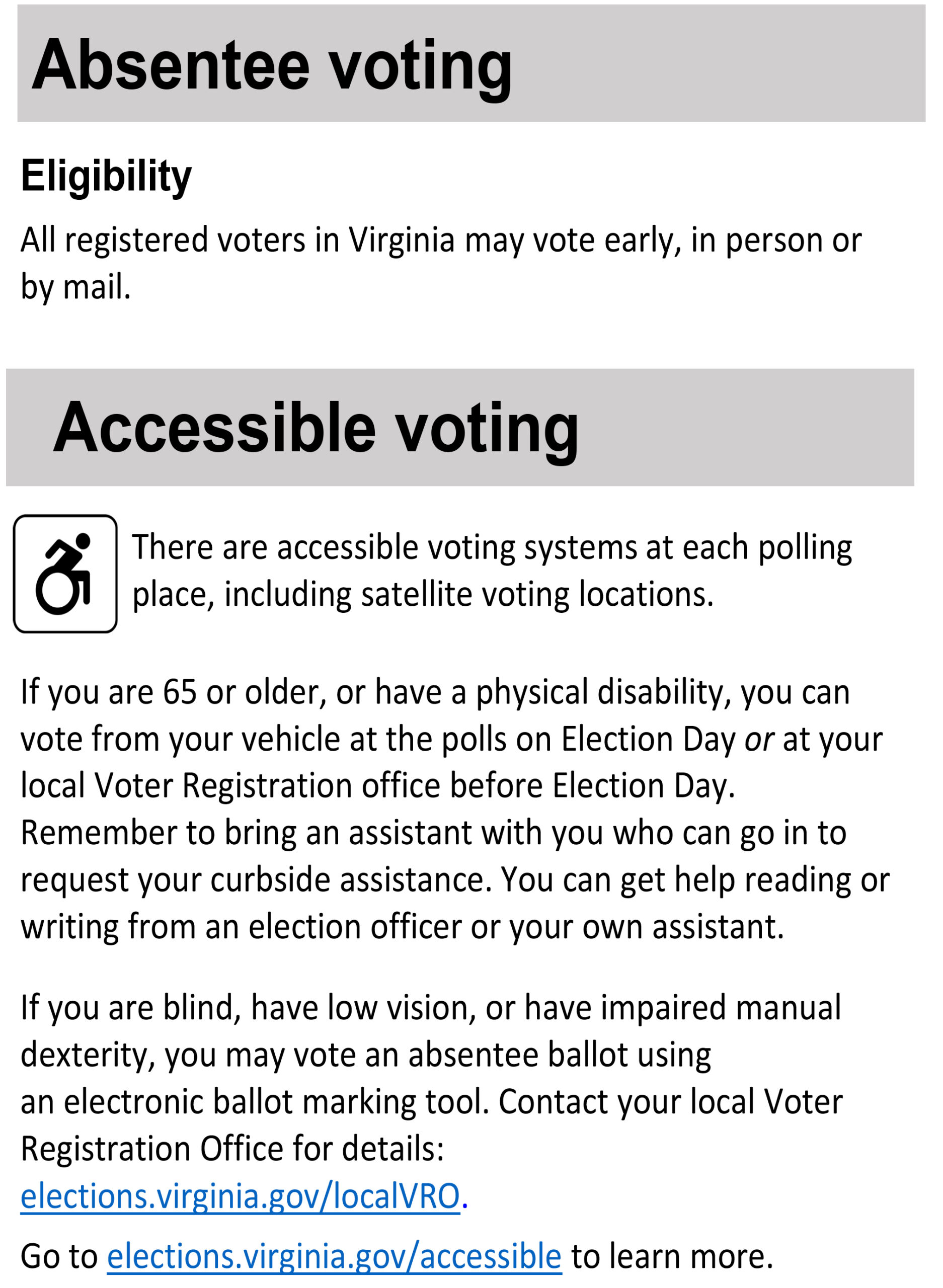
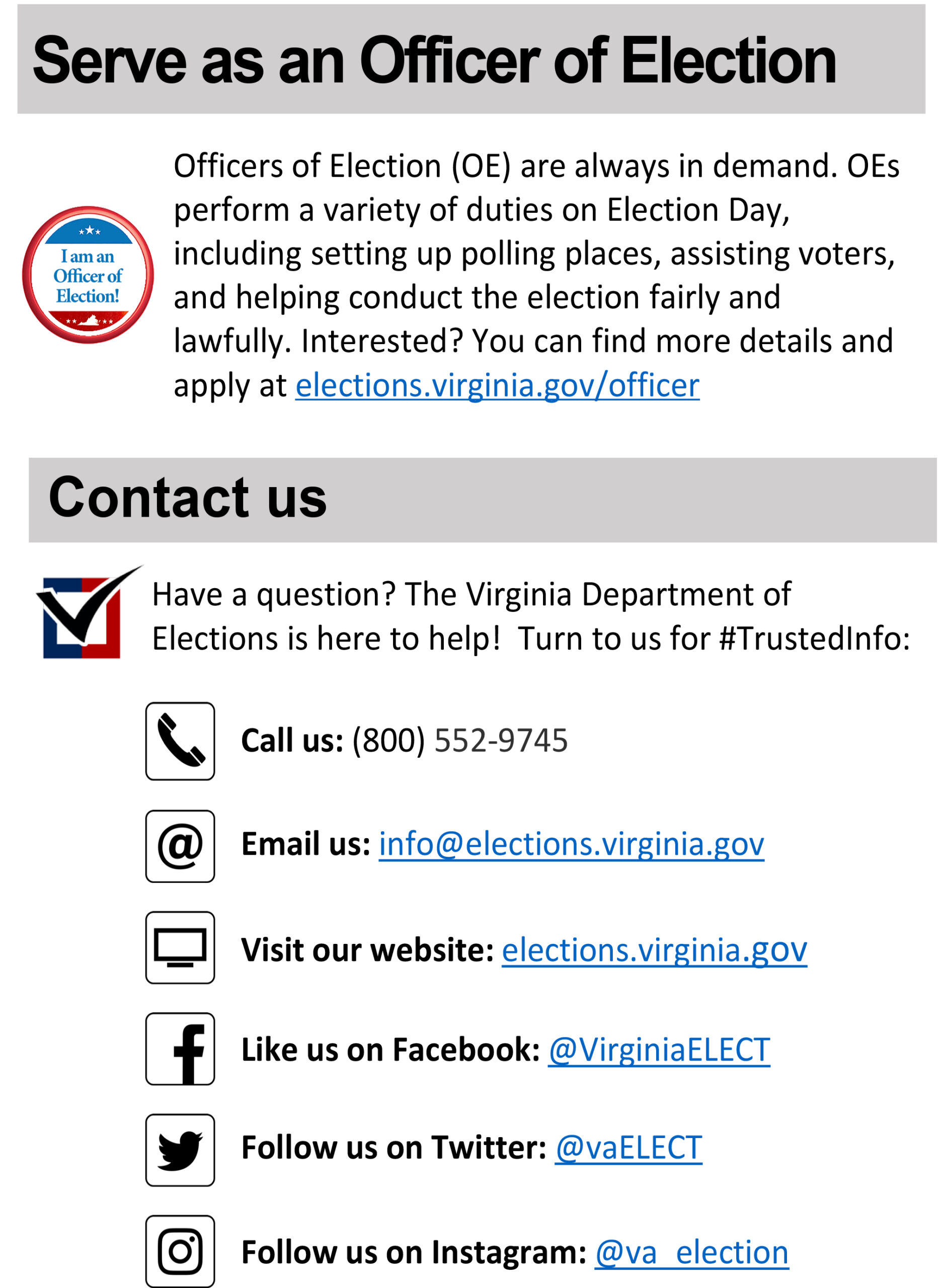
2021 Pocket Guide for Virginia Voters

2021 Pocket Guide for Virginia Voters

Courtesy of the Virginia Department of Elections. Learn more: vote.virginia.gov

Click here to download the 2021 “Pocket Guide for Voters” as a PDF >

Click the images below to enlarge.

What Does the Lieutenant Governor Do? (and Who’s Running?)

Two Women of Color Vie for Lieutenant Governor in Historic Race

By: Alex Russell, Mason Votes Alumni Contributor
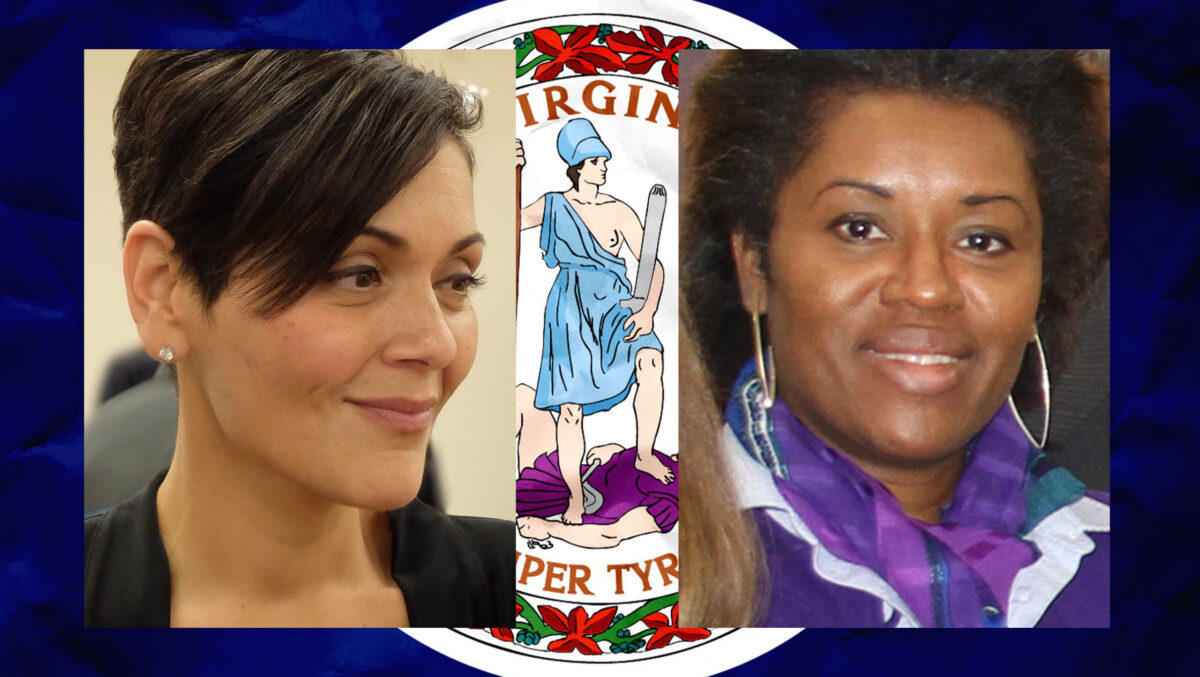
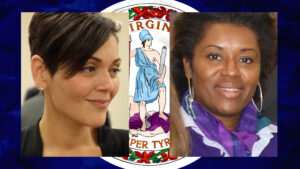
Hala Ayala (D), left, and Winsome Sears (R), right, are running to be Virginia’s next lieutenant governor.

The 2021 Virginia General Election will take place on Tuesday, November 2, but in-person early voting is already underway in the Commonwealth (September 17th was the first day of early voting). The last day for early, in-person voting is Saturday, October 30.

The deadline to register, or to update existing voter information and registration, is Tuesday, October 12th. To vote “absentee” (through the use of a mail-in ballot), voters must send their request to a local voter registration office by 5pm on Friday, October 22nd. Since July 2020, Virginia voters do not need an excuse to vote absentee.

The last day to vote in the Virginia General Election will be November 2nd, between the hours of 6am and 7pm. For more information and to check your registration status, visit elections.virginia.gov/registration.

Click here to read our handy Guide to Voting as a Mason Student >


What’s on Virginia’s Ballot in 2021?

The offices on the ballot this election are governor, lieutenant governor, attorney general, members of the House of Delegates, and some local offices and referenda, which vary by locality.

Terry McAuliffe, a former Virginia governor, is the Democratic Party nominee. Incumbent Governor Ralph Northam (D) is unable to run for re-election due to specific term limits that bar governors from serving consecutive terms.

Glenn Youngkin, the Republican Party nominee, is a former co-CEO and president of the Carlyle Group, a global investment firm. Former President Donald Trump has endorsed Youngkin’s candidacy.

Janet Hook of the Los Angeles Times referred to Virginia’s gubernatorial race as “the first big test of strength between parties since Biden was elected,” adding that it “could set the tone for the 2022 midterm election.”

With so much local, state, and national attention focused on the race for Virginia’s next governor, candidates for lieutenant governor risk getting overlooked. However, Virginia is set to make history in 2022 no matter who wins, when the first woman of color will be sworn in to serve in a  statewide elected office.

The Lieutenant Governor’s Role

The role of lieutenant governor is outlined in Article V of the Virginia Constitution and his or her duties include serving as President of the Virginia Senate (“but shall have no vote except in case of an equal division.“) In addition, the lieutenant governor is the first in the line of succession: “in the case of the removal of the Governor from office or in the case of his disqualification, death, or resignation, the Lieutenant Governor shall become Governor.

While the lieutenant governor is elected at the same time as the governor, in Virginia the two candidates do not run on the same ticket, making it possible to have a governor and a lieutenant governor of different political affiliations and beliefs. The Virginia Constitution limits the governor to one four-year term; there is no limit on the number of terms for lieutenant governor.

The 41st and current lieutenant governor in Virginia is Justin Fairfax (D). Lieutenant Governor Fairfax assumed office in 2018; his term ends in January of next year.

Meet the 2021 Candidates

Photo by: Mark Hanzel (CC BY-SA 4.0)

Hala Ayala (D)

A native of Alexandria, Virginia, with a family background stemming from El Salvador, North Africa, Lebanon, and Ireland, Hala Ayala (D) has been a member of the Virginia House of Delegates since 2018, representing the 51st district.

Before entering politics, her professional experience included working as a cybersecurity specialist with the U.S. Department of Homeland Security. With 18 years of work within the field of information technology and cybersecurity, Ayala made this a focus of her political efforts, introducing bills that concentrated on creating a state interagency cybersecurity task force and increasing the security of network-connected devices across the Commonwealth.

During Terry McAuliffe’s (D) tenure as Governor between 2014 and 2018, Ayala served on his Advisory Council on Women. In 2017, Ayala and Elizabeth Guzman (D) were the first Hispanic women in Virginia’s history to be elected to the House of Delegates. Her committee assignments include the Science and Technology Committee and the Finance Committee. She is endorsed by Governor Ralph Northam (D) for the position of lieutenant governor.

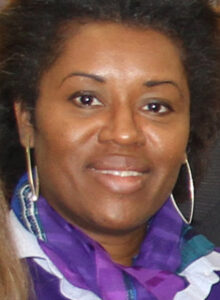
Photo by: Virginia Department of Education (CC BY 2.0)

Winsome Sears (R)

Winsome Sears (R), a naturalized citizen originally hailing from Kingston, Jamaica, served as an electrician in the United States Marine Corps before entering politics. Sears served in the Virginia House of Delegates from 2002 to 2004; in 2004, she ran unsuccessfully for the United States House of Representatives from Virginia’s 3rd congressional district.

Sears was the first black female Republican, the first female veteran, and the first naturalized citizen delegate to serve in the House of Delegates. In addition, she has served as vice president of the Virginia Board of Education and has received presidential appointments to the Department of Veterans Affairs and the U.S. Census Bureau. The Virginia Police Benevolent Association endorses Winsome Sears for lieutenant governor.

Where Do They Stand?

Below is a summary comparing where each candidate stands on the following topics: jobs and the economy, education, racial equity in Virginia, and law enforcement. Excerpts have been taken directly from the candidates’ public campaign websites, with additional information provided from public statements and news sources regarding the topics of COVID-19 and abortion — two pressing, important issues both nationally and in Virginia.

Jobs and the Economy

Candidate Hala Ayala’s focus is on building an “inclusive economy” for Virginia, acknowledging the adverse effects that COVID-19 has had on the economy, especially on Black and Brown residents. Ayala’s stance also highlights the importance of investing in affordable housing.

Candidate Winsome Sears’ priorities focus on maintaining low taxes, reducing regulations, and promoting small businesses. Some of her proposed plans include enacting “a 12-month small business tax holiday” and cutting “unnecessary regulations by 25 percent.”

Education

Ayala’s outlook on the issue of education highlights the topic’s ever-changing dynamics. In view of an increasing reliance on technology, as well as the effects of COVID-19 on schools and colleges over the past year and a half, if elected, Ayala promises to “work with the Administration and General Assembly to expand Pre-K, reduce overcrowding in classrooms, and invest in school infrastructure.” With higher education proving to be increasingly important in regards to acquiring work and building a professional career, Ayala “will support measures to make colleges more affordable for all Virginians as well as lead the charge to create and improve training programs for those who choose not to attend a four-year college.”

Sears’ stated plan has many similarities to Ayala’s, in that, if elected, she will “champion investments in public schools, empower parents with choices, and raise standards in education.” Outlined in a brief plan are the following steps: “Keep schools open safely 5 days a week; raise teacher pay & recruit more teachers to end the teacher shortage; restore high standards for school accreditation” and focus on promoting “choice by creating more opportunities, especially in failing school districts.”

Racial Equity

Ayala’s focus on improving racial equity in Virginia spreads across several topics, with healthcare being one of the major focuses. Her plan features the following building blocks: “Implementing required implicit bias training for…healthcare providers in Virginia…establishing pregnancy medical homes to connect high-risk women with health and social services,” and “increasing access to doula care.” (Doulas are medical professionals and advocates specializing in pregnancy and labor assistance; they provide physical and emotional support to those giving birth during pregnancy as well as during the postpartum period.) Ayala believes that this type of healthcare work needs increased funding and would greatly help people of color.

Sears’ approach to racial equity highlights how “data shows…Black Virginians are disproportionately failed by our government, whether it’s in education or when it comes to job opportunities.” A brief outline of her plan to combat the disparages in education and economic status includes creating a “Black Virginians Advisory Cabinet to the Governor,” establishing a “once-in-a-generation investment in historically Black colleges & universities” and making ten “‘Legacy Wealth Startup Incubators’ in Black communities to promote Black entrepreneurship.”

Law Enforcement

Ayala’s platform acknowledges both the recent racially-motivated police violence and injustice against people of color as well as the long history of slavery in the Commonwealth. Her approach to the subject of law enforcement highlights the need for “accountability and transparency,” while working to “prevent uses of excessive force that have led to the unjustified deaths of Black and Brown men, women, and children.” Ayala supports reforming the justice system and the creation of alternatives to the “school to prison pipeline.” Some of the core ideas that Ayala cites, in the fight to improve and reform law enforcement conduct and procedures in Virginia, is the “banning of no knock warrants,” the creation of “civilian review boards, establishing a statewide code of conduct for police officers, and mandating racial bias, de-escalation, and crisis intervention training for police.”

Sears’ approach to the issue of law enforcement states that, as lieutenant governor, she will “defend our law enforcement heroes, crack down on violent criminals and preserve truth-in-sentencing.” Her plan underscores “promoting commonsense criminal justice reforms that give nonviolent offenders a path to redemption.” The steps listed in her rationale are as follows: “Fire the parole board and preserve truth in sentencing; raise pay for Virginia state police troopers, sheriff’s deputies, corrections officers, and police officers” and “reduce law enforcement interactions by increasing the use of handheld photo speed enforcement.”

COVID-19 & Abortion

Based on public remarks made by both candidates, Hala Ayala supports the administration of the COVID-19 vaccine, is vaccinated, and has urged her opponent, Winsome Sears, to share whether or not she herself has taken the vaccine. In an interview with CNN, Sears declined to discuss her vaccination status, adding that “if we’re not careful, we’re going to start asking for other things, because we have already determined that this is everybody’s business.”

While candidate Ayala’s campaign website features a section on women’s healthcare, candidate Sears’ website does not. Ayala’s focus highlights the importance of expanding “access to birth control and contraception,” as well as defending “a woman’s right to choose.” 19thnews.org, an independent and nonprofit newsroom that focuses its reporting on the issues of gender, politics and policy, in a September 14 article, cited candidate Sears’ anti-abortion views which were posted in a statement on her website. Candidate Sears’ websites featured comments like “The baby in the womb wants to live! God creates life: whether by test-tube or natural means. As a mother, I understand the importance of protecting life. As the next Lt. Governor of Virginia, I will fight to protect life, not devalue it.” According to 19thnews, this anti-abortion rhetoric has since been removed. The American Independent, a progressive news website, in an article from September 13, also cited Sears’ extreme position on healthcare for women and how her campaign website “no longer highlights her most extreme positions.”

_____________________________________________________________

Hala Ayala photo by: Mark Hanzel (CC BY-SA 4.0), 2017, cropped

Winsome Sears photo by: Virginia Department of Education (CC BY 2.0), 2012, cropped